1770-1790 ca. Child’s Stays, American. Linen plain weave, baleen, or whalebone, silk braided tape. Dimensions: Center Front Length: 5 3/4 inches (14.6 cm) Waist: 18 inches (45.7 cm). Made in United States of America. This pair of stays is only eighteen inches around, and might have been worn by a small child of eighteen months to two years old. Putting stays on young girls and boys was not seen as harsh, but rather as insurance that their figures would develop the correct form, with chest out and shoulders down. While boys usually wore stays only in early childhood, they were considered essential for females throughout their lives. via Philadelphia Museum of Art philamuseum.org Accession Number: 1988-15-1Credit Line: Purchased with the Bloomfield Moore Fund, 198
19th Century Mid-Late Five Desk Seals. L-R Carnelian seal with silver mounts set with colored stones; malachite urn seal: gilt-bronze seal with winged cherub heads: Silver-gilt seal eagle, Silver-gilt seal as eagle’s leg below a blue glass ball. via Sotheby’s Auctions. sothebys.com
In the Bridgerton family, or Jane Austen’s household, and during the Regency Era, sealing wax was not only impressed onto the back of a letter with a seal to protect against tampering, but also to identify the sender of the letter. People, especially aristocrats, kept personal and family seals to be used for many different purposes e.g. A letter to a government official would be sealed with an aristocrat’s crest or title. Personal seals for identification have been since early civilizations. The rubber stamps and embossers we use today serve the same purpose, identifying the sender.
Definition: Wax Seals: Pressed onto a letter or envelope to show that a document is unopened or to verify the sender’s identity. A signet ring or was seal is pressed into a dollop of hot wax to seal a letter or envelope closed.
Do you need more factual and visual information for your historical fiction? History of fashion, music, peerage and customs in 18th and 19th centuries. Non-fiction series full of gorgeous pictures and engraved fashion plates. A visual history of fashion, music, peerage, social manners and customs from late 1700s to late 1800s, or 18th and 19th centuries.
1807 Fashionable French Couple. Man: Blue cutaway coat and yellow breeches. Lady: Lemon and blue dress and bonnet. This is the fashion styles worn by Jane Austen and her family and friends in the early 1800s. Fashion Plate via Journal des Dames et des Modes, or Costume Parisien.https://books2read.com/SuziLoveFashionMen1800-1819
1807 Fashionable French Couple. Man: Blue cutaway coat and yellow breeches. Lady: Lemon and blue dress and bonnet. Fashion Plate via Suzi Love ~ suzilove.com & Journal des Dames et des Modes, or Costume Parisien.
1818 December 11th A dandy fainting or – an exquisite in fits. Scene a private box opera. A dandy lies back fainting in a chair, his limbs rigid, supported by three others while a fourth (left) draws the curtain, cutting off a view of the (distant) stage where a singer is posturing. Via British Museum, London, UK. britishmuseum.org (PD-Art)
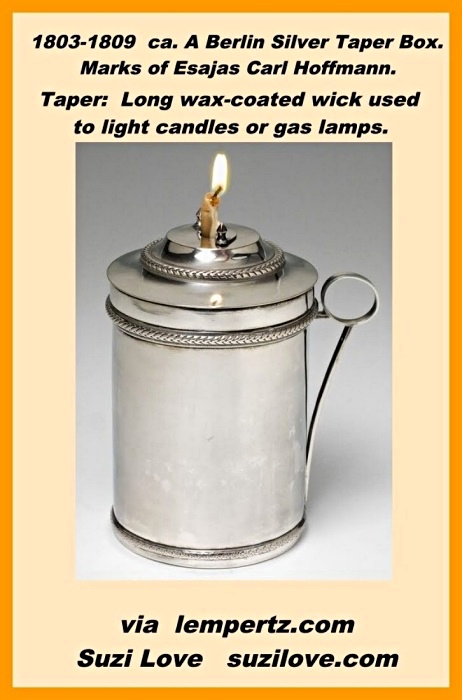
1803-1809 ca. A Berlin silver taper box. Small, ornate container for holding tapers, which are long wax-coated wicks used to light candles or gas lamps. Marks of Esajas Carl Hoffmann, prominent silversmith in early 19th-century Prussia. This is a piece of domestic decorative art from the Regency Era and the Napoleonic period in Germany.
1818 September ‘A Nice Gentleman’ By George Cruikshank. A grotesque dandy walks outdoors sucking a cane. Inscribed with names of food, e.g. red carbuncled rose is ‘Currant Jelly’, shallow broad-brimmed hat is ‘Calves Head Jelly’ and ‘Pancake’, cravat which covers neck, cheek and chin is ‘Puff Paste’, loose short trousers are ‘White Sugar Bags’, handkerchief ‘Blow Monge’ and long spurs ‘Gilt Gingerbread’. Via British Museum, London, UK. britishmuseum.org (PD-Art)
1800 ca. Writing Box, British, as would have been used by people in Jane Austen’s times, or, the Regency Era. Small brass bound solid mahogany writing box of dovetail construction. Green baize sloping writing surface with compartments for storing papers beneath. Small size may be designed for private intimate correspondence. Drop down carrying handles on two sides are early form of handle. Side drawer pulls out after retaining brass pin is taken out. via hygra.com
HN_13_D2D_WritingTools Book 13 What did the lady of the house use to pen notes? What sat on the desk of the man of the house when managing his accounts? #History #Nonfiction #travel books2read.com/SuziLoveWritingTools