↓
 

Suzi Love

Making history fun, one year at a time.

Header_
  • Home
  • Newsletter
  • Pre order form
  • Shop
    • Cart
    • Checkout
    • My account
    • Refund and Returns Policy
  • Blog
  • BOOKS
    • History Events
    • Kelly’s Justice
    • Outback Arrival
    • Irresistible Aristocrats
    • History Notes
    • Scandalous Siblings
    • Love After Waterloo
    • Regency Life Series
  • Privacy Policy
  • EVENTS
Home » Russia » Page 4 << 1 2 3 4 5 6 >>

Category Archives: Russia

Post navigation

← Previous Post
Next Post→

1916 Steel Military Surprise Faberge Easter Egg, Russia. #Easter #EasterEgg #Faberge #Russia

Suzi Love Posted on March 27, 2026 by Suzi LoveMarch 27, 2026

1916 Steel Military Surprise Faberge Easter Egg, Russia. Gift from Nicholas II to his wife Tzaritsa Alexandra Fyodorovna. Surprise is a miniature painting on an easel of the Tzarin planning with his generals in field. Faberge Easter Egg, Russia.

The name Faberge is associated with the Russian Imperial family for whom most of the world’s most famous eggs were created. In 1870, Faberge inherited his father’s jewelry business and quickly became known for his brilliant designs. A display of his work and the gold medal he was awarded in Moscow’s Pan-Russian Exhibition of 1882 brought him to the attention of the Russian nobility.
In 1885, Faberge was commissioned by Tsar Alexander III of Russia to create an Easter egg for his wife, the Empress Maria Fedorovna. This became known as The Hen Egg, the first Imperial Faberge Egg, and is made of gold. The Empress was so happy with the gift that Alexander appointed Fabergé a ‘Goldsmith by Special Appointment to the Imperial Crown’ and the following year commissioned another egg. From then on, Faberge was given complete freedom with future Imperial designs which become even more elaborate every year. A famous Fabergé egg is one of sixty eight jeweled eggs made by Fabergé and his assistants for the Russian Tzars and private collectors between 1885 and 1917.
After the Russian Revolution, the House of Faberge was nationalized by the Bolsheviks and the Faberge family fled to Switzerland where Peter Carl Faberge died in 1920. Several of the Faberge Imperial eggs are still missing.

egg_1916_SteelMilitarySurpriseEgg_Sml

Posted in 1900s, Box Or Container, Decorative Item, Easter, Edwardian Era, Europe, History, Russia, Suzi Love Books, Suzi Love Images | Tagged antiques, Customs and Traditions, Easter, easter egg, Easter in Images, Faberge, Royalty, Russia, Suzi Love Books

1900 Mosaic Faberge Surprise Egg, Russia. #easter #easteregg #russia

Suzi Love Posted on March 26, 2026 by Suzi LoveMarch 26, 2026

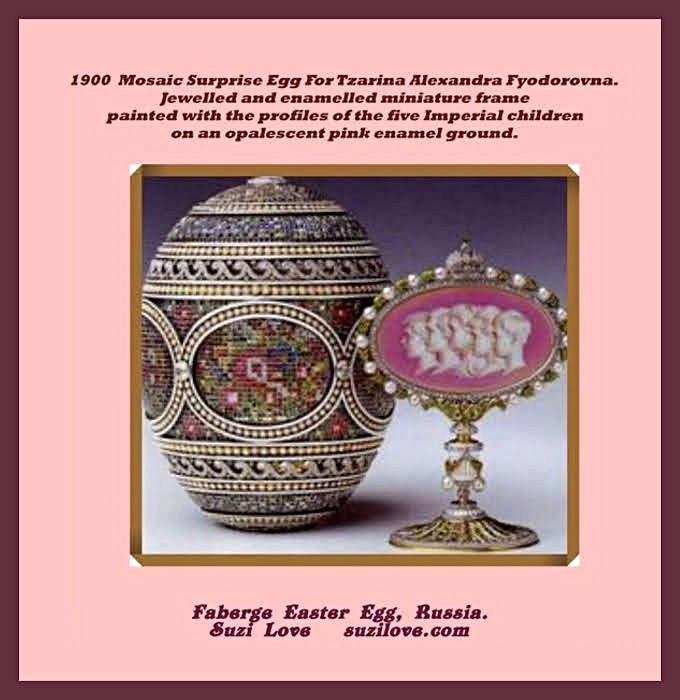
1900 Mosaic Faberge Surprise Egg, Russia. For Tzarina Alexandra Fyodorovna The miniature frame is painted with the profiles of the five Imperial-Russian children on an opalescent pink enamel ground. Faberge Easter Egg, Russia.

egg_1900 Mosaic Faberge Surprise Egg. For Tzarina Alexandra Fyodorovna_Sml

Posted in 1900s, Decorative Item, Easter, Ester In Images, Royalty, Russia | Tagged decorative, Easter, easter egg, Faberge, Hermitage Museum Russia, Royalty, Russia

1899-1903 ca. Spring Flowers Imperial Surprise Faberge Easter Egg, Russia. #easter #faberge #russia #easteregg

Suzi Love Posted on March 26, 2026 by Suzi LoveMarch 26, 2026

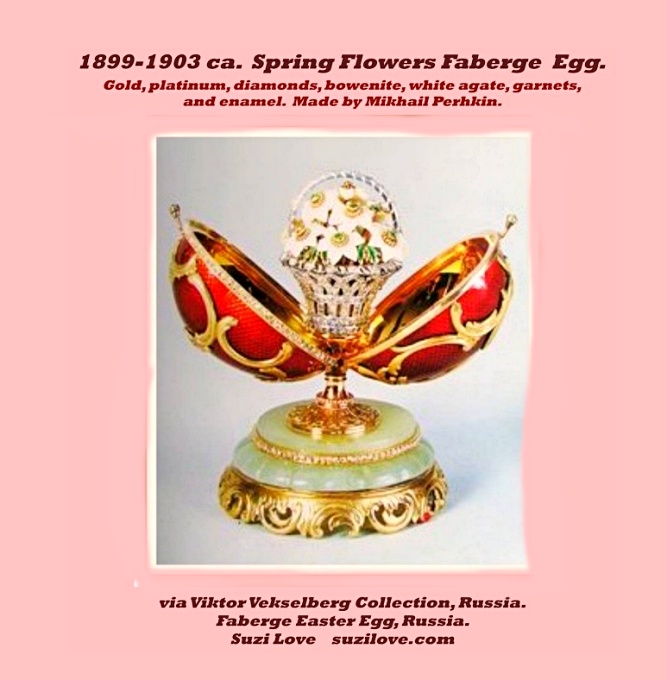
1899-1903 ca. Spring Flowers Imperial Surprise Faberge Easter Egg. Gold, platinum diamonds, bowenite, white agate, demantoid, garnets, and enamel. By Mikhail Perhkin. Via Viktor Vekselberg Collection in Russia. Faberge Easter Egg, Russia. Faberge Easter Egg, Russia.

egg_1899-1903_SpringFlowers_Faberge Easter Egg, Russia.
Posted in 1900s, Decorative Item, Easter, Ester In Images, household, Royalty, Russia | Tagged decorative, Easter, easter egg, Easter in Images, Faberge, household, Russia

1911 Orange Tree, or, Bay Tree Faberge Imperial Easter Egg. #Easter #EasterEgg #christianity #russia #faberge

Suzi Love Posted on March 25, 2026 by Suzi LoveMarch 25, 2026

1911 Orange Tree, or, Bay Tree Faberge Imperial Easter Egg. Gift to Maria from her son. Automaton nightingale emerges and sings when the correct orange is turned. Gold, jade, diamonds, vitrines, amethysts, rubies, pearls, agates, and bird has feathers. Faberge Easter Egg, Russia.

The name Faberge is associated with the Russian Imperial family for whom most of the world’s most famous eggs were created. In 1870, Faberge inherited his father’s jewelry business and quickly became known for his brilliant designs. A display of his work and the gold medal he was awarded in Moscow’s Pan-Russian Exhibition of 1882 brought him to the attention of the Russian nobility.In 1885, Faberge was commissioned by Tsar Alexander III of Russia to create an Easter egg for his wife, the Empress Maria Fedorovna. This became known as The Hen Egg, the first Imperial Faberge Egg, and is made of gold. The Empress was so happy with the gift that Alexander appointed Fabergé a ‘Goldsmith by Special Appointment to the Imperial Crown’ and the following year commissioned another egg. From then on, Faberge was given complete freedom with future Imperial designs which become even more elaborate every year. A famous Fabergé egg is one of sixty eight jeweled eggs made by Fabergé and his assistants for the Russian Tzars and private collectors between 1885 and 1917.After the Russian Revolution, the House of Faberge was nationalized by the Bolsheviks and the Faberge family fled to Switzerland where Peter Carl Faberge died in 1920. Several of the Faberge Imperial eggs are still missing.
egg_1911_OrangeTreeEasterEgg
Posted in 1900s, Customs & Manners, Decorative Item, Easter, Ester In Images, household, Royalty, Russia, Suzi Love Books | Tagged decorative, Easter, easter egg, Easter in Images, Edwardian Era, Faberge, household, Royalty, Russia
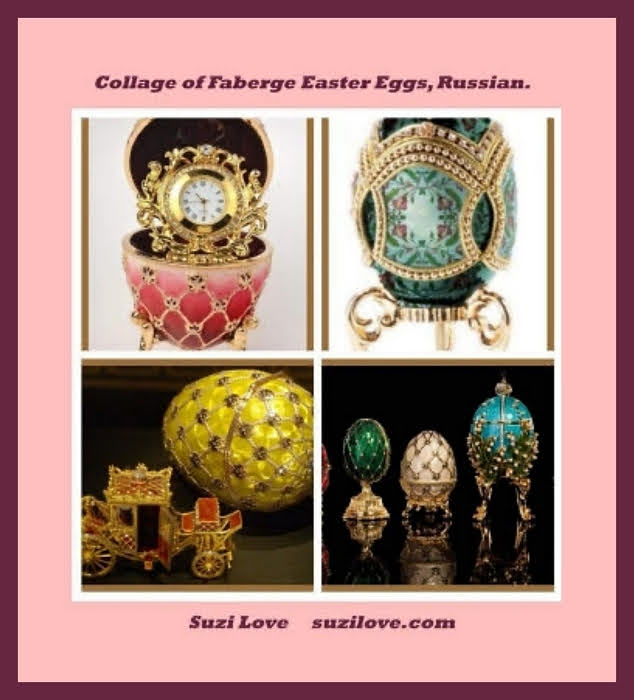
easter-collage_fabergeeaster-eggsbeautiful_collage_sml

1900s Early Gorgeous Faberge Eggs From Russia. 2. #Easter #Faberge #Russia

Suzi Love Posted on March 25, 2026 by Suzi LoveMarch 26, 2026

The name Faberge is associated with the Russian Imperial family for whom most of the world’s most famous eggs were created. In 1870, Faberge inherited his father’s jewelry business and quickly became known for his brilliant designs. A display of his work and the gold medal he was awarded in Moscow’s Pan-Russian Exhibition of 1882 brought him to the attention of the Russian nobility.

In 1885, Faberge was commissioned by Tsar Alexander III of Russia to create an Easter egg for his wife, the Empress Maria Fedorovna. This became known as The Hen Egg, the first Imperial Faberge Egg, and is made of gold. The Empress was so happy with the gift that Alexander appointed Fabergé a ‘Goldsmith by Special Appointment to the Imperial Crown’ and the following year commissioned another egg. From then on, Faberge was given complete freedom with future Imperial designs which become even more elaborate every year. A famous Fabergé egg is one of sixty eight jeweled eggs made by Fabergé and his assistants for the Russian Tzars and private collectors between 1885 and 1917.

After the Russian Revolution, the House of Faberge was nationalized by the Bolsheviks and the Faberge family fled to Switzerland where Peter Carl Faberge died in 1920. Several of the Faberge Imperial eggs are still missing.
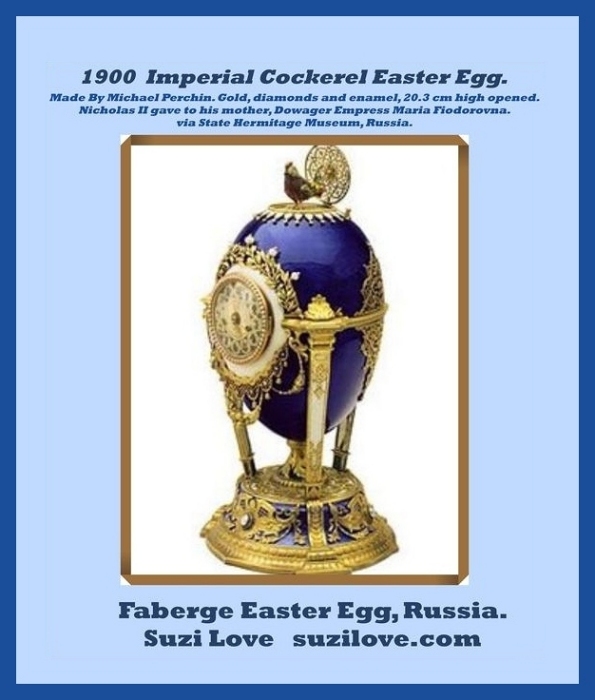
1900 Cockerel Faberge Easter Egg, or, Cuckoo Clock Egg was given by Tsar Nicholas II to Empress Maria Feodoronova. Mechanism on top rear enables its bird to come out and move. The egg is part of the Viktor Vekselberg Collection, owned by The Link of Times Foundation, and housed in the Fabergé Museum in Saint Petersburg, Russia. Faberge Easter Egg, Russia.

Easter_1900 Imperial Cockerel Faberge Easter Egg, or, Cuckoo Clock Egg was given by Tsar Nicholas II to Empress Maria Feodoronova. Mechanism on top rear enables its bird to come out and move. The egg is part of the Viktor Vekselberg Collection, owned by The Link of Times Foundation, and housed in the Fabergé Museum in Saint Petersburg, Russia. Faberge Easter Egg, Russia. Suzi Love suzilove.com
egg_1912_imperial_faberge-easter-egg-russia
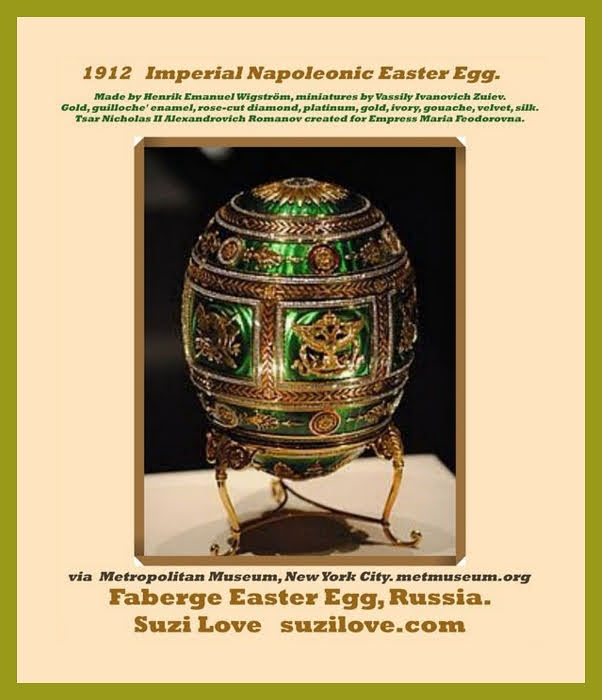
Easter_1912 Imperial Napoleonic Faberge Surprise Egg. Made by Henrik Emanuel Wigström, miniatures by Vassily Ivanovich Zuiev. Gold, guilloch enamel, rose-cut diamond, platinum, gold, ivory, gouache, velvet, silk. For Tsar Nicholas II Alexandrovich Romanov to give to Empress Maria Feodorovna. via suzilove.com and Metropolitan Museum New York City, U.S.A. metmuseum.org
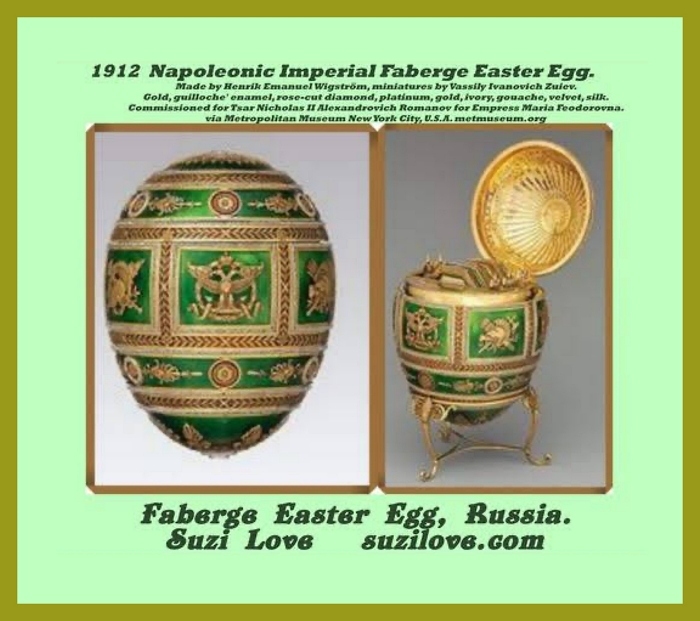
1912 Imperial Napoleonic Faberge Surprise Egg. Made by Henrik Emanuel Wigström, miniatures by Vassily Ivanovich Zuiev. Gold, guilloch enamel, rose-cut diamond, platinum, gold, ivory, gouache, velvet, silk. For Tsar Nicholas II Alexandrovich Romanov to give to Empress Maria Feodorovna. via Metropolitan Museum New York City, U.S.A. metmuseum.org

Posted in 1900s, Box Or Container, Decorative Item, Easter, Edwardian Era, Europe, History, Russia, Suzi Love Books, Suzi Love Images | Tagged 1900s, Easter, Easter in Images, Edwardian Era, Faberge, Russia, Suzi Love Books, Suzi Love Images | Leave a reply

1897 The Imperial Coronation Egg With A Surprise. #Easter #Faberge #Russia

Suzi Love Posted on March 24, 2026 by Suzi LoveMarch 19, 2026

1897 The Imperial Coronation Egg With A Surprise.Made By Mikhail Pushkin. Presented by Emperor Nicholas II to his wife Empress Alexandra Feodorovna as memento of entry to Moscow on May 26th, the day of the Coronation, in Uspensky Cathedral. Gold embellished with translucent yellow guilloché enamel.

Many Russian Easters were celebrated with Imperial monogramed eggs as the royals were very involved with both the religious celebrations of Easter and the family traditions. Fabergé eggs were jeweled eggs created by Peter Carl Fabergé  and his company in Russia from 1885 to 1917. The most famous of the eggs are the ones made for the Russian Tsars, Alexander III and Nicholas II, as Easter gifts for their wives and mothers, often called the ‘Imperial’ Fabergé eggs. The House of Fabergé made about 50 eggs and 43 have survived. Another two were planned for Easter 1918, but because of the Russian Revolution were not delivered. After the Revolution, the Fabergé family left Russia and the Fabergé trademark has been sold several times since then. Several companies have sold Easter egg merchandise using the Fabergé name. The trademark is now owned by Fabergé Limited, which makes egg-themed jewelry.

Posted in 1800s, Box Or Container, Decorative Item, Easter, Ester In Images, Europe, History, History Events, Russia, Victorian Era | Tagged Easter, Easter in Images, europe, Faberge, Russia, Suzi Love Books

Are you a Bridgerton and Jane Austen fan? 1800-1819 Women’s Fashions In Bridgerton Family And Jane Austen’s Times In A Box Set. #Bridgerton #RegencyFashion #JaneAusten #HistoricalFashion

Suzi Love Posted on February 15, 2026 by Suzi LoveFebruary 15, 2026

An overview of women’s fashions in the first twenty years of the 19th century. What was fashionable for women in Jane Austen’s times, or the early 1800s. Wars were being fought around the globe so women’s fashion adopted a military look in support of soldiers. In Britain, the Prince Regent ruled instead of his father, King George III, so fashions, like the lifestyle, became more extravagant and accessories went from pretty to opulent. This set includes books 12, 25, 26, 27 and 28.

What was fashionable for women in Jane Austen’s times, or 1800s, or Regency Era. High-waisted dresses were extravagantly accessorized and hats, shoes, parasols and bags were added. Set includes History Notes Books 12, 25, 26, 27 and 28.

https://books2read.com/SuziLoveFashionWomenBoxSet

HN_24 https://books2read.com/SuziLoveFashionWomenBoxSet
Fashion Women 1800-1819 Box Set History Notes Book 24
An overview of the first twenty years of the 19th century. These books look at what was fashionable for women in Jane Austen’s times, or the early 1800s. Wars were being fought around the globe so women’s fashion adopted a military look in support of soldiers. In Britain, the Prince Regent ruled instead of his father, King George III, so fashions, like the lifestyle, became more extravagant and accessories went from pretty to opulent. This set includes books 12, 25, 26, 27 and 28.
https://books2read.com/SuziLoveFashionWomenBoxSet
HN_24_D2D Fashion Women 1800-1819  Box Set
https://books2read.com/SuziLoveFashionWomenBoxSet

Posted in 1800s, 1800s women's fashion, art, Australia, bedroom fashion, Bridgerton, Canada, cartoon, Chatelaine, Coat or Pelisse Or Redingote, Corset, dancing, Dress Or Robe, England, Europe, fashion accessories, France, Google Books, hats, History, History Notes, Jane Austen, London, mourning, Quotations, Regency Era, Regency Fashion, Reticule or Bag, riding, Russia, sewing, shoes, Spencer, Suzi Love Books, Suzi Love Images, U.S.A, underclothing, weddings | Tagged 1800s women's fashion, Book 24, Bridgerton, Corset, Dress Or Gown, fans, fashion accessories, Fashion Plate, Fashions Of London and Paris, gloves, google books, Hats And Hair, History Notes, Jane Austen, jewelry, Journal des Dames et des Modes, La Belle Assemblee, Le Beau Monde, mourning, Napoleon Bonaparte, Regency Fashion, Regency Women, reticule or bag, riding, shawls, Shoes, Spencer, Suzi Love Books, The Lady's Monthly Museum, The Repository Of Arts, underclothing, weddings

19th Century Taking Snuff and Pretty Snuff Boxes In Bridgerton and Jane Austen Years. #bridgerton #RegencyEra #JaneAusten #Antiques

Suzi Love Posted on February 4, 2026 by Suzi LoveJanuary 28, 2026

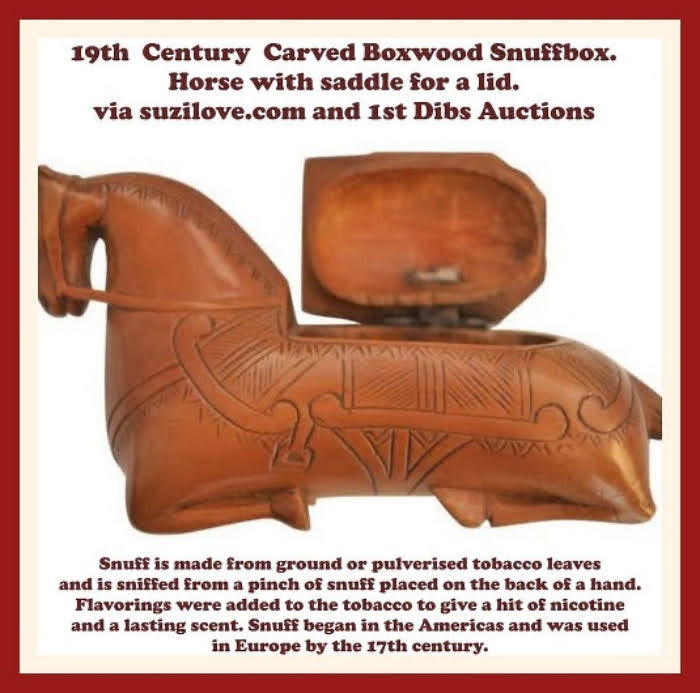
19th Century Snuff Boxes. Not only were boxes made to serve a purpose, but decorative boxes of all types were prized, especially in the 18th-19th Centuries when everything decorative and extravagant was in vogue and taking a pinch of snuff was fashionable. Snuff is made from ground or pulverized tobacco leaves and is sniffed from a pinch of snuff placed on the back of the hand.Flavorings were added to the tobacco to give a fast hit of nicotine and a lasting scent. Snuff began in the Americas and was used in Europe by the 17th Century.

Snuff became popular from the mid 1600s to the mid 1800s and was more popular than smoking. Inhaling snuff, or snuffing, was first seen by a European missionary in 1493 in Christopher Columbus’s new world within Haiti’s indigenous Taino. Until then, tobacco had been unknown to Europeans, but its use spread quickly throughout Europe during the 1500s.  By the second half of the 17th century, ornate boxes started being produced to keep the precious powder dry and an entire industry making accessories blossomed around the fashion of taking snuff.  Noblemen, and some women, carried extravagantly decorated snuff boxes with them at all times and would offer a pinch of their own particular blend to friends and family. Therefore, these boxes were always on display and so it became a competition to see who could have the most bejeweled or expensive box possible. By the mid 1800s, snuff taking was no longer popular so these exquisite and expensive snuff boxes became decorative, rather than functional.

19th Century Shoe Snuffbox. via suzilove.com and 1st Dibs Auctions 1stdibs.com
19th Century Shoe Snuffbox. via 1st Dibs Auctions 1stdibs.com
19th Century Engraved Horn Snuffbox. Heart surrounded by flowers and leaves, sides with dove, symbol of purity and peace, brass hinge and setting. via suzilove.com and 1st Dibs Auctions
19th Century Engraved Horn Snuffbox. Heart surrounded by flowers and leaves, sides with dove, symbol of purity and peace, brass hinge and setting. via 1st Dibs Auctions
Box_Snuff_19th Century Carved Boxwood Snuffbox. Horse with saddle for a lid. via 1st Dibs Auctions
19th Century Carved Boxwood Snuffbox. Horse with saddle for a lid. via 1st Dibs Auctions

1804-1809 ca. Snuffbox in the Shape of A Lion, Moulinie, Bautte and Cie, Geneva, Switzerland.via Victoria and Albert Museum.
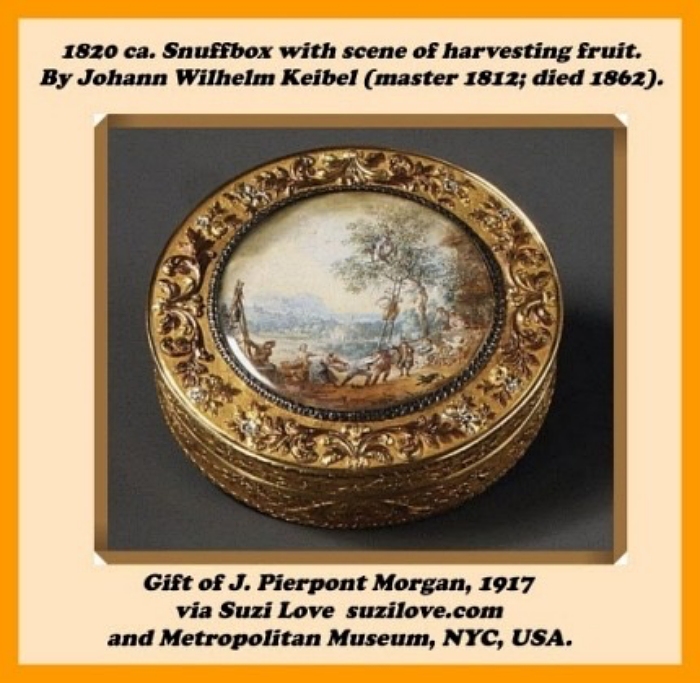
1820 Snuffbox with scene of harvesting fruit. By Johann Wilhelm Keibel (master 1812; died 1862).  via suzilove.com and Metropolitan Museum New York City, U.S.A.  metmuseum.org
1820 Snuffbox with scene of harvesting fruit. By Johann Wilhelm Keibel (master 1812; died 1862). via Metropolitan Museum New York City, U.S.A. metmuseum.org
1810 ca. Jeweled Gold Snuff Box, Switzerland. Maker’s Mark Geneva. via Christie’s Auction Rooms. christies.com
HN_11_D2D_Craftsmen created containers of precious metals, leather, silks, and decorated them with jewels to make exquisite and expensive items as well as practical carrying cases. books2read.com/suziloveBoxesCases
Posted in 1800s, Australia, Box Or Container, Bridgerton, Canada, Customs & Manners, Decorative Item, England, Europe, fashion accessories, France, household, Jane Austen, London, Pastimes, Regency Era, Regency Fashion, Romantic Era, Russia, Suzi Love Images, U.S.A, Victorian Era | Tagged 1800s men fashion, 1800s Or 19th Century, 1st Dibs Auctions, antiques, Box Or Container, Bridgerton, Christie's Auction Rooms, decorative, fashion accessories, Jane Austen, Metropolitan Museum NYC, Regency Fashion, Romantic Era, Victoria and Albert Museum

I love Old Stuff! How about you? Take a look at Suzi Love’s Pinterest Boards. #Pinterest #History #RegencyEra

Suzi Love Posted on January 24, 2026 by Suzi LoveJanuary 24, 2026

I love Old Stuff! How about you? Take a look at Suzi Love’s Pinterest Boards. pinterest.com/suziloveoz

Fashion women 1800- 1820 http://pinterest.com/suziloveoz/fashion-women-1800-1820/

Fashion Women 1820- 1850 http://pinterest.com/suziloveoz/fashion-women-1820-1850/

Fashion Men 1800- 1820 http://pinterest.com/suziloveoz/fashion-men-1800-1820/

Fashion Accessories 1800- 1850  http://pinterest.com/suziloveoz/fashion-accessories1800-1850/

Books – Jane Austen  http://pinterest.com/suziloveoz/books-jane-austen/

I love Old Stuff! How about you? Take a look at Suzi Love's Pinterest Boards. pinterest.com/suziloveoz
I love Old Stuff! How about you? Take a look at Suzi Love's Pinterest Boards. #Pinterest #History #RegencyEra

https://au.pinterest.com/suziloveoz/_created

Posted in 1700s, 1700s Mens fashion, 1700s Womens Fashion, 1800s, 1800s Mens Fashions, 1800s women's fashion, 1900s, art, Australia, bedroom fashion, Box Or Container, Canada, Carriage, cartoon, children, Coat or Pelisse Or Redingote, Corset, Customs & Manners, dancing, Decorative Item, Dress Or Robe, Edwardian Era, England, Europe, fashion accessories, Food and Drink, France, furniture, Georgian Era, Georgian Fashion, Google Books, Grand Tour, hats, History, household, Jane Austen, London, medical, military, money, mourning, Music, pants, Pastimes, peerage, Places, postal, Quotations, Regency Era, Regency Fashion, Reticule or Bag, riding, Romantic Era, Royalty, Russia, sewing, shoes, Spencer, sports, Suit, Suzi Love, Suzi Love Books, Suzi Love Images, Suzi Love Writing, travel, U.S.A, underclothing, Vest or Waistcoat, Victorian Era, weapons, weddings, Writing Tools | Tagged 1800s men fashion, 1800s women's fashion, fashion accessories, Fashion Plate, google books, Hats And Hair, historical romance, household, Jane Austen, medical, Regency Fashion, Regency Life Series, Regency London, Regency Men, Regency romance, Regency Royalty, Regency Women, Shoes, Suzi Love Books, underclothing

1795 ca. Ormolu Mounted and Brass Inlaid Mahogany Traveling Desk, Russian. #Georgian #History #Antiques

Suzi Love avatarPosted on January 19, 2026 by Suzi LoveJanuary 16, 2026

1795 ca. Ormolu Mounted and Brass Inlaid Mahogany Traveling Desk, Russian. #GeorgianEra #Russia #History #Antiques books2read.com/SuziLoveWritingTools

Continue reading →
Posted in 1700s, Europe, furniture, Georgian Era, History, household, Russia, Suzi Love Images, travel, Writing Tools | Tagged antiques, europe, furniture, Georgian era, Russia, Sothebys Auctions, Suzi Love Images, travel, Writing Tools

Post navigation

← Previous Post
Next Post→

SUBSCRIBE TO SUZI LOVE'S NEWSLETTER.

Recent Posts

  • 1838 White Cotton Hand Quilted Petticoat. #HistoricalFashion #RomanticEra #Underclothing
  • 19th Century First Half. Gentleman’s Black Wool Tailcoat With Embroidered Buttons as Worn in Bridgerton and Jane Austen times. #Bridgerton #JaneAusten #RegencyFashion
  • Do you love Jane Austen and Bridgerton fashions? Corsets Or Stays Worn During the Early 1800s, or Regency Era, Book 17 History Notes #Bridgerton #JaneAusten #RegencyFashion #Corsets
  • Tradition of Birthday Parties #history #customs #birthday
  • 1800 Riding Dress For A Young Man of Jane Austen’s Acquaintance. Blue cutaway coat and loose pants tucked into high black riding boots. #JaneAusten #ridingfashion #RegencyFashion #France

Recent Comments

  1. Suzi Love on Book Hooks: Petunia and the Pearl Diver. Petunia was too well spoken for a brothel worker. #Regencyromance #historicalromance #London #mfrw
  2. Bianca White on Book Hooks: Petunia and the Pearl Diver. Petunia was too well spoken for a brothel worker. #Regencyromance #historicalromance #London #mfrw
  3. Suzi Love on Book Hooks: Petunia and the Pearl Diver. Petunia was too well spoken for a brothel worker. #Regencyromance #historicalromance #London #mfrw
  4. Suzi Love on Book Hooks: Petunia and the Pearl Diver. Petunia was too well spoken for a brothel worker. #Regencyromance #historicalromance #London #mfrw
  5. Suzi Love on Book Hooks: Petunia and the Pearl Diver. Petunia was too well spoken for a brothel worker. #Regencyromance #historicalromance #London #mfrw

Login

  • Log in

Archives

  • October 2026
  • September 2026
  • August 2026
  • July 2026
  • June 2026
  • May 2026
  • April 2026
  • March 2026
  • February 2026
  • January 2026
  • December 2025
  • November 2025
  • October 2025
  • September 2025
  • August 2025
  • July 2025
  • June 2025
  • May 2025
  • April 2025
  • March 2025
  • February 2025
  • January 2025
  • December 2024
  • November 2024
  • October 2024
  • September 2024
  • August 2024
  • July 2024
  • June 2024
  • May 2024
  • April 2024
  • March 2024
  • February 2024
  • January 2024
  • November 2023
  • October 2023
  • September 2023
  • August 2023
  • April 2023
  • June 2022
  • April 2022

Categories

  • 1700s
  • 1700s Mens fashion
  • 1700s Womens Fashion
  • 1800s
  • 1800s Mens Fashions
  • 1800s women's fashion
  • 1900s
  • art
  • Australia
  • Bath
  • bedroom fashion
  • Book Hooks
  • Box Or Container
  • Bridgerton
  • Bus Trips
  • Canada
  • Carriage
  • cartoon
  • Celebrity
  • Chatelaine
  • Children
  • children
  • Christmas
  • Coat or Pelisse Or Redingote
  • Contemporary
  • Corset
  • Couple
  • Customs & Manners
  • dancing
  • December Scandal
  • Decorative Item
  • Dress Or Robe
  • Easter
  • Edwardian Era
  • Embracing Scandal
  • England
  • Ester In Images
  • Europe
  • Events
  • Fashion
  • fashion accessories
  • Food and Drink
  • Four Times A Virgin
  • France
  • furniture
  • Georgian Era
  • Georgian Fashion
  • Google Books
  • Grand Tour
  • Group
  • hats
  • History
  • History Events
  • History Notes
  • History Of Christmases Past
  • household
  • Hygiene
  • Irresistible Aristocrats
  • Jane Austen
  • Keanu Reeves
  • Kellys Justice
  • Legal
  • London
  • Love After Waterloo
  • Loving Lady Katharine
  • medical
  • military
  • money
  • mourning
  • Music
  • Outback Arrival
  • pants
  • Pastimes
  • peerage
  • People
  • Petunia and Pearl Diver
  • Places
  • Pleasure House Ball
  • postal
  • Queensland
  • Quotations
  • Regency Era
  • Regency Fashion
  • Regency Life Series
  • Reticule or Bag
  • riding
  • Romantic Era
  • Royalty
  • Russia
  • Scandalous Siblings Series
  • Scenting Scandal
  • Self Publishing
  • sewing
  • Shirt
  • shoes
  • Shopping
  • South Pacific
  • Spencer
  • sports
  • Suit
  • Sunday Snippet
  • Suzi Love
  • Suzi Love Books
  • Suzi Love Images
  • Suzi Love Writing
  • Swain Cove
  • THe Viscount's Pleasure House
  • travel
  • U.S.A
  • underclothing
  • Vest or Waistcoat
  • Victorian Era
  • Victorian Fashion
  • weapons
  • weddings
  • Writing Tools

1800s men fashion 1800s women's fashion antiques Bridgerton British history Cartoons Corset cravat decorative Dress Or Gown England europe fashion accessories Fashion Plate France Georgian era Georgian Fashion gloves google books Hats And Hair historical romance History Notes household Jane Austen jewelry Journal des Dames et des Modes London Metropolitan Museum NYC pants Redingote Or Pelisse Or Coat Regency Era Regency Fashion Regency London Regency romance reticule or bag riding sewing shawls Shoes Suzi Love Books Suzi Love Images Tailcoat The Repository Of Arts underclothing Vest or Waistcoat

©2026 - Suzi Love - Weaver Xtreme Theme Privacy Policy
↑