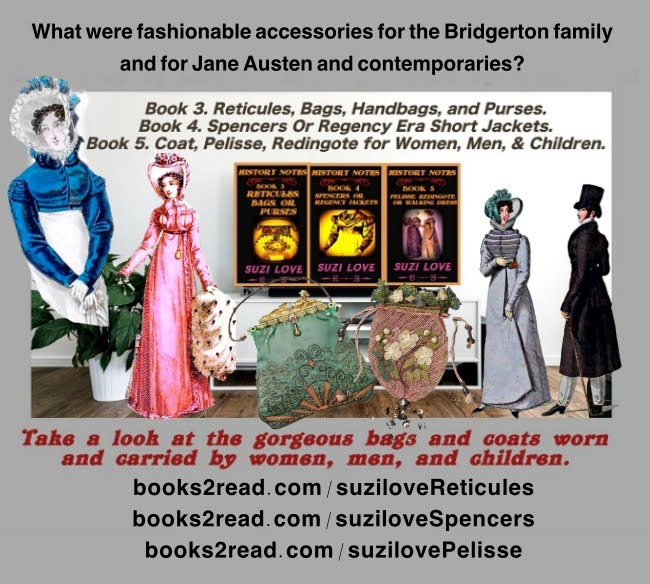
Reticule Or Bag: Purse, often with a drawstring to pull closed and usually made of cloth or covered cardboard and often decorated with beading or embroidery. Carried by a woman during the Regency period to carry all their daily necessities. in the place of pockets.
Spencer: Short jacket, cropped at the waist, worn over a dress, or gown. Delicate and regency dresses provided so little protection from the cold, so over garments were essential for warmth, modesty and good health.
Pelisse Or redingote Or Walking Dress: Coat worn over clothing of both sexes for warmth and protection from the elements.
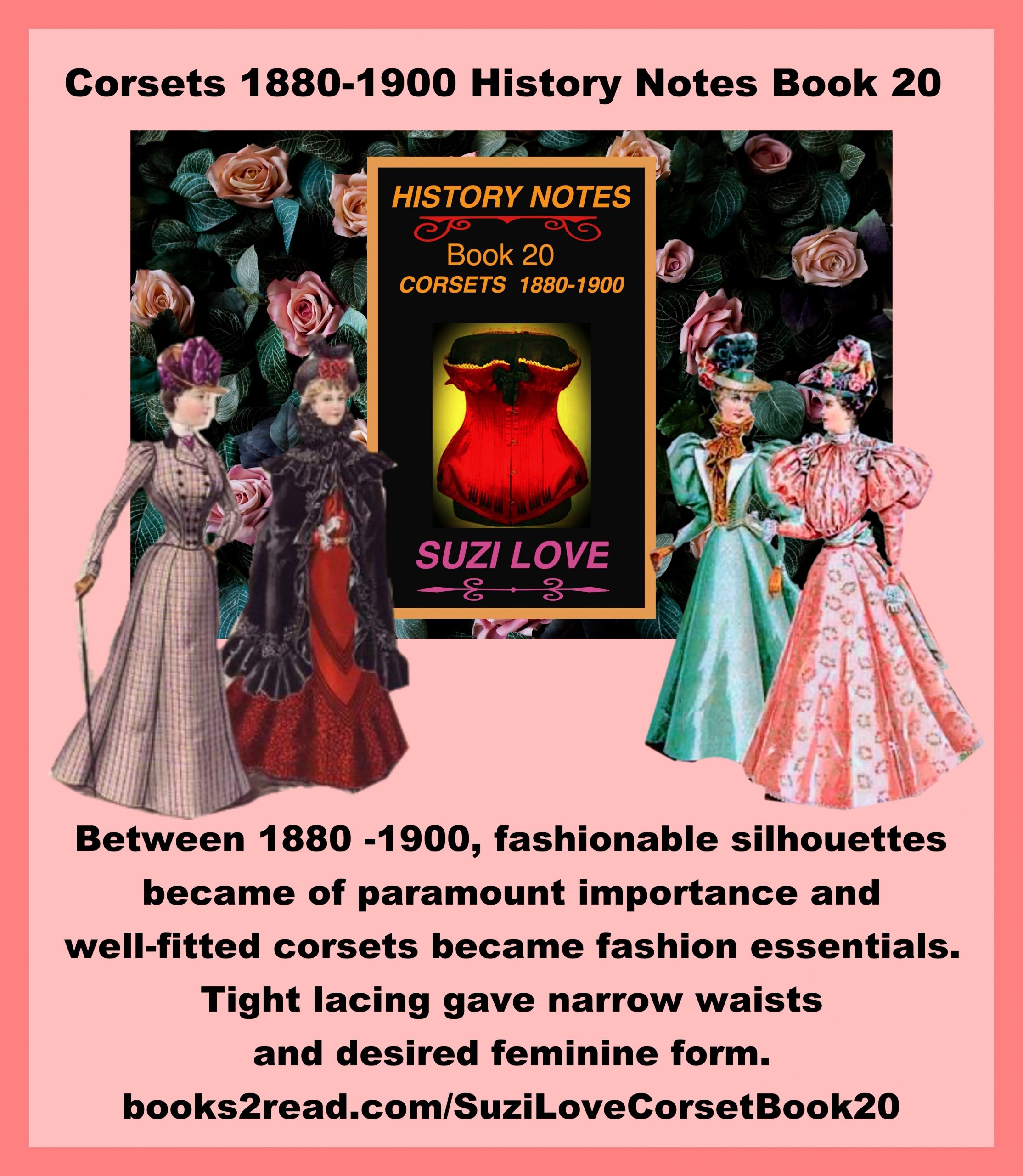
Corsets 1880-1900 History Notes Book 20. This book shows how a fashionable silhouette became of paramount importance and how a well-fitted corset became a fashion essential. As well as a decorative fashion item, tight lacing gave a narrow waist and the desired feminine form under clothing. https://books2read.com/SuziLoveCorsetBook20
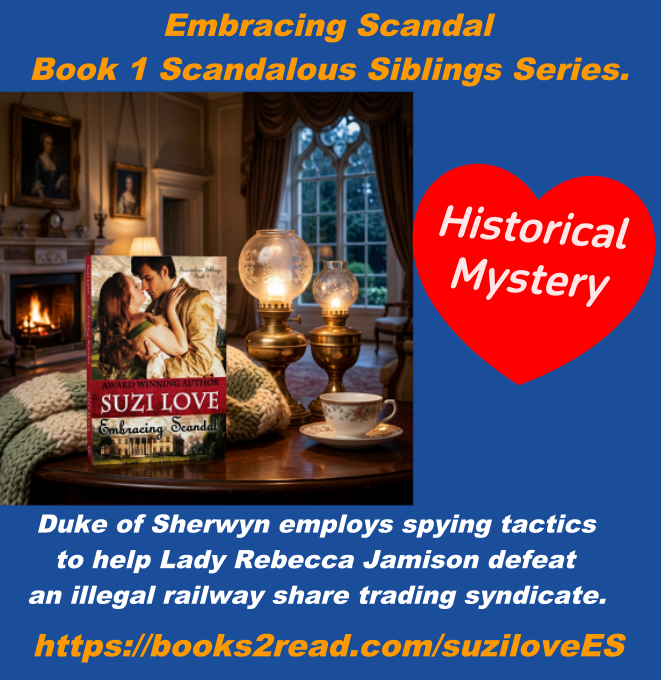
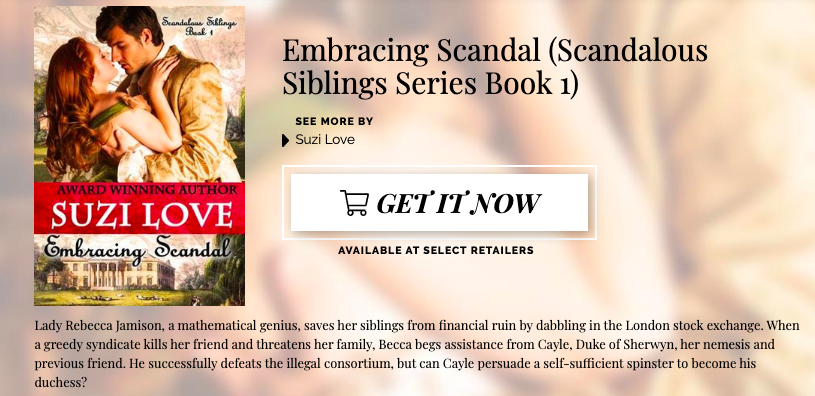
“Two nights ago,” Lady Rebecca Jamison said, “the woman we engaged at the Women’s Betterment Society to tally the Stock Exchange ledgers — our friend — was murdered. The killer was still inside Peggy’s house when I arrived. Her slayer stopped at the back door and stared directly at me, memorizing my features.”
Her pronouncement was flat-voiced, deadly calm.
“Thankfully, his immediate concern was escaping with our two accounting books. But when the cache identifies me as the woman who saw their lackey’s face, I am certain they will send him to dispose of me as well. They are peers, titled and wealthy, and cannot risk being exposed as members of an illegal group. If we cannot stop these men, brutes who employ cold-blooded assassins to do their dirty work, I will certainly be the next to die.”
The Duke of Sherwyn’s chilled blood turned to ice.
Pleasure House Ball Book 3 Irresistible Aristocrats. Love revealed at a courtesan’s ball. Brenton, Lord Mallory, attends his first courtesan’s ball in ten years to appease his concerned friends, though he’d rather stay home and read to his motherless daughters. books2read.com/suzilovePHB
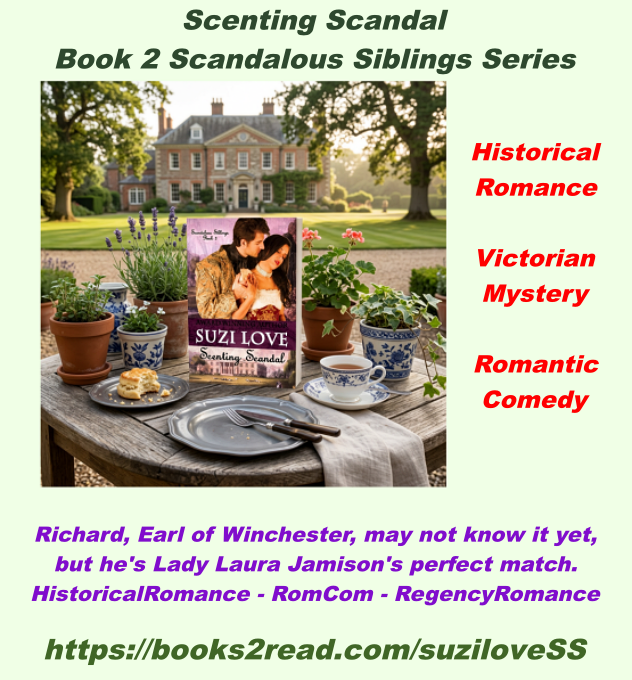
Lady Laura Jamison believes her extraordinary olfactory senses will sniff out her perfect match, but will Richard St. Martin, the Earl of Winchester, prove her theory wrong? Scenting Scandal By Suzi Love Book 2 Scandalous Siblings Series. books2read.com/suziloveSS
EXCERPT
Laura concentrated on restful images. Brooks babbled, birds sang, white fluffy clouds floated. Colorful rainbows arced and…. Nothing, dammit. Her frazzled nerves refused to be soothed. Trying not to alert her aunt, whose over-emotional farewells had already delayed proceedings, Laura tugged on Winchester’s arm. His leather-gloved hand held fast. The Devil take the blasted Earl and his oversized anatomy, his overwhelming maleness and his…
She shivered. Everything overpowering about this man, including his unwanted invasion of her senses, ought to be declared illegal. A ticket tied to each limb reading: Danger. Avoid at all cost.
His cologne’s citrus tang, bergamot with an after-note of lemon, flooded her nose and made her sneeze. Another confirmation that the theory of natural selection being developed by scientists at the Royal Academe was correct. And an extra incentive to elude her keeper, ergot the enigmatic Earl, and pay another visit to her friends, Mr. Charles Darwin and his cousin, both men grandsons of Mr. Erasmus Darwin, famed researcher and theorist.
While she listed to herself the scientific reasons for avoiding the Earl, her herbalist and caring side, or more likely her feminine one, overruled. She reminded herself a few more drops of lemon should be added to the next batch of cologne she blended for Richard. Even as she mentally cursed her siblings for insisting she work closely with Winchester, Laura’s traitorous body responded in a physical way to his presence.
Imagining him, an expert financier, being granted full authority over not merely her ‘Change transactions, but also her daily household accounts, horrified her. Mortification would nail closed her coffin if he compared her scientific skills with those of her extraordinarily talented four siblings and found her wanting. Or, heaven save her, exposed her failures to the world.
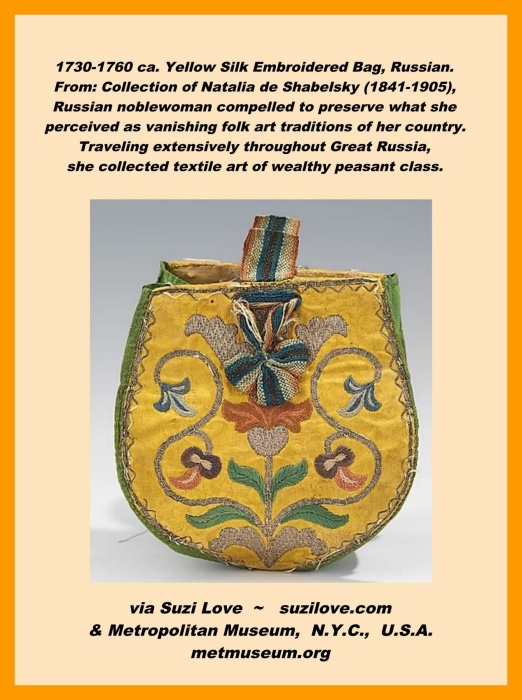
1730-1760 ca. Yellow Silk Embroidered Bag, Russian. From: Collection of Natalia de Shabelsky (1841-1905), Russian noblewoman preserving vanishing folk art traditions of her country. Traveling extensively throughout Great Russia, she collected textile art of wealthy peasant class. via Metropolitan Museum, NYC.
18th Century bags, or purses, were usually designed to hang from the waist or wrist to carry essential daily items on the person rather than making the long walk back through a castle or grand house to fetch things like coins, personal seals, toiletries or medicines.
What did the Bridgerton ladies and Jane Austen use to carry her personal items? Ridicule, Reticule, Or Handbag? Call them what you like: purses, bags, handbags, reticules, ridicules, clutches, or pocket replacements. They all did the same job and they changed greatly with the prevailing fashions of time. books2read.com/suziloveReticules
Definition Of A Reticule; Bag or purse, often with a drawstring to pull closed and usually made of cloth or covered cardboard and often decorated with beading or embroidery. A reticule, or purse, or handbag, was usually carried by a woman during the Regency period to carry all their daily necessities. Earlier, women used pockets that tied at the waistline and were hidden in the folds of their skirts. Empire style, or early 1800s, high-waisted dresses made it impossible to either sewn in a pocket or to tie on a pocket, so women began carrying small, decorated bags called Reticules, or ridicules, which generally pulled close at the top with a drawstring. These Reticules, or bags, were the forerunners of our modern day purses.
The term ‘ridicule’ derived from the Latin ‘ridiculum’ and first used in France during the 17th century and meant subjecting something or someone to mockery. As women’s tiny bags were mocked, or ridiculed, for being a useless fashion accessory carried outside when they were first used in the late 1700s, it’s likely this is how the name ‘ridicule’ started. The later term ‘reticule’ derived from the Latin reticulum, meaning ‘netted bag’ and was applied when bags became larger and often made from netting. In the late 1700s and early 1800s, they were also known as indispensables as they carried all the personal items a lady needed upon her person every day. They were easily made by ladies, easy to carry and became an indispensable fashion accessory.
In the early nineteenth century, reticules started to look like future handbags as they were often made from rigid card or molded mâché or card into a variety of shapes. Early bags were circular and with a drawstring but as women wanted their reticules to look individual they could be made with two halves and a hinged metal closure or with concertina sides. Materials varied from silk, cotton and string and shapes were round, hexagonal or lozenge shapes with shell shaped bags becoming very popular during the Regency and Romantic Eras.
1800s magazines were written for well bred women who could read, so they gave plenty of ideas for how ladies could make and embellish reticules for their own use and as pretty gifts. Needlework was highly encouraged as a pastime for a lady so bags were frequently embroidered or decorated with beading. By the 1820s, reticules became more like our modern handbags using soft leather gathered at the top or hard leather with a rigid fastener and metal chain for carrying.
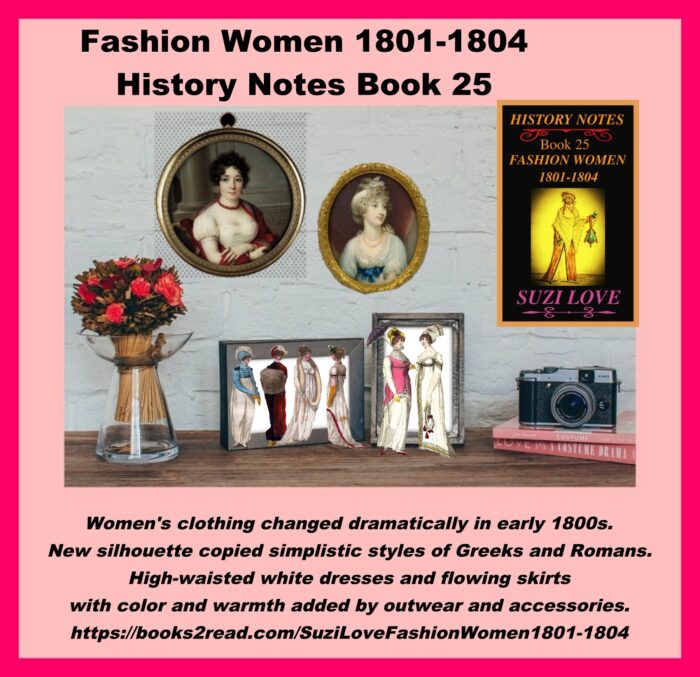
Writer Or Reader Of Regency Era?What did Jane Austen and friends wear? Women’s clothing changed dramatically in early 1800s. New silhouette copied simplistic styles of Greeks and Romans. High-waisted white dresses and flowing skirts with color and warmth added by outerwear and accessories. Fashion Women 1801-1804 History Notes Book 25 https://books2read.com/SuziLoveFashionWomen1801-1804
Definition Empire Style Dress: High-waisted white gowns defined women’s fashion during the Regency Era. ‘Empire’ is the name given to the period when Napoleon Bonaparte built his French Empire. High-waisted, loose gowns were adopted by the aristocracy as a symbol of turning away from the elaborate clothing worn in the 1700s. This sort of high-waisted dress would have been worn by Jane Austen and her contemporaries in England.
Definition Shawls: The shawl started off in India as a fine wool garment for men that could be worn as a scarf, turban or as a mantle: the word comes from the Persian shäl. Originally imported from the East, European Kashmir shawls were made first in Norwich and Edinburgh in Britain in the late 18th century. Shawls were an essential item in the early 1800s to cover the thin gowns women wore. They were made of muslin, gauze, silk, wool, and velvet, though cashmere shawls were the softest and most prized.
Fashion Women 1801-1804 History Notes Book 25 This book looks at the changes to women’s clothing in the early 1800s and the move away from complicated styles and heavy fabrics. The new silhouette copied the simplistic styles of the Greeks and Romans. White dresses were high-waisted and skirts were flowing, with color and warmth added by outwear and accessories. https://books2read.com/SuziLoveFashionWomen1801-1804
Four Times A Virgin: “Are you suffering some sort of aliment in your abdomen, Your Grace?” #RegencyRomance #HistoricalMystery #ReadARegency #HistoricalEroticRomance
books2read.com/suziloveFTAV
The Viscount’s Pleasure House allows Justin, the most notorious Viscount in London, to fund his search for his missing mother and sisters. But after three years catering to the sordid whims of the perpetually bored Upper Ten Thousand in early Victorian times, the Virile Viscount announces his retirement.
Justin plans to sell his exotically themed brothel and cease all Arabian Nights held on his estate, a desperate attempt to cleanse his blackened soul and perhaps revive his deadened sexual interest. So when Lady Chrissie Wellsby begs Justin to tutor her two friends in the amorous arts in exchange for information about his family, Justin is torn. For though he’ll do anything to discover the whereabouts of his family, including teaching three naive ladies how to act like well-schooled courtesans, he loathes being forced into this last performance as a sex God served by his harem.
Having Chrissie willingly act as his sex slave stirs the world-weary viscount into the wildest performance ever given at the Sultan’s tent, but does little to convince Chrissie that he has fallen head over heels in love with her and put his rakish ways behind him. Justin enjoys a wonderful reunion with his family but feels cheated of his chance at love until Chrissie’s friends encourage her to trust the newly reformed viscount.
Chrissie organizes one final gala at the Pleasure House, an erotic night of lovemaking for two to prove her love for Justin and show him she longs to be his wife.