Fashion Women 1805-1809 History Notes Book 26 What did Jane Austen and friends wear? https://books2read.com/SuziLoveFashionWomen1805-1809
1808 Fashionable English Couple, Dressed As In Jane Austen’s times. Lady in a white dress with pointed hem decorations, fitted white hat tied under her chin with yellow ribbon, yellow shawl and pink slippers. Gentleman in formal dress of blue tailcoat, black knee breeches, white stockings, black shoes, black bicorn hat, curly hair style and sideburns and a sword. Interestingly, this is English style fashions from a French magazine. Fashion Plate via Journal des Dames et des Modes, or Costume Parisien.
Fashion Women 1805-1809 History Notes Book 26 What did Jane Austen and friends wear? https://books2read.com/SuziLoveFashionWomen1805-1809
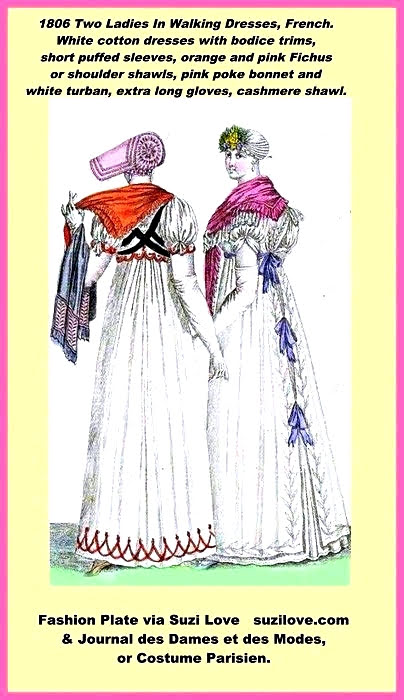
1806 Two Ladies In Walking Dresses, French. White cotton dresses with bodice trims, short puffed sleeves, orange and pink Fichus or shoulder shawls, pink poke bonnet and white turban, extra long gloves, cashmere shawl. Fashion Plate via Journal des Dames et des Modes, or Costume Parisien. These fashionable ensembles with a variety of fashionable and practical accessories would have been worn by Jane Austen and her family and friends during the day when out walking in the park or visiting village shops. Hats were a necessity to protect fair skin from the sun and scarfs and shawls added color and warmth to an outfit.
Definition Fichu: Draped scarf or shawl worn about shoulders and tied in knot at breast, with ends hanging down loosely. Word, meaning negligee or careless, first used to describe breaking away from stiff collar of the past.
Fashion Women 1805-1809 History Notes Book 26 What did Jane Austen and friends wear? https://books2read.com/SuziLoveFashionWomen1805-1809
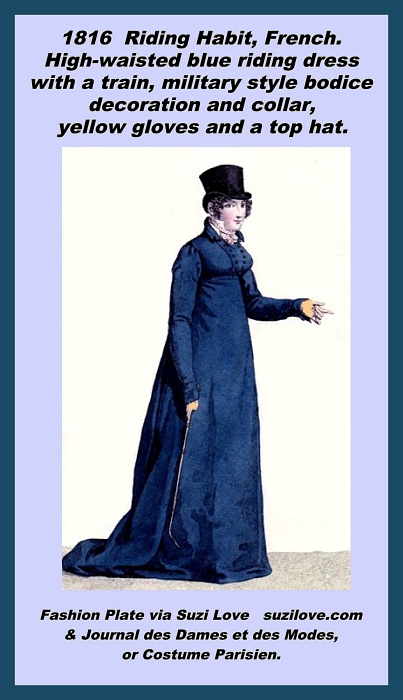
1816 Blue Riding Habit, French. High-waisted blue riding dress with a train, the long full skirt being necessary to cover a lady’s legs and preserve her modesty when riding side saddle. These riding habits were usually designed by men and were in two pieces, a jacket and a skirt, worn over a shirt. A military style bodice decoration, high pointed collar and a knotted pink dotted cravat worn underneath that imitate male styles, or even Dandy fashion. Sleeves are very long as was the trend in French riding habits. Yellow gloves and a masculine style beaver hat. This print was designed by Horace Vernet and engraved by Pierre Baquoy. Fashion Plate via Journal des Dames et des Modes, or Costume Parisien. Although, there are very similar riding habit fashion plates in other magazines.
The type of outfit Jane Austen and her friends would have worn when they went horse riding. https://books2read.com/SuziLoveFashionWomen1815-1819
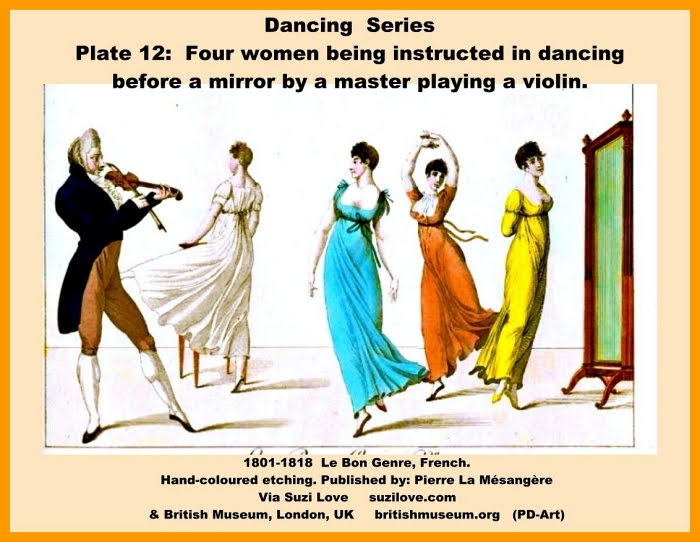
1802-1812 ca. Dancing Or La Dansomanie Series. Four women being instructed in dancing before a mirror by a master playing a violin. Le Bon Genre Description Plate 12. Via British Museum, London, UK. britishmuseum.org (PD-Art)
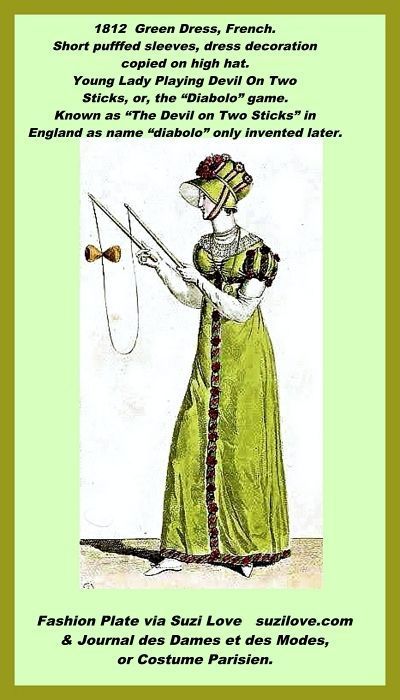
1812 Young Lady Playing Devil On Two Sticks, or, the “diabolo” game. The game was known as “The Devil on Two Sticks” in England at the time as the name “diabolo” was only invented later. Green dress with short puffed sleeves, dress decoration copied on high hat. Fashion Plate via Journal des Dames et des Modes, or Costume Parisien.
1812 Young Lady Playing Devil On Two Sticks, or, the “diabolo” game. The game was known as “The Devil on Two Sticks” in England at the time as the name “diabolo” was only invented later. Fashion Plate via Journal des Dames et des Modes, or Costume Parisien.27_D2D_FashWomen1810-1814
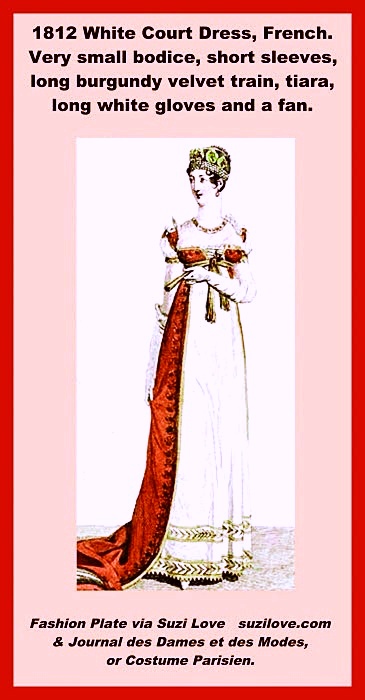
1812 White Court Dress, French. Very small bodice, short sleeves, long burgundy velvet train, tiara, long white gloves and a fan. Fashion Plate via Journal des Dames et des Modes, or Costume Parisien.
Definition Court Dress: Usually, the difference between a court dress and a ball dress was in the quality of fabrics used, how elaborate the design, and the number and quality of the accessories. Plus, in England in the early 1800s court dresses were required by Queen Charlotte to have hoops and in France and other European countries court dresses a long train, usually expensively decorated. During the Regency Era, white cotton dresses were considered suitable for many evening events, but definitely not for an evening event in a palace.
1811 White Dress, French. Dress with scalloped hem, pink Redingote, green paisley shawl and white hat. Fashion Plate via Journal des Dames et des Modes, or Costume Parisien.
Definition Redingote Or Pelisse Or Walking Dress Or Coat: Long fitted outdoor coat worn over other garments for warmth. Often left open at the front to show off the dress underneath. French word developed from English words, riding coat. Jane Austen and her contemporaries wore long coats like these to keep warm when out and about, visiting, shopping etc. The thin muslin dresses worn in the early 1800s were little protection against European winters.
1802 Blue Riding Habit, French. Lady in a riding costume with a black fitted hat and a whip. Fashion Plate via Journal des Dames et des Modes, or Costume Parisien. Typical of the riding costumes worn by Jane Austen’s female contemporaries. The style is still in the Empire fashion of a high-waist with the skirt falling from just under the bust and worn under a matching short jacket or Spencer.
1811 Typical Regency Era Man’s Overcoat or Driving Coat. Fashion Plate via Journal des Dames et des Modes, or Costume Parisien. Overcoats were called many names: Greatcoat, Carrick or Garrick Coat, Coachman’s or Driving Or Box Coat. With many shoulder capes, or pelerines, to keep rain and snow off the body.
1800 Gentleman In Morning Dress French. Looking In Mirror, Double breasted, long coat high black boots with tan tops red cravat walking stick. Fashion Plate via Journal des Dames et des Modes, or Costume Parisien.
During the early 1800s skirted coats were replaced with short-fronted, or cutaway, tailcoats worn over fitted waistcoats and plain, white linen shirts. Knee breeches were gradually replaced by tight-fitting pantaloons and later trousers, decorative shoes were replaced with boot, such as the tan topped boots worn here, and fussy neckwear gave way to intricately tied, white linen neck cloths. A Regency Era, or early 1800s, gentleman was outfitted in more practical fabrics, such as wool, cotton and buckskin rather than the fussy brocades and silks of the late 1700s. The men in Jane Austen’s life would have worn an elegant outdoor ensemble like this for everyday excursions around the countryside.
HN_23_D2D_Fashion Men 1800-1819 History Notes Book 23
https://books2read.com/SuziLoveFashionMen1800-1819