1818 September ‘A Nice Gentleman’ By George Cruikshank. A grotesque dandy walks outdoors sucking a cane. Inscribed with names of food, e.g. red carbuncled rose is ‘Currant Jelly’, shallow broad-brimmed hat is ‘Calves Head Jelly’ and ‘Pancake’, cravat which covers neck, cheek and chin is ‘Puff Paste’, loose short trousers are ‘White Sugar Bags’, handkerchief ‘Blow Monge’ and long spurs ‘Gilt Gingerbread’. Via British Museum, London, UK. britishmuseum.org (PD-Art)
1809 June Evening Full Dress, English. Lemon dress with white underskirt, short sleeves, braid decorated bodice, zig-zag hem, long white gloves, plumed headdress, full Parure of necklace, bracelet and earrings, evening slippers and a fan. Fashion Plate via John Belle’s La Belle Assemblée or, Bell’s Court and Fashionable Magazine, London.
Definition Full Evening Dress – Ball, dinner, evening and opera gowns but with every possible accessory added to make the most impressive display possible, such as adding a Grand Parure, or full jewelry set and including headpieces as with the feathered headdress above.
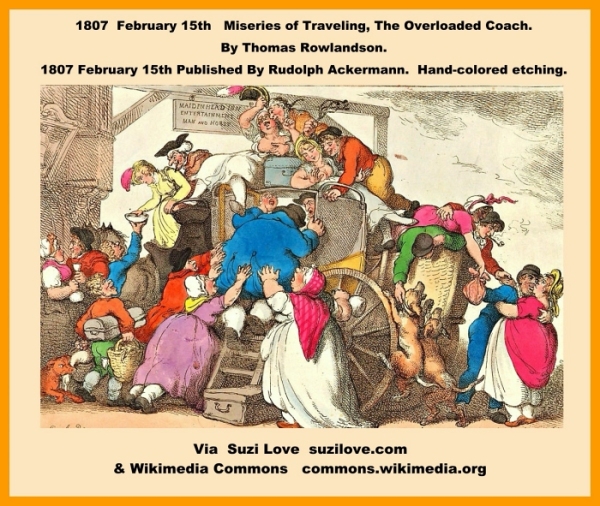
1807 February 15th ‘Miseries of Travelling’ in Jane Austen’s times. The Overloaded Coach Series By Thomas Rowlandson. Publisher Rudolph Ackermann, London (active 1794–1829). Hand colored etching.
1800s Early Tattersall’s Horse Auctions, London, U.K.. Top sporting venue for Regency Life in London. ‘A mixture of persons of nearly all ranks’. By Pierce Egan. Via Wikimedia Commons (PD-ART)
In Jane Austen’s and Bridgerton times, or the Regency Era, horse riding was a vital mode of transport and Tattersall’s was the best place to buy and sell horses. Tattersall’s was established in 1773 near Hyde Park Corner for the sale by auction of horses, carriages, hounds and harnesses. Sales during the winter months were every Monday and Thursday, and on Mondays only during the spring and summer. On the mornings when there was no sale, Tattersall’s was a meeting place for fashionable sporting gentlemen.
Pierce Egan’s Description of Tattersall’s
A masquerade could scarcely exhibit more motley groups than the attendants of this place of fashionable resort. There were Peers, Baronets, Members of Parliament, Turf gentlemen and Turf-servants, Jockies, Grooms, Horse-dealers, Gamblers, &c. There you might see the oldest and some of the best blood in England, disguised like coachmen.
From: 1820 Sporting Anecdotes by Pierce Egan via Google Books (PD-150)
As the Duke of Stirkton, Max was well accustomed to being watched. Young pups copied his dress style. Toad-eaters mimicked his behavior in futile attempts to ingratiate themselves into his life. Conservative groups applauded his somber public behavior, while cartoonists ridiculed his straight-laced demeanor and suggested he take a mistress. Or two.
Whichever way people viewed him, no one had dared ridicule him to his face. Until this evening. The Countess had side-stepped his butler and marched into his drawing room as if an unannounced call upon an unmarried duke was something she did regularly. Max had informed her, in great detail, of the extensive search he and his cousin had undertaken to locate her and the other women. She’d huffed and rolled her eyes.
Normally, his month-about- mistresses gleefully accepted his proposal because sharing a duke’s bed for a month would set them up for the rest of their lives. Apart from the financial benefits, he was a generous lover. One benefit of his abnormal upbringing had been an early and full education into what women wanted in a bed partner. Until the Countess had laughed at him, he’d never had reason to doubt his sexual prowess. In the brief time she’d been in his house, she’d challenged several of his beliefs.
“It’s the ideal solution.” And something he needed. “I will help you search my grandfather’s boxes by day and, in exchange, you’ll make yourself available to me in the evenings.” Max waited, unsure what to expect. An odd situation for a man who prided himself on reading adversaries as easily as he tallied the accounts. books2read.com/suziloveFTAV
Lover of Jane Austen and the Regency Era fashions? History Notes Book 25. #JaneAusten #RegencyFashion #HistoricalFashion books2read.com/SuziLoveFashionWomen1801-1804
1826 Cartoon: A squeeze at Carlton Palace in Bridgerton and Jane Austen times. From Regency Social Life. #JaneAusten #Bridgerton #Cartoon #England https://books2read.com/suziloveYGD
1816 August. Morning Dress in Bridgerton or Jane Austen style, English. White high-waisted dress worn with a blue striped spencer, blue boots, and a white hat white blue trim. Fashion Plate via Lady’s Magazine.
Description Spencer: Short jackets worn for warmth over the high-waisted Empire style gowns that were popular after the French Revolution, where there was a shift away from opulence and decadence to simpler fashion. This jacket with very short bodice and long sleeves was known as a Spencer and was named after the male coat made famous by the Earl Spencer and said to have originated in accident to Lord Spencer in hunting when coat tails torn off and a cropped jacket was invented. The dresses in the early 1800s therefore became looser, lighter, and flowing and women became cold due to their very low cut and short bodices. Short fitted jackets that went easily over the dresses and provided extra modesty and some warmth. As Europe and many other parts of the world were deep in wars in the late 1700s and early 1800s, men in uniform were found everywhere. In support of these military men, fashions leaned towards military style shoulder paddings, shoulder embellishments, loops, buttons, and braids.
I love these snippets from Captain Gronow’s Recollections 1864. Even though they were written after the Regency, they give us fun bits of information about Almack’s Assembly Rooms, the Prince Regent or later King George IV.
“Good society at the period to which I refer was, to use a familiar expression, wonderfully “select.” At the present time one can hardly conceive the importance which was attached to getting admission to Almack’s, the seventh heaven of the fashionable world. Of the three hundred officers of the Foot Guards, not more than half a dozen were honoured with vouchers of admission to this exclusive temple of the beau monde; the gates of which were guarded by lady patronesses, whose smiles or frowns consigned men and women to happiness or despair. These lady patronesses were the Ladies Castlereagh, Jersey, Cowper, and Sefton, Mrs Drummond Burrell, now Lady Willoughby, the Princess Esterhazy, and the Countess Lieven.
Almack’s: Exclusive temple of the beau monde. The gates of which were guarded by the lady patronesses,The Ladies Castlereagh, Jersey, Cowper, Sefton, Willoughby, Princess Esterhazy, and Countess Lieven.
From Captain Gronow’s Recollections 1864.
The most popular amongst these grandes dames was unquestionably Lady Cowper, now Lady Palmerston. Lady Jersey’s bearing, on the contrary, was that of a theatrical tragedy queen; and whilst attempting the sublime, she frequently made herself simply ridiculous, being inconceivably rude, and in her manner often ill-bred. Lady Sefton was kind and amiable, Madame de Lieven haughty and exclusive, Princess Esterhazy was a hon enfant, Lady Castlereagh and Mrs Burrell de tres grandes dames.
Many diplomatic arts, much finesse, and a host of intrigues, were set in motion to get an invitation to Almack’s. Very often persons whose rank and fortunes entitled them to the entree anywhere, were excluded by the cliqueism of the lady patronesses; for the female government of Almack’s was a pure despotism, and subject to all the caprices of despotic rule: it is needless to add that, like every other despotism, it was not innocent of abuses.
Almack’s
The fair ladies who ruled supreme over this little dancing and gossiping world, issued a solemn proclamation that no gentleman should appear at the assemblies without being dressed in knee-breeches, white cravat, and chapeau bras.
From Captain Gronow’s Recollections 1864.
1815 The First Quadrille at Almack’s Assembly Rooms, London. Left to Right: Marquis of Worcester, Lady Jersey, Clanronald MacDonald and Lady Worcester. “It was not until 1815 that Lady Jersey introduced from Paris the favourite quadrille, which has so long remained popular. I recollect the persons who formed the very first quadrille that was ever danced at Almack’s: they were Lady Jersey, Lady Harriett Butler, Lady Susan Ryde, and Miss Montgomery; the men being the Count St Aldegonde, Mr Montgomery, Mr Montague, and Charles Standish.” From The Reminiscences of Captain Gronow 1810-1860. 1811-1820 Snippets of Regency Life By Captain Gronow. #RegencyEra #Almack's #PrinceRegent https://books2read.com/suziloveROver Share on XRL_1_D2D_Regency Overview RetailerLinks
https://books2read.com/suziloveROver
1818 ‘The Stamford Dandy or A Modern Peeping Tom’. Lord Stamford rides past a row of houses looking through his glass at a woman who stands at an open first-floor window. Other women watch him from the two other windows. Dressed as a dandy with red tailcoat, high white collar and cravat, black top hat and wearing loose white trousers. Artist not known. Via British Museum, London, UK. britishmuseum.org (PD-Art)