19th Century Food For The Upper Classes In Bridgerton and Jane Austen Times.
Typical Meals Served for the upper classes in the Georgian and Regency Eras. For the Upper classes in the 18th and through to the end of the 19th century, meals were elaborate affairs. and served by well-trained staff anticipated their every need. Women prided themselves on hosting dinners for 50-60 people which often consisted of numerous courses, and all served with the best wines and followed, for the men at least, by expensive port.
An older lady usually controlled the servants and the serving of meals. For more about this, take a look at Older Lady’s Day Regency Life Series Book 5 by Suzi Love. Overview of what an older lady did, wore, and how she lived in the early 19th Century. Information for history buffs and pictures for readers and writers of historical fiction. books2read.com/suziloveOLD
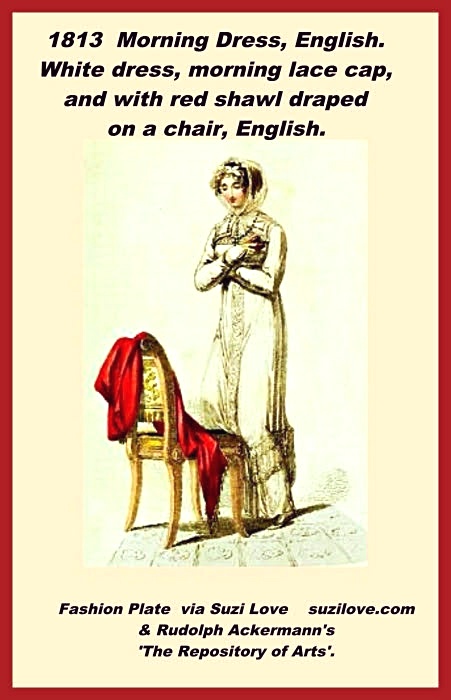
1813 October Morning Dress, English. Jane Austen and her family and friends would have worn this style of relaxed dress and cap. White At-Home dress with morning lace cap and a red shawl. Plain cambric underdress, three-quartered muslin or Chinese silk robe trimmed round the bottom and up the front with Indian border, or needle-work, and finished with a deep flounce of lace. Convent hood and pelerine of white net lace, confined under the chin with a silk cord and tassel. Hair in irregular curls with a fancy flower in the front. Short rosary and cross, plus bracelets, of coquilla beads. Buff or lemon kid slippers and pale tan gloves. Fashion Plate via Rudolph Ackermann’s ‘The Repository of Arts’.
This is a typical outfit worn at home in the morning in the house, to be seen only by family or close friends. A lady might wear this while writing having breakfast, writing letters, or reading. Called by the various names of Undress, to At-Home dress, or Morning dress, it is the most relaxed ensemble a lady will wear all day. The sort of outfit Jane Austen would have worn when writing her books.
1812 Red Dress, French. High-waisted red Merino wool dress with short puffed sleeves, high Chako hat with a plume long white gloves and white shoes. Fashion Plate via Journal des Dames et des Modes, or Costume Parisien.HN_27_D2D_fashwomen1810-1814
https://books2read.com/SuziLoveFashion1810-1814
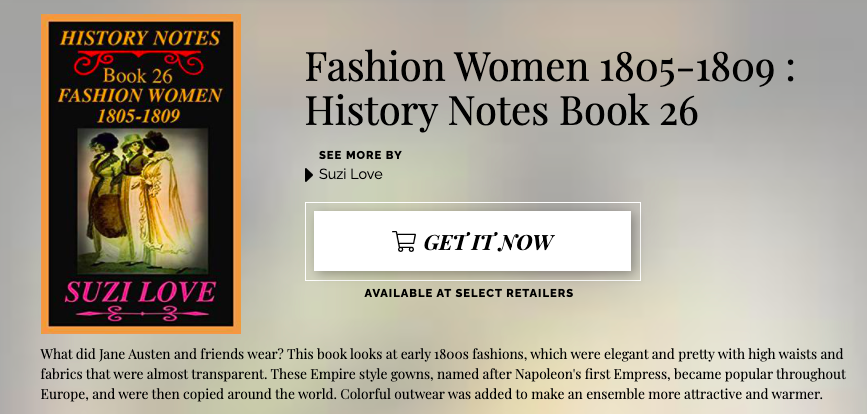
What did Jane Austen and friends wear? Early 1800s fashions were elegant and pretty with high waists and fabrics that were almost transparent. These Empire style gowns, named after Napoleon’s first Empress, became popular throughout Europe, and were then copied around the world. Colorful outwear was added to make an ensemble more attractive and warmer. History Notes Book 26 Fashion Women 1805-1809. https://books2read.com/SuziLoveFashionWomen1805-1809
The Empire waist gown defined women’s fashion during the Regency Era. ‘Empire’ is the name given in France to the period when Napoleon built his French Empire. High-waisted, loose gowns were adopted by the aristocracy as a symbol of turning away from the fussy, elaborate and expensive clothing worn in the 1700s. Jean-Jaques Rousseau advocated copying peasants and returning to a simpler life and more natural fashions. Unrestricting clothing was part of the new Democracy in France and these simpler and flowing fashions were adopted all over Europe, including Britain and despite the continual wars being fought against France during the early 1800s. Not even war stopped fashions from being copied everywhere.
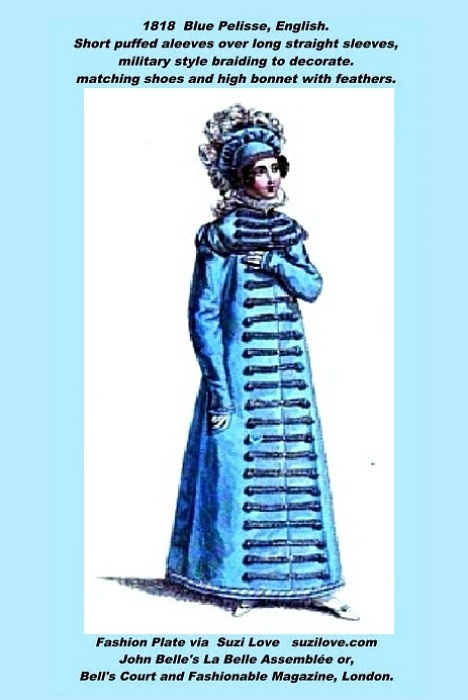
1818 Blue Pelisse, Or Coat, English. Short puffed sleeves over long straight sleeves, military style braiding to decorate. matching shoes and high bonnet with feathers. Fashion Plate John Belle’s La Belle Assemblée or, Bell’s Court and Fashionable Magazine, London. The type of outfit young Regency Era ladies would have worn if they were out shopping on Bond Street, walking in a park, or taking a carriage ride through Hyde Park.
Definition Redingote Or Pelisse Or Walking Dress Or Coat: French word developed from English words, riding coat. Long fitted outdoor coat worn over other garments for warmth. Often left open at the front to show off the dress underneath. Sometimes cut away in front. Originally made with several capes and trimmed with large buttons. French fashion plates call these coats Redingotes and they are designed for women, men and children. English fashion plates call them a Pelisse, a walking dress, Promenade dress, or Carriage dress.
1818 Blue Pelisse, Or Coat, English. Short puffed sleeves over long straight sleeves, military style braiding to decorate. matching shoes and high bonnet with feathers. Fashion Plate John Belle’s La Belle Assemblée or, Bell’s Court and Fashionable Magazine, London.
Carina, Countess of Dorchester, glanced out at the square for the twentieth time and clutched the window casing for support when she saw that striding along the pavement towards her house was an exceedingly tall man, dressed in up-to-the minute fashion and wreathed in an aura of power and control. The Duke of Stirkton cut such a superior figure that men stepped aside and women turned to stare as he passed them on the footpath. The fact that he was oblivious to their attention and admiration made him more interesting, and for the first time in many years, Carina felt a glimmer of hope.
“Oh, Gertie, yes, yes,” she said, clapping her hands and spinning in a giddy circle before the window. “I think Georgie’s way out is about to present itself, and sooner than we thought.”
Gertie joined her at the window but groaned aloud. “Oh, no, no, no, Carina! Not him. The Duke of Stirkton is not the best person to help us introduce the girls to gentlemen.”
“Why not? He may not be a perfect solution but, with his influence in society, he may provide our best way forward.”
“You were only going to ask to see his grandfather’s papers. Look at whatever the Duke may have already found, whether it’s letters, directions, or anything else to help us work out the names and locations of those two men.”
1800s Typical Puddings and Pastries.These are the sort of puddings and pastries Jane Austen’s family would have eaten on a regular basis during the early 1800s, or Regency Era. Open Apple Tart, Galette, Apricot Fritters, Pancakes and Apricot Jam, Charlotte Russe, Macaroni Cheese, Cherry Tart, Mince Pies, Almond Puddings, Tartlets, Compote Of Fruit, Fruit Pudding, Fruit Tart, Christmas Plum Pudding, Milk Pudding and Roly Poly Jam Pudding. From: 1850s- 1860s Mrs. Beeton’s Books of Household Management. via Google Books (PD-150). 1800s Typical Puddings and Pastries Served In Households Like Jane Austen’s. https://books2read.com/suziloveOLD
1813 April Carriage Dress, English. Green coat over white Empire style dress of jaconet or cambric muslin, plaited bodice, long sleeve, deep frill, with a vandyke of needle-work. Russian mantle is made of Pomona or spring green sasnet, lined with white satin, trimmed with a rich frog fringe and closed with a cord or tassel. Close-fitting cottage slouch bonnet of the same material and edged with scalloped lace, tied on the left under the chin with ribbon, and decorated with a small cluster of spring flowers. Reticule, or bag, of the sam fabric, slippers of green kid, and gloves of primrose kid. Fashion Plate via Rudolph Ackermann’s ‘The Repository of Arts’.
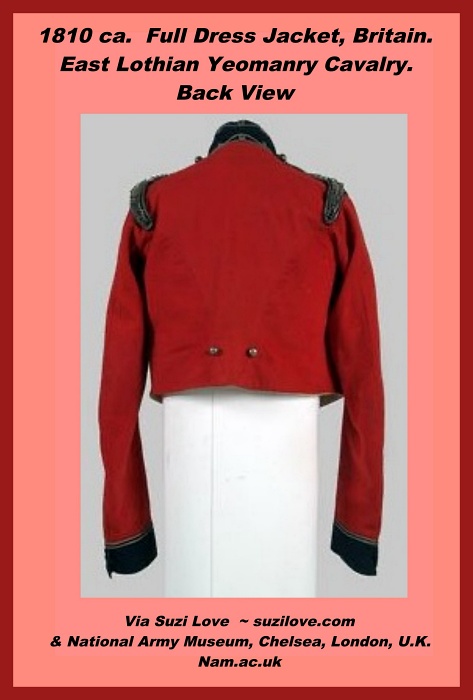
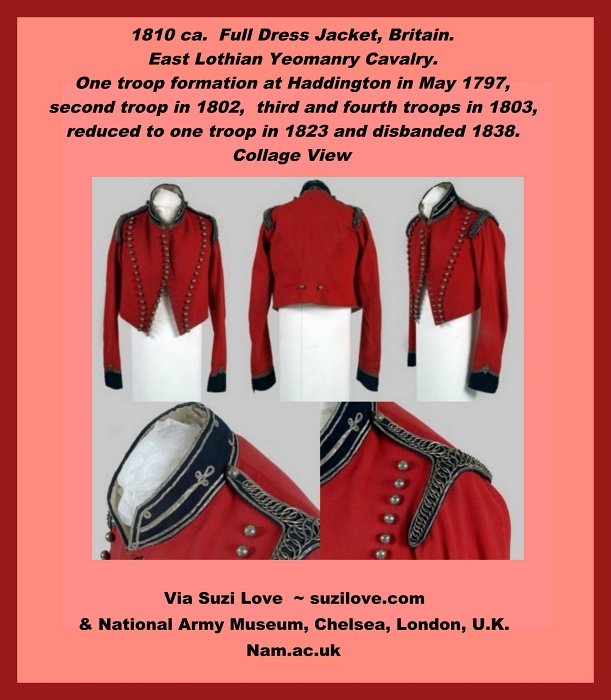
1810 ca. Full Dress Jacket, Lothian Yeomanry Cavalry, Britain. The East Lothian Yeomanry Cavalry was raised as a one troop formation at Haddington in May 1797. Five years later a second troop was raised and in 1803 a third and fourth troop. The regiment was reduced to one troop in 1823 and disbanded 15 years later. National Army Museum, London, UK. https://books2read.com/SuziLoveFashionMen1800-1819 In Jane Austen’s time, or the early 1800s, gentlemen were seen in military coats like this often because many Englishmen were involved in the long lasting wars against Napoleon. .
Richard, Earl of Winchester, has no time for their family friend and mad scientist, Lady Laura Jamison, yet when he’s with her, passion and desire explodes. Scenting Scandal By Suzi Love Book 2 Scandalous Siblings Series. books2read.com/suziloveSS
Richard had schooled himself into playing the role of mentor with such brilliance, Laura’s brothers and sisters would applaud his aptitude for match-making. He’d find Laura’s perfect husband as quickly as possible. And at those long and interminable dinners, he’d prove his own unsuitability by arguing until their fellow diners rolled their eyes and closed their ears to another of their battles of wit. When their companions’ eyes glazed over and they turned to more interesting conversation, he’d be free to let his eyes roam and his senses feast on Laura as she raved about the wonders of evolutionary science.
It was more likely that he’d need to dig his fingers into the elegant carvings on his chair to stop himself leaping across the table like a lunatic and shocking everyone at the sixty-seat table. He’d been in control of himself and his minor kingdom since he’d turned eighteen. So, for pity’s sake, why did being within thirty yards of Laura turn him into a wet-behind-the ears randy youth?
After her olfactory tests had proved he wasn’t her ideal mate, he should feel relieved, not affronted. And rather than reveling in a bachelor’s escape from the clutches of another would-be countess, Laura’s rejection had prompted him to childishly extol his own virtues. For an earl who also held minor titles and controlled several estates, being categorized as ‘Examined and Disregarded’ was as abnormal as it was lowering.
“Laura,” he said, dodging lace frills. “Picture my brutalized face if Michael and Jonathon caught me, the one man able to resist your charms and ignore your demands, composing appalling odes to the length of your lashes like your other fawning fops.”
“Is that why Sherwyn needed to coerce you into acting as my keeper?”
Ah yes, trust Laura to demand to know the reason he complied with his cousin’s wishes. “I was the only able-bodied male available for the time required.”