1860 Corset, American. Cotton, metal, and bone. Manufacturer: Langdon Batcheller and Company, A1851-1860 ca. Blue Ribbed Silk Corset, English. Front and Back. Front hooks and back lacing. via Museum of London, UK. museumoflondon.org.uk


1860 Corset, American. Cotton, metal, and bone. Manufacturer: Langdon Batcheller and Company, A1851-1860 ca. Blue Ribbed Silk Corset, English. Front and Back. Front hooks and back lacing. via Museum of London, UK. museumoflondon.org.uk

As some of my historical romance books are set in a house in Grosvenor Square, its history fascinates me. How about you? Do you love the history associated with Grosvenor Square? The Jamison family in Embracing Scandal and Scenting Scandal live in Grosvenor Square.
Grosvenor Square - Pronounced ˈɡrovna’, is a large garden square in the exclusive Mayfair district and the centrepiece of the Mayfair property of the Duke of Westminster and takes its name from their surname, “Grosvenor”.
In 1710, Sir Richard Grosvenor obtained a licence to develop Grosvenor Square and the surrounding streets and development started around 1721. Grosvenor Square became one of the most fashionable residential addresses in London from its construction until the Second World War, with numerous leading members of the aristocracy in residence. The early houses had five or seven bays, basement, three main stories, and an attic. Colen Campbell produced a design for a palatial east side to the square featuring thirty Corinthian columns but this was not carried out and in the end most of the houses were built to individual designs. There were mews behind all four sides. Many houses were rebuilt later and acquired an extra storey. Number 23 (later 26) was rebuilt in 1773–74 for the 11th Earl of Derby by Robert Adam and shows how grandeur of effect and sophisticated planning might be achieved on a confined site. It was demolished and rebuilt again in the 1860s.
Nearly all of the older houses were demolished during the 20th century and replaced with blocks of flats in a neo-Georgian style, hotels and embassies. The central garden was originally reserved for the occupants of the houses but is now a public park managed by The Royal Parks. Grosvenor Square. Grosvenor Square has been the traditional home of the official American presence in London since John Adams established the first American mission to the Court of St. James’s in 1785. Adams lived, from 1785 to 1788, in the house which still stands on the corner of Brook and Duke Streets. During World War II, Eisenhower established a military headquarters at 20 Grosvenor Square, and during this time the square was nicknamed “Eisenhower Platz”.
The former American Embassy of 1938–1960 on the square was purchased by the Canadian government and renamed Macdonald House. In 1960, a modern USA Embassy was built on the western side of Grosvenor Square and caused controversy in the mainly Georgian and neo-Georgian area. In 2008, the United States Government chose a site for a new embassy in the Nine Elms area, south of the River Thames with with relocation completed by 2016 or 2017. In October, 2009, English Heritage granted Grade II listed status to the building which means new owners will not be allowed to change the facade.
Grosvenor Square in Literature In Little Dorrit by Charles Dickens the Barnacles are said to live at “four Mews Street Grosvenor” which “was not absolutely Grosvenor Square itself but it was very near it”. Caroline Bingley makes a comment regarding the local dance in Pride and Prejudice ”We are a long way from Grosvenor Square, are we not, Mr Darcy”. It appears in the title of several novels including The Lonely Lady of Grosvenor Square by Mrs. Henry De La Pasture (1907) and The House in Grosvenor Square by Linore Rose Burkard (2009) In Oscar Wilde’s play Lady Windermere’s Fan, the Duchess of Berwick says, “I think on the whole that Grosvenor Square would be a more healthy place to reside in. There are lots of vulgar people live in Grosvenor Square, but at any rate there are no horrid kangaroos crawling about.”


1807 Cotton Linen Shirt, British. Non-regulation shirt worn under uniform. High collar to allow room for a stock, fullness and pleated sleeves enable wearer to fit into tight arms popular in coats. The men in Jane Austen’s life would have worn a shirt like this, especially if they were in the military as many men were during the Napoleonic Wars. via Royal Museums Greenwich collections.rmg.co.uk


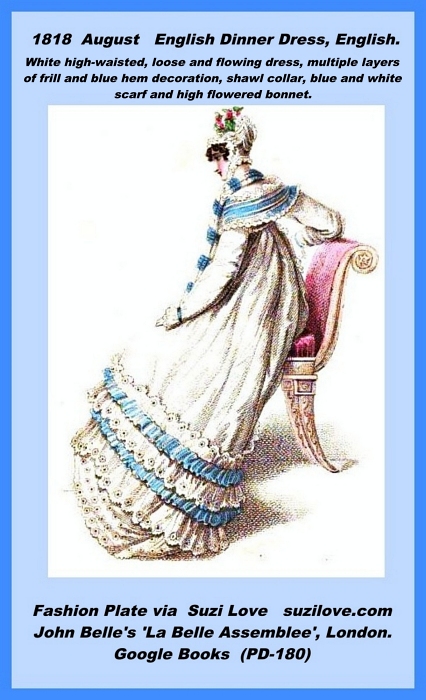
1818 August English dinner Dress. White high-waisted, loose and flowing dress, multiple layers of frill and blue hem decoration, shawl collar, blue and white scarf and high flowered bonnet. Fashion Plate John Belle’s La Belle Assemblée or, Bell’s Court and Fashionable Magazine, London.
1812 February Winter Walking Dress, English. Scarlet Merino wool pelisse lined with straw colored sarsnet, trimmed with light colored spotted fur attached with loops of black silk cordon and rich frog tassels, broad fur in front forming a tippet, pointed at back, narrow fur passes from top of sleeves, worn over a white dress, yellow winter hat, gray gloves, and paisley shawl. Fashion Plate via John Belle’s La Belle Assemblee.
Definition Merino Wool: Finest quality wool, originating in Spain. Just before and during the Regency, Merino sheep were exported from Spain into Britain and other parts of Europe. Napoleon supported Merino growth in France. In 1808, after French invaded Spain, King George purchased additional 2000 Merinos for royal flock but Britain too wet for thriving industry. Other countries i.e. Australia, began producing fine quality Merino.
I can picture Jane Austen and her female friends and family wearing a Pelisse, or Walking Dress, Or Redingote, like this to keep them warm when shopping or paying visits to friends. During the Regency Era, out door activities were encouraged and outside clothing needed to be more practical and with thicker fabrics, such as Merino wool. Tunics gave an additional layer to thin dresses and walking dresses, pelisses, Redingotes and half cloaks were worn and accessorized with cashmere shawls and oversized fur muffs.

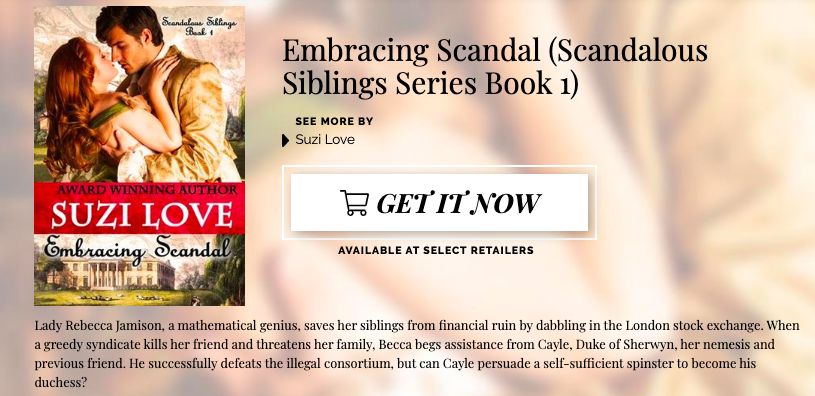
The Duke of St. Martin asks Lady Rebecca Jamison, “Who protects you from the current set of fire-breathing dragons?” #HistoricalRomance #Mystery https://books2read.com/suziloveES
“And who protects you from the current set of fire-breathing dragons?”
She raised her chin. “I’ve outgrown such childishness.”
She lowered herself to the closest settee, a demonstration of ladylike maturity and a reprieve for her trembling knees.
“Pity.” His forehead furrowed into a pained frown. “Ah.
That’s why you wore a disguise. And why you came so late at night.”
She nodded. “The consortium watches our house and tracks our movements. In order to speak with you alone, I was forced to dress like this and sneak out the servant’s entrance in the dark. Although luckily, the syndicate’s inner circle doesn’t want me dead. Not yet.
“Wonderful!” He glared at her. “Your blithe not yet offers such comfort to my nerves.”
She glared back. “Oooh! I cannot explain if you interrupt with your sarcastic jabs.”
He dipped his head, and then waved a hand. “I apologize for my uncertain temperament this evening. Please, tell me about Peggy, and what she did at your Women’s Society.”
“She writes — No, she wrote the letters for women who wish to invest in stock ventures. We were trying to keep their identities, and their objectives, a secret.”
“Why? Because they’re women? Because jobbers stood for them in the Exchange?”
She raised a brow. “For someone only recently returned to London, you appear exceedingly well acquainted with the inside activities at the Exchange.”
He shrugged. “I’ve spent every spare moment since my return settling the family’s finances. Naturally, I’ve looked in at the Foreign Funds Room a time or two. Nobody in my position can afford to let bank balances sit idle, despite some labeling it as trade.”
“I’m impressed, Cayle. You detested accounts when your father wanted you to learn.”
Once more he shrugged, yet his show of nonchalance appeared overdone. “Perhaps it was more of not liking the methods of the educator, rather than the subject being taught.”
She shuddered at her recollection of the late duke’s disciplinary methods. “But you’re correct,” she said, pushing away images of birch rods twanging on bare flesh. “Some in our prudish society frown upon a gentleman of your caliber frequenting auction rooms. But, for a woman, it’d be an outrage.”
His eyes fixed upon her, all signs of his earlier fatigue vanished. “I can well imagine.”
“Though legally nothing prevents a woman from owning shares,” she said, assessing his concentration by the tense way he held his long, muscled body. “Visiting members are vetted at the door. Bank managers and jobbers pay eight guineas a year to enter the main Exchange room, yet self-righteous men evict females.”
“So, is it your gender that sees you under threat?”
“Not merely our gender. When the consortium heard we invested in secret, and often did very well, at first they became alarmed. Then, they became angry. Very angry indeed.”
“I can well imagine men abhorring being bested by a female.”

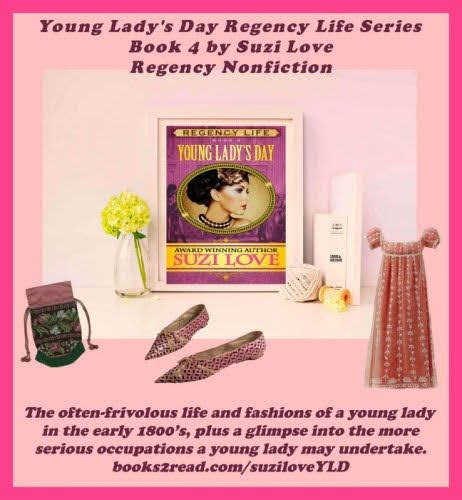
Want a glimpse into the life of a young lady in Jane Austen and the Bridgerton years? #bridgerton #RegencyEra #JaneAusten
Young Lady’s Day is Book 4 in the Regency Life Series.
This book depicts the often-frivolous life and fashions of a young lady in the early 1800’s, but also gives a glimpse into the more serious occupations a young lady may undertake. Through historic images, historical information, and funny anecdotes, it shows how a young lady fills her day, where she is permitted to go, and who she is allowed spend time with. These light-hearted looks at the longer Regency years are an easy to read overview of what people did and wore, and where they worked and played. There is plenty of information to interest history buffs, and lots of pictures to help readers and writers of historical fiction visualize the people and places from the last years of the 18th Century until Queen Victoria took the throne. https://books2read.com/suziloveYLD

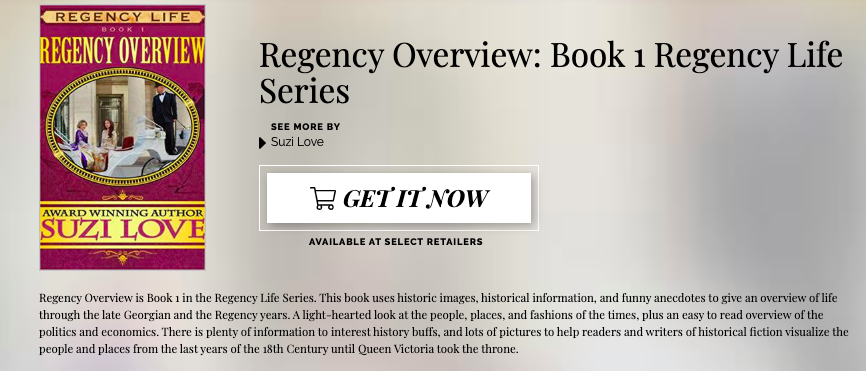
Love the life of Jane Austen and her stories? Fan of the Bridgerton series? Reader or writer of the early 1800s, or Regency Era? For information and pictures, try Regency Life Series by Suzi Love. Light-hearted series about Regency Era, or early 1800s. For writers, readers and history lovers.
Thes books use historic images, historical information, and funny anecdotes to give an overview of life through the late Georgian and the Regency years. A light-hearted look at the people, places, and fashions of the times, plus an easy to read overview of the politics and economics. There is plenty of information to interest history buffs, and lots of pictures to help readers and writers of historical fiction visualize the people and places from the last years of the 18th Century until Queen Victoria took the throne.
Try Books 1-5 Regency Life Series by Suzi Love. Regency Overview – Young Gentleman’s Day – Older Gentleman’s Day – Young Lady’s Day – Older Lady’s Day

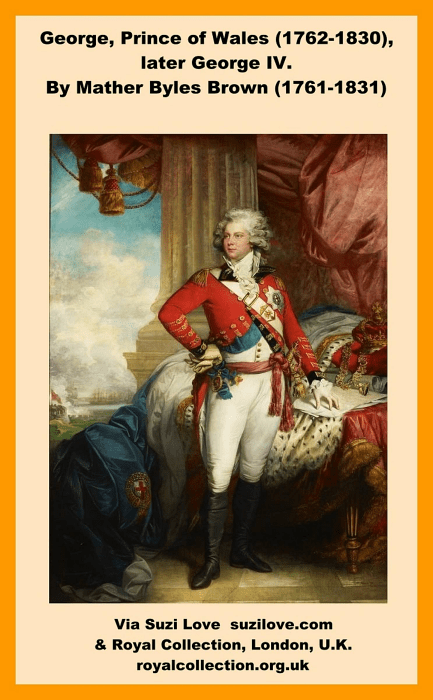
George, Prince of Wales (1762-1830), later George IV. By Mather Byles Brown (1761-1831) via Royal Collection, London, U.K.
The decision to make Prince George the Regent took a lot of political debate. After nearly two and a half months of political wrangling, the British government agreed to grant the title of Prince Regent on George. The Act of Parliament was finally passed by a commission in the House of Lords on February 5th 1811 and the Prince was formally sworn in as Regent at Carlton House the next day. He continued to rule as Regent until 1820 when, on his father’s death, he assumed the title George IV and reigned until his own death in 1830.
The British Regency was the period from 1811-1820. King George III was deemed mad and unfit to rule so his son became his proxy, the Prince Regent, or Prinny to his close friends. This was the situation when Jane Austen was alive. The Regency Era was famous for its beautiful clothing as well as the magnificent buildings erected and furnished in the ‘Regency Style’ under orders from the extravagant Prince Regent.

1811 January Walking Dress in the English style worn by Jane Austen and her female relations and friends. Pelisse of scarlet Merino cloth, buttoned down front and up arm with small gold buttons, collar and cuffs of purple velvet, empire tippet pointed in back, Scarlet bonnet turned up with velvet, veil through front, scarlet cloth boots trimmed with velvet. Fashion Plate via John Belle’s La Belle Assemblée or, Bell’s Court and Fashionable Magazine, London.Jane Austen and her contemporaries wore long coats like these to keep warm when out and about, visiting, shopping etc. The thin muslin dresses worn in the early 1800s were little protection against European winters.
Definition Merino Wool: Finest quality wool, originating in Spain. During Napoleonic wars, Merino sheep exported to Britain and other parts of Europe. Napoleon supported Merino growth in France. In 1808, after French invaded Spain, King George purchased additional 2000 Merinos for royal flock but Britain too wet for thriving industry. Other countries i.e. Australia, began producing fine quality Merino.
Definition Velvet: Historically made with silk pile on silk backing, or cheaper backing e.g. linen. Velvets were also made from cotton or wool. Today, silk velvet is usually rayon pile on silk backing so you only see the rayon and not the silk.
