1845-1865 ca. Cream Silk Evening Slippers, British. Cream evening shoes with ankle ties and lace trim. Trim is unusual because mid 19th Century ladies’ shoes were often plain as only toes showed beneath fashionable long skirts. Designed By Hobbs, famous London shoemaker, and with a label attached to lining with a regal crest to show maker’s royal patronage. via Metropolitan Museum, NYC, U.S.A. metmuseum.org
1819 White Dress With Short Sleeves, English. Styled after the Court of France. Yellow skirt with long train decorated with flowers. Flowered headdress, long white gloves, necklace.Fashion Plate via John Belle’s La Belle Assemblée or, Bell’s Court and Fashionable Magazine, London.
1819 White Dress With Short Sleeves Styled after the Court of France.#RegencyEra #JaneAusten #Fashion https://books2read.com/SuziLoveFashionWomen1815-1819
Fashion Women 1815-1819 History Notes Book 28 https://books2read.com/SuziLoveFashionWomen1815-1819
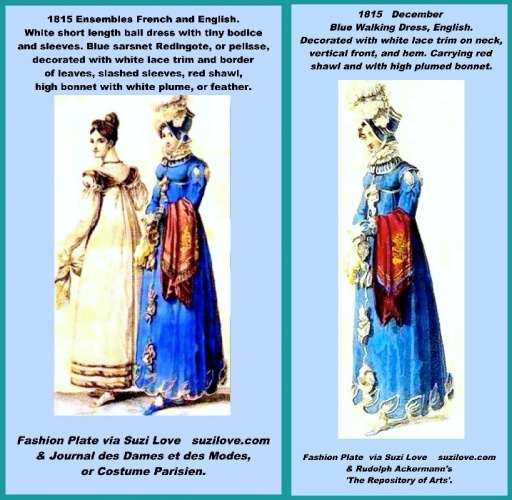
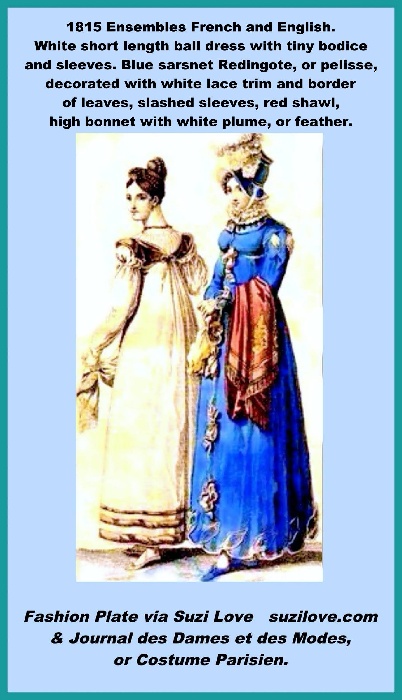
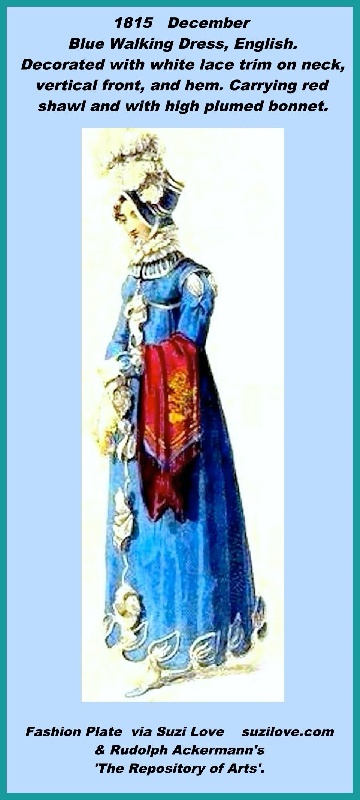
Here is an example of when English magazines copied French fashion plates. 1815 December Left: French fashion plate Ensembles French and English via Journal des Dames et des Modes. White short length ball dress with tiny bodice. Right: English fashion plate by Rudolph Ackermann in the Repository Of arts. Blue sarsnet Pelisse, or Walking dress, or Redingote. Decorated with white lace trim on neck, vertical front, and hem. Carrying red shawl and with high plumed bonnet.
Typical of the outfits worn by Jane Austen and her contemporaries for daytime and evening activities. An Empire style, or high-waisted white dress with jewelry for evening and for daytime a Pelisses or Walking Dress or Redingote or coat for warmth and with pretty hats, shawls and shoes.
Here is an example of when English magazines copied French fashion plates.
1815 December Left: French fashion plate Ensembles French and English via Journal des Dames et des Modes. White short length ball dress with tiny bodice.
Right: English fashion plate by Rudolph Ackermann in the Repository Of arts. Blue sarsnet Pelisse, or Walking dress, or Redingote. Decorated with white lace trim on neck, vertical front, and hem. Carrying red shawl and with high plumed bonnet.1815 December Ensembles French and English. White short length ball dress with tiny bodice. Blue sarsnet Pelisse, or Walking dress, or Redingote. Decorated with white lace trim on neck, vertical front, and hem. Carrying red shawl and with high plumed bonnet. via Journal des Dames et des Modes. 1815 December Blue Walking Dress, English. Decorated with white lace trim on neck, vertical front, and hem. Carrying red shawl and with high plumed bonnet. Fashion Plate via Rudolph Ackermann’s ‘The Repository of Arts’.
1815 December French and English Ensembles In Fashion Plates. #JaneAusten #Regency #Fashion https://books2read.com/SuziLoveFashionWomen1815-1819 Share on X
What did Jane Austen and friends wear? Early 1800s fashions were elegant and pretty with high waists and fabrics that were almost transparent. These Empire style gowns, named after Napoleon’s first Empress, became popular throughout Europe, and were then copied around the world. Colorful outwear was added to make an ensemble more attractive and warmer. History Notes Book 26 Fashion Women 1805-1809. https://books2read.com/SuziLoveFashionWomen1805-1809
Are you a reader or writer of Regency Romance? Love Jane Austen and the Bridgertons? Want to know more about the mourning, riding, underclothing and other Regency Era women’s fashions in Regency romances? What was fashionable for women in Jane Austen’s times? Mourning, riding, daytime, evening clothing, plus underclothing, corsets and accessories. This book looks at what was fashionable for women in Jane Austen’s times, or the early 1800s, or the Regency Era in Britain. Wars were being fought around the globe so women’s fashion adopted a military look in support of soldiers. Fashions, like the lifestyle, became progressively more extravagant and accessories went from colorful to over-the-top.
What did Jane Austen and friends wear? Early 1800s fashions were elegant and pretty with high waists and fabrics that were almost transparent. These Empire style gowns, named after Napoleon’s first Empress, became popular throughout Europe, and were then copied around the world. Colorful outwear was added to make an ensemble more attractive and warmer. History Notes Book 26 Fashion Women 1805-1809. https://books2read.com/SuziLoveFashionWomen1805-1809
The Empire waist gown defined women’s fashion during the Regency Era. ‘Empire’ is the name given in France to the period when Napoleon built his French Empire. High-waisted, loose gowns were adopted by the aristocracy as a symbol of turning away from the fussy, elaborate and expensive clothing worn in the 1700s. Jean-Jaques Rousseau advocated copying peasants and returning to a simpler life and more natural fashions. Unrestricting clothing was part of the new Democracy in France and these simpler and flowing fashions were adopted all over Europe, including Britain and despite the continual wars being fought against France during the early 1800s. Not even war stopped fashions from being copied everywhere.
1808 Richard Trevithick’s Steam Circus, Bloomsbury, London, U.K. Site where Trevithick ran his locomotive ‘Catch Me Who Can’. Trevithick wanted to prove that traveling by train was faster than on horseback. Locomotive ran at top speed of 19 km per hour and people paid a shilling to sit in an attached car and be pulled around. Via Wikimedia Commons commons.wikimedia.org (PD-ART) This was the start of the railway expansions across England in Jane Austen’s time.
1799 November 24th ‘Parisian Ladies in Their Full Winter Dress for 1800’. By Isaac Cruikshank. Ridiculing excesses of late 1790s Parisian high-waisted Greek look gowns of transparent fabrics and extremely low cut bodices.Full Dress meant every possible accessory was added to outfits.g. elaborate hats, reticules or bags, anklets and jewels. Via British Museum, London, UK. britishmuseum.org (PD-Art)
1799 November 24th ‘Parisian Ladies in Their Full Winter Dress for 1800’. By Isaac Cruikshank. Ridiculing excesses of late 1790s Parisian high-waisted Greek look gowns of transparent fabrics and extremely low cut bodices.Full Dress meant every possible accessory was added to outfits.g. elaborate hats, reticules or bags, anklets and jewels. Via Suzi Love – suzilove.com & British Museum, London, UK. britishmuseum.org (PD-Art)1799 November 24th 'Parisian Ladies in Their Full Winter Dress for 1800'. Caricature By Isaac Cruikshank. #GeorgianEra #Cartoon #BritishHistory books2read.com/suziloveFashWomen1700s Share on XHN_1 Fashion Women Late 1700s History Notes Book 1 by Suzi Love.
What was fashionable for women in the late 1700s? Extravagant colors and fabrics and outrageous styles were all seen in these flamboyant fashions.
books2read.com/suziloveFashWomen1700s