1821 December Green Promenade Dress, English. High waisted coat over white dress with ruffled collar, vertical front bows, short puffed sleeves over long straight sleeves, matching ruffled bonnet and yellow gloves. Fashion Plate via Rudolph Ackermann’s ‘The Repository of Arts’, London, U.K.
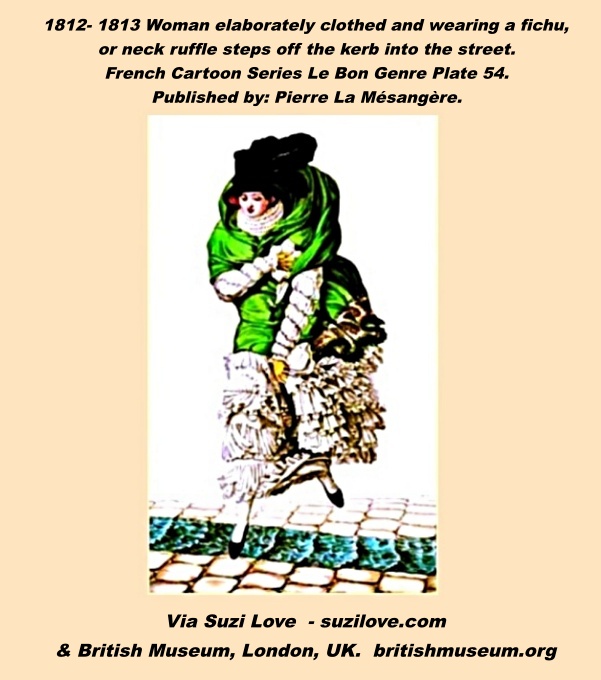
1812 -1813 Woman elaborately clothed and wearing a fichu, or neck ruffle, steps off the kerb into the street. She holds up her dress before stepping over the dirty Parisian gutter. French Cartoon Series Le Bon Genre Plate 54. Published by: Pierre La Mésangère. https://books2read.com/SuziLoveFashion1810-1814
Le Bon Genre, or Good Taste, series pokes fun at the absurdities of the fashion styles adopted by high society.
Plate 54: Manches en Spirale. Profusion de Garnitures. Mouchoir servant de porte-clef.
Manches en Spirale: Spiral Sleeves. Spiraling or puffy sleeves of the late Empire period looked like three-scoop ice cream cones.
Profusion de Garnitures: Profusion of Trimmings.
Ridicules the excessive use of ruffles, bows, and lace on a garment.
Mouchoir servant de porte-Clef: Handkerchief used as a Keyring. Women made a fashion statement by carrying richly decorated handkerchiefs that doubled as makeshift keyrings.
Definition Fichu: Triangular piece of lace, muslin, or other cloth worn about the neck and cleavage to fill in a low bodice or neckline and preserve a lady’s modesty. From the French ‘thrown over’.
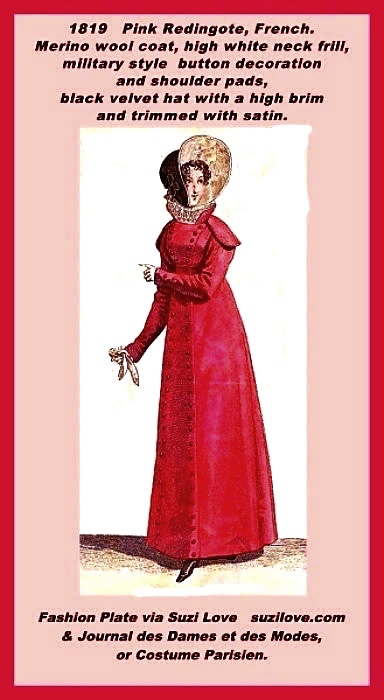
1819 Pink Merino Wool Redingote, French. Merino wool coat over a white dress with a high lace collar, military style buttons decoration and shoulder pads, matched with a black velour, or velvet, hat with a high front brim and lined with white satin. Military style shoulder pads and front buttons. It was fashionable at the time to wear military inspired clothing to show support of all the fighting men involved in the Napoleonic and other wars. The type of outfit young Regency Era ladies would have worn if they were out shopping on Bond Street, walking in a park, or taking a carriage ride through Hyde Park. Fashion Plate via Journal des Dames et des Modes, or Costume Parisien. Fashion Plate via Journal des Dames et des Modes, or Costume Parisien.
Definition Redingote Or Pelisse Or Walking Dress Or Coat: French word developed from English words, riding coat. Long fitted outdoor coat worn over other garments, especially light-weight muslin dresses, for warmth. Often left open at the front to show off the dress underneath. Sometimes cut away in front. Originally made with several capes and trimmed with large buttons. French fashion plates call these coats Redingotes and they are designed for women, men and children. English fashion plates call them a Pelisse, a walking dress, Promenade dress, or Carriage dress.
1819 January Red Redingote, French. Also called a Pelisse or Walking Dress in England. Merino wool coat over a white dress with a high lace collar, matched with a black velour, or velvet, hat lined with white satin. Fashion Plate via suzilove.com and Journal des Dames et des Modes, or Costume Parisien.
1819 Bridgerton or Jane Austen Style Pink Merino Wool Redingote, Or Coat, With Military Styling. #Bridgerton #JaneAusten #RegencyFashion #FashionPlate #French https://books2read.com/SuziLoveFashionWomen1815-1819
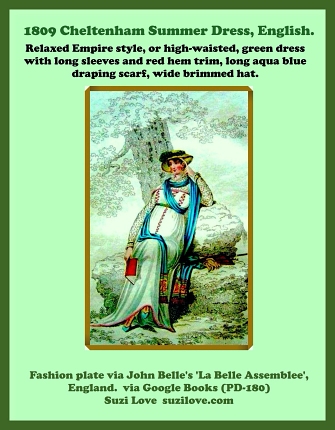
1809 Cheltenham Summer Dress, English. Relaxed Empire style high-waisted green dress with long sleeves and red hem trim, long aqua blue draping scarf, wide brimmed hat and holding a red book. Fashion Plate via John Belle’s ‘La Belle Assemblee’, London.
Seaside clothing was very popular. High-waisted dresses, usually of white muslin, were loose and flowing for the summer heat but ladies could easily add colorful accessories, such as shawls, hats, and parasols. In the early 1800s, it was fashionable to parade along the shorefront or in parks, to see and be seen. These are the sort of ensembles that Jane Austen and her family and friends would have worn at seaside towns or at sea bathing resorts.
Fashion Women 1805-1809 History Notes Book 26 What did Jane Austen and friends wear? This book looks at early 1800s fashions, which were elegant and pretty with high waists and fabrics that were almost transparent. These Empire style gowns, named after Napoleon’s first Empress, became popular throughout Europe, and were then copied around the world. Colorful outwear was added to make an ensemble more attractive and warmer. https://books2read.com/SuziLoveFashionWomen1805-1809
Fashion Women 1805-1809 History Notes Book 26 What did Jane Austen and friends wear? https://books2read.com/SuziLoveFashionWomen1805-1809
Fashion Women 1805-1809 History Notes Book 26 What did Jane Austen and friends wear? https://books2read.com/SuziLoveFashionWomen1805-1809
1808 Fashionable English Couple, Dressed As In Jane Austen’s times. Lady in a white dress with pointed hem decorations, fitted white hat tied under her chin with yellow ribbon, yellow shawl and pink slippers. Gentleman in formal dress of blue tailcoat, black knee breeches, white stockings, black shoes, black bicorn hat, curly hair style and sideburns and a sword. Interestingly, this is English style fashions from a French magazine. Fashion Plate via Journal des Dames et des Modes, or Costume Parisien.
Fashion Women 1805-1809 History Notes Book 26 What did Jane Austen and friends wear? https://books2read.com/SuziLoveFashionWomen1805-1809
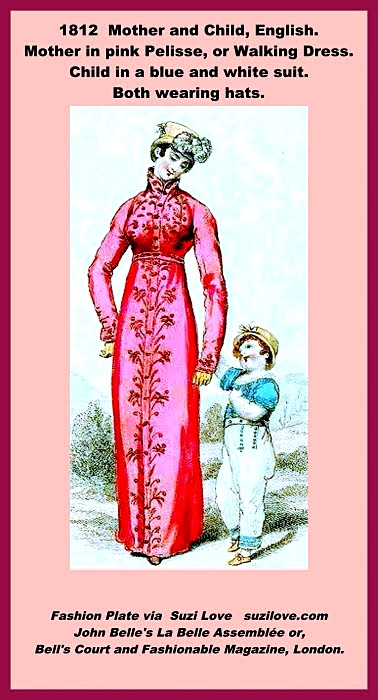
1812 December Mother and Child, English. Mother in a pink Pelisse, or Walking Dress, of Merino wool with an embroidered front and frogs and tassels to fasten it. Waist is of a moderate length and there is an elegant figured belt and tassels. Tight long sleeves finish at the cuff with embroidery, like the stand-up collar. York tan gloves and half-boots, small straw turned up hat with two short ostrich feathers. Child wears a blue and white suit and both wearing adorable hats.
Fashion Plate via John Belle’s La Belle Assemblée or, Bell’s Court and Fashionable Magazine, London. The child is not mentioned in the description. ‘This truly elegant and fashionable order of promenade costume was furnished by Mr. S. Clark, Ladies Pelisse and Habit Maker, No. 37 Golden Square, whose taste in articles of this description has been so generally admired.’
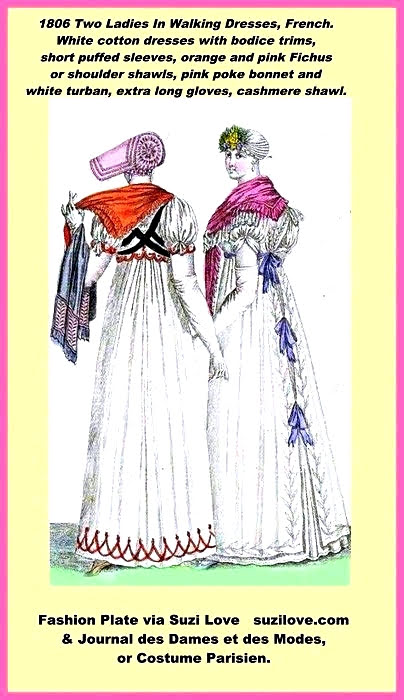
1806 Two Ladies In Walking Dresses, French. White cotton dresses with bodice trims, short puffed sleeves, orange and pink Fichus or shoulder shawls, pink poke bonnet and white turban, extra long gloves, cashmere shawl. Fashion Plate via Journal des Dames et des Modes, or Costume Parisien. These fashionable ensembles with a variety of fashionable and practical accessories would have been worn by Jane Austen and her family and friends during the day when out walking in the park or visiting village shops. Hats were a necessity to protect fair skin from the sun and scarfs and shawls added color and warmth to an outfit.
Definition Fichu: Draped scarf or shawl worn about shoulders and tied in knot at breast, with ends hanging down loosely. Word, meaning negligee or careless, first used to describe breaking away from stiff collar of the past.
Fashion Women 1805-1809 History Notes Book 26 What did Jane Austen and friends wear? https://books2read.com/SuziLoveFashionWomen1805-1809
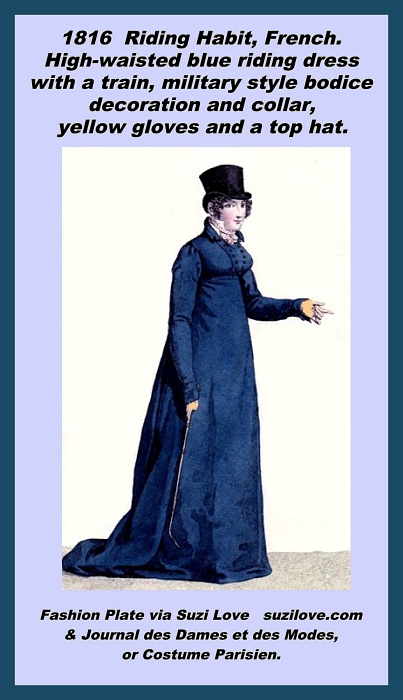
1816 Blue Riding Habit, French. High-waisted blue riding dress with a train, the long full skirt being necessary to cover a lady’s legs and preserve her modesty when riding side saddle. These riding habits were usually designed by men and were in two pieces, a jacket and a skirt, worn over a shirt. A military style bodice decoration, high pointed collar and a knotted pink dotted cravat worn underneath that imitate male styles, or even Dandy fashion. Sleeves are very long as was the trend in French riding habits. Yellow gloves and a masculine style beaver hat. This print was designed by Horace Vernet and engraved by Pierre Baquoy. Fashion Plate via Journal des Dames et des Modes, or Costume Parisien. Although, there are very similar riding habit fashion plates in other magazines.
The type of outfit Jane Austen and her friends would have worn when they went horse riding. https://books2read.com/SuziLoveFashionWomen1815-1819
1817 December Black Walking Mourning Dress, English. Black bombazine dress with a black crepe hem, with tight bodice wrapping across to the right side, trimmed with a piping of black crape that looks like braiding and finished by rosettes of crape, in the center of each of which is a small jet ornament. Long sleeves trimmed similarly at the wrists, half-sleeve of a new form trimmed with crape, high standing collar displaying a mourning ruff. Claremont bonnet, named because it is the same shape as one worn by the Princess, whose home with her husband, Prince Leopold, was called Claremont. Black crape over black sarsnet and lined with double white crape. Low crown but large front and tastefully finished by black crape with a bunch of crape flowers on one side. Black shamois gloves, and black shoes. “We have again to acknowledge our obligations to the lady who favored us last month; and we understand that the dresses from which our prints this month have been taken were also purchased from Mrs. Bell of St. James’s-street.” Fashion Plate via Rudolph Ackermann’s ‘The Repository of Arts’.
Mrs. Bell ‘invented’ fashion plates and as well as publishing in La Belle assemblee, she also sold them to other magazines. Hence the crossover we often see where the same plate, or a similar version, appears in different magazines.
Fashion Women 1815-1819 History Notes Book 28 https://books2read.com/SuziLoveFashionWomen1815-1819
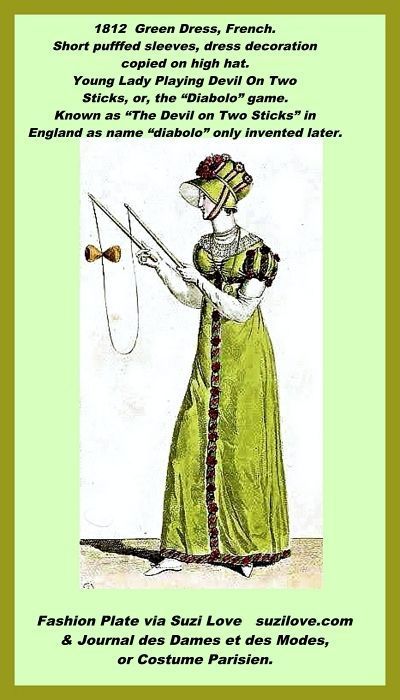
1812 Young Lady Playing Devil On Two Sticks, or, the “diabolo” game. The game was known as “The Devil on Two Sticks” in England at the time as the name “diabolo” was only invented later. Green dress with short puffed sleeves, dress decoration copied on high hat. Fashion Plate via Journal des Dames et des Modes, or Costume Parisien.
1812 Young Lady Playing Devil On Two Sticks, or, the “diabolo” game. The game was known as “The Devil on Two Sticks” in England at the time as the name “diabolo” was only invented later. Fashion Plate via Journal des Dames et des Modes, or Costume Parisien.27_D2D_FashWomen1810-1814