1818 September 18th Le Palais Royal de Paris, Or ‘A Peep at the French Monstrosities’. By George Cruikshank. Two English tourists, both dressed as dandies, walk arm-in-arm under the arcade of the Palais Royal, interested in the promenading courtesans. Two Frenchmen make more direct overtures to two women. Their dress is rather similar to that of the Englishmen, but the latter wear bell-shaped top-hats, while the Frenchmen have flower-pot shaped hats. An officer wearing a large cocked hat addresses a girl, and a man, said by Reid to be Irish, jovially accosts another. Some of the women are in evening-dress, others in street costume. Behind are iron railings between the supports of the roof; on one of these is the inscription ‘Caveau des Sauvages’. Published by: George Humphrey. via British Museum.
1820 Ice Blue Figured Silk Pelisse or Redingote. Bodice with hussar-style frogging, trimmed with fringed passementerie and silk covered buttons, puffed mancherons and cuffs en tablier with satin piping and buttons, hem with deep border of blue plush and flecked fringing which gives effect of feathers. This silk pelisse shows how women’s fashions, especially outer garments, were leaning towards men’s military styles. Braiding became popular, sleeves often had layers at the shoulders of either short sleeves under long sleeves or they had the braiding and buttons and buttonholes found on military uniforms. Fabrics were luxurious as seen in this figured silk, and decorative or extravagant hems were added, like the hem fringing on this coat. Because these coats were somewhat fragile due to being made of silk, not many would have survived. Extant Pelisse, or Redingote via Kerry Taylor Auctions. Kerrytaylorauctions.com
Definition Redingote Or Pelisse Or Walking Dress Or Coat: French word developed from English words, riding coat. Long fitted outdoor coat worn over other garments for warmth. Often left open at the front to show off the dress underneath. Sometimes cut away in front. Originally made with several capes and trimmed with large buttons. French fashion plates call these coats Redingotes and they are designed for women, men and children. English fashion plates call them a Pelisse, a walking dress, Promenade dress, or Carriage dress.
Here is an example of when English magazines copied French fashion plates.
1815 December Left: French fashion plate Ensembles French and English via Journal des Dames et des Modes. White short length ball dress with tiny bodice.
Right: English fashion plate by Rudolph Ackermann in the Repository Of arts. Blue sarsnet Pelisse, or Walking dress, or Redingote. Decorated with white lace trim on neck, vertical front, and hem. Carrying red shawl and with high plumed bonnet.
1815 December Blue Walking Dress, English. Blue twilled sarsnet pelisse, or Redingote, with ribbon bows adorning the front. Decorated with white lace trim on neck, vertical front, and a border of leaves on the hem. Slashed sleeves at shoulders and wrists plus an elaborate collar would have been time consuming to make. Carrying a red shawl and with a high bonnet with a white plume, or feather. Fashion Plate via Rudolph Ackermann’s ‘The Repository of Arts’.
1815 December Blue Walking Dress, English. Decorated with white lace trim on neck, vertical front, and hem. Carrying red shawl and with high plumed bonnet. Fashion Plate via Rudolph Ackermann’s ‘The Repository of Arts’.
Below is the French version of this pelisse but with a lady in a ball dress. Possibly another example of the English magazines ‘copying’ French designs.
1815 Ensembles French and English. White short length ball dress with tiny bodice and sleeves. Blue sarsnet Redingote, or pelisse, decorated with white lace trim and border of leaves, slashed sleeves at shoulders and wrists, elaborate collar, red shawl, high bonnet with white plume, or feather. Fashion Plate via Journal des Dames et des Modes, or Costume Parisien.
Fashion Women 1815-1819 History Notes Book 28
What did Jane Austen wear? This book looks at what was fashionable for women in the Georgian Era and at the end of the Regency Era in Britain and the reconstruction in Europe after the wars. Lifestyles were freer and fashions expressed this by becoming the focus of most women’s lives. A wardrobe full of opulent accessories was requisite. Includes mourning and riding fashion, dresses, hats, shoes, reticules or bags, underclothing, and fashion accessories.
D2D_HN_28_https://books2read.com/SuziLoveFashionWomen1815-1819
1820 August Walking and Evening Dresses, English. Walking Dress of cambric muslin with frilled hemline. Blue-purple Spencer with epaulettes of points of satin. Bonnet to match of metallic gauze and tied under her chin, yellow Limeric gloves, reticule or bag, and blue boots. Evening Dress of Urling’s lace with aqua blue leaf decoration, earl combs, pearl necklace and ear-rings, gold chain or chatelaine with a watch, white kid gloves and white silk shoes. Via Ladies’ Monthly Museum in The Mirror of Fashion, London, U.K.
Definition Limerick Gloves: Named after County Limerick in Ireland where they were first made. Often referred to as chicken skin gloves, though actually made from skins of unborn calves. Usually cream or yellow, superior quality and very thin.
Definition Ridicule, Reticule, Indispensable, or Handbag: From the late 1700s, pockets could no longer be sewn into gowns, as skirts fell from just under the bust and were full and flowing. Instead, women began carrying small bags, known at first as ridicules and later as reticules, to keep necessary items on their person e.g. handkerchiefs, coins, vinaigrettes, calling cards, glasses etc.
Definition Spencer: Short jackets cut to match the high waistlines of Empire dresses. They often copied military styling, such as braiding, shoulder decoration, buttons and loop fasteners, and wrist adornments. They were generally of complex construction, often with a diamond shaped piece in the back. Said to have originated in an accident to Lord Spencer while hunting when his coat tails were torn off and he wore it as a short jacket.
HN_4_Spencers, Or Jackets. #Regency #Georgian #Victorian #Fashion History Notes Book 4 By Suzi Love.
1807 January Couple In Morning Walking Ensembles, English. Lady in white dress with lemon pelisse or coat, fitted hat and interesting reticule, or bag. Gentleman in long black tailcoat over yellow breeches, high black boots with wide tan tops, yellow gloves, cane and top hat. via Le Beau Monde, or Literary and Fashionable Magazine, London, U.K.
These are the types of outfits worn by Jane Austen and contemporaries in England and shown in their English magazines.The same designs had probably already been seen in France, because English publishers obsessively copied French fashions despite the two countries being at war for many years. https://books2read.com/SuziLoveFashionWomen1805-1809
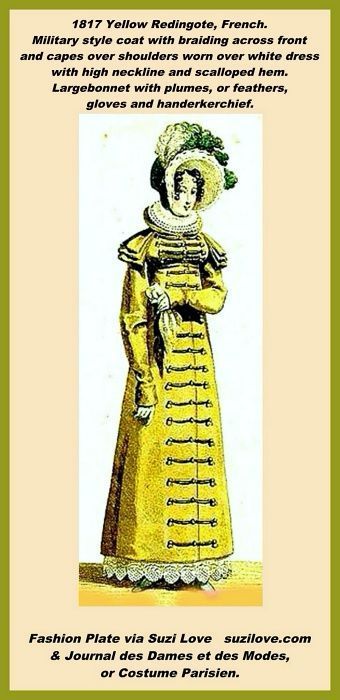
1817 Yellow Redingote, or Pelisse, or Walking Dress, French. Yellow military style pelisse with braiding across the front and capes across the shoulders and worn over a white dress with a high neckline and a scalloped hem. Large and high bonnet with plume, or feathers, and green flowers, gloves and a handkerchief. Although this is a French fashion plate, similar styles were worn everywhere and Jane Austen would have worn a Pelisse like this before her death on the 18th July, 1817. Fashion Plate via Journal des Dames et des Modes, or Costume Parisien.
The ongoing years of wars followed by the victories of Wellington’s armies brought the military into fashion in England and there was a rush of fashion articles named after him e.g. Wellington hat, Wellington bonnet, Wellington jacket and Wellington Boot. In other European countries, military headwear was copied from military helmets and hats and frogging and epaulettes added a further patriotic touch to women’s clothing. And as always, fashions were copied and spread around the world, despite the battles being fought.
Definition Redingote Or Coat Or Pelisse: Long fitted outdoor coat worn over other garments for warmth. French word developed from English words, riding coat. French fashion plates call these coats a Redingote and English plates call them a Pelisse, Or Walking Dress, or Carriage Costume.
1817 Yellow Redingote, or Pelisse, or Walking Dress, French. Yellow military style pelisse with braiding across the front and capes across the shoulders and worn over a white dress with a high neckline and a scalloped hem. Large and high bonnet with plume, or feathers, and green flowers, gloves and a handkerchief. Fashion Plate via Journal des Dames et des Modes, or Costume Parisien. Fashion Women 1815-1819 History Notes Book 28 What did Jane Austen wear? . D2D_HN_28_https://books2read.com/SuziLoveFashionWomen1815-1819
1805-1810 ca. Double Breasted Tailcoat, South Carolina, U.S.A. Cotton, plain-woven (tabby woven), partly lined with cotton, plain-woven (tabby). Cutaway at the front waist and with a notched collar. via Colonial Williamsburg, USA. history.org
Tailcoat: A Regency Era, or early 1800s, gentleman was outfitted in more practical fabrics, such as wool, cotton and buckskin rather than the fussy brocades and silks of the late 1700s.
1819 January ‘Going to White’s’. By Richard Dighton. Lord Alvanley walks on the pavement going to White’s Club for gentlemen in London wearing a top-hat, double-breasted coat, strapped trousers, and the high collar of a dandy. Via British Museum, London, UK. britishmuseum.org (PD-Art)
White’s was an exclusive Gentlemen’s Club on St. James Street, London, U.K where well-dressed men, or Dandies, gathered at a special table in front of the large bow window looking out at the street. This became known as a seat of privilege and was used by London’s most famous Dandy, Beau Brummell. Other well-known dandies were William Arden, Joshua Allen, Thomas Raikes and Ball Hughes. Cartoonists loved to ridicule these high-in-the-instep gentlemen who wore the most fashionable clothes and set the fashion trends for the Regency years, and the years when Jane Austen was writing her famous novels.
What was fashionable for outer wear in past centuries? Different names in different countries: Pelisse, Redingote, Coat, Or Walking Dress. The Bridgertons and Jane Austen and her contemporaries wore long coats like these to keep warm when out and about, visiting, shopping etc. The thin muslin dresses worn in the early 1800s were little protection against European winters. http://books2read.com/suzilovePelisse
Pelisse, Redingote, Or Walking Dress. History Notes Book 5 By Suzi Love. What was fashionable for outer wear in past centuries? Call them what you like: Coat, Pelisse, Redingote, Walking Dress, Promenade Dress. Take a look at what was being worn by women, men, and children. books2read.com/suzilovePelisseD2D_RetailerBuyLink_HN_5_books2read.com/suzilovePelisse
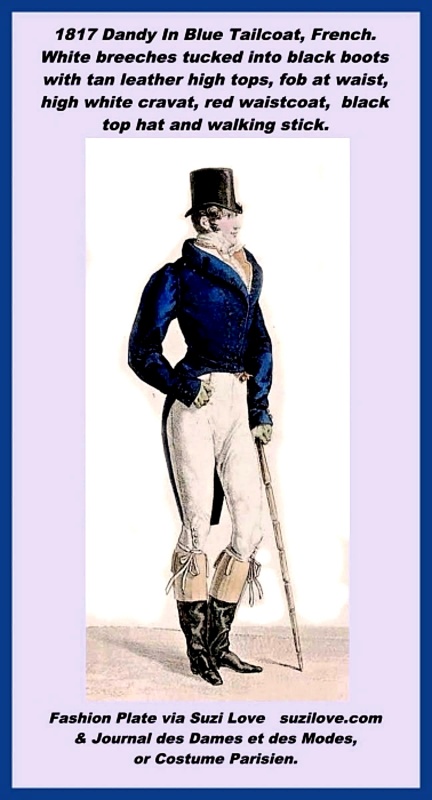
1817 Dandy In Blue Tailcoat, French. White breeches tucked into black boots with tan leather high tops, fob at waist, high white cravat, red waistcoat, black top hat and walking stick. Fashion Plate via Journal des Dames et des Modes, or Costume Parisien.
Dandy: The author of The Hermit in London, a series of sketches published in 1819—1820 observed: ‘A distinguished Exquisite is padded all over to-day; and all the other foplings are, on the morrow, mere walking pin-cushions. A fat prince, or a fat dandy, requires confinement in his limbs; and all his subjects are immediately restrained within the same limits. One day, the back is to be as broad as an Irish chairman’s, and the shoulders to be bolstered up to imitate a hod-man; and the next, the shoulders are to be flat, and a man is to be pinched in and laced up until he resembles an earwig. All these are Master Snip’s maneuvers, who continues to make his bill equally long, whether the spencer or the box-coat be in vogue.
Beau Brummell was one of the most celebrated dandies of all time. Cartoonists ridiculed these high-in-the-instep gentlemen who wore the most fashionable clothes and set the fashion trends for the Regency years, the years when Jane Austen was writing her famous novels and the years when the Bridgerton series is set.