Are you a Bridgerton fan? Love Jane Austen? Love history? Take a look at a Young Gentleman’s Day in early 1800s. Young Gentleman’s Day Regency Life Series Books 2 by Suzi Love. Easy to read books on what a young gentleman did, wore, and lived during the early 1800s, or the Regency Era when King George 3rd was mad and his son, Prince George, was the Regent in Britain. #Regency #JaneAusten #amwriting books2read.com/suziloveYGD
1805 November Three English Ladies In Full Dress. White walking dress with high neck under a purple tunic, or pelisse, and a masculine style straw hat. Two in evening dresses, one white and one pink, fur stoles and plumed, or feathered, hats. via Vernon and Hood Poultry at The Lady’s Monthly Museum, London, U.K.
These gorgeous dresses show the transition from the round dresses of the late 1700s to the Empire style dresses with the waistline high under the bust. Small trains were still worn in the early 1800s, but much more manageable than the larger and more elaborate trains of the late 1700s. Jane Austen and her friends would have worn dresses like this to their assemblies and evening events.
Definition Accessory: An accessory completes and complements an outfit.
Two groups – 1. Those worn e.g. bonnets, caps and hats, boots and shoes, cravats and ties, gloves, mittens and muffs, jewelry, scarves and shawls, socks and stockings.
2. Those carried e.g. bags, fans, and parasols.
Definition Full Dress: The most formal and complete ensemble, worn for day or night events, and includes the fullest range of accessories that could be added to the outfit to make the most impressive display.
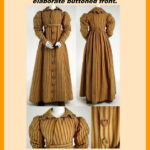
1820 ca. Brown Silk Pelisse, Or Coat, British. Worn over a light weight dress for warmth. Silk, lined with blue silk satin and cotton, hand-sewn. Front opening with concealed buttons and loops, wide stiffened collar, elaborate piping with thin rolls of fabric, skirt cut A-line shape and hem padded to accentuate shape, fairly high waistline with attached gored skirt and gathered panel at back. Long sleeves with short puffed over-sleeves. Green shawl, parasol, matching bonnet. via Victoria and Albert Museum, London, UK. collections.vam.ac.uk.
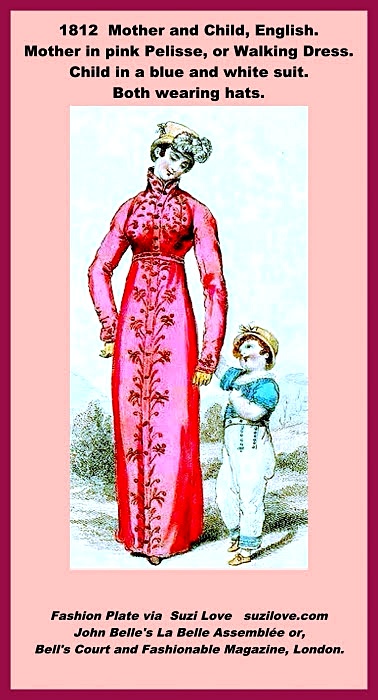
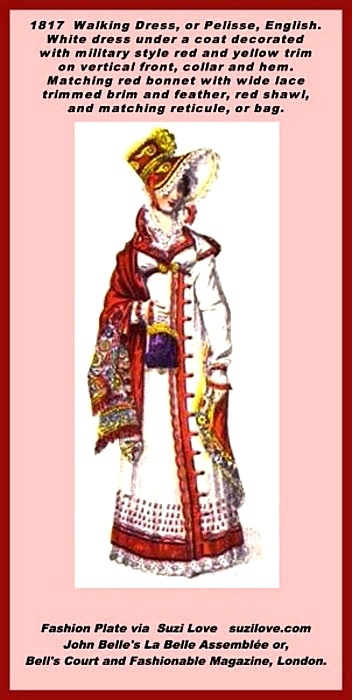
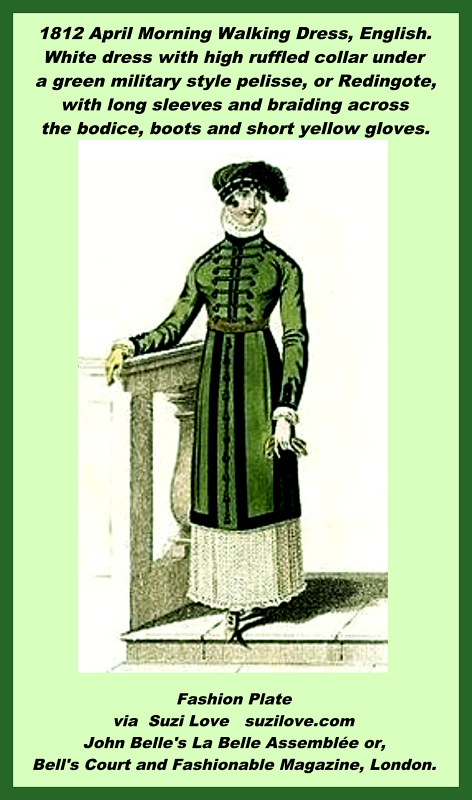
Definition Redingote Or Pelisse Or Walking Dress Or Coat: French word developed from English words, riding coat. Long fitted outdoor coat worn over other garments for warmth. Often left open at the front to show off the dress underneath. Sometimes cut away in front. Originally made with several capes and trimmed with large buttons. French fashion plates call these coats Redingotes and they are designed for women, men and children. English fashion plates call them a Pelisse, a walking dress, Promenade dress, or Carriage dress.
Do you need more factual and visual information for your historical fiction? History of fashion, music, peerage and customs in 18th and 19th centuries. Non-fiction series full of gorgeous pictures and engraved fashion plates. A visual history of fashion, music, peerage, social manners and customs from late 1700s to late 1800s, or 18th and 19th centuries.
1807 Fashionable French Couple. Man: Blue cutaway coat and yellow breeches. Lady: Lemon and blue dress and bonnet. This is the fashion styles worn by Jane Austen and her family and friends in the early 1800s. Fashion Plate via Journal des Dames et des Modes, or Costume Parisien.https://books2read.com/SuziLoveFashionMen1800-1819
1818 Women’s outdoor fashions In the times of Jane Austen. Pelisses or coats or Redingotes, with matching hats, shoes, goves, reticules or bage, plus other accessories as displayed in various fashion magazines. Definition Redingote Or Coat Or Pelisse: Long fitted outdoor coat worn over other garments for warmth. French word developed from English words, riding coat. French fashion plates call these coats a Redingote and English plates call them a Pelisse, Or Walking Dress, or Carriage Costume.
1818 December 11th A dandy fainting or – an exquisite in fits. Scene a private box opera. A dandy lies back fainting in a chair, his limbs rigid, supported by three others while a fourth (left) draws the curtain, cutting off a view of the (distant) stage where a singer is posturing. Via British Museum, London, UK. britishmuseum.org (PD-Art)
1818 September ‘A Nice Gentleman’ By George Cruikshank. A grotesque dandy walks outdoors sucking a cane. Inscribed with names of food, e.g. red carbuncled rose is ‘Currant Jelly’, shallow broad-brimmed hat is ‘Calves Head Jelly’ and ‘Pancake’, cravat which covers neck, cheek and chin is ‘Puff Paste’, loose short trousers are ‘White Sugar Bags’, handkerchief ‘Blow Monge’ and long spurs ‘Gilt Gingerbread’. Via British Museum, London, UK. britishmuseum.org (PD-Art)
1800s Early Tattersall’s Horse Auctions, London, U.K.. Top sporting venue for Regency Life in London. ‘A mixture of persons of nearly all ranks’. By Pierce Egan. Via Wikimedia Commons (PD-ART)
In Jane Austen’s and Bridgerton times, or the Regency Era, horse riding was a vital mode of transport and Tattersall’s was the best place to buy and sell horses. Tattersall’s was established in 1773 near Hyde Park Corner for the sale by auction of horses, carriages, hounds and harnesses. Sales during the winter months were every Monday and Thursday, and on Mondays only during the spring and summer. On the mornings when there was no sale, Tattersall’s was a meeting place for fashionable sporting gentlemen.
Pierce Egan’s Description of Tattersall’s
A masquerade could scarcely exhibit more motley groups than the attendants of this place of fashionable resort. There were Peers, Baronets, Members of Parliament, Turf gentlemen and Turf-servants, Jockies, Grooms, Horse-dealers, Gamblers, &c. There you might see the oldest and some of the best blood in England, disguised like coachmen.
From: 1820 Sporting Anecdotes by Pierce Egan via Google Books (PD-150)