1815 Man’s Double Breasted Navy Wool Tailcoat As Worn By the Men In the Bridgerton and Jane Austen Families.
This navy double breasted wool tailcoat has M-notched lapels, kite-shaped rear seaming, and black silk covered buttons. The sleeves are gathered at the shoulders and there is a high collar.
Quilting has been added to the inside chest and lower neck areas and brown velvet has been added to line the cuffs. The pockets are concealed in the tails and have been lined with brown chintz. via Kerry Taylor Auctions. kerrytaylorauctions.com
1819 Typical Gentleman’s Outfit, French. The type of outfit worn by Jane Austen’s male family and friends. Brown cutaway coat with extra long tails, white trousers, high white cravat, heeled black boots with spurs, gloves, black top hat and a cane. Fashion Plate via Journal des Dames et des Modes, or Costume Parisien.
Trousers: The word Trouser came into usage in the late 1600’s, so we’ve had trousers around for a long time. But at first, they were mostly for lower classes. Revolutionary France started a trend for sans-culottes, which meant trousers or pantaloons instead of culottes, or knee breeches, which were associated with the aristocracy. The styles of the revolution moved across to England and were taken up by those who either sided with revolutionary ideals or who took them up as part of a protest against the establishment set. Early on, trousers were generally a bit looser than pantaloons or breeches and ended at the ankles, often with side slits to get the foot through or straps under the foot straps to keep the trousers in place.
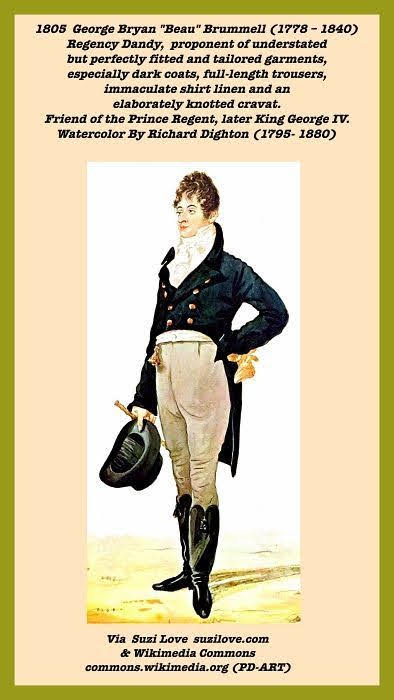
George Bryan “Beau” Brummell (June 7th 1778 – March 30th 1840) Arbiter of men’s fashion and friend of the Prince Regent, the future King George IV. Established mode of dress for men that rejected overly ornate fashions for understated but perfectly fitted and tailored clothing. Look based on dark coats, full-length trousers rather than knee breeches and stockings, with immaculate shirt linen and an elaborately knotted cravat. 1855 Engraving of Beau Brummell from an article in Harper’s New Monthly Magazine.
1823 Couple In Walking Dress, French, as worn in Europe and England in the Regency Era. Redingote, or Coat, with matching hat, neck frill of Gros de Nice lace. Gentleman in tailcoat, short length brown trousers, yellow vest, high white cravat, top hat and black shoes. via Modes Françaises L’Indiscret, France.
Weird Historical Pants for Men. No wonder men needed valets! It wasn’t just women struggling into tight fitting clothing!
And no wonder it took both sexes so long to dress every day, often changing clothes four or five times a day!
Early on were Breeches – Short, close-fitting trousers that fastened just below the knees or above the ankles, with a horizontal front flap called the ‘fall’ and were worn with stockings. Boys of 3 – 6 years stopped wearing loose dress-type children’s garments and went into short pants instead, and were considered ‘breeched. In Regency times, breeches were worn tighter to show off a manly physique.
Then of course we had Pantaloons
By the late 1810s and beyond, these became popular and eventually they evolved into full length trousers. Originally pantaloons were made to suit shorter Hessian boots that fell below the typical knee-breech level and they were worn very form-fitting.
Buckskins – Fashionable trousers made from deer skin also showed off every curve of the man’s figure. How could ladies not want to peek? Oooh, what a display of fine, manly figure!! Swoon!
And so to more modern Trousers – The word Trouser came into usage in the late 1600?s, so we’ve had trousers around for a long time. But at first, they were mostly for lower classes. Revolutionary France started a trend for sans-culottes, which meant trousers or pantaloons instead of culottes, or knee breeches, which were associated with the aristocracy.
The styles of the revolution moved across to England and were taken up by those who either sided with revolutionary ideals or who took them up as part of a protest against the establishment set.
Early trousers looked strange because they were generally a bit looser than pantaloons or breeches, and ended at the ankles with slits on the side for foot access. They often needed under-the-foot straps to fix them in place.
Now here’s a couple of insider tips from a gentleman’s valet for you to remember –
– False calves can be created by padding so that a master’s calves fill out his stockings and make him look more muscular, especially when he is wearing knee-breeches. Every woman’s dream!
– For rotund gentlemen, tightly pulled corsets help keep the paunch to a minimum and enhance his figure.
– To keep trousers in place and prevent disgrace, braces( suspenders) can be worn under vests.
Even in cases of his master’s over-imbibing, or just plain clumsiness, a valet can ensure his lordship remains correctly clothes at all times when representing the household in public by taking a few early precautions.
Imagine the poor valet’s work if – a gentleman rode before breakfast – changed to join the family– spent the morning boxing with friends in looser attire – changed for lunch at his club with peers – changed for afternoon calls or a drive in the park with the women- changed for dinner with friends – changed into evening dress for a formal ball- arrived home just before daylight to change into his banyan( robe) to smoke his cheroot before bed – then rose 3 hours later expecting his clothes laid out so he could do it all over again.!!
No, I seriously do not want to go back in time and become either a lady’s maid or a gentleman’s valet
– although, if I had the choice…
Hmmmm….being in a gentleman’s bedroom…. does hold a certain appeal.
Suzi Love
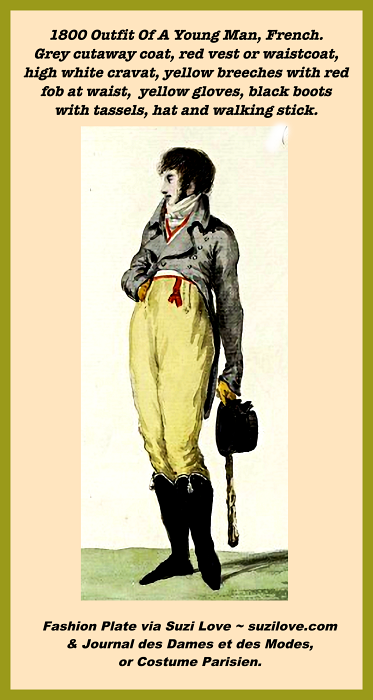
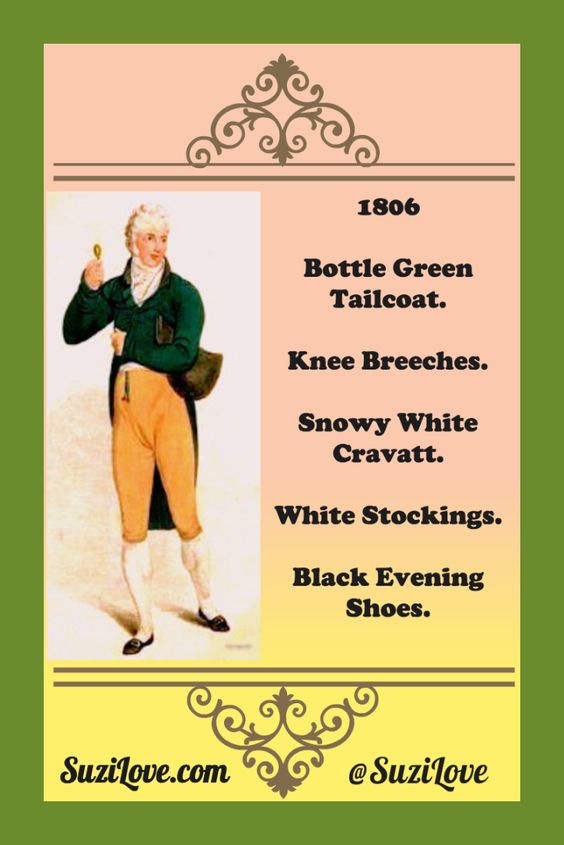
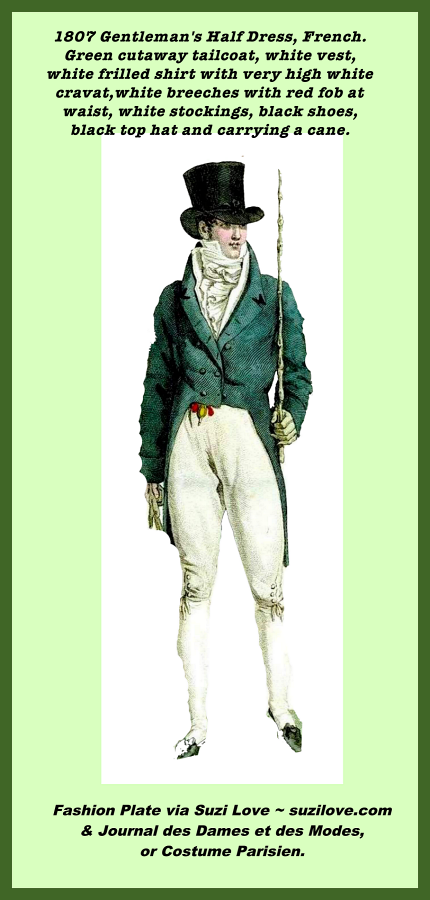
1775-1825 ca. Black Silk Breeches, American or European. via Metropolitan Museum, N.Y.C., U.S.A. metmuseum.org1806 Young French Gentleman. Short Brown Castorine Coat Over Blue Tailcoat, White Cashmere breeches, yellow gloves, black top Hat. Fashion Plate via Journal des Dames et des Modes, or Costume Parisien.1804-1814 ca. Collage View. Breeches, French. Cream silk and linen. Buttoned waist, drop down front flap, or fall, extra fullness in the back for ease of movement, ties at the knees to keep in place. via Suzi Love ~ suzilove.com & Metropolitan Museum, N.Y.C., U.S.A. metmuseum.org1812-1813 ca. A man with a hat shaped as a balloon, green coat, white breeches, colored cravat. Hand-colored etching. 1812-1813 Le Chapeau en Ballon Series: Le Bon Genre Plate 51. Via British Museum, London, UK. 1807-1817 ca. Man’s Leather Breeches, American. Drop front buttoned flap at the waist, a drawstring at the back waist to adjust waist size, and drawstrings and buttons at the calves to keep the breeches secure when worn with high boots. via Metropolitan Museum New York City, U.S.A. metmuseum.org 1807 Pale Blue Tailcoat, French. White frilled shirt with extra high collar and cravat, vest, white knee breeches, white stockings, black shoes, gloves, bicorn hat and a curly hairstyle. Fashion Plate via Journal des Dames et des Modes, or Costume Parisien. 1800 Outfit Of A Young Man, French. Grey cutaway coat, red vest or waistcoat, high white cravat, yellow breeches with red fob at waist, yellow gloves, black boots with tassels, hat and walking stick. Fashion Plate via Journal des Dames et des Modes, or Costume Parisien.1805 ca. Collage Leather Breeches, French. Buttoned and adjustable waist, back waist gusset for ease of movement, front fall flap, two tone fitted cuffs on legs with many buttons to fasten and hold in place on the legs. via Metropolitan Museum New York City, U.S.A. metmuseum.org 1790 British Consul’s Tan Leather Pants, Boston. Tan buckskin, fall front, brass and self covered buttons, breeches have leather ties at waist and at leg hems. via Augusta Auction 1806 Gentleman’s Daily Outfit, French. Bottle green tailcoat, knee breeches, snowy white cravat, white stockings, flat black shoes. Fashion Plate via Journal des Dames et des Modes, or Costume Parisien.1807 Gentleman’s Half Dress, French. Green cutaway tailcoat, white vest, white frilled shirt with very high white cravat, white breeches with red fob at waist, white stockings, black shoes, black top hat and carrying a cane. Fashion Plate via Journal des Dames et des Modes, or Costume Parisien. Weird Historical Pants for Men. #regencyera ##regencyfashion #breeches https://books2read.com/SuziLoveFashionMen1800-1819 Share on X https://books2read.com/SuziLoveFashionMen1800-1819
Regency Life Series: Images, information, funny anecdotes give overview of Jane Austen’s and Bridgerton times. #bridgerton #RegencyEra #JaneAusten #BritishHistory https://books2read.com/suziloveROver
Are you a Bridgerton fan? Love Jane Austen? Love history? Take a look at a Young Gentleman’s Day in early 1800s. Young Gentleman’s Day Regency Life Series Books 2 by Suzi Love. Easy to read books on what a young gentleman did, wore, and lived during the early 1800s, or the Regency Era when King George 3rd was mad and his son, Prince George, was the Regent in Britain. #Regency #JaneAusten #amwriting books2read.com/suziloveYGD
19th Century Early Men’s Trousers as worn by the men in Jane Austen’s family and life. Textured cotton woven with small dash motif. Wide waistband double row five ivory bone buttons, fall front bone buttons plus button centre front, two large pockets, full width flap with buttonholes and with wide legs. via Meg Andrews, Costumes and Textiles. Meg-andrews.com
1803 White Redingote, Or Overcoat, French. Striped vest, casually knotted white cravat, blue trousers tucked into high boots. Fashion Plate via Journal des Dames et des Modes, or Costume Parisien.
Definition Redingote Or Pelisse Or Walking Dress Or Coat: French word developed from English words, riding coat. Long fitted outdoor coat worn over other garments for warmth. Originally made with several capes and trimmed with large buttons. For women, the coat was often cut away in the front or left open to show off the dress underneath. French fashion plates call these coats Redingotes and they were worn by men, women, and children. English fashion plates call the coats a Pelisse, a walking dress, Promenade dress, or Carriage dress. books2read.com/suzilovePelisse
1826 House Of Lords In High Debate. From A Regency Gentleman’s Life. From The English Spy By Robert Cruikshank.
Light-hearted look at a young man’s day in the early 1800s. Depicts the ups and downs of a young gentleman’s day in the Regency Era, or Jane Austen’s years. Through historic images, historical information, and funny anecdotes, it shows how a young man about town fills his day, where he goes, and who he spends time with. This light-hearted look at the longer Regency years is an easy to read overview of what people did and wore, and where they worked and played. There is plenty of information to interest history buffs, and lots of pictures to help readers and writers of historical fiction visualize the people and places from the last years of the 18th Century until Queen Victoria took the throne. Regency Life Series Book 3 Young Gentleman’s Day.com/suziloveYGD