1811 January Evening Full Dress, English. Round dress of white satin, small train with pink velvet, vandyke edges, dotted with black chenille, turban cap of white satin with pearls, necklace, earrings, bracelets of gold and pearls, white kid shoes and gloves, fan of white crape and gold. Fashion Plate via John Belle’s La Belle Assemblée or, Bell’s Court and Fashionable Magazine, London.
Definition Van Dyke Points: V-shaped lace and trims named after a 17th Century Flemish painter, Sir Anthony Van Dyck, known for painting V-shaped lace collars and scalloped edges on sitters.
Definition Velvet or Velour: Silk with short, dense and smooth pile produced by pile warp raised in loops above ground weave through introduction of rods during the weaving.
1807 October Drawing Room Full Dresses In Empire Style, English. Blue overdress over trained gown. White dress with train and feathered headdress. Fashion Plate via Lady’s Monthly Museum, London, UK.
Definition Empire Style Dress: High-waisted white gown defined women’s fashion during the Regency Era. ‘Empire’ is the name given to the period when Napoleon Bonaparte built his French Empire. High-waisted, loose gowns were adopted by the aristocracy as a symbol of turning away from the fussy, elaborate and expensive clothing worn in the 1700s.
1806 ca. Typical Silk and Straw Bonnet, French. Definition Bonnet: Soft form of hat with little brim at back and usually tied under the chin with ribbons. via Metropolitan Museum, N.Y.C., U.S.A. metmuseum.org
Hats were an essential item during the Regency Era for women, men and children. Nobody left their home without one, no matter what their social class. Jane Austen and her friends would have worn gorgeous bonnets or hats, tied under the chin like this.
1806 ca. Typical Silk and Straw Bonnet in Jane Austen style. #RegencyEra #JaneAusten #Hats https://books2read.com/SuziLoveFashionWomen1805-1809 Share on XFashion Women 1805-1809 History Notes Book 26
What did Jane Austen and friends wear? This book looks at early 1800s fashions, which were elegant and pretty with high waists and fabrics that were almost transparent. These Empire style gowns, named after Napoleon’s first Empress, became popular throughout Europe, and were then copied around the world. Colorful outwear was added to make an ensemble more attractive and warmer.
https://books2read.com/SuziLoveFashionWomen1805-1809
An overview of women’s fashions in the first twenty years of the 19th century. What was fashionable for women in Jane Austen’s times, or the early 1800s. Wars were being fought around the globe so women’s fashion adopted a military look in support of soldiers. In Britain, the Prince Regent ruled instead of his father, King George III, so fashions, like the lifestyle, became more extravagant and accessories went from pretty to opulent. This set includes books 12, 25, 26, 27 and 28.
What was fashionable for women in Jane Austen’s times, or 1800s, or Regency Era. High-waisted dresses were extravagantly accessorized and hats, shoes, parasols and bags were added. Set includes History Notes Books 12, 25, 26, 27 and 28.
1815-1825 ca. Back lacing, hand embroidered cotton sateen corset. The type of corset worn by Jane Austen and her female friends and family. Entirely hand sewn, cotton cord bones, dark cream embroidered flowers, centre front busk channel, bone eyelets and with the monogram ‘MS’ embroidered twice. via Augusta Auctions. augusta-auction.com
1815-1825 ca. Cream cotton sateen back lacing corset. Entirely hand sewn, cotton cord, boning, dark cream embroidered flowers, centre front busk and busk channel, bone eyelets, embroidered with ‘MS’ twice. via Augusta Auctions.1815-1825 ca. Cream cotton sateen back lacing corset. Entirely hand sewn, cotton cord, boning, dark cream embroidered flowers, centre front busk and busk channel, bone eyelets, embroidered with ‘MS’ twice. via Augusta Auctions.1815-1825 ca. Cream cotton sateen back lacing corset. Entirely hand sewn, cotton cord, boning, dark cream embroidered flowers, centre front busk and busk channel, bone eyelets, embroidered with ‘MS’ twice. via Augusta Auctions.1815-1825 ca. Cream cotton sateen back lacing corset. Entirely hand sewn, cotton cord, boning, dark cream embroidered flowers, centre front busk and busk channel, bone eyelets, embroidered with ‘MS’ twice. via Augusta Auctions.1815-1825 ca. Cream cotton sateen back lacing corset. Entirely hand sewn, cotton cord, boning, dark cream embroidered flowers, centre front busk and busk channel, bone eyelets, embroidered with ‘MS’ twice. via Augusta Auctions.1815-1825 ca. Cream cotton sateen back lacing corset. Entirely hand sewn, cotton cord, boning, dark cream embroidered flowers, centre front busk and busk channel, bone eyelets, embroidered with ‘MS’ twice. via Augusta Auctions.1815-1825 ca. Bridgeton and Jane Austen style Back Lacing Cotton Corset. #Bridgerton #JaneAusten #RegencyEra #Corset #HistoricalFashion https://books2read.com/SuziLoveCorsetBook17 Share on XHN_17_D2D_Corset_1810-1830
1801-1818 ca. ‘Diablo, or devil on two sticks’. Lessons In The Devil Series Plate 55: Man teaching a woman how to play diabolo, or devil on two sticks. via 1801-1818 Le Bon Genre, French. Gentleman in blue tailcoat, high white shirt and cravat, pants and black shoes. Lady in white dress with high frilled neckline, long sleeves and wearing green walking boots. Hand-colored etching. Published by: Pierre La Mésangère. Via British Museum, London, UK britishmuseum.org (PD-Art)
Jane Austen and Games: In Jane Austen’s times, games were a part of daily life. Families played all sorts of games, indoors and outside, to pass the time, especially at house parties or family gatherings.
Diablo, Or Devil On Two Sticks: Double cone type of yo-yo that is twirled, spun, tossed and caught on a string attached to two hand sticks. The toy, or Diablo, is kept spinning by manipulating it back and forth along the string and by tossing into the air. Numerous tricks can be performed e.g. toss, trapeze, cat’s tail and the umbrella.
1807 Two Ladies and a Gentleman, English. Lady in lavender walking dress, or Pelisse, with fur trim, holding a blue reticule or bag, fitted lavender bonnet with tassel and yellow gloves. Lady in white evening dress with salmon tunic caught up at one side and evening turban. Man in long blue overcoat, or Redingote, with contrasting collar, high white cravat, yellow gloves, tall Hessian boots with tassels, and wearing a top hat. via Le Beau Monde, or Literary and Fashionable Magazine, London, U.K.
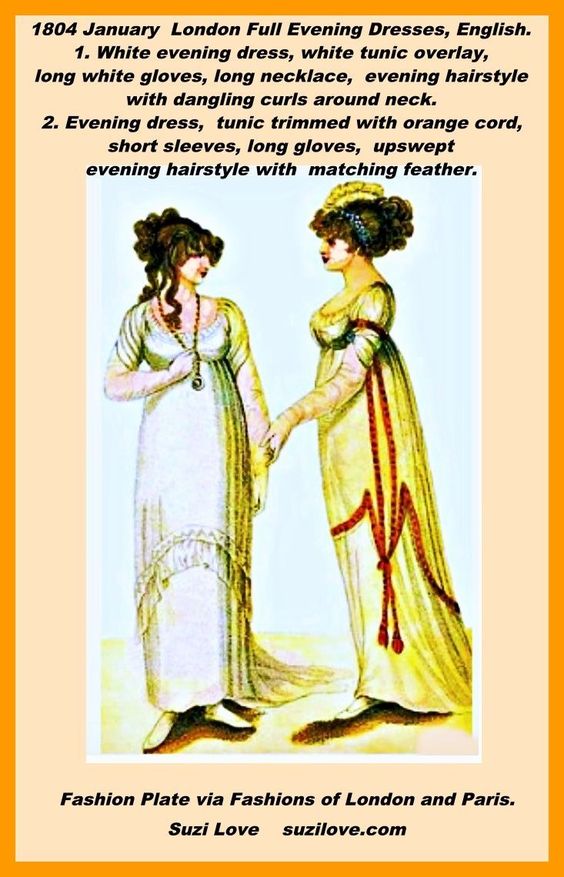
These are the types of outfits worn by Jane Austen and contemporaries in England and shown in their English magazines. The same designs had probably already been seen in France, because English publishers obsessively copied French fashions despite the two countries being at war for many years.
19th Century Early Women’s Cotton Caps. Worn as morning caps, night caps, or under other hats. With lappets, hanging ties, or tails, which were also called ‘follow me lads’, or ‘flirtation ribbons’. via Museum of Fine Arts, Boston, U.S.A. mfa.org. via Museum of Fine Arts, Boston, U.S.A. mfa.org
Definition Caps: Worn as morning caps, night caps, or under other hats. Jane Austen and her family and female friends would have worn caps like these, sometimes during the morning at home, to bed to keep their long hair from becoming knotted, or under a bonnet to hold a hairstyle in place. Caps sometimes had hanging ties, or tails, were also called ‘follow me lads’, or ‘flirtation ribbons’.
Definition Lappets: Two long strips of material, often lace, hanging from top of head down back or over shoulders. Sometimes extensions of a headdress and a requirement for court dress.
19th Century Early Women’s Cotton Caps. Worn as morning caps, night caps, or under other hats. Hanging ties, or tails, also called ‘follow me lads’, or ‘flirtation ribbon’s. via Museum of Fine Arts, Boston, U.S.A. mfa.org
1811-1820 Regency Era Overview. The British Regency was the period from 1811-1820. King George III was deemed mad and unfit to rule so his son became his proxy, the Prince Regent, or Prinny to his close friends. The Prince Regent was often a figure of ridicule in Jane Austen’s times and featured regularly in caricatures, or cartoons, as a fat man who overindulged in everything and spent an exorbitant amount of money.
As a period in Britain’s official history, the Regency lasted less than ten years, although scholars apply the term Regency to a much longer period. It began in 1811, when George Ill was declared mad and the Prince of Wales was appointed Regent. It ended in 1820 when the King finally died and the Regent was crowned George IV. However, the Regency was a period in Britain’s history that had an effect on the social and cultural life for four decades, from the start of the French Revolution in 1789 to the passing of Britain’s Great Reform Act in 1832.
The decision to make George IV the Regent took a lot of political debate. After nearly two and a half months of political wrangling, the British government agreed to grant the title of Prince Regent on George. The Act of Parliament was finally passed by a commission in the House of Lords on February 5th 1811 and the Prince was formally sworn in as Regent at Carlton House the next day. He continued to rule as Regent until 1820 when, on his father’s death, he assumed the title George IV and reigned until his own death in 1830.
During the Regency, royalty and upper class ladies and lords, or the Beau Monde, lived elegant and extravagant lives that also allowed excesses and depravity. Britain was united behind exceptional heroes in long wars against France, but internally divided by class distinction and political agitation. The foundations of a modem industrial nation were laid by engineers, inventors and scientists. while Romantic poets and visionary artists dreamt of escape to earlier times and more ideal worlds. From: Queen’s Gallery, London, U.K. For more on this, take a look at my book Regency Overview. https://books2read.com/suziloveROver