1826 Almack’s Revisited by Charles White. The ball of this evening passed off as all other balls at the same place, creating envy, jealousy, and hatred in the minds of many of those who have been unsuccessful in procuring tickets; affording real amusement to few, and disappointing a greater portion of those who, by dint of manoeuvring, petitioning, parliamentary interest, or presents, have been enabled to obtain the desired vouchers; and as this was one of the last balls of the season, and a general election already talked of, the mixture of company and the number was much greater than usual; and, consequently, it was what the most correct persons called, “horrid bad Almack’s!”
Almack’s or Willis’s Rooms, King Street, St James, London, UK. Almack’s Assembly Rooms, founded by William Almack at No. 26-28, were on the site of the present Almack House. The club was originally a gaming establishment but moved from Pall Mall. The Assembly rooms were on the South side of King Street in St James’s and were opened on February 12, 1765. At the time the subscription was ten guineas for which there was a ball and supper each week for the twelve weeks of the season.
1826 Almack’s Revisited by Charles White.: ‘It was what most correct persons called ‘horrid bad Almack’s’. #RegencyEra #London #BritishHistory
1805 Pink Redingote, French. Also called a Pelisse, a Walking Dress, or a Carriage Costume, in England. High-waisted, short puffed sleeves over long straight sleeves with elaborate embroidery to decorate, and close-fitting gold hat tied under her chin. Fashion Plate via Journal des Dames et des Modes, or Costume Parisien. Jane Austen and her contemporaries would have worn long coats like this one to keep warm when out and about, visiting, shopping etc. The thin muslin dresses worn in the early 1800s were little protection against European winters, so coats of some sort were added, plus colorful accessories like this shawl and the hat to add color and another layer of warmth.
Definition Redingote Or Coat Or Pelisse: Long fitted outdoor coat worn over other garments for warmth. French word developed from English words, riding coat. French fashion plates call these coats Redingotes and they are designed for women, men and children. English fashion plates call them a Pelisse, a walking dress, Promenade dress, or Carriage dress.
1805 Lady With Her Sketching Portfolio In Half Dress, French. White, At-Home, High-waisted, relaxed & flowing dress with white cap and pink flowers to match, long gloves, slippers. Fashion Plate via Journal des Dames et des Modes, or Costume Parisien. Definition Caps: Worn as morning caps, night caps, or under other hats. Jane Austen and her family and female friends would have worn caps like these, sometimes during the morning at home, to bed to keep their long hair from becoming knotted, or under a bonnet to hold a hairstyle in place. Caps sometimes had hanging ties, or tails, and were also called ‘follow me lads’, or ‘flirtation ribbons’. Or flaps covering theirs called Lappets. Magazine Journal des Dames et des Modes, or Costume Parisien, French. French fashion magazine published between 1797 and 1839 and second oldest fashion magazine published in France. Pierre de la Mesangere was editor and published every five days, which is why there is an abundance of French fashion plates from these years in France and internationally.
1805 Lady With Her Sketching Portfolio In Half Dress, French. White, At-Home, High-waisted, relaxed & flowing dress with white cap and pink flowers to match, long gloves, slippers. Fashion Plate via Journal des Dames et des Modes, or Costume Parisien.
1817-1820 ca. Spencer, English. Green silk, brown satin puffs, silk cord on deep V collar and sleeves. With the rise of fashionable waistlines in women’s dresses after around 1800, women’s outerwear followed suit. This jacket with very short bodice and long sleeves was known as a Spencer and was named after the male coat made famous by the Earl Spencer. The jacket is said to have originated in an accident to Lord Spencer in hunting when his coat tails were torn off and a cropped jacket was invented. via Museum of London, UK. museumoflondon.org.uk. books2read.com/suziloveSpencers. Jane Austen and her contemporaries often walked to places and so would have needed the warmth of a Spencer over her dress in the cold British winters.
Definition Spencer: Short jacket, cropped at the waist, worn over a dress, or gown. These close-fitting, tight sleeved, waist length jackets were modeled on a gentleman’s riding coat, but without tails. Delicate and regency dresses provided so little protection from the cold, so over garments were essential for warmth, modesty and good health.
1817-1820 ca. Spencer, English. With the rise of fashionable waistlines in women’s dresses after around 1800, women’s outerwear followed suit. This jacket with very short bodice and long sleeves was known as a spencer. via Museum Of London. HN_4_Spencers Or Regency Jackets.
books2read.com/suziloveSpencers
1800-1815 ca. Sprigged Mull Dress. Typical of the white cotton high-waisted dresses in vogue in the early 1800s. They replaced the more formal gowns from the end of the 18th Century and moved away from heavier and more decorative fabrics. This is the type of dress Jane Austen and her contemporaries would have worn on a daily basis. via Whitaker Auctions.
1816. June Blue Merino wool riding dress with high waist and embroidered and ornamented round the bust and cuffs and fastens on the back of the shoulder. Double ruff of fine Vandyke lace is separated from shirt collar by a Chinese silk handkerchief of blue and white. Small round hat made of fine beaver or moss silk, the half boots are of blue kid with Limerick gloves worked and seamed with blue and she is carrying a riding whip. These riding habits were usually designed by men and were in two pieces, a jacket and a skirt, worn over a shirt but this is in one piece and the full skirt falls from directly under the bust. Fashion Plate via John Belle’s La Belle Assemblée or, Bell’s Court and Fashionable Magazine, London. https://books2read.com/SuziLoveFashionWomen1815-1819
Typical of the riding costumes worn by Jane Austen’s female contemporaries. The style is still in the Empire fashion of a high-waist with the full skirt falling from just under the bust and with a frill and small decorations on the wrists and shoulders to make it look unique.
Fashion Women 1815-1819 History Notes Book 28 What did Jane Austen wear? . D2D_HN_28_https://books2read.com/SuziLoveFashionWomen1815-1819
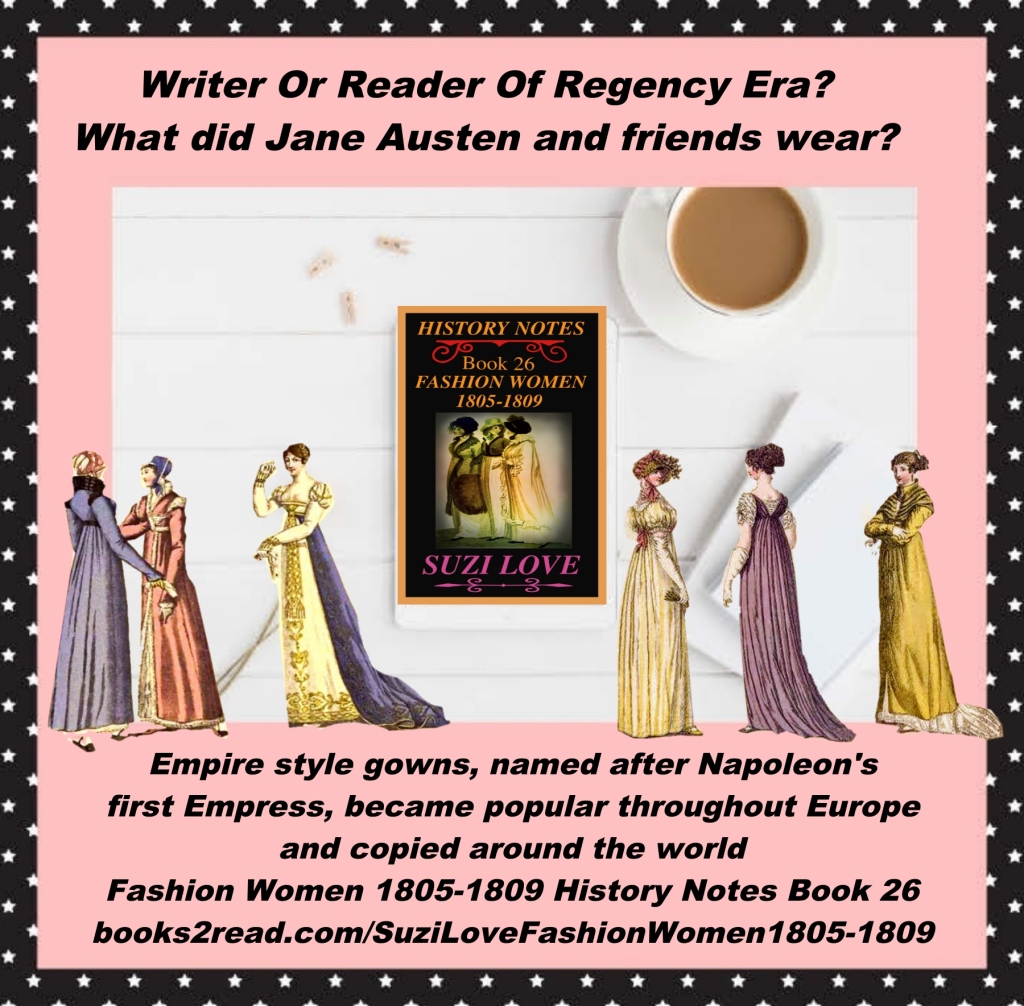
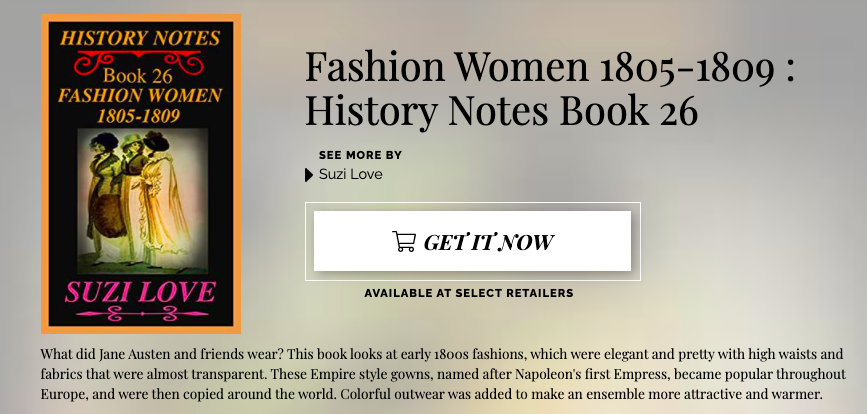
What did Jane Austen and friends wear? Early 1800s fashions were elegant and pretty with high waists and fabrics that were almost transparent. These Empire style gowns, named after Napoleon’s first Empress, became popular throughout Europe, and were then copied around the world. Colorful outwear was added to make an ensemble more attractive and warmer. History Notes Book 26 Fashion Women 1805-1809. https://books2read.com/SuziLoveFashionWomen1805-1809
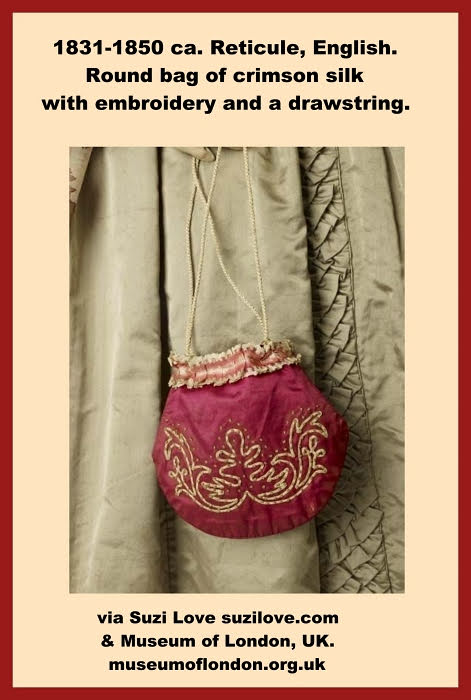
1831-1850 ca. Reticule, Or Handbag, English. Round bag of crimson silk with embroidery and a drawstring. via Museum Of London.
Definition Ridicule, Reticule, or Handbag: From the late 1700s, pockets could no longer be sewn into gowns, as skirts fell from just under the bust and were full and flowing. Instead, women began carrying small bags, known at first as ridicules and later as reticules, to keep necessary items on their person e.g. handkerchiefs, coins, vinaigrettes, calling cards, glasses etc.
The term ‘ridicule’ derived from the Latin ‘ridiculum’ and first used in France during the 17th century and meant subjecting something or someone to mockery. As women’s tiny bags were mocked, or ridiculed, for being a useless fashion accessory when they were first used in the late 1700s, it’s likely this is how the name ‘ridicule’ started. The later term ‘reticule’ derived from the Latin reticulum, meaning ‘netted bag’ and was applied when bags became larger and often made from netting.
In the early nineteenth century, reticules started to look like future handbags as they were often made from rigid card or molded Maché or card into a variety of shapes. Early bags were circular and with a drawstring but as women wanted their reticules to look individual they could be made with two halves and a hinged metal closure or with concertina sides. Materials varied from silk, cotton and string and shapes were round, hexagonal or lozenge shapes with shell shaped bags becoming very popular during the Regency and Romantic Eras.
1800s magazines were written for well-bred women who could read, so they gave plenty of ideas for how ladies could make and embellish reticules for their own use and as pretty gifts. Needlework was highly encouraged as a pastime for a lady so bags were frequently embroidered or decorated with beading. By the 1820s, reticules became more like our modern handbags using soft leather gathered at the top or hard leather with a rigid fastener and metal chain for carrying.
What was fashionable for purses in past centuries? Call them what you like: purses, bags, handbags, reticules, ridicules, clutches, or pocket replacements. They all did the same job and they changed greatly with the prevailing fashions of time. books2read.com/suziloveReticules History Notes Book 3 By Suzi Love.
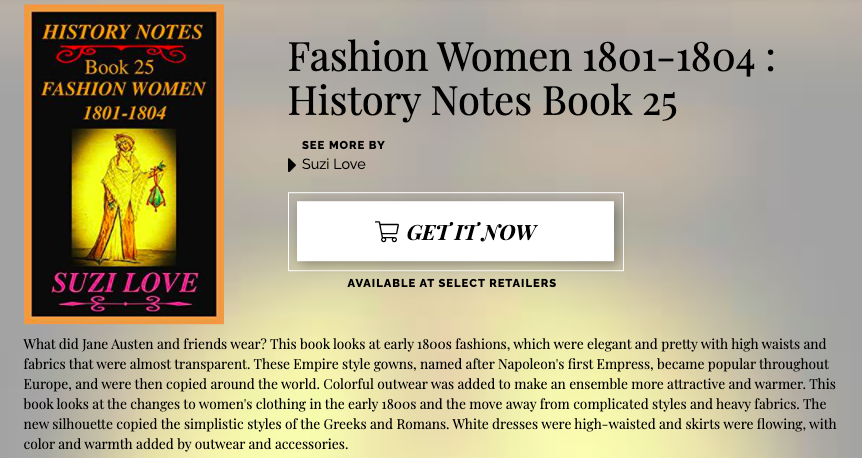
What did Jane Austen and friends wear? Early 1800s fashions were elegant and pretty with high waists and fabrics that were almost transparent. These Empire style gowns, named after Napoleon’s first Empress, became popular throughout Europe, and were then copied around the world. Colorful outwear was added to make an ensemble more attractive and warmer. History Notes Book 26 Fashion Women 1805-1809. https://books2read.com/SuziLoveFashionWomen1805-1809
The Empire waist gown defined women’s fashion during the Regency Era. ‘Empire’ is the name given in France to the period when Napoleon built his French Empire. High-waisted, loose gowns were adopted by the aristocracy as a symbol of turning away from the fussy, elaborate and expensive clothing worn in the 1700s. Jean-Jaques Rousseau advocated copying peasants and returning to a simpler life and more natural fashions. Unrestricting clothing was part of the new Democracy in France and these simpler and flowing fashions were adopted all over Europe, including Britain and despite the continual wars being fought against France during the early 1800s. Not even war stopped fashions from being copied everywhere.
1815 The First Quadrille at Almack’s Assembly Rooms, London. Left to Right: Marquis of Worcester, Lady Jersey, Clanronald MacDonald and Lady Worcester. “It was not until 1815 that Lady Jersey introduced from Paris the favourite quadrille, which has so long remained popular. I recollect the persons who formed the very first quadrille that was ever danced at Almack’s: they were Lady Jersey, Lady Harriett Butler, Lady Susan Ryde, and Miss Montgomery; the men being the Count St Aldegonde, Mr Montgomery, Mr Montague, and Charles Standish.” From The Reminiscences of Captain Gronow 1810-1860.
The patronesses of Almack’s controlled a lot of a young lady’s acceptance into English society in Jane Austen’s times. To be given a voucher and admitted to an assembly, there was an introduction into London’s polite society.




![1805_HalfDress_WhiteAtHomeDress_LadywithSketchingPortfolio_CP_Lge.jpg ]](https://www.suzilove.com/wp-content/uploads/2022/11/1805_HalfDress_WhiteAtHokmeDress_LadywithSketchingPortfolio_CP_Sml.jpg)