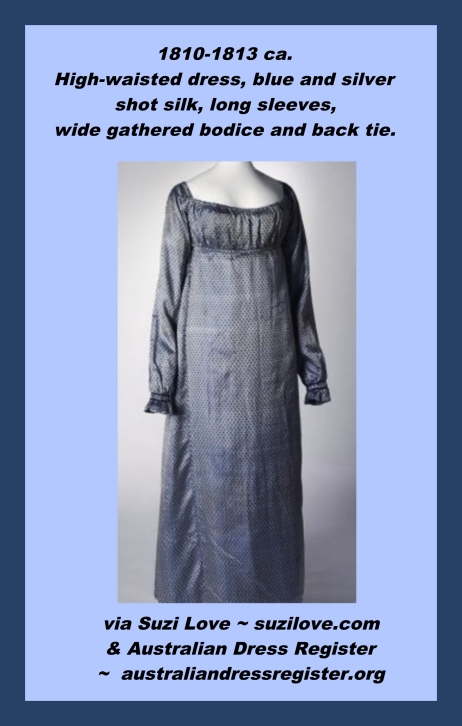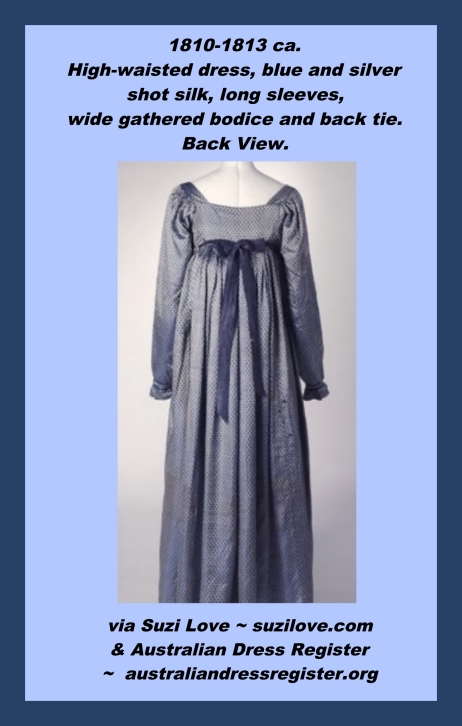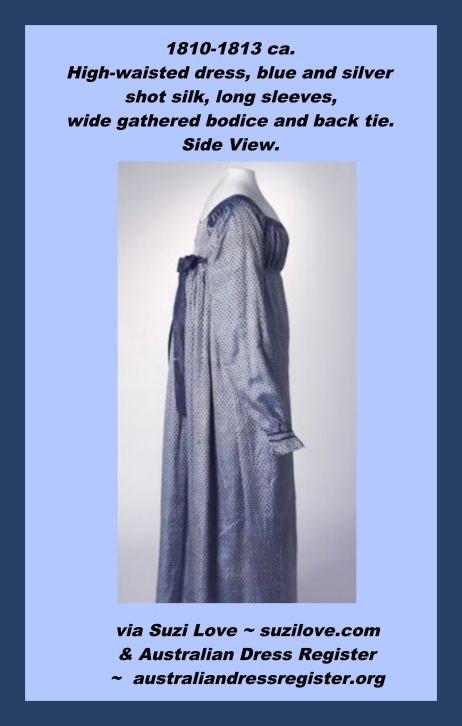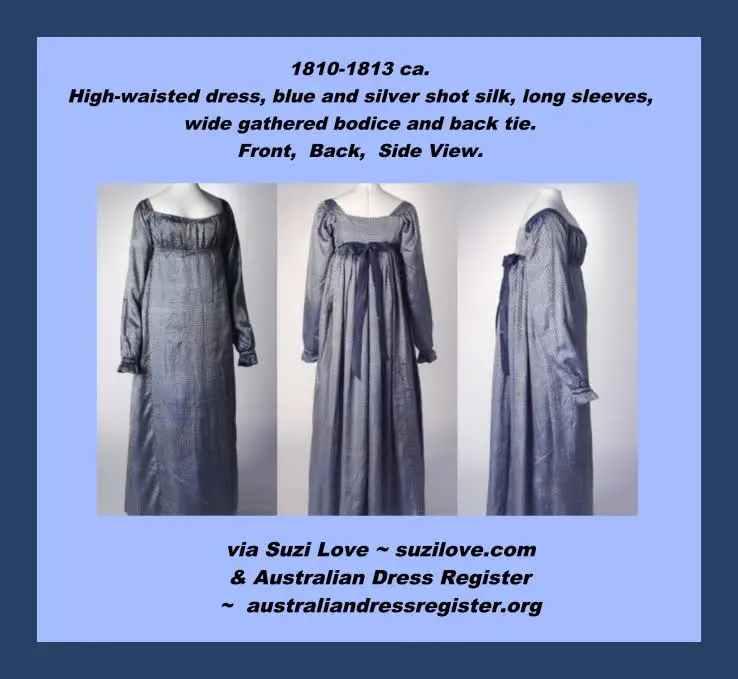
1815 Blue Striped Dress, Norway. Empire style, or high-waisted, dress with short puffed sleeves over long straight sleeves and gold trim. I can picture Jane Austen and her female friends and family wearing this sort of dress to an evening event. via Nordiska Museet, Nordic Museum, Stockholm, Sweden. digitaltmuseum.se
1810–1850 ca. Corset, American or European. Front lacing, extra wide straps for under a square neckline dress. via Metropolitan Museum, N.Y.C., U.S.A. metmuseum.org
Surviving stays, or corsets as they became to be called in the nineteenth century, show that both longline and shorter corsets were worn and that they were made of cotton, silk and sateen. A lot of these corsets were front fastening, plus many were laced at both the front and the back so our aristocratic fictional heroines could indeed dress and undress themselves without the assistance of a maid.
Corsets 1810-1830 History Notes Book 17 This book shows how corsets changed to fit well under clothing, give maximum support and comfort. Corsets pushed up breasts and showed off the bust line beneath a square-cut and low-cut neckline as in the early 1800s, or Regency years. Jane Austen and her female and friends wore these corsets. https://books2read.com/SuziLoveCorsetBook17
1800 ca. Fawn Cotton Bodiced Petticoat With Front Lacing, English. via National Trust Collections, UK. nationaltrustcollections.org.uk
Because dresses were so light and airy as to be almost see-through, petticoats were needed to protect a woman’s modesty. If a glimpse of an ankle was supposed to turn a man’s head, imagine what would happen if he saw an entire lady’s exposed leg.
Did Jane Austen wear this type of petticoat under her dress? Probably. This wide necked, small shoulder straps and Empire, or high-waisted, undergarment would have provided some warmth plus protect the modesty of Regency Era women. This would be worn under the high-waisted, wide necked, small bodiced type of thin, or even almost transparent, dresses of the early 1800s.
1817 March. Opera Dress, English. The sort of outfit Jane Austen and her contemporaries or the Bridgerton women would wear for an evening at the opera or theatre. Fashion Plate via Rudolph Ackermann’s ‘The Repository of Arts’.
A blue crape dress over a white satin slip; the dress trimmed round the skirt with a deep blond lace, which is headed with a light and novel trimming, composed of white floss silk and small pearl beads: this trimming is surmounted with a beautiful deep embroidery of lilies, surrounded by leaves. The body and sleeves of this dress, as our readers will perceive by our print, are extremely novel. Head-dress, toque à la Berri; it is a crown of a novel form, tastefully ornamented round the top with lilies to correspond with the trimming of the skirt, and a plume of white feathers, which droop over the face. Ear-rings, necklace, and bracelets, sapphire mixed with pearl. The hair dressed in loose light ringlets on the forehead, and disposed in full curls in the back of the neck. White kid gloves, and white satin slippers.
1813 Yellow Redingote Or Coat, French. Hooded coat with gorgeous white trim, yellow boots, yellow velvet bonnet with a white plume. Jane Austen and her female family and friends wore fashions like these. Fashion Plate via Journal des Dames et des Modes, or Costume Parisien.
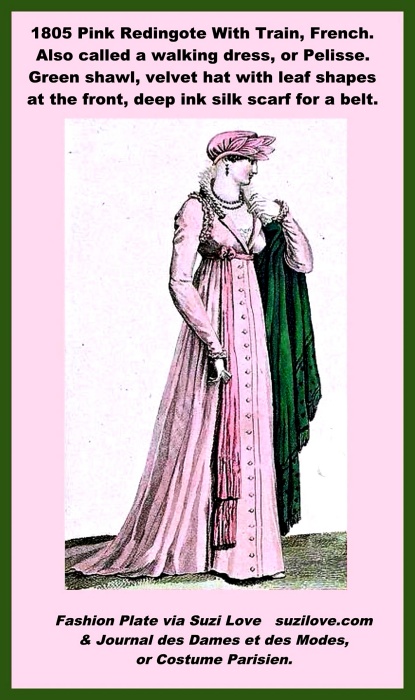
Redingote, or Pelisse, or Walking Dress, or Promenade Dress: Going by many names, this is a coat copied from men’s overcoats but worn by both men and women. Generally, opens down the front, worn for warmth over a dress or coat and breeches, and has a military look with front vertical buttoning or decoration. Called a Redingote in French periodicals but English magazines called them by many other names: pelisse, carriage dress, walking dress, promenade costume.
1810 ca. Spencer, Or Short Jacket, Of Printed Cotton, Europe. White base with rose and zigzag motifs in pink, red, yellow and green. via Mode Muze, Netherlands ~ modemuze.nl. Spencers were needed to cover the flimsy dresses made of lightweight fabrics of the Regency years, to provide warmth and some protection from windy conditions when the transparency of gowns might cause modesty issues. Jane Austen and her contemporaries often walked to places and so would have needed the warmth of a Spencer over her dress in the cold British winters.
Definition Spencer: Short body-hugging jacket worn for warmth and modesty. Said to have originated in an accident to Lord Spencer while hunting when his coat tails were torn off and he wore it as a short jacket.
1814 Couple In Walking Ensembles, French. Gentleman in a brown tailcoat with a notched collar and back pockets, vest, white breeches tied under his knees, red fob at the waist, white stockings, high white shirt collar, white cravat, top hat and cane. Lady in adorable pink Redingote with capes.
1818-1823 ca. Turban, London, U.K. Silk, silk thread, paper, cotton, wire,and hand-sewn. Cap is gathered and full to mimic the shape of a turban which became popular evening wear around 1820 when ‘exotic’ was fashionable.
Silk, silk thread, paper, cotton, wire and hand-sewn. A full cap of white satin gathered into a headband in imitation of a turban. The crown is inset with white net embroidered in circles with white silk thread. The headband is of white satin with three horizontal tucks and edged with white silk plush. Trimmed on one side with artificial flowers made of wired green paper leaves and white muslin rosebuds. via Victoria and Albert Museum, London, U.K.
Early 19th-century etiquette required a lady’s head to be covered at all times, even with evening dress. A cap such as this one, gathered and full to suggest the shape of a turban, was popular for evening wear about 1820. The Romantic movement created an interest in the dress of non-European countries, particularly North Africa and the Middle East. Decorative motifs and accessories were borrowed to make current fashions more ‘exotic’. Although knowledge of the proper proportions and construction of a turban was not available to British milliners, the overall shape was approximated for the most fashionable headwear.
1801 November 9th Playing Cards. Men and women play cards at round table. Supreme Bon Ton Plate 2. Published by S W Fores. Men and women play cards at round table. Man and woman talk to players. Woman sleeps in upright chair, two others, one with parasol and other fan, walk off arm-in-arm.Men: High-waisted coats, high collars, huge neck-cloths, with pumps or Hessian boots. Women: High-waisted dresses, short sleeves, long trains, very low necklines, short ringlets, two in caps. Via British Museum, London, UK. britishmuseum.org (PD-Art)
In Jane Austen’s times, cartoons posted in the windows of shops were one of the main ways people found news. Common people couldn’t afford newspapers so cartoonists ridiculed the people and the places with cartoons of the daily events happening in London and other cities. The ridiculous fashion trends of the late 1700s and early 1800s were easy targets for satirical cartoons as was the addiction to gambling by women and men alike.
Light-Hearted look at an Older Lady’s Life In Jane Austen’s Times, or early 1800s. An easy to read overview of what an older lady did, wore, and how she lived in the early 19th Century. Information for history buffs and pictures for readers and writers of historical fiction. Older Lady’s Day, Regency Life Series, Book 5, by Suzi Love. books2read.com/suziloveOLD
The older lady’s day usually started with her toilette in her bedroom, where her maid helped her dress for the day and styled her hair. After that, she would join her family downstairs for breakfast unless she preferred a tray with either tea or hot chocolate in her bedroom as she prepared for her busy day. Her day would be made up of speaking with the housekeeper and the cook about the week’s menus, assuring that the servants were all available that day and no one was ill, and checking the list of foods needed. She would also enquire if the laundry was up to date and that they had enough good linen to make up all the beds before extended family members and guests arrived. If she was in the country and hosting a weekend house party, she would assign rooms to the guests on her lists and query that all was in readiness for their arrival.