Young Lady’s Day is Book 4 in the Regency Life Series. This book depicts the often-frivolous life and fashions of a young lady in the early 1800’s, but also gives a glimpse into the more serious occupations a young lady may undertake. Through historic images, historical information, and funny anecdotes, it shows how a young lady fills her day, where she is permitted to go, and who she is allowed spend time with. These light-hearted looks at the longer Regency years are an easy to read overview of what people did and wore, and where they worked and played. There is plenty of information to interest history buffs, and lots of pictures to help readers and writers of historical fiction visualize the people and places from the last years of the 18th Century until Queen Victoria took the throne.
Love the Bridgertons? Jane Austen fan? Early 1800’s glimpse into frivolous and serious occupations filling a young lady’s day. #Bridgerton #JaneAusten #RegencyEra #Nonfiction #AmWriting https://books2read.com/suziloveYLD
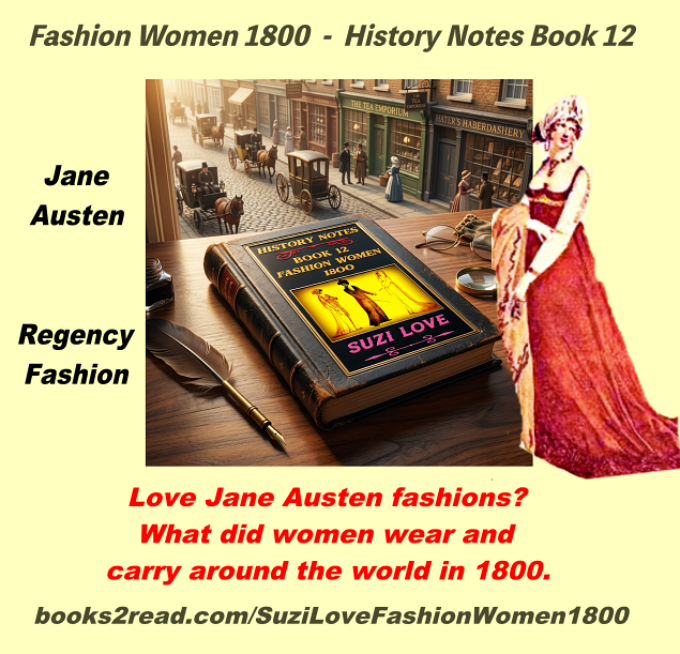
Fashion Women 1800 By Suzi Love History Notes Book 12 #Regency #Fashion Love gorgeous historical women’s fashions? Take a look at what women wore and carried in 1800 in Europe and around the world. books2read.com/SuziLoveFashionWomen1800
Women’s dress changed dramatically after 1785. The rich fabrics and complicated, formal shapes of the late 18th century gave way to simple, light fabrics that draped easily. These new gowns achieved something of the effect of the simple tunics shown on classical Greek and Roman statues and vases. Inspired in part by the statuary of ancient Greece and Rome, the new fashion was epitomised by light cotton gowns falling around the body in an unstructured way, held around the high waist with a simple sash and accompanied by a soft shawl draped around exposed shoulders. This style was ideal for the Indian imports like Kashmiri shawls and Bengali muslin, as used in this embroidered gown. Championed by such influential figures as Emma Hamilton in England and Madame Récamier in France, the so-called ‘Empire’ style catapulted Indian muslin into the forefront of fashion.
Empire Dress: Owes its name, physical emancipation, popularity, and even its sexiness to France. In this English example, French style is slavishly followed in the gown’s high waist and modish stripes.
Empire style, or early 1800s, high-waisted dresses made it impossible to either sewn in a pocket or to tie on a pocket. So women began carrying small, decorated bags called Reticules, or ridicules, which generally pulled close at the top with a drawstring.
Inspired in part by the statuary of ancient Greece and Rome, the new fashion was epitomised by light cotton gowns falling around the body in an unstructured way, held around the high waist with a simple sash and accompanied by a soft shawl draped around exposed shoulders. This style was ideal for the Indian imports like Kashmiri shawls and Bengali muslin, as used in this embroidered gown. Championed by such influential figures as Emma Hamilton in England and Madame Récamier in France, the so-called ‘Empire’ style catapulted Indian muslin into the forefront of fashion.
Love the Bridgerton Series? Fan of Jane Austen? What did men wear in the early 1800s? Suits, hats, shoes, underclothing, military and bedroom fashions. #Bridgerton #RegencyFashion #JaneAusten #BritishHistory
A Regency Era, or early 1800s, gentleman was outfitted in more practical fabrics, such as wool, cotton and buckskin rather than the fussy brocades and silks of the late 1700s. French fashions and Georgian and Regency Era fashions from Great Britain were copied around the world. Take a look at the outfits worn by gentlemen in the Bridgerton series and in Jane Austen’s lifetime. https://books2read.com/SuziLoveFashionMen1800-1819
The British Regency was the period from 1811-1820. King George III was deemed mad and unfit to rule so his son became his proxy, the Prince Regent, or Prinny to his close friends. This was the situation when Jane Austen was alive. The Regency Era was famous for its beautiful clothing as well as the magnificent buildings erected and furnished in the ‘Regency Style’ under orders from the extravagant Prince Regent.
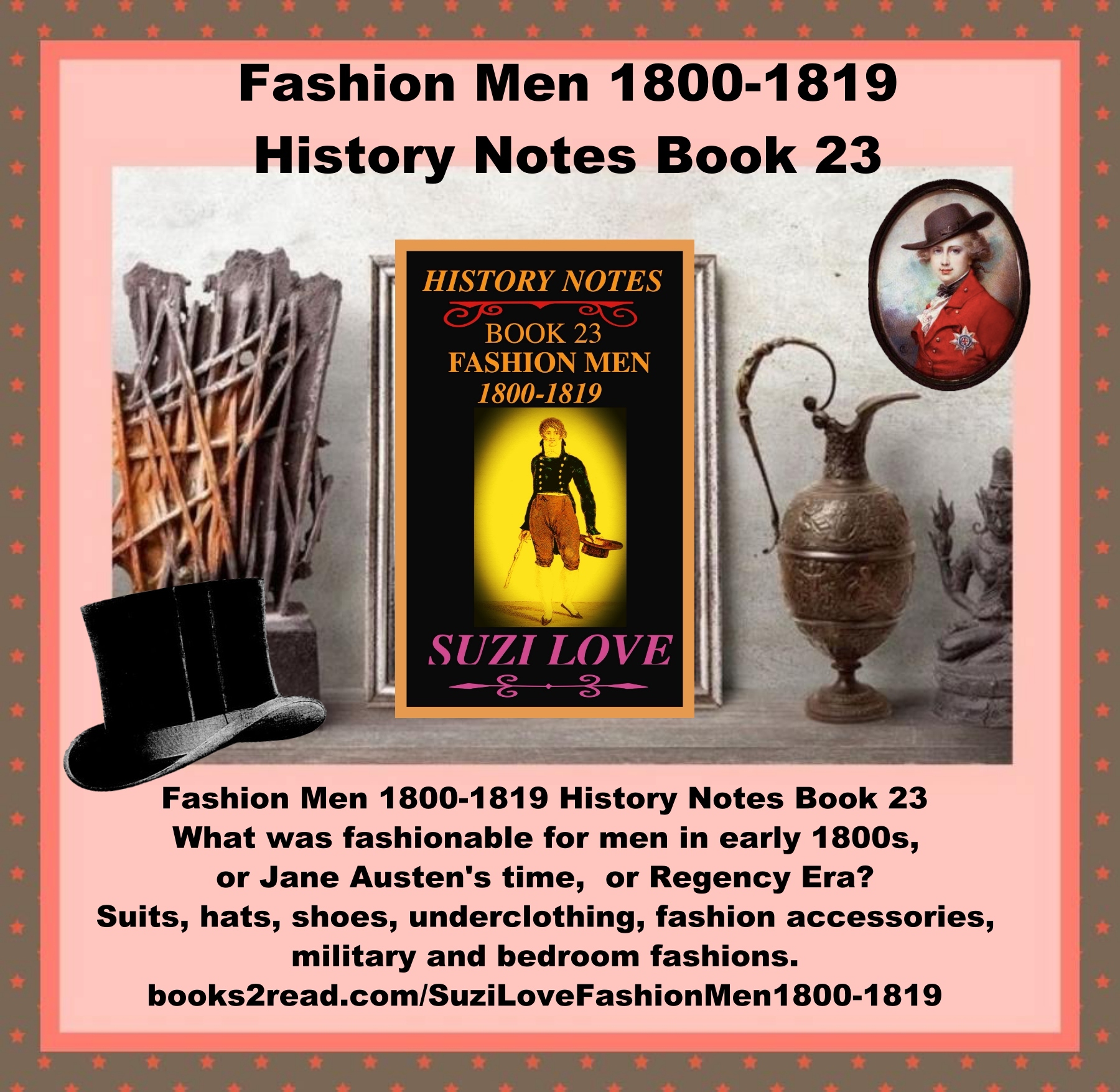
Fashion Men 1800-1819 History Notes Book 23 What was fashionable for men in early 1800s, or Jane Austen’s time, or Regency Era? Suits, hats, shoes, underclothing, fashion accessories, military and bedroom fashions. French fashions and Georgian and Regency Era fashions from Great Britain were copied around the world. https://books2read.com/SuziLoveFashionMen1800-1819
Love the Bridgerton Series? Fan of Jane Austen? What did men wear in the early 1800s? Suits, underclothing, military, bedroom fashions. #Bridgerton #RegencyFashion #JaneAusten #BritishHistory https://books2read.com/SuziLoveFashionMen1800-1819
Writer Or Reader Of Regency Era?What did Jane Austen and friends wear? Women’s clothing changed dramatically in early 1800s. New silhouette copied simplistic styles of Greeks and Romans. High-waisted white dresses and flowing skirts with color and warmth added by outerwear and accessories. Fashion Women 1801-1804 History Notes Book 25 https://books2read.com/SuziLoveFashionWomen1801-1804
Definition Empire Style Dress: High-waisted white gowns defined women’s fashion during the Regency Era. ‘Empire’ is the name given to the period when Napoleon Bonaparte built his French Empire. High-waisted, loose gowns were adopted by the aristocracy as a symbol of turning away from the elaborate clothing worn in the 1700s. This sort of high-waisted dress would have been worn by Jane Austen and her contemporaries in England.
Definition Shawls: The shawl started off in India as a fine wool garment for men that could be worn as a scarf, turban or as a mantle: the word comes from the Persian shäl. Originally imported from the East, European Kashmir shawls were made first in Norwich and Edinburgh in Britain in the late 18th century. Shawls were an essential item in the early 1800s to cover the thin gowns women wore. They were made of muslin, gauze, silk, wool, and velvet, though cashmere shawls were the softest and most prized.
Fan of the Bridgerton Series? Jane Austen Lover? Writer Or Reader Of Regency Era? What did they wear in early 1800s? #Bridgerton #RegencyFashion #JaneAusten #HistoricalFashion https://books2read.com/SuziLoveFashionWomen1801-1804
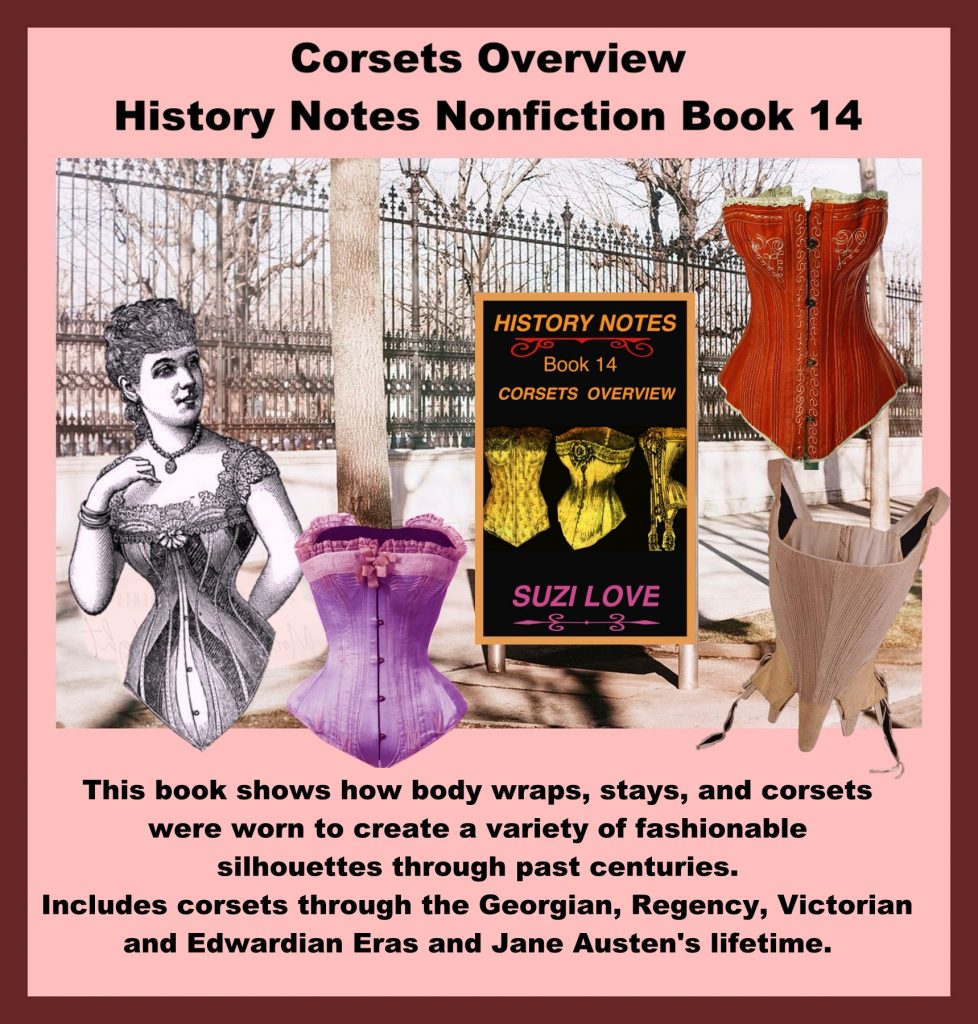
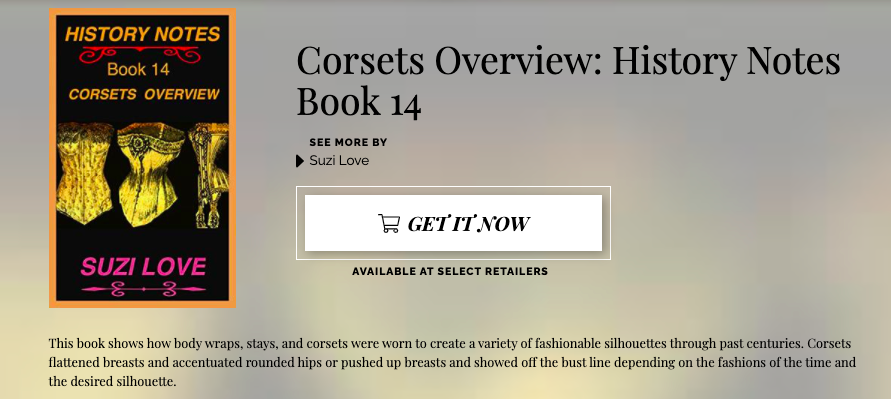
This book shows how body wraps, stays, and corsets were worn to create a variety of fashionable silhouettes through past centuries. Corsets flattened breasts and accentuated rounded hips or pushed up breasts and showed off the bust line depending on the fashions of the time and the desired silhouette. Includes corsets through the Georgian, Regency, Victorian and Edwardian Eras and Jane Austen’s lifetime. Overview of corsets through history, including the Georgian, Regency, Victorian and Edwardian Eras and Jane Austen’s lifetime. History Notes Book 14.
Do you read or write Historical Romance? Want a glimpse under dresses worn during the Bridgerton and Jane Austen years? Overview of corsets. #Bridgerton #JaneAusten #GeorgianFashion #RegencyFashion #Corset https://books2read.com/SuziLoveCorsetBook14
Love the Bridgerton Series? Fan of Jane Austen? What did men wear in the early 1800s? Suits, hats, shoes, underclothing, military and bedroom fashions. #Bridgerton #RegencyFashion #JaneAusten #BritishHistory.
The Regency Era saw a wide variety of acceptable pants for men. Breeches were worn as part of a man’s daily outfit during the early 1800s and were necessary for formal occasions, such as court appearances, during the entire Regency Era. However, younger gentlemen moved away from breeches for daytime wear around 1807 and adopted a variety of long pants called trousers, pantaloons, buckskins or inexpressables. Knee-length breeches, worn with stockings, continued to be worn by older gentlemen through the entire Regency Era.
Around 1807, upper class gentlemen wore trousers held up by suspenders or pantaloons, which were closely fitted and worn with tall boots. Buckskins, made from deerskin, were comfortable to wear for riding. Inexpressibles were very tight leggings that left little to the imagination of young ladies. Every Regency man’s outfit included a hat, gloves, shoes or boots, and a selection of added accessories from a walking stick, watch on a chain, fobs, coin purse and a handkerchief.
This book shows how body wraps, stays, and corsets were worn to create a variety of fashionable silhouettes through past centuries. Corsets flattened breasts and accentuated rounded hips or pushed up breasts and showed off the bust line depending on the fashions of the time and the desired silhouette. Includes corsets through the Georgian, Regency, Victorian and Edwardian Eras and Jane Austen’s lifetime. Overview of corsets through history, including the Georgian, Regency, Victorian and Edwardian Eras and Jane Austen’s lifetime. History Notes Book 14.
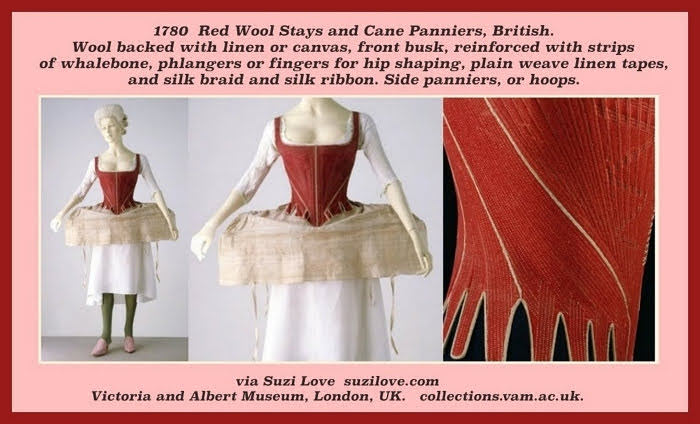
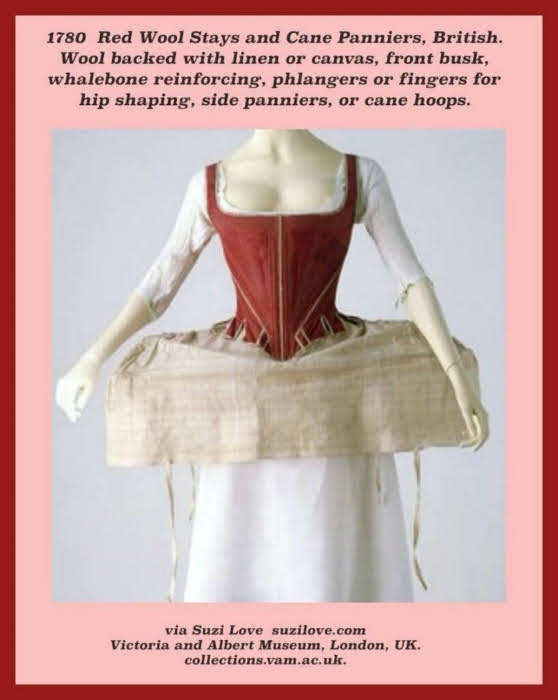
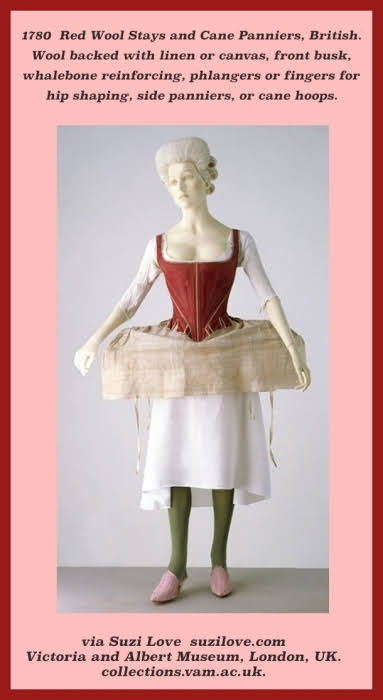
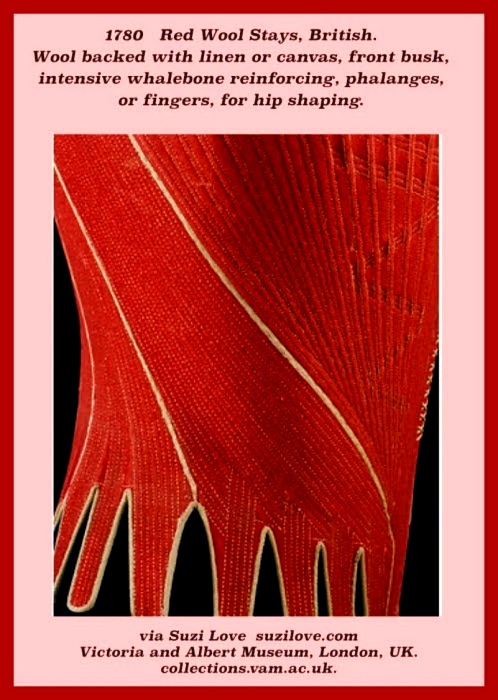
1780 Red Wool Stays, or corset, and Panniers, British. Wool backed with linen or canvas, stitched with linen thread reinforced with strips of whalebone, lined with glazed linen, bound with linen twill tape, fastened with plain weave linen tapes and decorated with silk braid and silk ribbon. Phalanges, or fingers, spread over the hips to give support. Side panniers, or hoops, are made of cane. via Victoria and Albert Museum, London, U.K.
Back-lacing stays with a high narrow back with a wide curving decolletage and V-point in front, about 5 cm below the waistline. Decorative white lacing and white silk braids on centre front which is wide at the top and narrow at the bottom. Below the waist there are 19 tabs, or phalanges, or fingers. Laced through 13 eyelets at back. Compartments for the strips of whalebone are 4 – 5 mm wide, running vertically and diagonally. Centre busk of whalebone about 2 cm wide. Shoulder straps have an eyelet and extend from the front and fasten with tape at each shoulder back.
Stays were an essential item of underwear for women during the 18th century. By the 1780s, the fashionable torso consisted of an inverted cone shape. Achieving smoothness of profile and firmness of contour were the primary function of 18th-century stays, rather than emphasising the bust or constricting the waist. Although custom-made and very intricately designed, stays were usually very plain. On these stays a simple silk ribbon and linen tape serve as decoration and functional finishings.
The narrow rows of very fine, even hand stitching form the compartments into which thin strips of whalebone were inserted. Although the stays appear very rigid, whalebone was quite flexible. It had the added advantage of softening with the heat of the wearer’s body, allowing the stays to mold to her shape. When worn, the shaped and boned tabs at the lower edge would splay over the wearer’s hips, giving further fullness to the petticoat tied at the waist over the stays.
1800 ca. Chemisette, English. In Jane Austen’s times, there were several ways for women to keep their modesty when the fashion trend was for low cut bodices and loose flowing dresses e.g. Chemisette, Fichu, Pelerine etc. DefinitionChemisette: Sleeveless under-bodice covering neck, shoulders and breast, usually of muslin or lace and worn to fill in the neckline of a dress. French term for vestee, gilet, etc. via Killerton House, U.K. & National Trust.
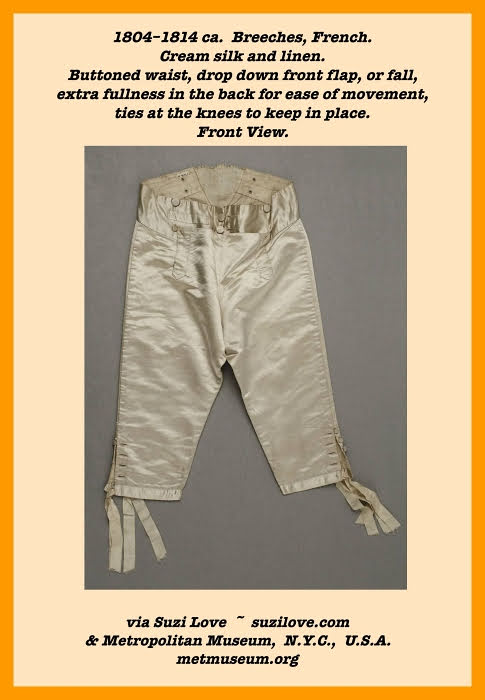
1804-1814 ca. Breeches, French. Cream silk and linen. Buttoned waist, drop down front flap, or fall, extra fullness in the back for ease of movement, ties at the knees to keep in place. via Metropolitan Museum, N.Y.C., U.S.A. metmuseum.org
Definition Pants – Breeches: Men’s close-fitting pants that fastened just below the knees or above the ankles with buttons, drawstrings, or buckles. They had a horizontal front flap called a ‘fall’ which unbuttoned to drop down. Some falls were narrow and some wide. Breeches were worn with stockings. In Jane Austen’s times, or the Regency Era, breeches were worn tighter to show off a gentleman’s manly physique, often leaving nothing to the imagination.