This book shows how corsets changed to fit well under clothing, give maximum support and comfort. Corsets pushed up breasts and showed off the bust line beneath a square-cut and low-cut neckline as in the early 1800s, or Regency years. Jane Austen and her female and friends wore these corsets. Corsets or stays worn during the early 1800s, or Jane Austen’s lifetime. https://books2read.com/SuziLoveCorsetBook17
The main purpose of corsets was to support and shape the breasts. Though they still slimmed the midriff, this was not the prime purpose of a corset between 1810 and 1830. The waistlines of dresses were lowering to below the bust line but nearer to the true waist, so corsets were longer and were given added shaping by stitching and cording and by shaping the breasts with pleated or gathered cups.
1780-1789 Linen Stays Or Corset, Great Britain. Stays, 1780-1789 (made). Linen, lined with linen and reinforced with whalebone, trimmed with pale blue silk ribbon. Hand sewn with linen thread, applied ribbon, chamois and whalebone.
Stays were an essential item of underwear for women during the 18th century. By the 1780s, the fashionable torso consisted of an inverted cone shape. Achieving smoothness of profile and firmness of contour were the primary function of 18th-century stays, rather than emphasising the bust or constricting the waist. Although custom-made and very intricately designed, stays were usually very plain. In this example a narrow blue ribbon covering the seams is the only decoration.
The narrow rows of very fine, even hand-stitching form the compartments into which thin strips of whalebone were inserted. Although the stays appear very rigid, whalebone was quite flexible. It had the added advantage of softening with the heat of the wearer’s body, allowing the stays to mould to her shape. When worn, the shaped and boned tabs at the lower edge would splay over the wearer’s hips, giving further fullness to the petticoat tied at the waist over the stays. Given by Mrs Strachan. Museum Number T.172-1914. Victoria and Albert Museum, London, U.K.
1809 The King Of Great Britain. From: 1809 A Book Explaining The Ranks and Dignities Of British Society. via Google Books. (PD-180) BRITISH RANKS, The King Of Great Britain and His Or Her Powers during Jane Austen’s lifetime.
BRITISH RANKS, THE KING .
The supreme executive power of these kingdoms is vested by our laws in a single person, the King or Queen, for it matters not to which sex the crown descends, but the person entitled to it, whether male or female, is immediately invested with all the ensigns, rights, and prerogatives of sovereign power .
In the earliest periods of our his tory the crown appears to have been elective. But hereditary succession has now been long established , and has proved a good preservative against that periodical bloodshed and misery, which both history and experience have long shewn are the consequences of elective kingdoms. The crown descends lineally to the issue of the reigning monarch , and not till the failure of the male issue is it allowed to be taken by the female.
Lawyers say the King of England is a mixed person, a priest as well as a prince and at his coronation he is anointed with oil, as the priests and kings of Israel were, to intimate that his person is sacred. The principal duty of the king is to govern his people according to law and these are the terms of the oath administered usually by the Archbishop of Canterbury at his coronation, in the presence of the people, who on their parts do reciprocally take the oath of allegiance to the crown : “ The archbishop, or bishop, shall say, Will you solemnly promise and swear to govern the people of this kingdom of England , and the dominions thereto belonging, according to the statutes in parliament agreed on and the laws and customs of the same?
The king or queen shall say , I solemnly promise so to do . Archbishop , or bishop .Will you to your power cause law and jus tice , in mercy , to be executed in all your judgments?
King or queen, I will, Archbishop , or bishop – Will you to the utmost of your power maintain the laws of God , the true profession of the gospel and the protestant reformed religion established by the law? And will you preserve unto the bishops and clergy of this realm, and to the churches com mitted to their charge, all such rights and privileges as by law do or shall appertain unto them or any of them ?
King or queen, All this I promise to do .
After this , the king or queen , laying his or her hand upon the holy gospels , shall say , The things which I have here before promised , I will perform and keep : so help me God . And then shall kiss the book .
One of the principal bulwarks of our liberty is the certain and definite limitation of the king’s prerogative, the extent and restrictions of which are marked out with the greatest clearness. But in the exertion of those powers which the LAW has given him , the king is irresistible and absolute. He is considered by the laws of England as the head and supreme governor of the national church and, in virtue of this authority, he convenes , prorogues , rogues , restrains , regulates , and dis solves all ecclesiastical synods or convocations. He has the supreme right of patronage over all ecclesiastical benefices and if they are not presented to within the time prescribed , their lapse becomes the advantage of the crown. In regard to foreign concerns, the king is the delegate or representative of his people. He has power, by his prerogative, with out any act of parliament, to make war or peace, conclude treaties, grant safe conducts, give commissions for raising and regulating fleets and armies, as well as for erecting, manning, and governing forts, and other places of strength. He can prohibit the exportation of arms and ammunition out of the kingdom, can dispose of magazines, castles, ships, public moneys, etc. and all that is done in regard to foreign powers by the royal authority, is the act of the whole nation. He has the sole power of sending ambassadors to foreign states, and receiving ambassadors at home. He convokes, adjourns, prorogues, and dissolves parliaments and may refuse his assent to any bill passed by both houses, without giving his reason for it .
He may increase the number of members of either house at plea sure, by creating new peers and bestowing privileges on other towns for sending burgesses to Parliament, but the last has by late kings been given up.
The sole power of conferring dignities and honors is entrusted to him so that all degrees of nobility and knighthood, and other titles, are received by immediate grant from the crown. And the king has also the prerogative of conferring privileges upon private persons such as granting place or precedence to any of his subjects such is also the power to enfranchise an alien and make him a denizen, and the prerogative of erecting corporations. The coining of money too, as well as the settling thedenomination or value for which it shall pass current, is the act of the sovereign power.
But to take all the characters into view in which the king is considered in domestic affairs would be almost endless for from thence an abundant number of prerogatives arise. All lands re covered from the sea , gold and silver mines, royal fishes etc. be long to him. He can unite, separate, enlarge, or contract the limits of ecclastical benefices and, by his letters, erect new bishoprics, colleges etc. He can dispense with the rigor of ecclesiastical laws except those which have been con firmed by act of parliament, or declared by the bill of rights. He has also power to moderate the rigor of the law to pardon a man condemned by law except in appeals of murder, and in case of impeachment by the house of commons, and to interpret by his judges in statutes and cases which are not defined by law.
But though he be entrusted with the whole executive power of the law, yet he cannot sit in judgment in any court for justice must be administered according to the powers committed and distributed to the several courts.
As the king is declared to be the supreme head in matters both civil and ecclesiastical so no suit can be brought against him even in civil matters because no court can have jurisdiction over him. The law also ascribes to the king in his political capacity absolute perfection. The king can do no wrong, by which ancient and fundamental maxim we are not to understand that every transaction of government is of course just and lawful but that whatever is exceptionable in the conduct of public affairs is not to be imputed to the king nor is he answerable for it personally to his people and farther that the prerogative of the crown extends not to do any injury. It is created for the benefit of the people and therefore cannot be exerted to their prejudice. In the king there can be no negligence and therefore no delay will bar his right. In the king also there can be no infamy, stain, or corruption of blood. And the law ascribes a kind of perpetuity, or immortality to him. His death is termed his demise , because the crown is thereby demised to another. He is not in law liable to Death, being a corporation of him self that lives for ever. There is no interregnum but the moment one king dies, his heir is king, fully and absolutely, without any coronation , ceremony etc. To these it may be added that by the law the king is said in a manner to be every where in all courts of judicature , which he alone has the right of erecting and therefore cannot be nonsuited.
The power of issuing proclamations is vested in the king alone, considered as the fountain of justice. The laws make it high treason barely to imagine or intend the death of the king, and because the destruction of the king may ensue that of his great counsellors or officers, it is felony in any of the king’s subjects to conspire even that. Some things the king cannot do. He cannot divest himself or successor of any part of the regal prerogative or authority and there are two things which he cannot do without the consent of Parliament:the making of new laws and the raising of new taxes. The king cannot dispense with the laws nor do any thing contrary to law. In England the law is as much superior to the king , as to any of his subjects and the obedienceof the king of England to the laws is his greatest glory while it is the security of the rights and liberties of his people who are the greatest as well as the freest people on the face of the earth , merely because their sovereigns are obliged to live insubjection to the written laws of the land.
The title of grace was first given to our kings about the time of Henry IV and that of majesty first to Henry VIII. The title of his present Majesty is , GEORGE the Third , King of the United Kingdom of Great Britain and Ireland, Defender of the Faith, Sovereign of the Orders of the Garter, Thistle, Bath and St. Patrick, Duke and Elector of Brunswick Lunenburg, Bishop of Osnaburg and Arch Treasurer of the Holy Roman Empire.
1826 The Cyprian’s Ball At the Argyll Rooms. A Regency Gentleman’s Life. From The English Spy By Robert Cruikshank.
1826 The Cyprian’s Ball At the Argyll Rooms. A Regency Gentleman’s Life. From The English Spy By Robert Cruikshank. RL_2_D2D_RetailerBuyLink_RL_2
https://books2read.com/suziloveYGD
Writing Regency Era Fiction Or Nonfiction? Need more information on Older Gentleman’s Day in early 1800s, or the Bridgerton family or Jane Austen’s Regency Era. A lighthearted overview of an older gentleman’s clothing, social life, and responsibilities in the early 1800s. Take a look at where an older man went, what he wore, and how he managed the family’s finances and his estates. Older Gentleman’s Day Regency Life Series Book 3 books2read.com/suziloveOGD
An overview of an older gentleman’s clothing, social life, and responsibilities in the early 1800s. books2read.com/suziloveYGD
A portrait from 1810-1814 of Rudolph Ackermann, shop owner and founder of ‘The Repository Of Arts’ magazine, The Strand, London. via National Portrait Gallery, London. Plus, an image of Ackermann’s premises in 1809. His ‘Repository of Arts, Literature, Fashion, Manufactures, etc.’ was published from 1809 to 1829 with images of Regency London, Regency furnishings and grand homes as well as beautiful fashion prints and descriptions every month. Ackermann originally supplied artists, amateur and professional, with supplies for watercolor painting. In 1799, he began manufacturing and selling his own watercolor paint blocks which were supplied by other colourmen, although at least three colors were his own mixture – Ackermann’s Green, White and Yellow. From 1817, his eldest son Rudolph Ackermann junior was responsible for the watercolor manufacturing. Ackermann also trained as a carriage designer. He began publishing prints and colour-plate books like ‘The Microcosm of London’ and ‘Doctor Syntax’ in the early 1800s.
The Repository of Arts was one the most popular magazines in Jane Austen’s time as it displayed everything ladies wanted to learn e.g. history, important country seats and houses in England, music, current events such as theatre plays, plus fashion plates and embroidery patterns. Ackermann’s shop in The Strand, London, was one of the fashionable places to shop during the Regency Era. The Repository also included poetry, travel reports, society reports and upcoming lectures. It also included serious subjects e.g. politics, legal matters, medicine and agriculture, a meteorological journal and details of the London markets. In 1817, the price of the magazine was 4 Shillings, so quite expensive for the time.
In the first issue, published for January 1809, Ackermann included an ‘introduction to the history of the useful and polite arts’ which said: “It is universally admitted, that to cultivate a taste for the arts, and an acquaintance with the sciences, is a pleasure of the most refined nature; but to do this without regard to its influence upon the passions and affections, is to ‘tear a tree for its blossoms, which is capable of yielding the richest and most valuable fruit.’ The cultivation of this taste may and ought to be subservient to higher and more important purposes: it should dignify and exalt our affections, and elevate them to the admiration and love of that Being who is the author of every thing that is fair, sublime, and good in nature.”
1810-1814 Portrait of Rudolph Ackermann, shop owner and founder of The Repository Of Arts magazine. via National Portrait Gallery, London.
1809 January Ackermann’s Repository of Arts, 101 Strand, London, U.K. Drawn by Augustus Pugin and Thomas Rowlandson. Published By Rudolph Ackermann. Etching and aquatint with hand coloring.
How did Jane Austen and her family? Did they go by stagecoach? The dreadful condition of British roads caused great apprehension to all classes of travelers. Making a journey anywhere in the country was a big undertaking and often a gentleman composed his last will and testament before his departure. Traveling in vehicles was only possible during the day or on the nights with very bright moonlight with few vehicles attempting road travel in winter and any travel on a Sunday was frowned upon.
Description of Stage Coach Travel in England. via 1815 Journal Tour of Great Britain. “The gentlemen coachmen, with half-a dozen great coats about them, immense capes, a large nosegay at the button-hole, high mounted on an elevated seat, with squared elbows, a prodigious whip, beautiful horses, four in hand, drive in a file to Salthill, a place about twenty miles from London, and return, stopping in the way at the several public-houses and gin-shops where stage-coachmen are in the habit of stopping for a dram, and for parcels and passengers on the top of the others as many as seventeen persons. These carriages are not suspended, but rest on steel springs, of a flattened oval shape, less easy than the old mode of leathern braces on springs. Some of these stage coaches carry their baggage below the level of the axletree.”
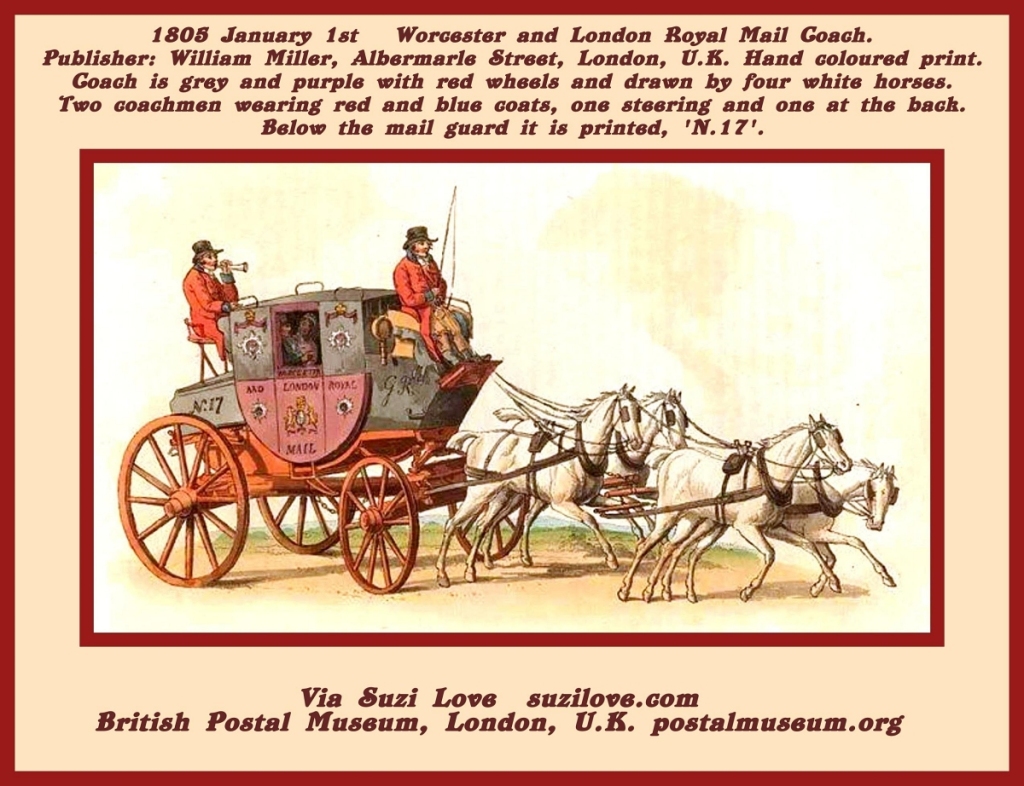
Coach Carriage Line Drawing. Photo Editing by Suzi Love ~ suzilove.com via Pearson Scott Foresman donation to Wikimedia Commons.1805 January 1st Worcester and London Royal Mail Coach. Publisher: William Miller, Albermarle Street, London, U.K. Hand colored print. Coach is grey and purple with red wheels and drawn by four white horses. Below the mail guard it is printed, ‘N.17’. Via Suzi Love suzilove.com British Postal Museum, London, U.K. postalmuseum.org
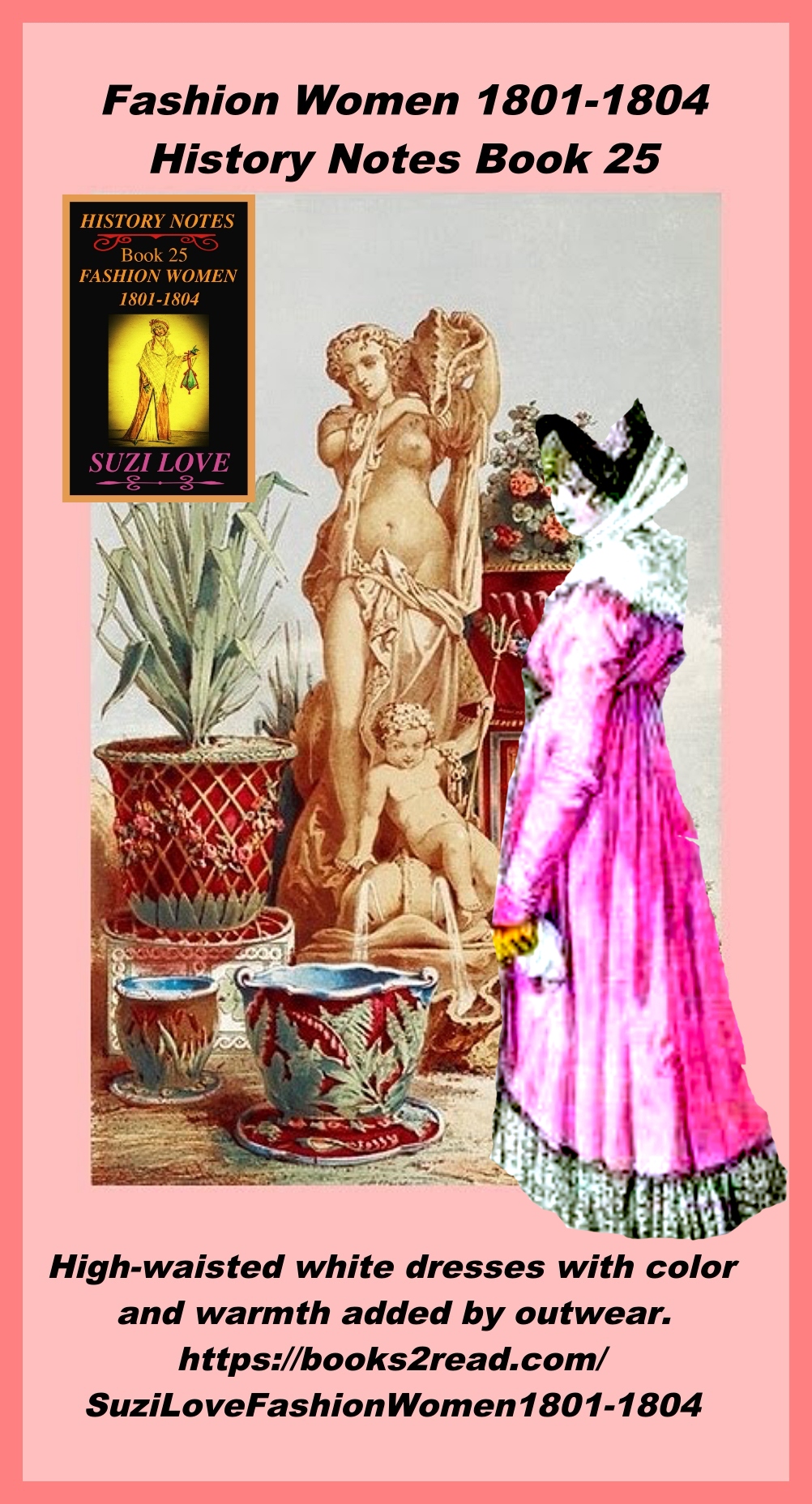
Fan of the Bridgerton Series? Jane Austen Lover? Writer Or Reader Of Regency Era? What did they wear in early 1800s? Women’s clothing changed dramatically in early 1800s. New silhouette copied simplistic styles of Greeks and Romans. High-waisted white dresses and flowing skirts with color and warmth added by outerwear and accessories. Fashion Women 1801-1804 History Notes Book 25 https://books2read.com/SuziLoveFashionWomen1801-1804
Definition Empire Style Dress: High-waisted white gowns defined women’s fashion during the Regency Era. ‘Empire’ is the name given to the period when Napoleon Bonaparte built his French Empire. High-waisted, loose gowns were adopted by the aristocracy as a symbol of turning away from the elaborate clothing worn in the 1700s. This sort of high-waisted dress would have been worn by Jane Austen and her contemporaries in England.
Definition Shawls: The shawl started off in India as a fine wool garment for men that could be worn as a scarf, turban or as a mantle: the word comes from the Persian shäl. Originally imported from the East, European Kashmir shawls were made first in Norwich and Edinburgh in Britain in the late 18th century. Shawls were an essential item in the early 1800s to cover the thin gowns women wore. They were made of muslin, gauze, silk, wool, and velvet, though cashmere shawls were the softest and most prized.
1816 July Opera Dress, English. Dress of white lace worn over a rich soft white satin slip. Skirt trimmed in a style of peculiar elegance, with lace festooned at regular distances, festoons edged by plain band of byas satin and finished by pearl ornaments of a very novel and pretty shape. Lace body is cut byas and richly ornamented round the bosom with pointed lace. Plain long sleeve, very full, except towards the wrist, which is nearly tight to the arm, and elegantly finished with lace. Hair ornamented with a wreath of French roses, parted in front, and simply dressed in loose curls, which fall very low on each side. Hind hair forms a tuft at the back of the head. Necklace, ear-rings, and bracelets of pearl. White satin slippers, and white kid gloves and a blush colored French silk scarf. Fashion Plate via Rudolph Ackermann’s ‘The Repository of Arts’. https://books2read.com/SuziLoveFashionWomen1815-1819
Gorgeous Regency Era clothing came in a wide range of styles to suit every season and occasion. Ladies in the Bridgerton series and in Jane Austen’s times wore Empire style dresses which were usually made of light fabric and floaty in style. By the later 1810s, stripes were very popular and lace and frills were added to make the dress more individual.
Fashion Women 1815-1819 History Notes Book 28 What did Jane Austen wear? https://books2read.com/SuziLoveFashionWomen1815-1819