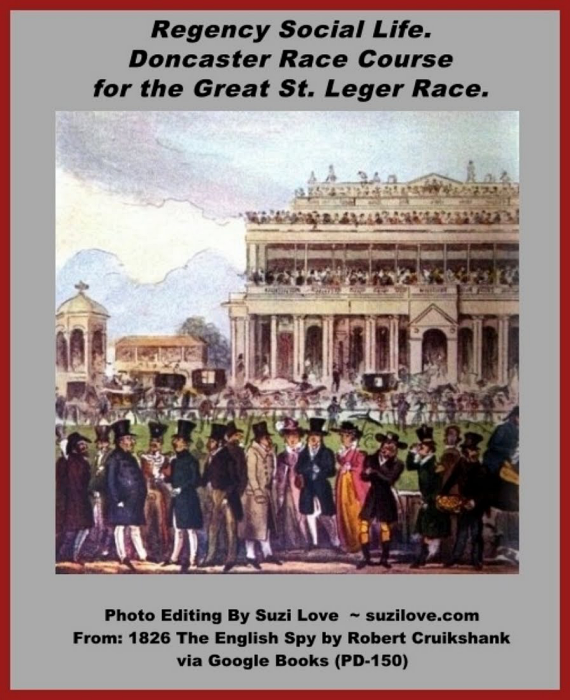
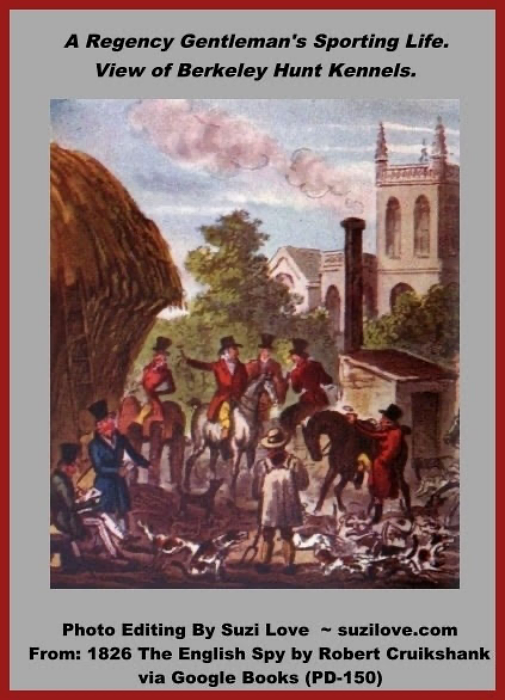
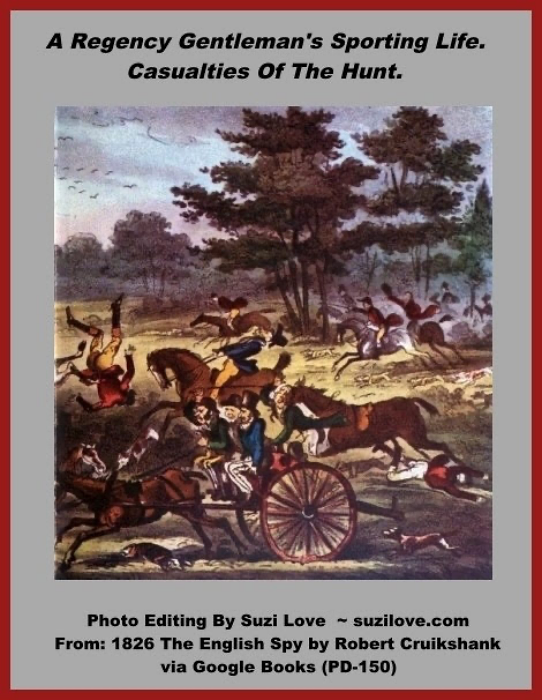
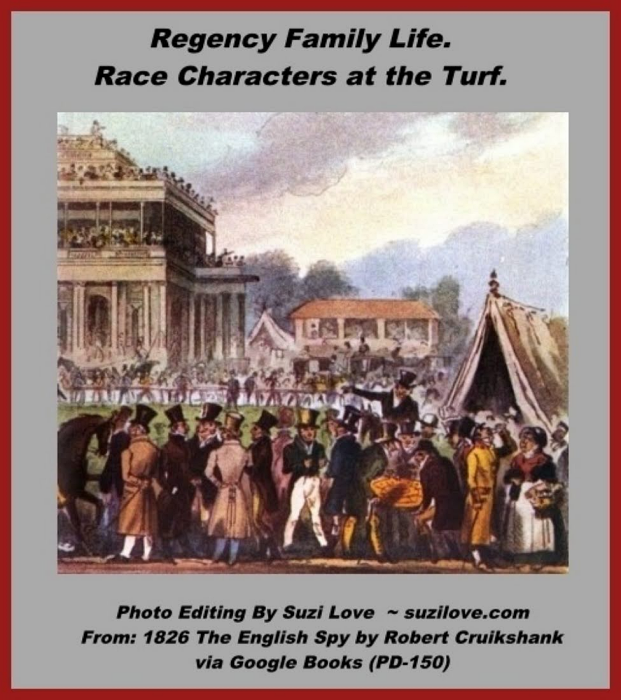
Regency Gentleman’s Sporting Life in the times of the Bridgertons and Jane Austen. By Robert Cruikshank via Google Books Races, bowls, sailing, fox hunting… all the sports enjoyed by people in Regency Era. From: 1826 The English Spy by Robert Cruikshank via Google Books (PD150)
1826 Doncaster Race Course for the Great St. Leger Race. Regency Sporting Life. via 1826 The English Spy By English Cartoonist, Robert Cruikshank.1826 Bowling Alley at Worcester, England. Regency Sporting Life. via 1826 The English Spy By English Cartoonist, Robert Cruikshank.1826 View of Berkeley Hunt Kennel, England. Regency Sporting Life. via 1826 The English Spy By English Cartoonist, Robert Cruikshank.1826 Casualties Of The Hunt.A Regency Gentleman’s Sporting Life. Regency Sporting Life. via 1826 The English Spy By English Cartoonist, Robert Cruikshank.1826 Race characters at the turf, Regency Sporting Life. via 1826 The English Spy By English Cartoonist, Robert Cruikshank.RL_2_D2D_RetailerBuyLink_RL_2
https://books2read.com/suziloveYGD
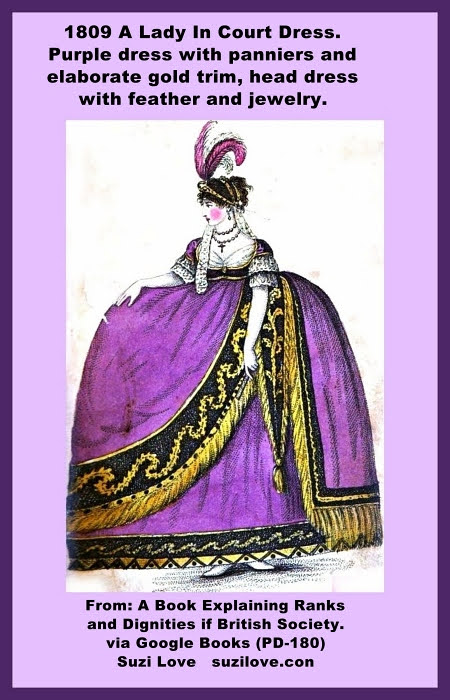
1809 A Lady In Court Dress. From: 1809 A Book Explaining Ranks and Dignities in British Society. via Google Books (PD-180)
Definition Court Dress: Usually, the difference between a court dress and a ball dress was in the quality of fabrics used, how elaborate the design, and the number and quality of the accessories. Plus, in England in the early 1800s court dresses were required by Queen Charlotte to have hoops and in France and other European countries court dresses a long train, usually expensively decorated. During the Regency Era, white cotton dresses were considered suitable for many evening events, but definitely not for an evening event in a palace.
History Notes Book 26. Fashion Women 1805-1809 This book looks at early 1800s fashions, which were elegant and pretty with high waists and fabrics that were almost transparent. These Empire style gown named after Napoleon’s first Empress, became popular throughout Europe, and were then copied around the world. Colorful outwear was added to make an ensemble more attractive and warmer. https://books2read.com/SuziLoveFashionWomen1805-1809
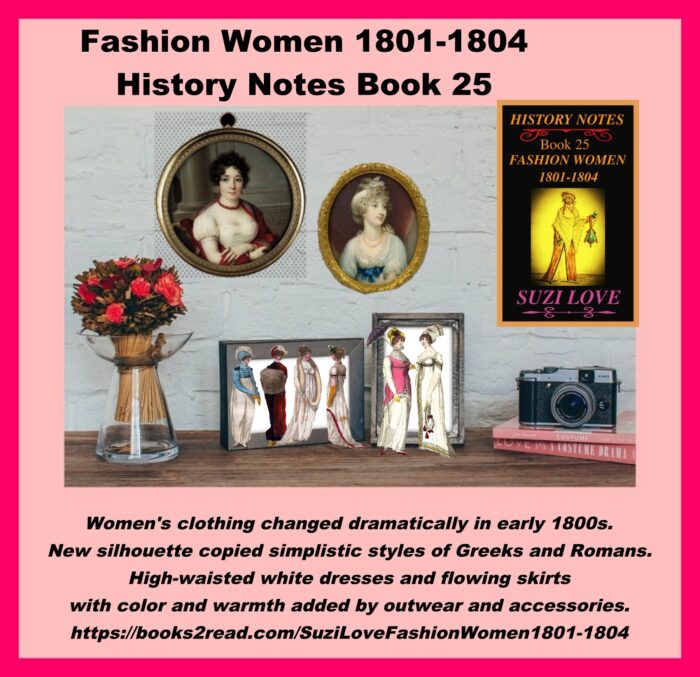
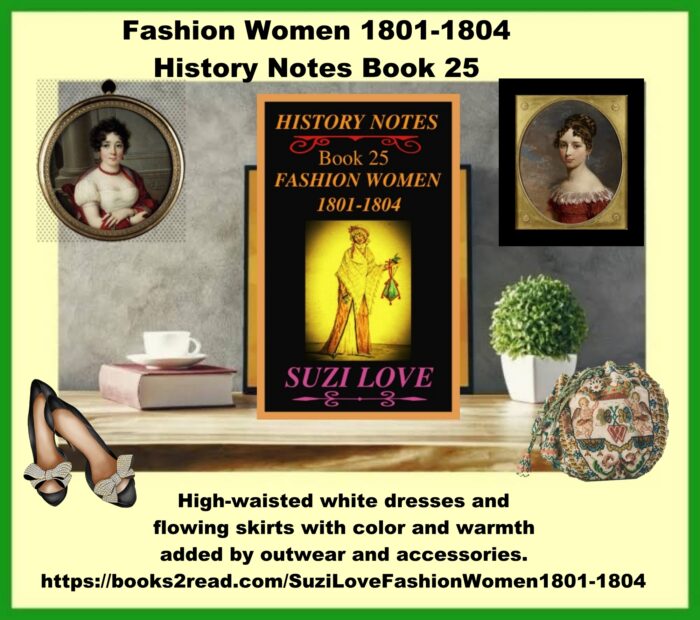
Writer Or Reader Of Regency Era?What did Jane Austen and friends wear? Women’s clothing changed dramatically in early 1800s. New silhouette copied simplistic styles of Greeks and Romans. High-waisted white dresses and flowing skirts with color and warmth added by outerwear and accessories. Fashion Women 1801-1804 History Notes Book 25 https://books2read.com/SuziLoveFashionWomen1801-1804
Definition Empire Style Dress: High-waisted white gowns defined women’s fashion during the Regency Era. ‘Empire’ is the name given to the period when Napoleon Bonaparte built his French Empire. High-waisted, loose gowns were adopted by the aristocracy as a symbol of turning away from the elaborate clothing worn in the 1700s. This sort of high-waisted dress would have been worn by Jane Austen and her contemporaries in England.
Definition Shawls: The shawl started off in India as a fine wool garment for men that could be worn as a scarf, turban or as a mantle: the word comes from the Persian shäl. Originally imported from the East, European Kashmir shawls were made first in Norwich and Edinburgh in Britain in the late 18th century. Shawls were an essential item in the early 1800s to cover the thin gowns women wore. They were made of muslin, gauze, silk, wool, and velvet, though cashmere shawls were the softest and most prized.
Fashion Women 1801-1804 History Notes Book 25 This book looks at the changes to women’s clothing in the early 1800s and the move away from complicated styles and heavy fabrics. The new silhouette copied the simplistic styles of the Greeks and Romans. White dresses were high-waisted and skirts were flowing, with color and warmth added by outwear and accessories. https://books2read.com/SuziLoveFashionWomen1801-1804
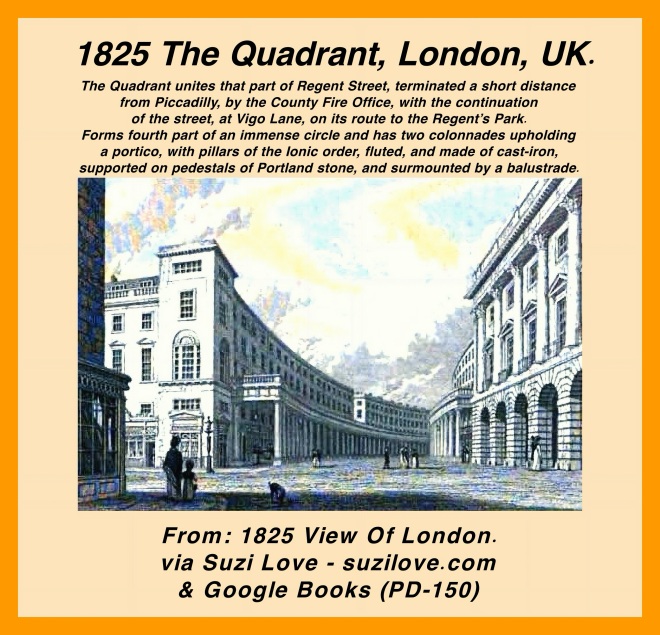
The Quadrant, London, UK. From 1825 Views Of London.
1825 The Quadrant From Views of London via Google Books.
The Quadrant unites that part of Regent Street, terminated a short distance from Piccadilly, by the County Fire-Office, with the continuation of the same street, at Vigo Lane, on it route to the Regent’s Park. As the name imports, it forms the fourth part of an immense circle, and consists of two magnificent colonnades upholding spacious porticos, and attached to two curvilinear ranges of buildings.
The pillars composing the colonnades are of the Ionic order, fluted, and are made of cast-iron. They are supported on pedestals of Portland stone, and surmounted by an appropriate entablature, balustrade, &c. of the same. For elegance of design, and grandeur of effect, the Quadrant may vie with the most celebrated erections of a similar description which have done honour to any period or country. It is well calculated to raise the pride of Englishmen, and excite the admiration of strangers; nor are there many objects in London capable of conveying a higher or juster idea of the architectural taste of the present.
Description The Quadrant: One of the most impressive features of the ‘Royal Mile’ to link Carlton House with Regent’s Park. With the famous curved buildings in Regent Street in central London, it was designed by architect John Nash between 1818 and 1820 to connect lower Regent Street toward Piccadilly Circus. Quadrant Arcade is Regent Street’s only shopping arcade, plus a pedestrian retail passage connecting Regent Street to Glasshouse Street near Piccadilly Circus.
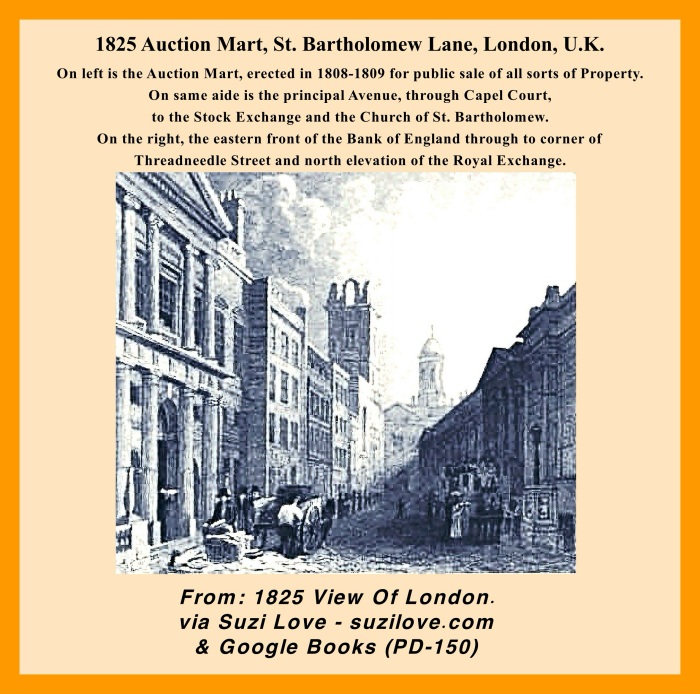
1825 Auction Mart, From Views of London. via Google Books.
The View from the end of St. Bartholomew Lane (at the union of Lothbury and Throgmorton Street), to the entrance into the Royal Exchange at the opposite extremity, has many attractions. Immediately on the left is the Auction Mart, a building which possesses considerable architectural pretensions. It was erected in the year 1808-9, for the public sale of all sorts of Property, and has since had a literary Institution engrafted un the original Establishment.
At some distance, on the same aide, is the principal Avenue, through Capel Court, to the Stock Exchange; and still further, the Church of St. Bartholomew, built in the year 1670. On the right, the eastern front of the Bank of England, which has been lately repaired and much improved, occupies the entire space to the corner of Threadneedle Street: the entrance to the Rotunda. where stockjobbers, &c. carry on their dealings in British Securities, being about the centre of the range, and nearly opposite the Stock Exchange. The View is terminated by a portion of the north elevation of the Royal Exchange, over which the new Tower and Cupola, surmounting the south front of the same Building, and finished in 1824, is conspicuous.
What a scene of even species of Traffic—of the exchange of every denomination of Commodity, and every representative of Wealth—beneath a single glance of eye! Under certain effects and aspects the pictorial correspond in interest and grandeur with the other impressive features of this View.
Regency Life Series Book 2 Young Gentleman’s Day. This book depicts the ups and downs of a young gentleman’s day in the early 1800’s. Through historic images, historical information, and funny anecdotes, it shows how he fills his day, where he goes, and who he spends time with. These light-hearted looks at the longer Regency years are an easy to read overview of what people did and wore, and where they worked and played. There is plenty of information to interest history buffs, and lots of pictures to help readers and writers of historical fiction visualize the people and places from the last years of the 18th Century until Queen Victoria took the throne.
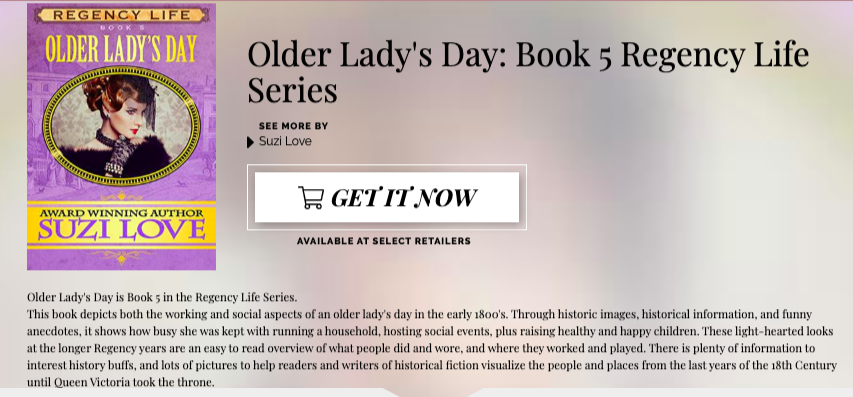
Older Lady’s Day Regency Life Series Book 5. An easy to read overview of what an older lady did, wore, and how she lived in the early 19th Century. Information for history buffs and pictures for readers and writers of historical fiction.
The older lady’s day usually started with her toilette in her bedroom, where her maid helped her dress for the day and styled her hair. After that, she would join her family downstairs for breakfast unless she preferred a tray with either tea or hot chocolate in her bedroom as she prepared for her busy day. Her day would be made up of speaking with the housekeeper and the cook about the week’s menus, assuring that the servants were all available that day and no one was ill, and checking the list of foods needed.
She would also enquire if the laundry was up to date and that they had enough good linen to make up all the beds before extended family members and guests arrived. If she was in the country and hosting a weekend house party, she would assign rooms to the guests on her lists and query that all was in readiness for their arrival.
Writer Or Reader Of Regency Era?What did Jane Austen and friends wear? Women’s clothing changed dramatically in early 1800s. New silhouette copied simplistic styles of Greeks and Romans. High-waisted white dresses and flowing skirts with color and warmth added by outerwear and accessories. Fashion Women 1801-1804 History Notes Book 25 https://books2read.com/SuziLoveFashionWomen1801-1804
Definition Empire Style Dress: High-waisted white gowns defined women’s fashion during the Regency Era. ‘Empire’ is the name given to the period when Napoleon Bonaparte built his French Empire. High-waisted, loose gowns were adopted by the aristocracy as a symbol of turning away from the elaborate clothing worn in the 1700s. This sort of high-waisted dress would have been worn by Jane Austen and her contemporaries in England.
Definition Shawls: The shawl started off in India as a fine wool garment for men that could be worn as a scarf, turban or as a mantle: the word comes from the Persian shäl. Originally imported from the East, European Kashmir shawls were made first in Norwich and Edinburgh in Britain in the late 18th century. Shawls were an essential item in the early 1800s to cover the thin gowns women wore. They were made of muslin, gauze, silk, wool, and velvet, though cashmere shawls were the softest and most prized.
Fashion Women 1801-1804 History Notes Book 25 This book looks at the changes to women’s clothing in the early 1800s and the move away from complicated styles and heavy fabrics. The new silhouette copied the simplistic styles of the Greeks and Romans. White dresses were high-waisted and skirts were flowing, with color and warmth added by outwear and accessories. https://books2read.com/SuziLoveFashionWomen1801-1804
1815 The First Quadrille at Almack’s Assembly Rooms, London. Left to Right: Marquis of Worcester, Lady Jersey, Clanronald MacDonald and Lady Worcester. “It was not until 1815 that Lady Jersey introduced from Paris the favourite quadrille, which has so long remained popular. I recollect the persons who formed the very first quadrille that was ever danced at Almack’s: they were Lady Jersey, Lady Harriett Butler, Lady Susan Ryde, and Miss Montgomery; the men being the Count St Aldegonde, Mr Montgomery, Mr Montague, and Charles Standish.” From The Reminiscences of Captain Gronow 1810-1860.
The patronesses of Almack’s controlled a lot of a young lady’s acceptance into English society in Jane Austen’s times. To be given a voucher and admitted to an assembly, there was an introduction into London’s polite society.
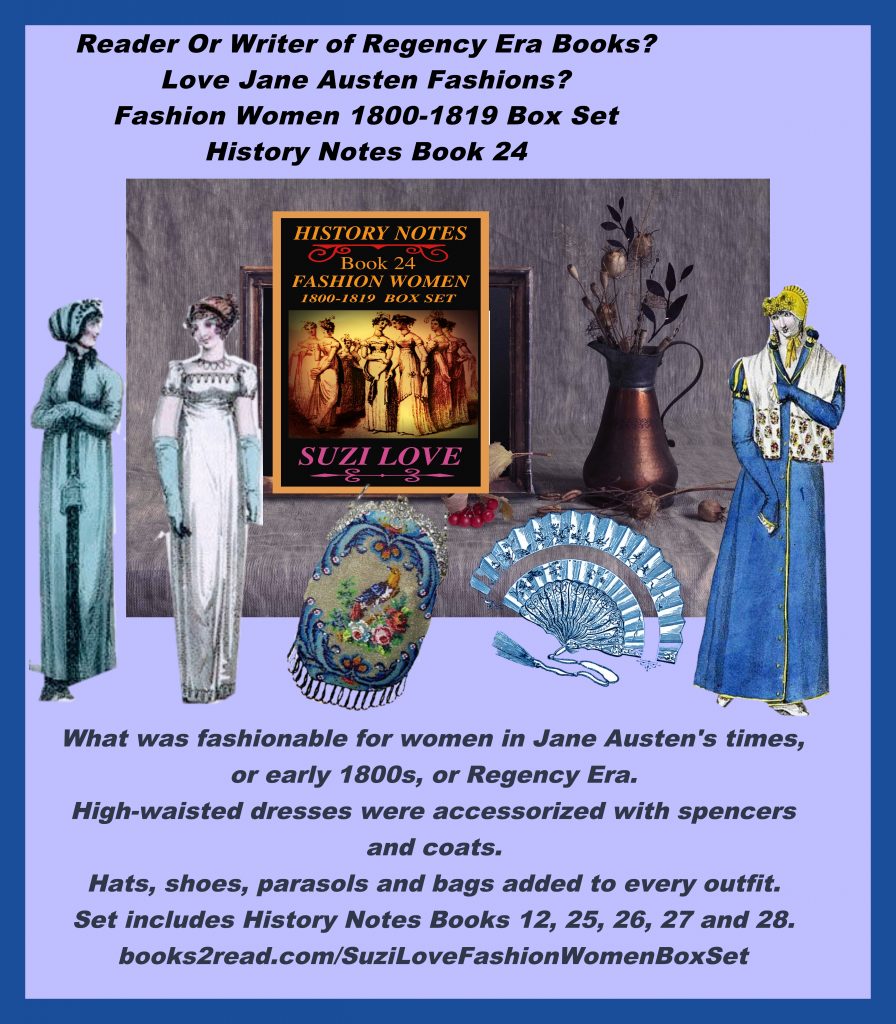
An overview of women’s fashions in the first twenty years of the 19th century. What was fashionable for women in Jane Austen’s times, or the early 1800s. Wars were being fought around the globe, so women’s fashion adopted a military look in support of soldiers. In Britain, the Prince Regent ruled instead of his father, King George III, so fashions, like the lifestyle, became more extravagant and accessories went from pretty to opulent. This set includes books 12, 25, 26, 27 and 28. https://books2read.com/SuziLoveFashionWomenBoxSet
Ladies clothing in the early 1800’s featured a high waist line called an Empire Line, or Empire style dress, with a waist line just under the natural bust line and much higher than the natural waist. The high-waisted, or short-bodied, Regency styles shifted focus away from the natural waist and so left the natural waist unconstricted, in direct contrast to previous and future styles. Britain took these simple European styles and progressively made them more elaborate by adding more and more complicated embroidery onto white fabrics to create the white on white look popular for many years.
The empire look of fine muslin dresses left women more exposed than in the Georgian Era when fabrics had been thicker and styles bulkier. Women, especially in England, preserved their modesty by adding lace, frills, flounces, ruches, and fabric plaits to dresses to adequately cover any parts that might inadvertently be exposed. Outer layers, such as Spencers, Redingotes or Pelisses or coats, and shawls, were also added for warmth and to brighten outfits.
This Empire fashion was totally dependent on a supply of fine, translucent cotton muslin – at first imported from India, then later, less exclusive imitations often woven and printed or embroidered in Britain. Fabrics were soft and lightweight and muslins and other cotton fabrics from India and other Asian countries were in high demand.