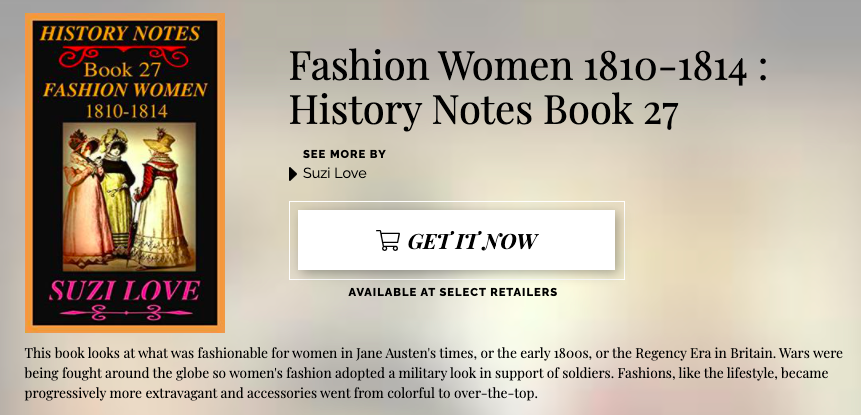
Do you need more factual and visual information for your historical fiction? Try History Notes Books 1-13. Non-fiction Series: Fashion, music and social manners in the 18th and 19th centuries e.g.
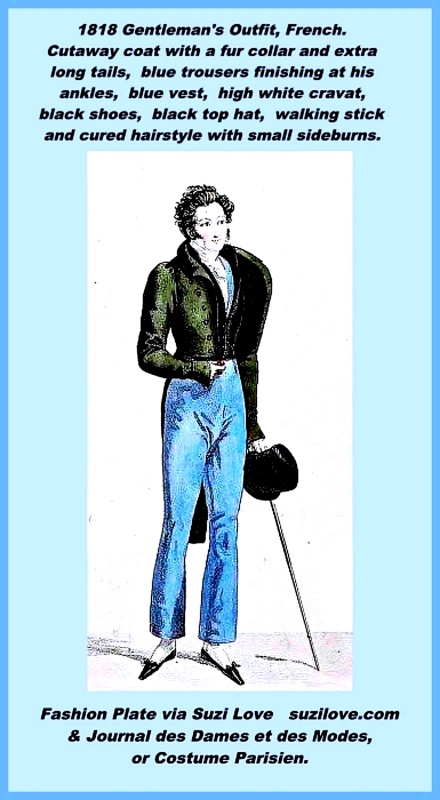
1818 Gentleman’s Outfit, French. Cutaway coat with a fur collar and extra long tails, blue trousers finishing at his ankles, blue vest, high white cravat, black shoes, black top hat, walking stick and cured hairstyle with small sideburns. Fashion Plate via Journal des Dames et des Modes, or Costume Parisien.
19th Century Early Caroline Bonaparte Murat, Wife and Queen Consort Of Joachim, King Of Naples. Wearing a Grand Parure, or jewelry set of tiara, necklace, earrings etc, of red coral, pearls and diamonds. By Salomon-Guillaume Counis, after Nicholas-Francois Dun.
Want a glimpse into the life of a young lady in Jane Austen and the Bridgerton years? #bridgerton #RegencyEra #JaneAusten
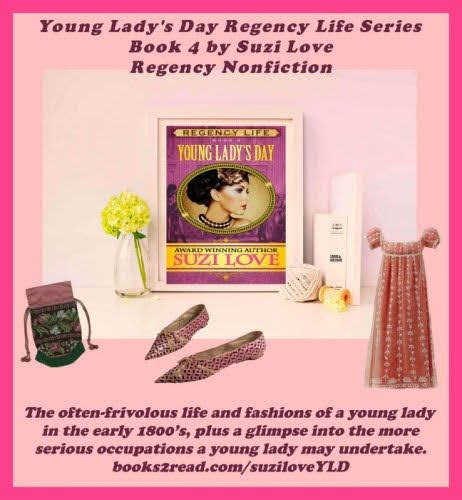
Young Lady’s Day is Book 4 in the Regency Life Series. This book depicts the often-frivolous life and fashions of a young lady in the early 1800’s, but also gives a glimpse into the more serious occupations a young lady may undertake. Through historic images, historical information, and funny anecdotes, it shows how a young lady fills her day, where she is permitted to go, and who she is allowed spend time with. These light-hearted looks at the longer Regency years are an easy to read overview of what people did and wore, and where they worked and played. There is plenty of information to interest history buffs, and lots of pictures to help readers and writers of historical fiction visualize the people and places from the last years of the 18th Century until Queen Victoria took the throne. https://books2read.com/suziloveYLD
Love the life of Jane Austen and her stories? Fan of the Bridgerton series? Reader or writer of the early 1800s, or Regency Era? For information and pictures, try Regency Life Series by Suzi Love. Light-hearted series about Regency Era, or early 1800s. For writers, readers and history lovers.
Thes books use historic images, historical information, and funny anecdotes to give an overview of life through the late Georgian and the Regency years. A light-hearted look at the people, places, and fashions of the times, plus an easy to read overview of the politics and economics. There is plenty of information to interest history buffs, and lots of pictures to help readers and writers of historical fiction visualize the people and places from the last years of the 18th Century until Queen Victoria took the throne.
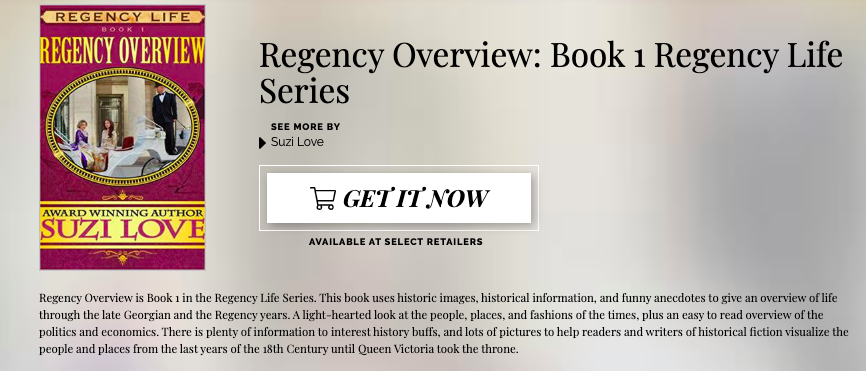
Try Books 1-5 Regency Life Series by Suzi Love. Regency Overview – Young Gentleman’s Day – Older Gentleman’s Day – Young Lady’s Day – Older Lady’s Day
Regency Era Overview: Images, information and funny anecdotes give an overview of life in Jane Austen’s times or early 1800s. #Regency #JaneAusten #BritishHistory
1811 January Walking Dress in the English style worn by Jane Austen and her female relations and friends. Pelisse of scarlet Merino cloth, buttoned down front and up arm with small gold buttons, collar and cuffs of purple velvet, empire tippet pointed in back, Scarlet bonnet turned up with velvet, veil through front, scarlet cloth boots trimmed with velvet. Fashion Plate via John Belle’s La Belle Assemblée or, Bell’s Court and Fashionable Magazine, London.Jane Austen and her contemporaries wore long coats like these to keep warm when out and about, visiting, shopping etc. The thin muslin dresses worn in the early 1800s were little protection against European winters.
Definition Merino Wool: Finest quality wool, originating in Spain. During Napoleonic wars, Merino sheep exported to Britain and other parts of Europe. Napoleon supported Merino growth in France. In 1808, after French invaded Spain, King George purchased additional 2000 Merinos for royal flock but Britain too wet for thriving industry. Other countries i.e. Australia, began producing fine quality Merino.
Definition Velvet: Historically made with silk pile on silk backing, or cheaper backing e.g. linen. Velvets were also made from cotton or wool. Today, silk velvet is usually rayon pile on silk backing so you only see the rayon and not the silk.
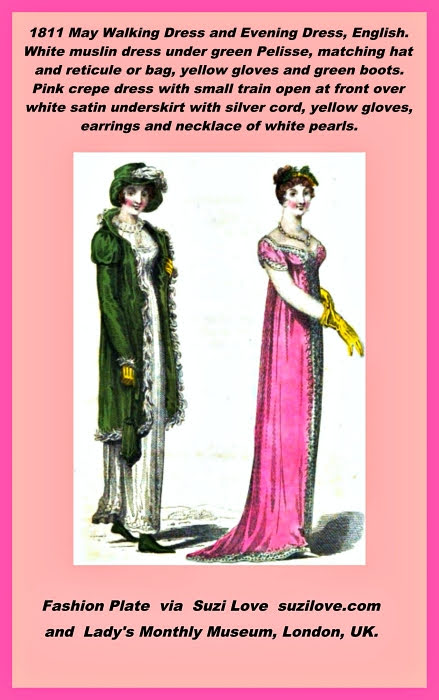
1811 May Walking Dress and Evening Dress, English. White muslin dress under green Pelisse, matching hat and reticule or bag, yellow gloves and green boots. Pink crepe dress with small train open at front over white satin underskirt with silver cord, yellow gloves, earrings and necklace of white pearls. Fashion Plate via The Lady’s Monthly Museum, London, UK.
Definition Walking Dress: Worn out shopping, walking in a city park or the country estate. Presentable and warm, more fashionable than Morning Dress but not overly accessorized.
Definition Evening Dress: Minute distinctions between ball, dinner, evening and opera gowns meant different quality of fabrics and designs.
1826 January Promenade Dress, English. Green walking dress with wide lace hem, zigzag white collar edge, white buttons on front vertical, large fur muff with pink lining, large hat with pink ribbons and black bows on crown. Fashion Plate via Rudolph Ackermann’s ‘The Repository of Arts’, London, U.K.
Definition: Promenade Dress, Walking Dress, Pelisse Or Redingote. Woman’s long, fitted overdress or coat often worn open in front to show off the dress underneath. Sometimes cut away in front. Originally made with several capes and trimmed with large buttons. French word developed from English words, riding coat. reefer. Single- or double-breasted, fitted, tailored, over-all coat usually made from sturdy fabric. In England, this sort of coat was generally called a pelisse, walking dress, carriage dress or promenade dress. In France, these coats were called a Redingote.
1802 Lavender Gown With Long Train and Decorative Trim, French. Short sleeved Empire style, or high-waisted, dress, long pale gloves, black straw hat with ribbon trim, necklace and fan. Fashion Plate via Journal des Dames et des Modes, or Costume Parisien. https://books2read.com/SuziLoveFashionWomen1801-1804
Definition Empire Style Dress: High-waisted white gown defined women’s fashion during the Regency Era. ‘Empire’ is the name given to the period when Napoleon Bonaparte built his French Empire. High-waisted, loose gowns were adopted by the aristocracy as a symbol of turning away from the fussy, elaborate and expensive clothing worn in the 1700s.
The type of dress worn across Europe in the early 1800s. This sort of high-waisted dress would have been worn by Jane Austen and her contemporaries in England. The Empire waist gown defined women’s fashion during the Regency Era. ‘Empire’ is the name given in France to the period when Napoleon built his French Empire. High-waisted, loose gowns were adopted by the aristocracy as a symbol of turning away from the fussy, elaborate and expensive clothing worn in the 1700s.
1802 Lavender Gown With Long Train and Decorative Trim, French. HN_25_D2D_fashwomen1801-1804 https://books2read.com/SuziLoveFashionWomen1801-1804
Want To Know More About Georgian Era Men’s Fashions? Try History Notes Book 2: Fashion Men 1700s Late. What was fashionable for men in the late 1700s? Extravagant colors and fabrics and outrageous styles. Take a look at their suits, hats, accessories and bedroom fashions.
Strictly speaking, the Georgian Era might include all the years that a ‘King George’ ruled in England, but for the purposes of this book the ‘Georgian Era’ is primarily the late 1700s when mad King George III ruled. His son became Prince Regent in the early 1800s, therefore creating the years known as the Regency, and became George IV on the death of his father.
The Georgian years officially ended with the death of King George IV in 1830.
George I ruled 1714-1727
George II ruled 1727-1760
George III ruled 1760-1820
George IV ruled 1820-1830
HN_2_D2D_Fashion Men 1700s
books2read.com/suziloveFashMen1700