“No, she was a very sober- minded young lady, sufficiently well-read in novels to supply her imagination with amusement, but not at all
unreasonably influenced by them.” Jane Austen ~ Sanditon (1817)



“No, she was a very sober- minded young lady, sufficiently well-read in novels to supply her imagination with amusement, but not at all
unreasonably influenced by them.” Jane Austen ~ Sanditon (1817)
1809 September. Garden Promenade Dresses. Empire style gowns, shawls, hats, and parasols for walking in the park, to see and be seen, in London or at fashionable resorts. More elegant than walking dresses, which are usually morning dresses with outerwear and more elaborate headdresses. These are the sort of ensembles that Jane Austen and her family and friends would have gone walking in. Foreground lady has a silk shawl mantelet trimmed with an amber silk fringe and fastened on the bosom with a pebble brooch, amber hoop earrings, white Morocco leather shoes, York tan gloves and a blue parasol with a fringe. Straw hat with flowers. Background lady wears a Nun’s hood that falls over her shoulders and holds a purple parasol. Fashion Plate via John Belle’s La Belle Assemblée or, Bell’s Court and Fashionable Magazine, London.


1808 Gentleman’s Ball Outfit, French. Long tailcoat, black knee breeches, white stockings, high white cravat, white stockings, black shoes and gloves. Fashion Plate via Journal des Dames et des Modes, or Costume Parisien. Typical Gentleman’s outfit as worn by men to balls and evening events in Jane Austen’s Times.

From the finish of the 18th century until 1820, men’s fashions in European and European-influenced countries moved away from the formal wear of brocades, lace, wigs and powder to more informal and relaxed styles. Focus was on undress rather than formal dress. Typical menswear in the early 1800s included a tailcoat, a vest or waistcoat, either breeches, pants, or the newer trousers, stockings, shoes or boots, all worn with an overcoat and hat. This basic ensemble was accessorized with some form of neckcloth or cravat, gloves, walking stick, cane or riding crop, handkerchief, fobs, watch and perhaps a quizzing glass or eye glass.
Skirted coats were replaced with short-fronted, or cutaway, tailcoats worn over fitted waistcoats and plain, white linen shirts. Knee breeches were gradually replaced by tight-fitting pantaloons and later trousers, decorative shoes with buckles were replaced with a variety of boot styles, and fussy and ruffled neckwear gave way to intricately tied, white linen neck cloths. A Regency Era, or early 1800s, gentleman was outfitted in more practical fabrics, such as wool, cotton and buckskin rather than the fussy brocades and silks of the late 1700s.

1807 June Couple In Morning Dress, English. Lady in white dress with lemon cape and an interesting white hat with a tassel. Gentleman in black tailcoat, white shirt and cravat, breeches tucked into high black boots with tan tops, fob and watch chain at his waist, black top hat and cane. via Le Beau Monde, or Literary and Fashionable Magazine, London, U.K.
Definition Morning Dress: Comfortable outfits worn either at home, out shopping, or for walking in the park or country. Presentable but not overly accessorized. For women it was often an Empire style, high-waisted, gown made from sprigged or plain muslin, cotton, or wool and either a Spencer or a coat to cover it for warmth, plus shoes and a bonnet. For men it was breeches or trousers, shirt, cravat, coat, boots and hat. This couple is dressed as a lady and gentleman of Jane Austen’s acquaintance would dress for a morning outing to a village, for shopping, or visiting friends.

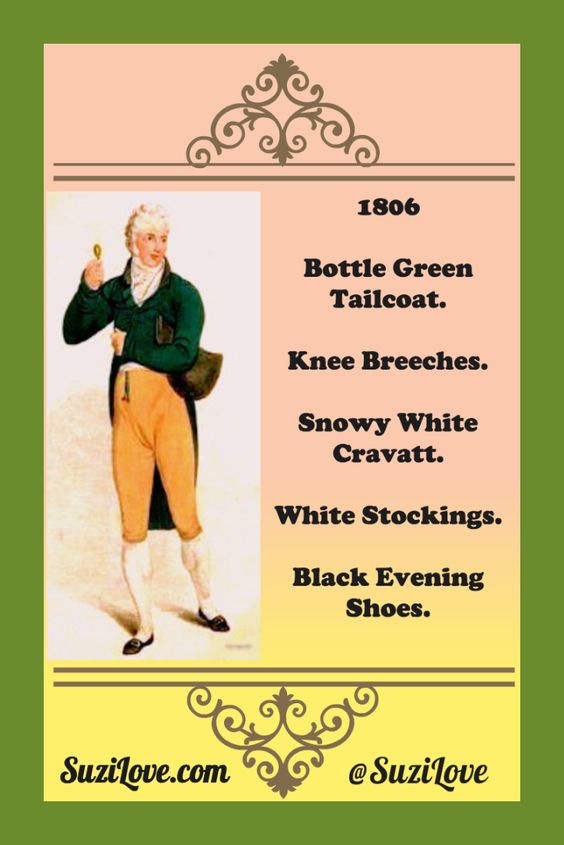
1806 Gentleman’s Daily Outfit, French. Bottle green tailcoat, knee breeches, snowy white cravat, white stockings, flat black shoes. Fashion Plate via Journal des Dames et des Modes, or Costume Parisien. French fashions and Georgian and Regency Era fashions from Great Britain were copied around the world. This is the normal daily outfit for a gentleman in the early 1800s, or in the times of Jane Austen, for daily city and country life. https://books2read.com/SuziLoveFashionMen1800-1819

1810-1814 ca. Muslin Dress, Canada. White muslin embroidered in white cotton with a delicate all-over design of sprigs and sheaves of wheat worked in stem stitch and long and short stitch. Unboned high-waisted bodice with draw-tape casing at square neckline, back draw-tapes at neck and waist, extra-long sleeves, puffed sleeves with flounce and whitework embroidery, straight-cut skirt gathered in back, hem trimmed with crocheted loops in white cotton. Embroidered in white cotton sprigs and wheat sheaves. In 1810s, draw-tapes often replaced drawstrings for bodice adjustment. Skirts changed to flaring around 1815.


The fit of this unboned bodice is controlled by a draw-tape in a casing at the square neckline. The back closure is controlled by draw-tapes at neckline and waist. The extra long sleeves have a narrow shoulder strap, are puffed and end with a flounce. Under the puff is a narrow horizontal insertion of whitework embroidery. The straight-cut skirt is fitted smoothly to the bodice in front, but is gathered to it in back. The hemline is trimmed with crocheted loops in white cotton. Lightweight muslin dresses like this one offered little warmth, so a stole was often needed to cover the shoulders. This dress was originally owned by the De Witt family of Quebec City. via McCord Museum, Canada. musee-mccord.qc.ca

1818 September 18th Le Palais Royal de Paris. ‘A Peep at the French Monstrosities’. Two English tourists dressed as dandies walk arm-in-arm under the arcade of the Palais Royal, interested in the promenading courtesans. Their dress is rather similar to that of the Englishmen, but the latter wear bell-shaped top-hats, while the Frenchmen have flower-pot shaped hats. By George Cruikshank. Via British Museum, London, UK. britishmuseum.org (PD-Art)

Easy to read overview of what an older lady did, wore, and how she lived in Jane Austen and Bridgerton’s time. Information for history buffs and pictures for readers and writers of historical fiction. Older Lady’s Day Regency Life Series Book 5 by Suzi Love books2read.com/suziloveOLD


1819 Gardens of the Tuileries Near the Rue de Rivoli, Paris, France. Woman in a red walking dress, or Redingote, or Pelisse, modeled after British riding dresses and worn with a high white bonnet with feathers, or plumes. The skirt remains fairly narrow and the waist is fairly low, indicating the transition into 1820 styles. In the background are women walking with children. From Illustrations by François Courboin from Octave Uzanne’s Les Modes de Paris.
Variations du goût et de l’esthétique de la femme, 1797-1897, L. Henry May, Paris, 1898, or from the English translation of the same work: Fashion in Paris : the various phases of feminine taste and aesthetics from 1797 to 1897, William Heinemann, London, 1898.


1809 February Walking or Carriage Dress, English. Polanese coat, Saragossa mantle of spring green Virgnia cloth, trimmed round the edges and up the front of the coat with black velvet bindings, and edgings of gold lace. High puckered collar, confined round the throat with a gold cord and acorn tassels. Belt of black velvet, and rich gold clasp. Military cap formed of the same material, and trimmed also with black velvet and gold. Short white lace veil falling from the edge of the cap just below the chin. Half-boots of green kid or cloth, calashed and bound with black, and laced with gold cord. Fashion Plate via John Belle’s La Belle Assemblée or, Bell’s Court and Fashionable Magazine, London.
