Are you a Bridgerton fan? Love Jane Austen? Love history? Take a look at a Young Gentleman’s Day in early 1800s. Young Gentleman’s Day Regency Life Series Books 2 by Suzi Love. Easy to read books on what a young gentleman did, wore, and lived during the early 1800s, or the Regency Era when King George 3rd was mad and his son, Prince George, was the Regent in Britain. #Regency #JaneAusten #amwriting books2read.com/suziloveYGD
1807 Fashionable French Couple. Man: Blue cutaway coat and yellow breeches. Lady: Lemon and blue dress and bonnet. This is the fashion styles worn by Jane Austen and her family and friends in the early 1800s. Fashion Plate via Journal des Dames et des Modes, or Costume Parisien.https://books2read.com/SuziLoveFashionMen1800-1819
1818 December 11th A dandy fainting or – an exquisite in fits. Scene a private box opera. A dandy lies back fainting in a chair, his limbs rigid, supported by three others while a fourth (left) draws the curtain, cutting off a view of the (distant) stage where a singer is posturing. Via British Museum, London, UK. britishmuseum.org (PD-Art)
1818 September ‘A Nice Gentleman’ By George Cruikshank. A grotesque dandy walks outdoors sucking a cane. Inscribed with names of food, e.g. red carbuncled rose is ‘Currant Jelly’, shallow broad-brimmed hat is ‘Calves Head Jelly’ and ‘Pancake’, cravat which covers neck, cheek and chin is ‘Puff Paste’, loose short trousers are ‘White Sugar Bags’, handkerchief ‘Blow Monge’ and long spurs ‘Gilt Gingerbread’. Via British Museum, London, UK. britishmuseum.org (PD-Art)
1800s Early Tattersall’s Horse Auctions, London, U.K.. Top sporting venue for Regency Life in London. ‘A mixture of persons of nearly all ranks’. By Pierce Egan. Via Wikimedia Commons (PD-ART)
In Jane Austen’s and Bridgerton times, or the Regency Era, horse riding was a vital mode of transport and Tattersall’s was the best place to buy and sell horses. Tattersall’s was established in 1773 near Hyde Park Corner for the sale by auction of horses, carriages, hounds and harnesses. Sales during the winter months were every Monday and Thursday, and on Mondays only during the spring and summer. On the mornings when there was no sale, Tattersall’s was a meeting place for fashionable sporting gentlemen.
Pierce Egan’s Description of Tattersall’s
A masquerade could scarcely exhibit more motley groups than the attendants of this place of fashionable resort. There were Peers, Baronets, Members of Parliament, Turf gentlemen and Turf-servants, Jockies, Grooms, Horse-dealers, Gamblers, &c. There you might see the oldest and some of the best blood in England, disguised like coachmen.
From: 1820 Sporting Anecdotes by Pierce Egan via Google Books (PD-150)
1818 ‘The Stamford Dandy or A Modern Peeping Tom’. Lord Stamford rides past a row of houses looking through his glass at a woman who stands at an open first-floor window. Other women watch him from the two other windows. Dressed as a dandy with red tailcoat, high white collar and cravat, black top hat and wearing loose white trousers. Artist not known. Via British Museum, London, UK. britishmuseum.org (PD-Art)
1819 Typical Gentleman’s Outfit, French. The type of outfit worn by Jane Austen’s male family and friends. Brown cutaway coat with extra long tails, white trousers, high white cravat, heeled black boots with spurs, gloves, black top hat and a cane. Fashion Plate via Journal des Dames et des Modes, or Costume Parisien.
Trousers: The word Trouser came into usage in the late 1600’s, so we’ve had trousers around for a long time. But at first, they were mostly for lower classes. Revolutionary France started a trend for sans-culottes, which meant trousers or pantaloons instead of culottes, or knee breeches, which were associated with the aristocracy. The styles of the revolution moved across to England and were taken up by those who either sided with revolutionary ideals or who took them up as part of a protest against the establishment set. Early on, trousers were generally a bit looser than pantaloons or breeches and ended at the ankles, often with side slits to get the foot through or straps under the foot straps to keep the trousers in place.
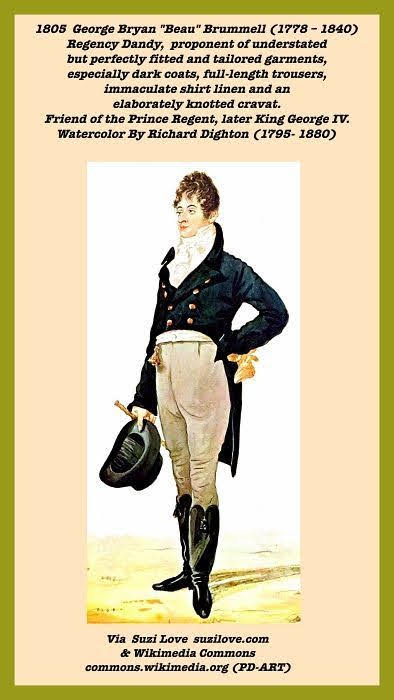
George Bryan “Beau” Brummell (June 7th 1778 – March 30th 1840) Arbiter of men’s fashion and friend of the Prince Regent, the future King George IV. Established mode of dress for men that rejected overly ornate fashions for understated but perfectly fitted and tailored clothing. Look based on dark coats, full-length trousers rather than knee breeches and stockings, with immaculate shirt linen and an elaborately knotted cravat. 1855 Engraving of Beau Brummell from an article in Harper’s New Monthly Magazine.
1823 Couple In Walking Dress, French, as worn in Europe and England in the Regency Era. Redingote, or Coat, with matching hat, neck frill of Gros de Nice lace. Gentleman in tailcoat, short length brown trousers, yellow vest, high white cravat, top hat and black shoes. via Modes Françaises L’Indiscret, France.