18th Century Late. Inkstand, Sheffield, England. Square, resting on four ball feet, the top pierced with four circular holes into which fit two inkwells, a pounce box and a box for wafers. Silver inkstands appeared in Britain in 17th century and included pot, or well, for ink, plus another pot with pierced cover held ‘pounce’ or sand, which writers scattered over paper to fix ink. Wafers to seal finished letter and tray to hold pens or quills. collections.vam.ac.uk
In Jane Austen’s times craftsmen created boxes and containers of precious metals, leather, silks, and decorated them with jewels. Boxes, Cases, Etui, Necessaire and everything else that was used to carry essential items for travel, sewing, medicine, writing, and toiletries. Containers were engraved to make exquisite and expensive items as well as practical carrying cases. books2read.com/suziloveBoxesCases
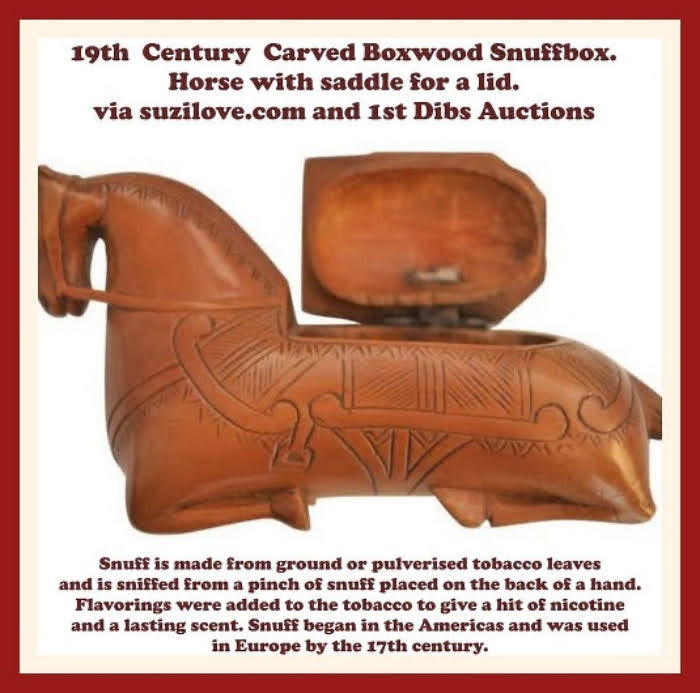
19th Century Snuff Boxes. Not only were boxes made to serve a purpose, but decorative boxes of all types were prized, especially in the 18th-19th Centuries when everything decorative and extravagant was in vogue and taking a pinch of snuff was fashionable. Snuff is made from ground or pulverized tobacco leaves and is sniffed from a pinch of snuff placed on the back of the hand.Flavorings were added to the tobacco to give a fast hit of nicotine and a lasting scent. Snuff began in the Americas and was used in Europe by the 17th Century.
Snuff became popular from the mid 1600s to the mid 1800s and was more popular than smoking. Inhaling snuff, or snuffing, was first seen by a European missionary in 1493 in Christopher Columbus’s new world within Haiti’s indigenous Taino. Until then, tobacco had been unknown to Europeans, but its use spread quickly throughout Europe during the 1500s. By the second half of the 17th century, ornate boxes started being produced to keep the precious powder dry and an entire industry making accessories blossomed around the fashion of taking snuff. Noblemen, and some women, carried extravagantly decorated snuff boxes with them at all times and would offer a pinch of their own particular blend to friends and family. Therefore, these boxes were always on display and so it became a competition to see who could have the most bejeweled or expensive box possible. By the mid 1800s, snuff taking was no longer popular so these exquisite and expensive snuff boxes became decorative, rather than functional.
19th Century Shoe Snuffbox. via 1st Dibs Auctions 1stdibs.com19th Century Engraved Horn Snuffbox. Heart surrounded by flowers and leaves, sides with dove, symbol of purity and peace, brass hinge and setting. via 1st Dibs Auctions19th Century Carved Boxwood Snuffbox. Horse with saddle for a lid. via 1st Dibs Auctions
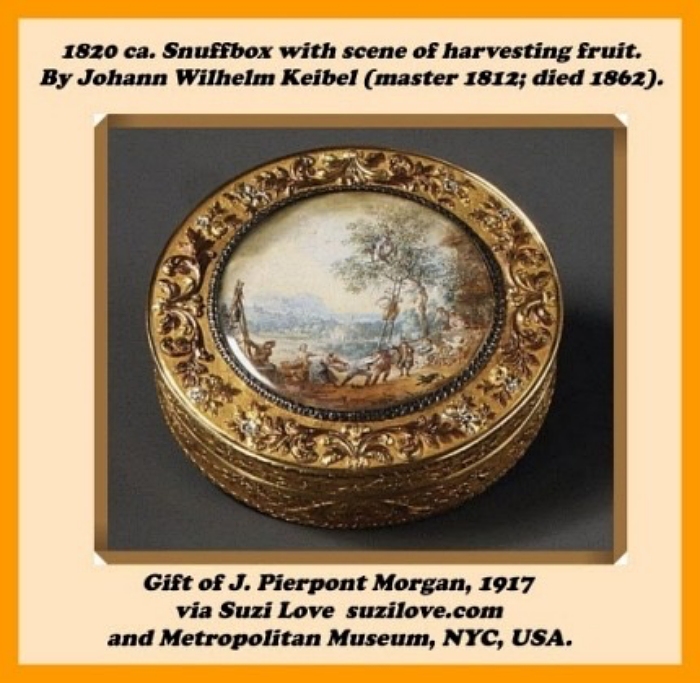
1804-1809 ca. Snuffbox in the Shape of A Lion, Moulinie, Bautte and Cie, Geneva, Switzerland.via Victoria and Albert Museum.1820 Snuffbox with scene of harvesting fruit. By Johann Wilhelm Keibel (master 1812; died 1862). via Metropolitan Museum New York City, U.S.A. metmuseum.org1810 ca. Jeweled Gold Snuff Box, Switzerland. Maker’s Mark Geneva. via Christie’s Auction Rooms. christies.com 19th Century Taking Snuff and Pretty Snuff Boxes In Bridgerton and Jane Austen Years. #bridgerton #RegencyEra #JaneAusten #Antiques https://www.books2read.com/suziloveBoxesCases Share on X
Music history from the 17th, 18th, and 19th Centuries. Pianos, pianofortes, harps, viols, violins played during Jane Austen’s times. Musical Instruments were so important in most of the more affluent households in history that large industries grew all around the world to manufacture instruments, musical accessories, and to print sheet music. Musical instruction and encouragement could be found everywhere and both young ladies and gentlemen were encouraged to have musical appreciation. And of course, playing music was on the list of social requirements for all young ladies desirous of becoming a wife and homemaker.
London became Europe’s leading centre for the manufacture of scientific instruments and this led to the manufacture of more musical instruments as well as factories developed and rail transport helped the faster distribution of goods to regional areas. One of the first places that music was used to tell stories and to share enjoyment was in Christmas music. Because music was such an integral part of households, music was always a feature in Magazines. There were advertisements everywhere for musical instruments for sale, for sheet music, and for music lessons. And of course, of most interest to the ladies were the hundreds of fashion plates included in magazines where people were depicted with their musical instruments.
19th Century Cross Letter or Cross Writing or Cross Hatching. The writer reached the bottom of the page, turned the paper sideways and adds a second layer of text. During the 19th century, paper was expensive and postal delivery was charged per page, or by the size of the paper. Cross-writing was a way to save paper and postage in Jane Austen and Bridgerton times, and many of Jane Austen’s letters were written this way. Once it becomes familiar, the mind adapts easily and cross-writing letters are surprisingly legible. Charles Darwin also favored this technique.
Rates of Postage of single Letters in Pence.
From any post-office in England or Wales, to any place not exceeding 15 miles from such office – – – 3
For any distance above 15, and not exceeding 30 miles — — 4
For any distance above 30, and not exceeding 50 miles — 5
For any distance above 50, and not exceeding 80 miles – 6
For any distance above 80, and not exceeding 12O miles — 7
For any distance above 120, and not exceeding 170 miles – 8
For any distance above 170, and not exceeding 230 miles — 9
For my distance above 230, and not exceeding 300 miles — — 10
For any distance above 300, and not exceeding 400 miles – 11
For any distance above 400, and nut exceeding 500 mites — 12
1802 Picture of London Printed for R. Phillips via Google Books (PD-180)
And so in proportion; the postage increasing progressively one penny for a single letter for every like excess ok distance of 100 miles. 1802 Picture of London Printed for R. Phillips via Google Books (PD-180)
The Twopenny Post- Office.
There are two principal offices, one in the General Post—office yard, Lombard—street and the other in Gerrard-street, Soho. There are also numerous receiving houses in both the town and country.
There are SI X collections and deliveries of letters in town daily, (Sundays excepted) and there are two dispatches from, and three deliveries at, most places in the country, within the limits of this office.
1802 Picture of London Printed for R. Phillips via Google Books (PD-180)
1826 The Dinner Party. Social Life. From 1826 The English Spy By Robert Cruikshank. via Google Books (PD-180).
An older lady usually controlled the servants and the serving of meals. For more about this, take a look at Older Lady’s Day Regency Life Series Book 5 by Suzi Love. Overview of what an older lady did, wore, and how she lived in the early 19th Century. Information for history buffs and pictures for readers and writers of historical fiction. books2read.com/suziloveOLD
Do you need more factual and visual information for your historical fiction? Try History Notes Books 1-28. Non-fiction Series: Fashion, corsets, Regency Era, music and social manners in the 18th and 19th centuries e.g.
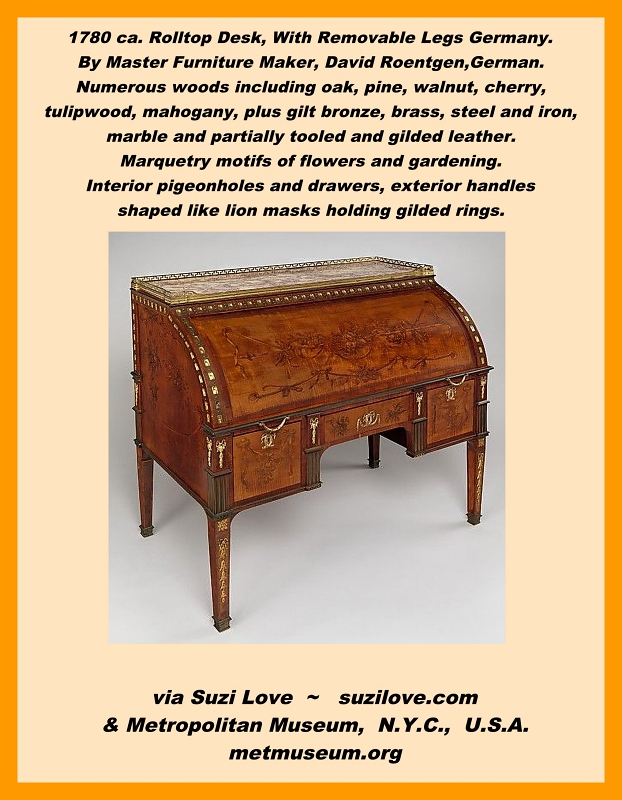
1780 Rolltop Desk, With Removable Legs Germany. By Master Furniture Maker, David Roentgen,German. Numerous woods including oak, pine, walnut, cherry, tulipwood, mahogany, plus gilt bronze, brass, steel and iron, marble and partially tooled and gilded leather. Marquetry motifs of flowers and gardening. Interior pigeonholes and drawers, exterior handles shaped like lion masks holding gilded rings. via Metropolitan Museum, N.Y.C., U.S.A. metmuseum.org