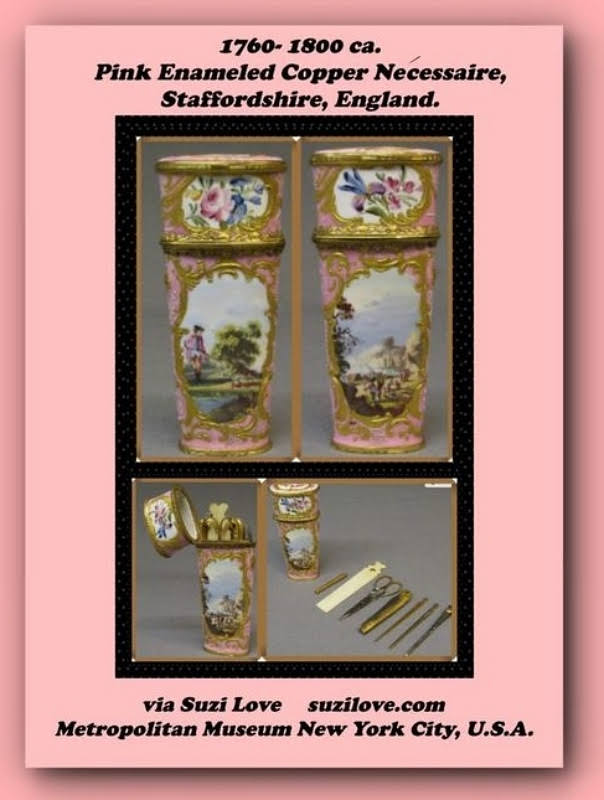
1760-1800 ca. Pink Enamel and Copper Necessaire Or Etui, Staffordshire, England. Dimensions: 3 3/4 x 1 5/8 in. (9.5 x 4.1 cm) Credit: Pierpont Morgan, 1917 via Metropolitan Museum, N.Y.C., U.S.A. metmuseum.org
Definition Necessaire Or Etui: Small toiletry, writing, or sewing containers were called Necessaire or Etui: Tiny boxes or containers were carried in large castles or sprawling manor houses so a lady or gentleman had their essentials with them all day. They were also important when traveling by coach, trains, or on ships where space was always limited. A necessaire or Etui was easily carried in a bag, reticule, or pocket so essentials were on hand for personal grooming, to repair a ripped hem, replace a button, to embroider, or to write a note or letter.
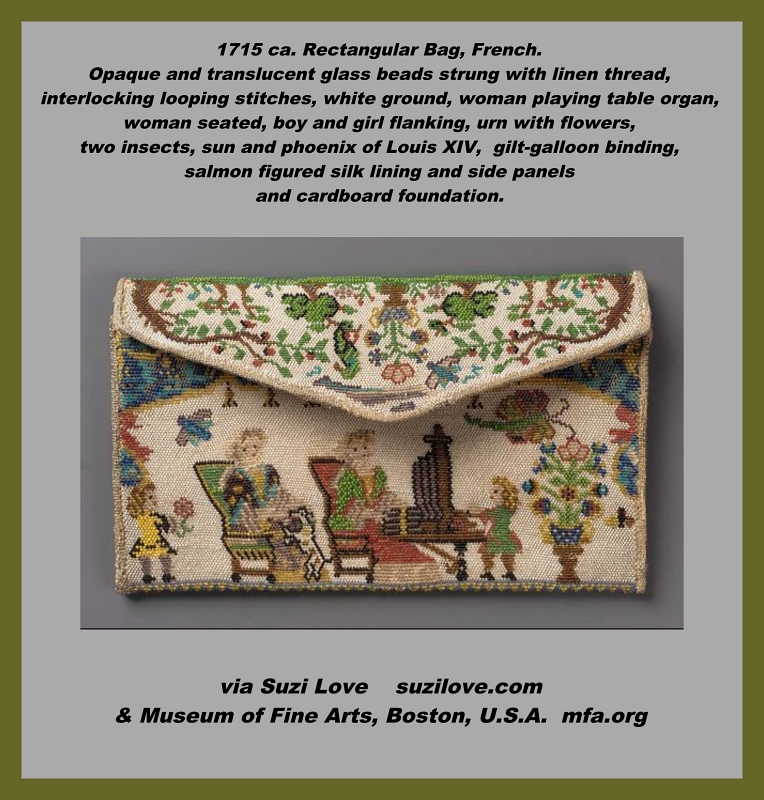
1715 ca. Rectangular Envelope Style Bag, French. Polychrome opaque and translucent glass beads strung with linen thread, held together by interlocking looping stitches (sablé). Design on white ground: woman playing table organ, woman seated, boy and girl flanking, urn with flowers right, two insects and curtain above (obv.); sun and phoenix of Louis XIV, ribbon above inscribed IE VIS SANS MOURIR, inscribed at bottom and right SI IE MEURS CE NEST QUE POVR REVIVRE (rev.); vegetative scene (flap). Gilt-galloon binding. Salmon figured silk lining and side panels. Cardboard foundation. via Los Angeles County Museum of Art, California, USA. collections.lacma.org
There has been some discussion on the names for Corset Makers. I’ve seen lots of names, including Stay Maker, Stay Manufacturer, Corset Maker, Body Tailor and Milliner. It was mainly men who were Stay Makers, but there were also some women who included stay making with their millinery.
Corsets Overview History Notes Nonfiction Book 14. This book shows how body wraps, stays, and corsets were worn to create a variety of fashionable silhouettes through past centuries. Corsets flattened breasts and accentuated rounded hips or pushed up breasts and showed off the bust line depending on the fashions of the time and the desired silhouette. Includes corsets through the Georgian, Regency, Victorian and Edwardian Eras and Jane Austen’s lifetime. Overview of corsets through history, including the Georgian, Regency, Victorian and Edwardian Eras and Jane Austen’s lifetime.
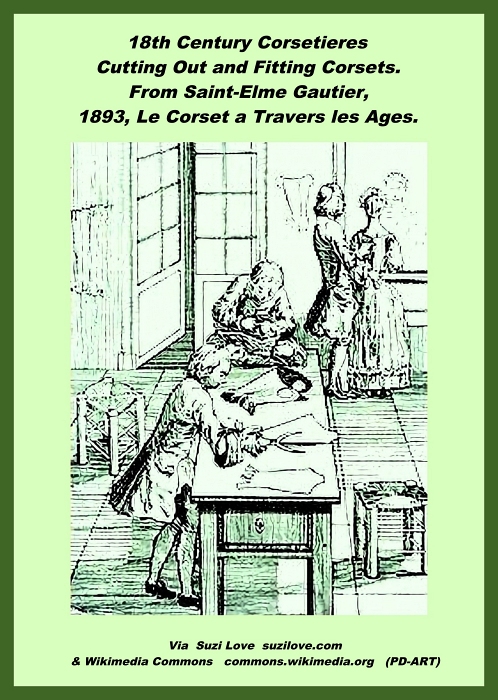
1776 April 28th John McQueen, Stay Maker., New York. At the sign of the White Stays in Smith Street,near the Mayor’s baths, New York. Making all sorts of stays in the newest fashion that is worn by the ladies of Great Britain or France. Packthread stays for babies from one month to seven years, stays for children of Tabby, Ruffled Canvas, Or Buckram, and for older girls an assortment of thin boned stays of different sorts and sizes.1835 Milliner, Dress and Corset Maker to the Royal Family. Mrs. Langdon. 37 Milson Street, Bath, U.K. Local Trade Advertisements. From 1835 The Historical and Local New Bath Guide By C. Duffield. via Google Books (PD- 150)18th Century Interior of the shop of a body tailor, or corset maker. From 1893 The Art of the Tailor of the Bodies of Women and Children.1835 Fashionable Long and Short Stay Manufacturer. Robert Drew & Co. Local Trade Advertisements. From- 1835 The Historical and Local New Bath Guide. Published by C. Duffield via Google Books (PD-150)18th Century Corset Maker From 1893 Le Corset, A Travers Les Ages.18th Century Corsetieres cutting out and fitting. From Saint-Elme Gautier, Le Corset a Travers les Ages. en.wikipedia.org
1798 Woman’s Light Blue Douillette, Or Housecoat, French. Trimmed with pink velvet, pink fan, black slave sandals, apricot hat with black trim. Fashion Plate via Journal des Dames et des Modes, or Costume Parisien.
Description Douillette: A coat or housecoat, sometimes quilted, worn in France.
What was fashionable for women in the late 1700s? Extravagant colors and fabrics and outrageous styles were all seen in these flamboyant fashions. #Georgian #nonfiction #amwriting books2read.com/suziloveFashWomen1700s
1750-1770 ca. Back Lacing Linen Corset, European. Made of linen, lining of natural linen, chamois leather to strengthen, straps of linen, stiffening of whalebone. Corset: deep point, hip flaps, lacing at the back, Netherlands.
Description: Quilted linen corset with vertical tunnels and with ribs. Whalebone stiffening, point on front, hip flaps, front shoulder straps of fabric plus long narrow linen strips to tie. Lined and has chamois leather at armpits, front point and waist. Linen corset with a deep thickened point at the front, hip flaps, and lacing at the back. Fully quilted with vertical tunnels, with ribs. Thickened tip at the front is slightly triangular. Above for round shape due to wide horizontal rib. Flares from the waist into hip phlangers, or fingers. Lacing eyelets and criss-crossed lacing at the back. Front shoulder straps are of the fabric with very long linen straps with narrower linen strap, total 110 cm, and two horizontal linen loops on top of the backs. There is a narrow linen strip on all seams and along all edges. Armpits and the front point are reinforced with chamois leather and chamois leather is at the waist with straps attached. Via Mode Museum Province of Antwerp
Corsets 1700-1790 History Notes Book 15 This book shows how body wraps, stomachers and stays were worn during the 1700s. They created a variety of fashionable silhouettes to suit the elaborate fashions worn for court and daily life during the 18th Century. Wearing the correct underclothing was essential for keeping garments in place and giving the best fashion display.
1740–1760 ca. Silk and Cotton Petticoat. via Suzi Love ~ suzilove.com & Metropolitan Museum, N.Y.C., U.S.A. metmuseum.org
HN_1 Fashion Women Late 1700s History Notes Book 1 by Suzi Love.
What was fashionable for women in the late 1700s? Extravagant colors and fabrics and outrageous styles were all seen in these flamboyant fashions.
books2read.com/suziloveFashWomen1700s
1798 Two ladies in Jane Austen style white walking dresses. Left: Dress has gold trim, white bonnet, green Parasol. Right: Stand up collar, short puffed sleeves, brown shawl and coiled head dresses, both with necklaces. via Rijks Museum, Amsterdam, Netherlands. rijksmuseum.nl
HN_1 Fashion Women Late 1700s History Notes Book 1 by Suzi Love.
What was fashionable for women in the late 1700s? Extravagant colors and fabrics and outrageous styles were all seen in these flamboyant fashions.
books2read.com/suziloveFashWomen1700s
1715-1775 ca. Flat Drawstring Bag, French. Strung glass beads, or sablé, held together by looping stitches. Polychrome Rococo design on white ground, shepherd, shepherdess, four sheep around orange tree center, border with cornucopias and flowers. Ecru silk cord drawstrings with floral bead-covered wood tassels. Blue silk lining. via Museum of Fine Arts, Boston.
1790-1810 ca. Woman’s Black Wool Shoes. Pointed toe and low wedge heel covered in same fabric, black tape binding, leather straight or symmetrical sole, linen insole and lining. Wool satin with wool twill tape binding, plain weave linen lining, and leather sole. Place of Use: Lexington, Massachusetts, United States. Place of Manufacture: possibly Massachusetts, United States Provenance: Worn by a member of the Robbins family; inherited by Ellen A. Stone; gift to MFA, 1899. Credit Line Gift of Miss Ellen A. Stone via Museum of Fine Arts, Boston, U. S.A.
In Jane Austen’s years, she and her contemporaries spent a lot of time outdoors. Fragile slippers were worn for balls and evening events but for walking sturdier shoes were needed, In the early 1800s, these were typically made of leather and were flat or had a very small heel.
1797 Elegant Couple Dancing At A Ball. Man: Bottle green tailcoat, yellow knee breeches, white stockings, red vest and black dancing slippers. Lady: White spotted dress with a pale pink overdress open at the front, high belted waist, red and green turban and a parure, or jewelry set. via Fashion Plate via Journal des Dames et des Modes, or Costume Parisien.
HN_2_D2D_Fashion Men 1700s
books2read.com/suziloveFashMen1700