18th Century Mid. Nécessaire, London, England. Wood, shagreen, silk, tortoiseshell with gold mounts, steel. Includes: pen knife, beard trimmer, scissors, bottles, paper cutter, 6 razors, hone, strop. via Metropolitan Museum New York City, U.S.A. metmuseum.org
Definition Shagreen: A type of rawhide, or rough untanned skin, originally made from the back of a horse or a wild donkey. In the 18th century, the skin of a shark or stingray also began to be called shagreen.
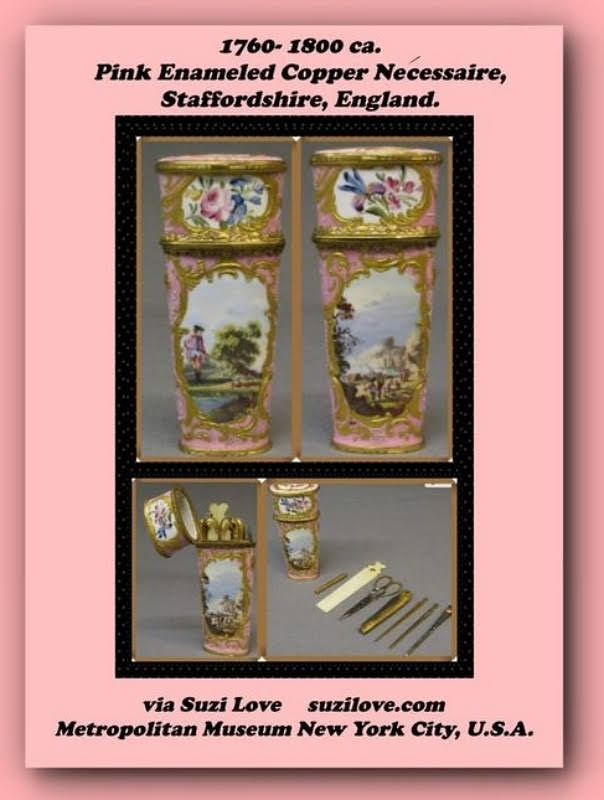
1760-1800 ca. Pink Enamel and Copper Necessaire Or Etui, Staffordshire, England. Dimensions: 3 3/4 x 1 5/8 in. (9.5 x 4.1 cm) Credit: Pierpont Morgan, 1917 via Metropolitan Museum, N.Y.C., U.S.A. metmuseum.org
Definition Necessaire Or Etui: Small toiletry, writing, or sewing containers were called Necessaire or Etui: Tiny boxes or containers were carried in large castles or sprawling manor houses so a lady or gentleman had their essentials with them all day. They were also important when traveling by coach, trains, or on ships where space was always limited. A necessaire or Etui was easily carried in a bag, reticule, or pocket so essentials were on hand for personal grooming, to repair a ripped hem, replace a button, to embroider, or to write a note or letter.
1745-1750 ca. Necessaire, or small decorative box, with watch, probably German. Fitted with sewing and writing implements as well as a watch, this unmarked nécessaire shows delightful chinoiserie decoration in the Rococo style, echoing the work of the influential Munich designer François Cuvilliés (1695–1768). via Metropolitan Museum New York City, U.S.A. metmuseum.org
Small toiletry, writing, or sewing containers were called Necessaire or Etui: Tiny boxes or containers were carried in large castles or sprawling manor houses so a lady or gentleman had their essentials with them all day. They were also important when traveling by coach, trains, or ships where space was always limited. A necessaire or Etui was easily carried in a bag, reticule, or pocket so essentials were on hand for personal grooming, to repair a ripped hem, replace a button, to embroider, or to write a note or letter.
1745-1750 ca. Necessaire With Watch. Probably German. via Suzi Love suzilove.com and Metropolitan Museum New York City, U.S.A. metmuseum.orgHN_13_D2D_Writing Tools books2read.com/SuziLoveWritingTools