Light-Hearted look at an Older Lady’s Life In Jane Austen’s Times, or early 1800s. An easy to read overview of what an older lady did, wore, and how she lived in the early 19th Century. Information for history buffs and pictures for readers and writers of historical fiction.
The older lady’s day usually started with her toilette in her bedroom, where her maid helped her dress for the day and styled her hair. After that, she would join her family downstairs for breakfast unless she preferred a tray with either tea or hot chocolate in her bedroom as she prepared for her busy day. Her day would be made up of speaking with the housekeeper and the cook about the week’s menus, assuring that the servants were all available that day and no one was ill, and checking the list of foods needed. She would also enquire if the laundry was up to date and that they had enough good linen to make up all the beds before extended family members and guests arrived. If she was in the country and hosting a weekend house party, she would assign rooms to the guests on her lists and query that all was in readiness for their arrival.
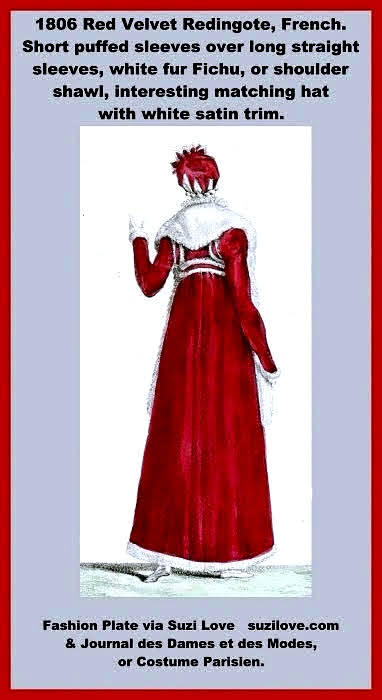
1806 Red Velvet Redingote, French. Short puffed sleeves over long straight sleeves, white fur Fichu, or shoulder shawl, interesting matching hat with white satin trim. Fashion Plate via Journal des Dames et des Modes, or Costume Parisien.
Redingotes or Pelisses were needed to cover the flimsy dresses made of lightweight fabrics of the Regency years to provide warmth and some protection from windy conditions when gowns might lift and cause modesty issues. Jane Austen and her contemporaries often walked to places and so would have needed the warmth of a Pelisse or coat in the cold British winters. https://books2read.com/SuziLoveFashionWomen1805-1809
Fashion Women 1805-1809 History Notes Book 26 What did Jane Austen and friends wear? https://books2read.com/SuziLoveFashionWomen1805-1809
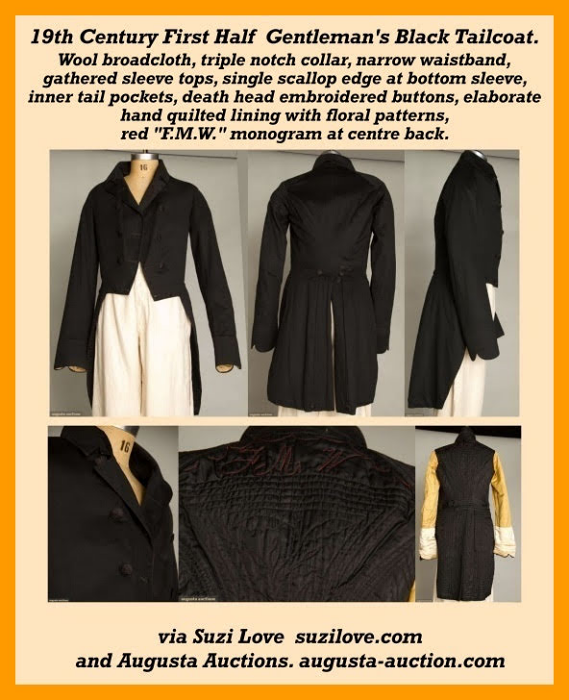
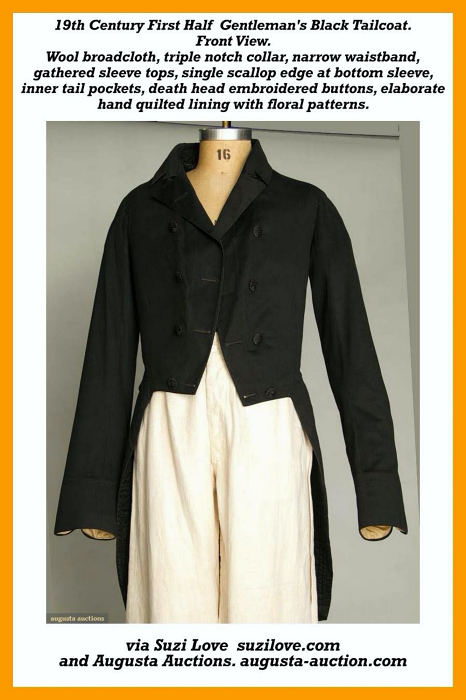
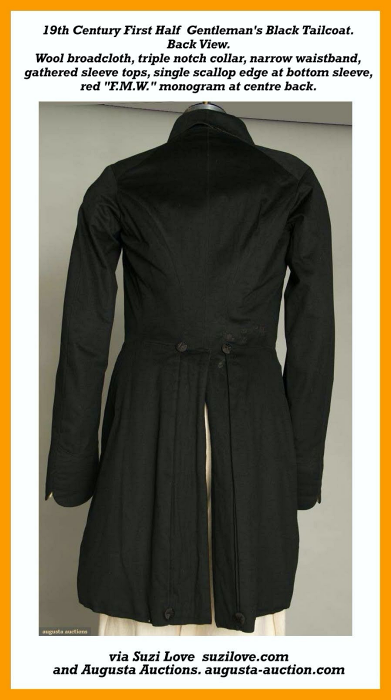
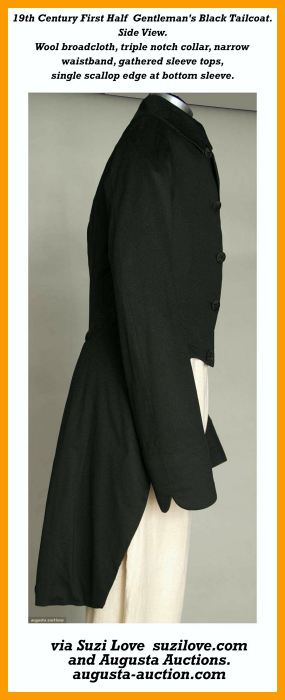
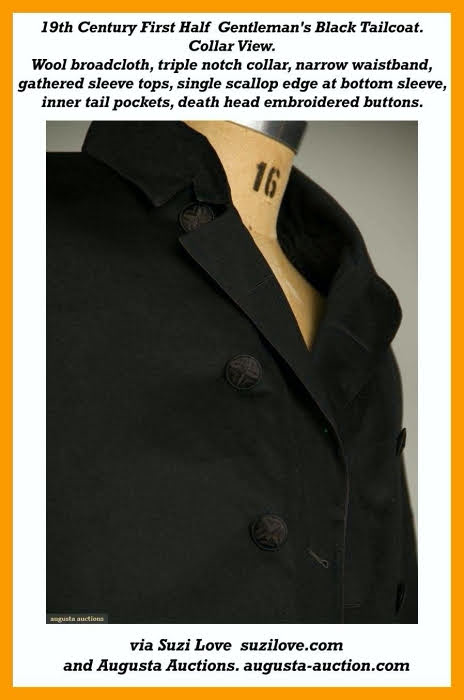
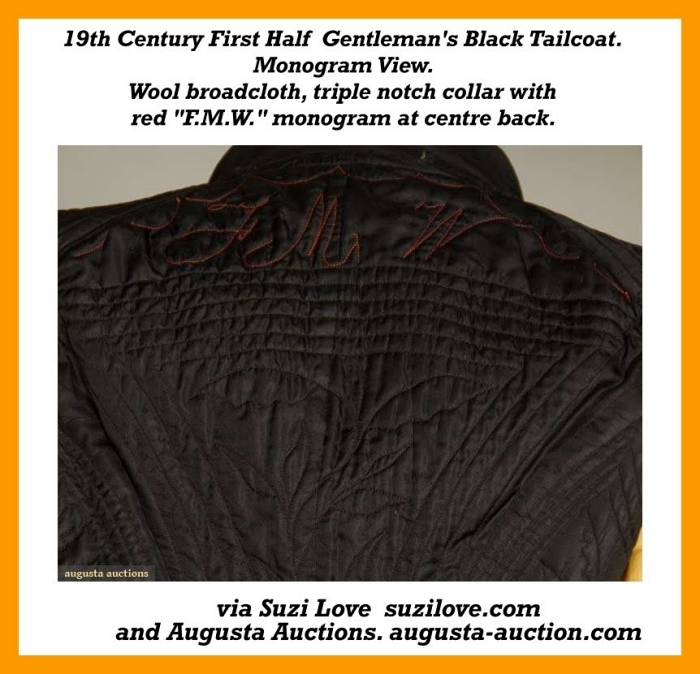
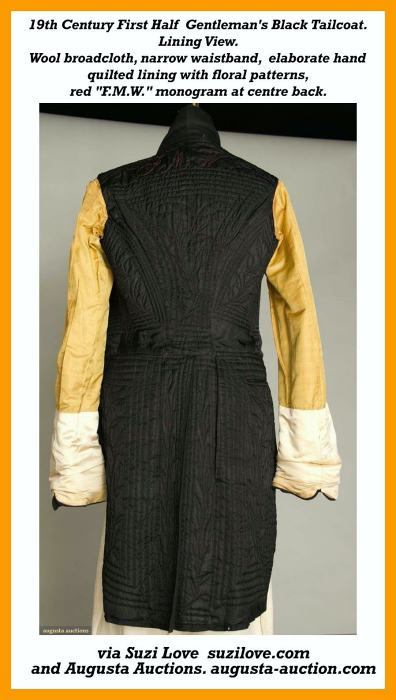
19th Century First Half Gentleman’s Black Tailcoat. Wool broadcloth, triple notch collar, narrow waistband, sleeve tops gathered and uniformly wide to single scallop edge at bottom sleeve, inner tail pockets, death head embroidered buttons, elaborate hand quilted lining with floral patterns in concentric square frames and a “F.M.W.” monogram embroidered at the centre back top in red. Via Augusta Auctions – augusta-auction.com
Tailcoat: A Regency Era, or early 1800s, gentleman was outfitted in more practical fabrics, such as wool, cotton and buckskin rather than the fussy brocades and silks of the late 1700s. The men in Jane Austen’s life would have worn a black tailcoat like this for everyday wear. https://books2read.com/SuziLoveFashionMen1800-1819
19th Century First Half Front View. 19th Century First Half Back View. 19th Century First Half. Side View. 19th Century First Half Collar View. 19th Century First Half Monogram View. 19th Century First Half Lining View. 23_d2d_fashionmen1800-1819
https://books2read.com/SuziLoveFashionMen1800-1819
This book shows how corsets changed to fit well under clothing, give maximum support and comfort. Corsets pushed up breasts and showed off the bust line beneath a square-cut and low-cut neckline as in the early 1800s, or Regency years. Jane Austen and her female and friends wore these corsets. Corsets or stays worn during the early 1800s, or Jane Austen’s lifetime. https://books2read.com/SuziLoveCorsetBook17
The main purpose of corsets was to support and shape the breasts. Though they still slimmed the midriff, this was not the prime purpose of a corset between 1810 and 1830. The waistlines of dresses were lowering to below the bust line but nearer to the true waist, so corsets were longer and were given added shaping by stitching and cording and by shaping the breasts with pleated or gathered cups.
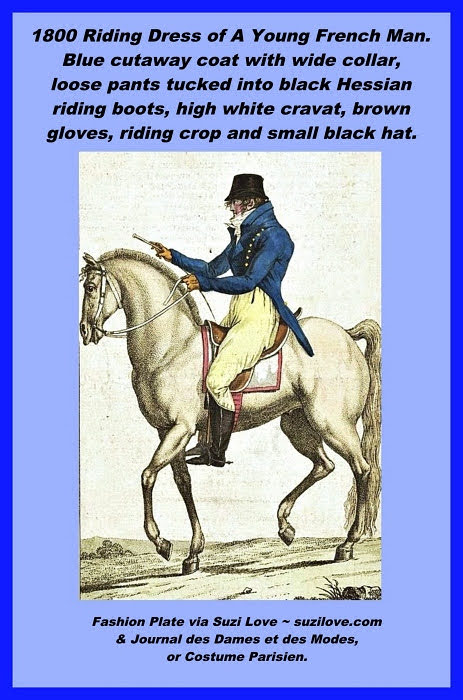
1800 Riding Dress of A Young French Man. Blue cutaway coat with wide collar, loose pants tucked into high black riding boots, high white cravat, brown gloves, riding crop and a very small black hat. Fashion Plate via Journal des Dames et des Modes, or Costume Parisien.
1820-1835 ca. Woman’s Underwear Combination, English. This style of underwear was worn during the Jabe Austen and Bridgerton years. Petticoat: 1820-1829 ca. Cotton with double row of piping round hem. Frontless with looped shoulder pieces. Corset: 1835: Cotton reinforced with whalebone and cording, hand-sewn. Shift Or Chemise:1830s Worn under corset. Drawers: Sheer clinging fabrics needed drawers underneath for modesty. via Victoria and Albert Museum, London, UK. collections.vam.ac.uk.
Fashion Women 1815-1819 History Notes Book 28 https://books2read.com/SuziLoveFashionWomen1815-1819
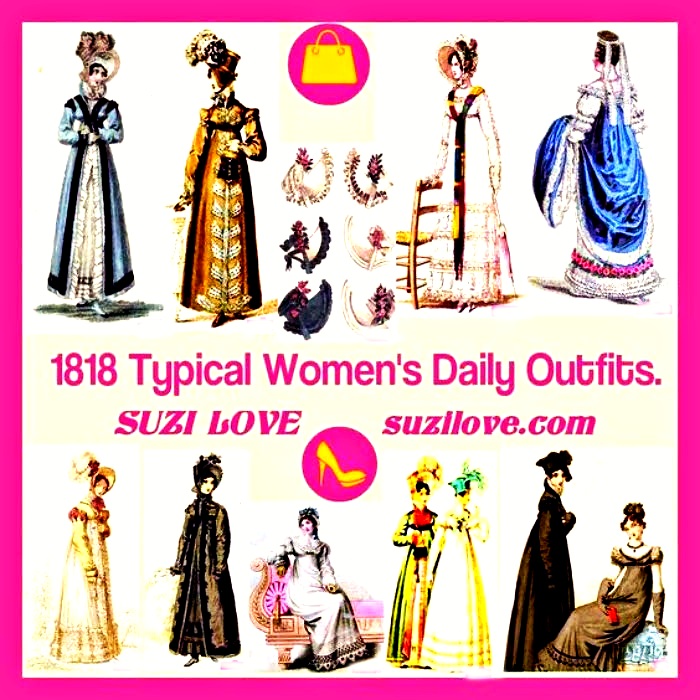
1818 Descriptions for types of ‘DRESS’ during Bridgerton’s and Jane Austen’s years. Dresses, coats or Redingotes, Spencers, shawls, fichu or shoulder cape, shoes, hats and headdresses, gloves, and Reticules or bags were displayed in various fashion magazines and copied by ladies and their modistes.
Morning Dress: Worn either at home, out shopping, or for walking in the park or country. Presentable but not overly accessorized.
Afternoon Dress: Dress made from the best fabric and beautifully decorated to see and be seen in when visiting friends, going to a museum or attending a daytime public event.
Walking Dress: Worn out shopping, walking in a city park or the country estate. Presentable and warm, more fashionable than Morning Dress but accessorized for sun protection and warmth, rather than display.
Promenade Dress: Includes gown, hat, and other accessories and more styled and fashionable than morning or walking dress. An ensemble designed to see and be seen in.
Evening Dress: Minute distinctions between ball, dinner, evening and opera gowns meant different quality of fabrics, designs, and embellishments.
Ball Dress: Gown of expensive silk fabrics, light or heavy, decorated with lace, embroidery or beading, with low-cut bodice, short or barely-there sleeves, and full skirts. Often shorter length skirt for dancing.
Mourning Dress: Mourning dress wasn’t as strict during the Regency as in Victorian era but periods of wearing black, white and grey were observed, especially for Royal deaths.
Empire Dress: Light and flowing dresses with waists just under bust worn during French Empire Period, or early 1800s.
Fashion Women 1815-1819 History Notes Book 28 What did Jane Austen wear? What was fashionable for women in Regency Era? Mourning and riding fashion, dresses, hats, shoes, reticules or bags, underclothing and fashion accessories. books2read.com/SuziLoveFashionWomen1815-1819
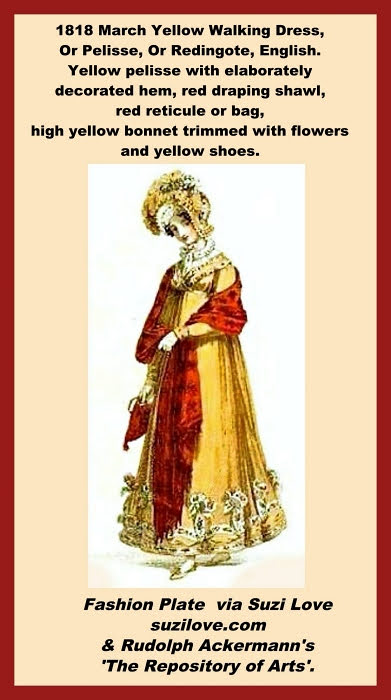
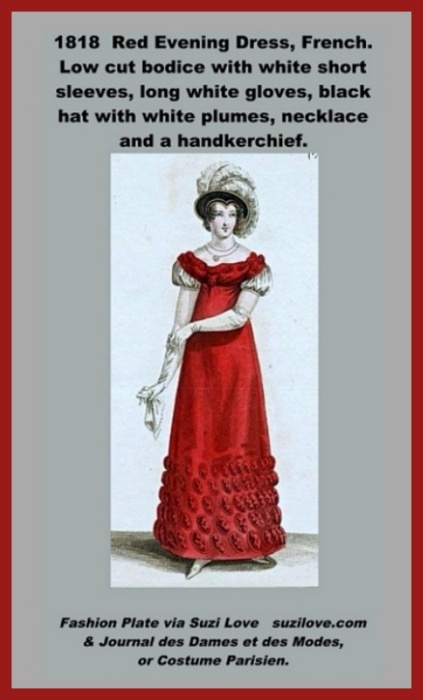
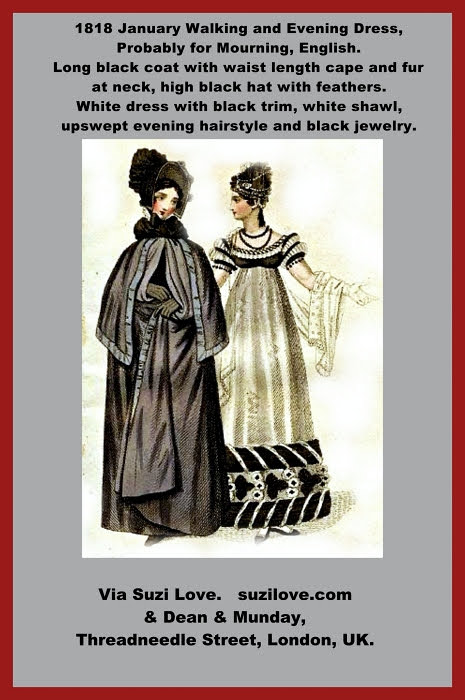
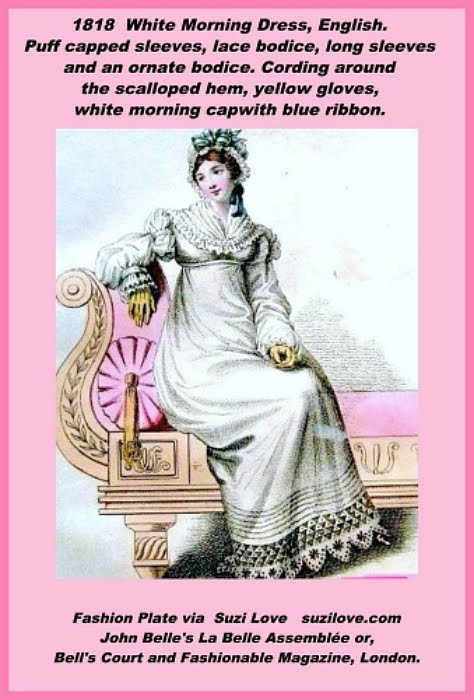
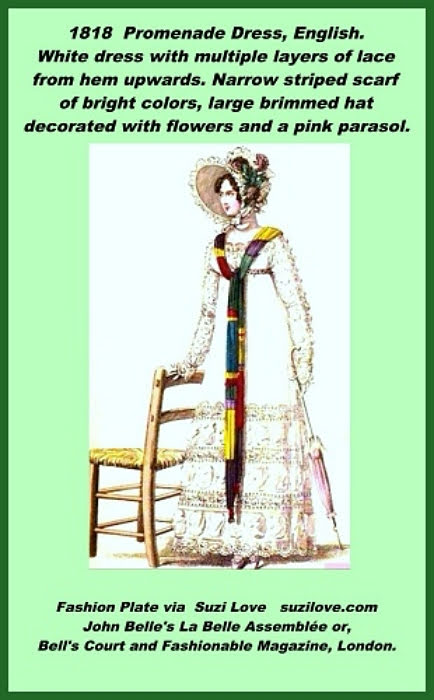
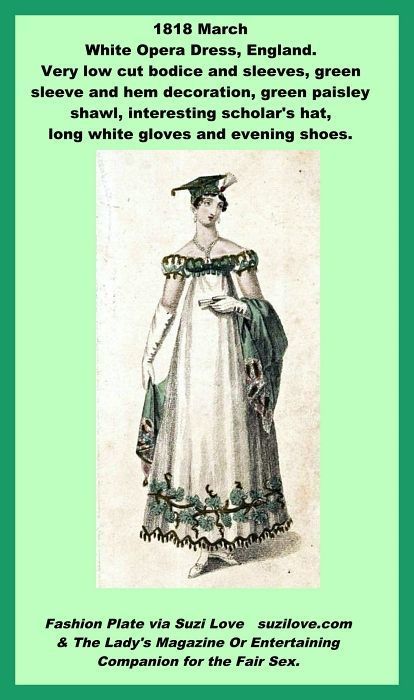
1818 March Yellow Walking Dress, Or Pelisse, Or Redingote, English. Yellow pelisse with elaborately decorated hem, red draping shawl, red reticule or bag, high yellow bonnet trimmed with flowers and yellow shoes. Fashion Plate via Rudolph Ackermann’s ‘The Repository of Arts’, London, U.K.1818 Red Evening Dress, French. Low cut bodice with white short sleeves, long white gloves, black velvet torque, or hat, with white plumes, necklace and a handkerchief. Fashion Plate via Journal des Dames et des Modes, or Costume Parisien. 1818 January Walking and Evening Dress, English. Probably for Mourning. Long black coat with waist length cape and fur at neck, high black hat with feathers. White dress with black trim, white shawl, upswept evening hairstyle and black jewelry. Via Dean & Munday, Threadneedle Street, London, UK.1818 White Morning Dress, English. Puffed capped sleeves, lace shawl like neckline, ornate bodice cording around a scalloped hem, small white hat with blue flowers, and yellow gloves. Fashion Plate via John Belle’s ‘La Belle Assemblee’, London. 1818 Promenade Dress, English. White dress with multiple layers of lace from hem upwards. Narrow striped scarf of bright colors, large brimmed hat decorated with flowers and a pink parasol. Fashion Plate via John Belle’s La Belle Assemblée or, Bell’s Court and Fashionable Magazine, London.1818 March White Opera Dress, England. Very low cut bodice and sleeves, green sleeve and hem decoration, green paisley shawl, interesting scholar’s hat, long white gloves and evening shoes. Fashion Plate via Lady’s Magazine. Fashion Women 1815-1819 History Notes Book 28 https://books2read.com/SuziLoveFashionWomen1815-1819
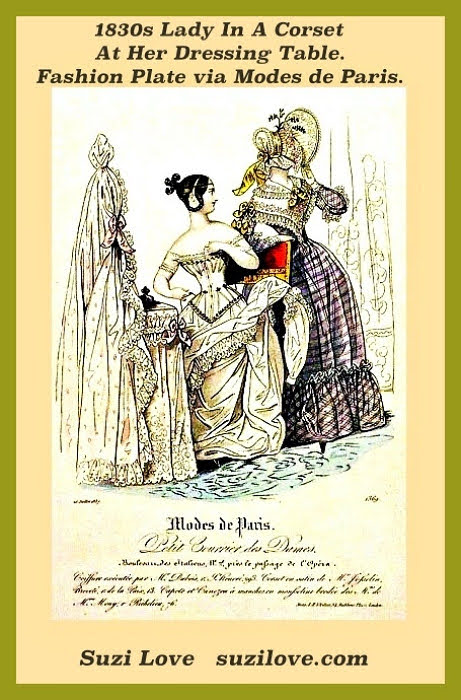
1830s Lady In A Corset At Her Dressing Table. Fashion Plate via Modes de Paris.
Romantic Era women’s corsets supported plus fitted well to give a fashionable silhouette. Becoming a fashion item, rather than simply hidden underclothing. https://books2read.com/SuziLoveCorsetBook18
Looking for a HOT Regency Era read? Love revealed at a courtesan’s ball. Brenton, Lord Mallory, attends his first courtesan’s ball in ten years to appease his concerned friends, though he’d rather stay home and read to his motherless daughters.
‘The upper rooms? Are you mad? A lady cannot go prowling around the bedrooms. There will be couples in those bedrooms having…”