Early Christians appropriated pagan customs and turned them into religious observances and, therefore, a victory over Paganism and a way to win more souls. By the end of the second century, numerous dates were being proposed as the correct date for the birth of Jesus. One popular method, allegorical theology, thought Christ must have born on the same day the sun was created, though our modern theorists estimate that the birth of Jesus was between 7 and 4 BC.
Unlike Easter, the earliest Christians didn’t celebrate the nativity or Christmas, which began in the late 3rd century AD as an alternative to pagan winter holidays. In the beginning, Christians only celebrated the baptism and resurrection of Christ and the death of the martyrs. The first evidence of Christmas being celebrated is in Rome in 336 AD and by the early fourth century, the 25th of December became the celebration day for the birth of Jesus Christ.
Origen of Alexandria, amongst others, opposed the celebration of Christ’s birth and pointed out that only Pharaoh and Herod celebrate their birthdays in the Bible, and that birthdays were for pagans, not Christians. Jehovah’s Witnesses follow this belief and reject the celebration of both Christmas and birthdays. Early religious Christmas customs began with special services held by candlelight and often at midnight. In Bethlehem, Midnight Mass is celebrated at the place of Jesus’ birth in the ancient Church of the Nativity.
But as the years passed, going to church, especially at Christmas, was something done by villagers and landowners as a custom, an obligation, or to show respect to the local clergyman rather than for any great religious reasons. People attended Church services on Sunday and Holy Days and donated money to village or church causes but the religious fervor of early years had dimmed. If a person was particularly devoted, they would read the Bible, the Book of Common Prayer, or a book of sermons on a regular basis and probably attend the Church of England, which was the main church by the late Georgian and early Regency years.
Angels – Heralds for the news of the birth of a baby in a manger.
Bells – Bells have rung out for all important events for centuries, plus lost sheep are found by the sound of the bell.
Candy Cane – Symbolizes the crook of the shepherds who visited Christ. Red represents the blood that was spilled and white is for purity. The peppermint oil that flavors is known for its strong healing properties.
Cards – Produced in Britain in 1843 to be sent with love to family and friends around the world by the new Postal services.
Carols – Poems and stories of worship made into songs.
Carolers – Groups of people who strolled the streets singing Christmas songs
Feasting – To celebrate the joy of the baby’s arrival on the 25th December.
Gift Giving – The Wise Men bowed before the baby and gave him gold, frankincense and myrrh.
Gold – Decorating using the color of one of the gifts of the wise men.
Green – Decorating using the color of evergreens which show everlasting love.
Holly – Represents Eternal Life and the crown of thorns worn by Jesus.
Mistletoe: In the 18th Century, men kissed a woman who stood under mistletoe to show love, friendship and goodwill. If a woman was un-kissed, she would (supposedly) never marry.
Nativity: The birth of Jesus Christ
Poinsettia – Red flowers used in countries such as Mexico to symbolize Christmas time.
Stockings – Hung by children to receive gifts
Twelve Days of Christmas: Twelve days between the birth of Christ on December 25 and the coming of the Magi on January 6, the Epiphany.
Tree – Evergreen tree symbolizes eternal life and love
Wreath – Made of evergreens to symbolize never ending love
Our modern Christmas tree tradition probably began in Germany in the 18th century, though some argue that Martin Luther began the tradition in the 16th century. An evergreen fir tree was used to celebrate winter festivals (pagan and Christian) for thousands of years. Nobody is really sure when Fir trees were first used as Christmas trees but it probably began 1000 years ago in Northern Europe. Many early Christmas Trees seem to have been hung upside down from the ceiling using chains.
The English phrase “Christmas tree”, first recorded in 1835, came from the German words Tannenbaum (fir tree) or Weinachtenbaum (Christmas tree). The Christmas tree is often explained as a Christianization of pagan tradition and ritual surrounding the Winter Solstice, which included the use of evergreen boughs, and an adaptation of pagan tree worship. At first, a figure of the Baby Jesus was put on the top of the tree. Over time it changed to an angel or fairy that told the shepherds about Jesus, or a star like the Wisemen saw.
Christian tradition associates the holly tree with the crown of thorns, and says that its leaves were white until stained red by the blood of Christ. Along with a Christmas tree, the interior of homes were decorated with plants, garlands, and evergreen foliage and in Victorian times, Christmas trees were decorated with candles to represent stars.
The early Germans conceived of the world as a great tree whose roots were hidden deep under the earth, but whose top, flourishing in the midst of Walhalla, the old German paradise, nourished the she-goat upon whose milk fallen heroes restored themselves. Yggdnafil was the name of this tree, and its memory was still green long after Christianity had been introduced into Germany, when much of its symbolic character was transferred to the Christmas-tree. At first fitted up during the Twelve Nights in honor of Berchta, the goddess of spring, it was subsequently transferred to the birthday of Christ, who, as the God-man, is become the “resurrection and the life.”
Queen Victoria saw a Christmas tree as a girl in 1832. The little princess wrote excitedly in her diary that her Aunt Sophia had set up two “trees hung with lights and sugar ornaments. All the presents being placed around the tree.” In 1841, Prince Albert, Queen Victoria’s German husband, arranged for a fir tree to be brought from Germany and decorated. By 1850, Victoria and Albert had Christmas trees erected in the British Royal Palaces and their children started the tradition of gathering around the tree.
‘The Christmas-tree is doubtless of German origin. Though in its present form it is comparatively of recent date, yet its pagan prototype enjoyed a very high antiquity.’ From 1873 Harper’s Bazaar, America.
A print of the royal family gathered about the Christmas tree at Windsor Castle appeared in the Illustrated London News in 1848, then in Godey’s Lady’s Book in 1850, and was reprinted again ten years later. The six-foot fir sits on a table, each tier laden with a dozen or more lighted wax tapers. An angel with outstretched arms poses at the top. Gilt gingerbread ornaments and tiny baskets filled with sweets hang by ribbons from the branches. Clustered around the base of the tree are dolls and soldiers and toys.
Christmas trees did exist in America before Queen Victoria made them famous, but mainly only amongst migrant groups from Europe. The writer of an 1825 article in The Saturday Evening Post mentions seeing trees in the windows of many houses in Philadelphia, a city with a large German population. He wrote, Their “green boughs laden with fruit, richer than the golden apples of the Hesperides, or the sparkling diamonds that clustered on the branches in the wonderful cave of Aladdin.” Gilded apples and nuts hung from the branches as did marzipan ornaments, sugar cakes, miniature mince pies, spicy cookies cut from molds in the shape of stars, birds, fish, butterflies, and flowers. A woman visiting German friends in Boston in 1832 wrote about their unusual tree hung with gilded eggshell cups filled with candies.
Not until the mid-nineteenth century did Christmas trees start spreading to homes with no known German connection. But once Queen Victoria approved of the custom of a Christmas tree, the practice spread throughout England and America and, to a lesser extent, to other parts of the world, through magazine pictures and articles. Upper-class Victorian Englishmen loved to imitate the royal family, and other nations copied the custom. Late in the century, larger floor-to-ceiling trees replaced the tabletop size.
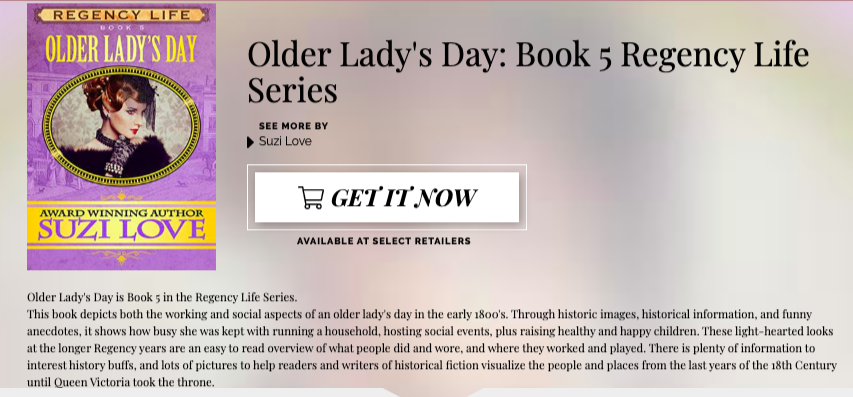
What did ladies do and wear in Jane Austen’s time, or early 1800s? #Regency #History #nonfiction Books 4 and 5 Regency Life Series. Young Lady’s Day and Older Lady’s Day in Books 4 and 5 in the Regency Life Series. These books depict the often-frivolous life and fashions of ladies in the early 1800’s, or during the lifetime of Jane Austen, but also gives a glimpse into the more serious occupations ladies may undertake. Through historic images, historical information, and funny anecdotes, they show how a lady fills her day, where she is permitted to go, and who she spends time with. These light-hearted looks at the longer Regency years are an easy to read overview of what people did and wore, and where they worked and played. There is plenty of information to interest history buffs, and lots of pictures to help readers and writers of historical fiction visualize the people and places from the last years of the 18th Century until Queen Victoria took the throne. Young Lady’s Day ~ Older Lady’s Day
1826 An Affair Of Honor Decided With Pistols In Hyde Park London, U.K. A Regency Gentleman’s Life. From The English Spy By Robert Cruikshank. By the Regency Era, dueling was outlawed, yet duels still happened because the courts were made up of peers who were reluctant to charge another peer with murder as a result of a duel. Gentlemen considered a duel a matter of honor and death was preferable to being labeled a coward.
Duels had a code of honor and were fought not so much to kill the opponent as to gain satisfaction and restore honor by demonstrating a willingness to risk your life. Originally dueling was only for the male members of nobility but then extended to all members of the upper classes. At first, duels were fought with swords but by the Regency Era, duels with pistols were more common. Some duels were also fought between women.
Favorite dueling grounds near London included Hampstead Heath, Chalk Farm and the common land that extended south of the Thames over modern Battersea, Putney and Wimbledon. The windmill there was a popular landmark beneath which duelists often agreed to meet. These locations were convenient for their proximity to the city, yet also sufficiently remote to avoid interruption and in the event of a fatality, attractively close to potential getaway routes on the roads out of London.
1826 An Affair Of Honor Decided With Pistols In Hyde Park London, U.K. A Regency Gentleman’s Life. From The English Spy By Robert Cruikshank.
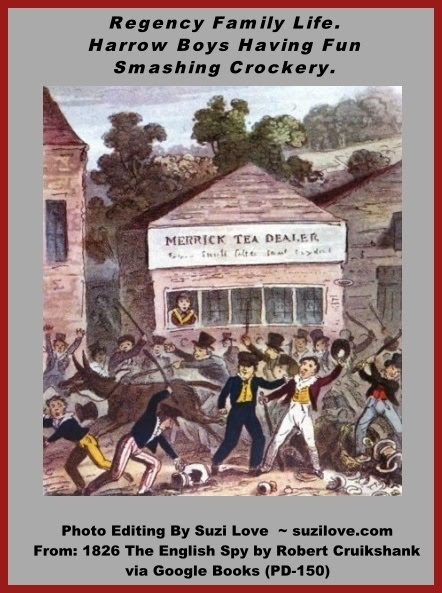
1826 Harrow Boys Having Fun Smashing Crockery. Regency Family Life. Photo Editing By Suzi Love. From: 1826 The English Spy By Robert Cruikshank via Google Books (PD-150)
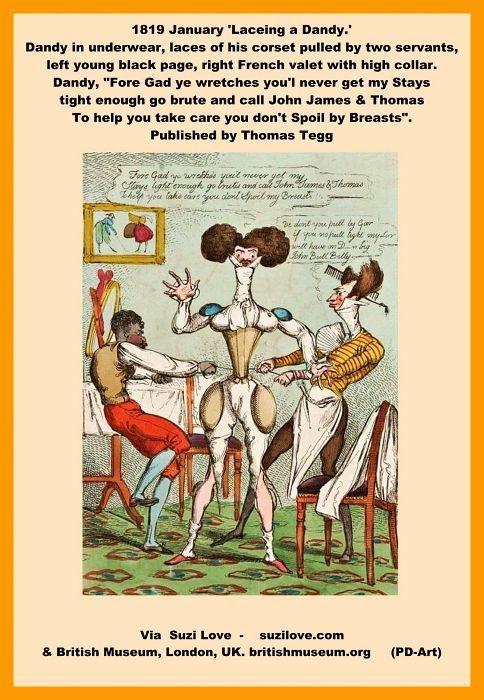
1819 January ‘Laceing a Dandy.’ Dandy in underwear, laces of his corset pulled by two servants, left young black page, right French valet with high collar. Dandy, “Fore Gad ye wretches you’ll never get my Stays tight enough go brute and call John James & Thomas, To help you take care you don’t Spoil by Breasts”. Published by: Thomas Tegg. Hand colored etching. Via British Museum, London, UK. britishmuseum.org (PD-Art)
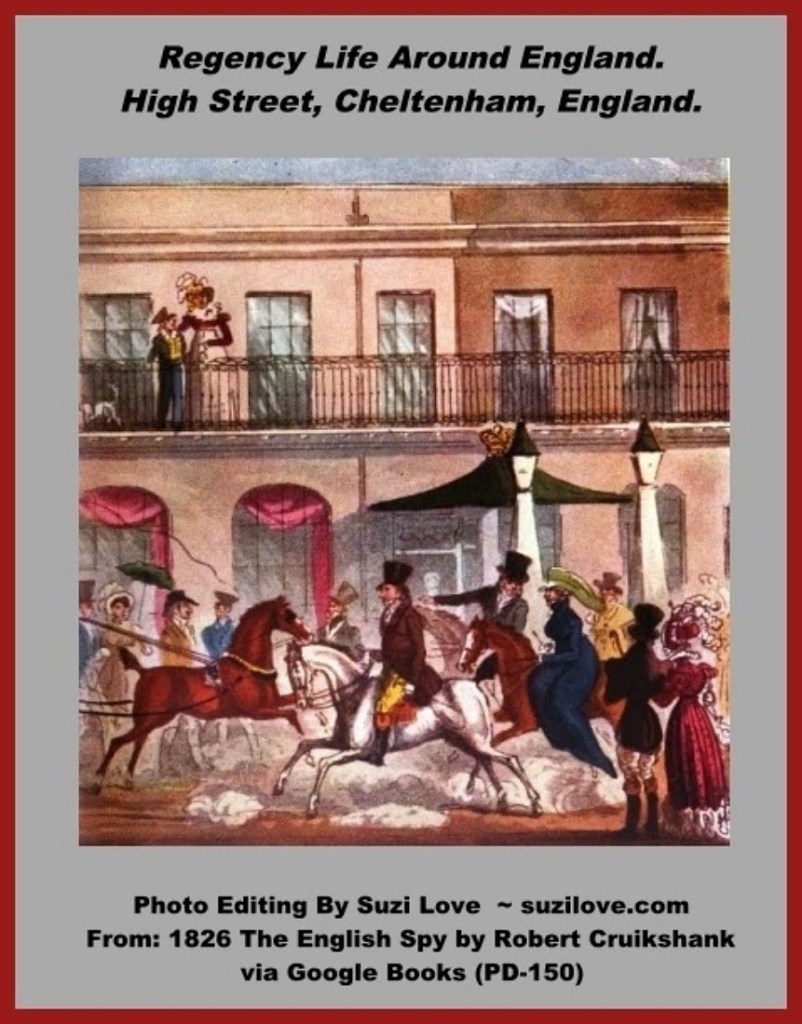
1826 Cheltenham Spa, England. From Regency Life Around England In Jane Austen’s Times. From The English Spy By Robert Cruikshank. via Google Books (PD-180)
1826 Affectations at Cheltenham Spa, England. Regency Life Around England. From The English Spy By Robert Cruikshank. 1826 Regency Social Life. View of the Commercial Room at the Bell Inn, Cheltenham, England. From 1826 The English Spy By Robert Cruikshank. via Google Books (PD-180)1826 High Street, Cheltenham, England. Regency Life Around England. From 1826 The English Spy By Robert Cruikshank. via Google Books (PD-180)1826 Oakland Cottages were a well-known place to stay At Cheltenham Spa, England. Regency Life Around England. From: 1826 The English Spy By Robert Cruikshank. via Google Books (PD-180)RL_2_D2D_RetailerBuyLink_RL_2
https://books2read.com/suziloveYGD