Michael Brandon travels to introduce the woman he loves to family but is shocked when his missing brother, presumed dead for years, arrives at the country estate of the Duke Of Sherwyn where several people are stranded due to a severe snow storm. https://books2read.com/suziloveDS December Scandal, Book 3, Scandalous Siblings.
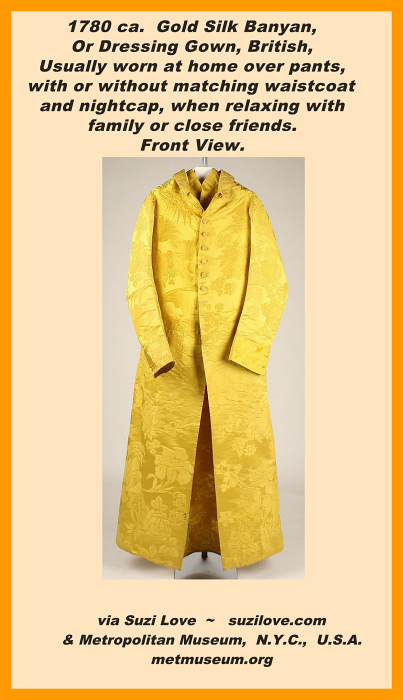
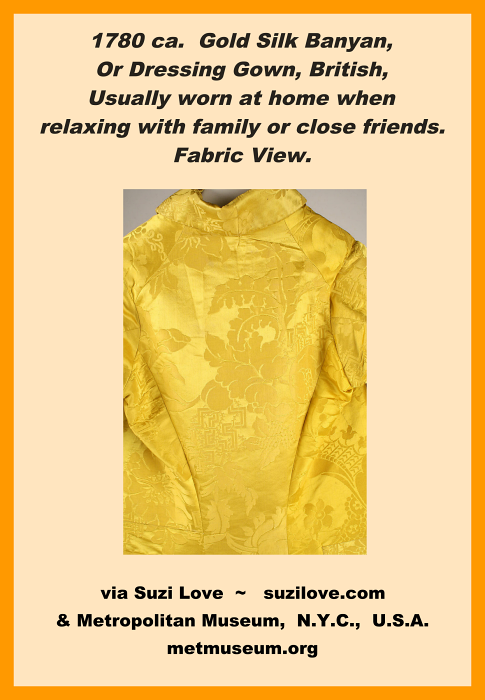
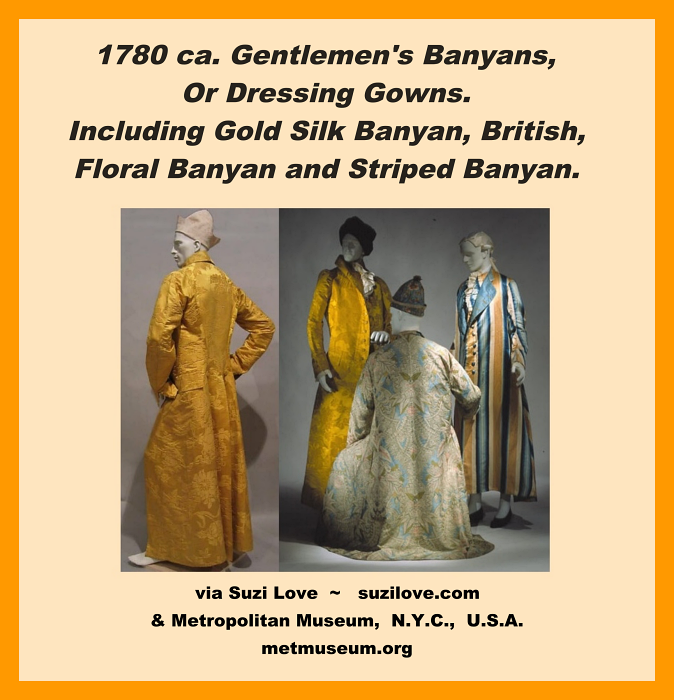
1780 ca. Gold Silk Banyan, British. For at-home wear, a gentleman had a dressing gown, often with a matching waistcoat, and an undress cap or turban. “This yellow damask banyan with its bold Chinese Chippendale – inspired pattern would have been an imposing sight on the streets or in the drawing rooms of London.” via Metropolitan Museum New York City, U.S.A. metmuseum.org Credit: Catharine Breyer Van Bomel Foundation Fund, 1978 Accession Number:1978.135.1
From the Curator: ‘For at-home wear, a gentleman had a dressing gown, often with a matching waistcoat, and an undress cap or turban.As for breeches, they were not designed especially for this casual ensemble, but rather borrowed from other suits.The dressing gown was cut like a man’s loose coat and usually hung to the floor, though there were also versions that stopped below the knees. Since there were no fastenings, the wearer overlapped the dressing gown in front when he walked so that the sides did not billow out behind him.The sleeves were originally rolled back to form cuffs, but later dressing gowns display the fashionable cuff of their period.In England these dressing gowns were called “banyans” or “Indian nightgowns” because of their kimono-like form and Eastern origin. Banyans were made in a variety of fabrics, including silk brocades, damasks, and printed cottons. By the 1780s, gentlemen ventured out of doors in this comfortable and stylish costume. According to Town and Country Magazine in 1785: “Banyans are worn in every part of the town from Wapping to Westminster, and if a sword is occasionally put on it sticks out of the middle of the slit behind. This however is the fashion, the ton, and what can a man do? He must wear a banyan.”This yellow damask banyan with its bold Chinese Chippendale – inspired pattern would have been an imposing sight on the streets or in the drawing rooms of London.’ via Metropolitan Museum New York City, U.S.A. metmuseum.org
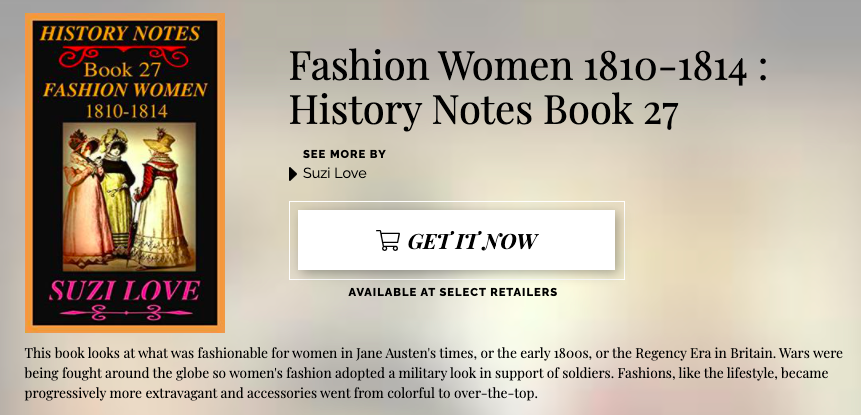
What was fashionable for women in Jane Austen’s times? Mourning, riding, daytime, evening clothing, plus underclothing, corsets and accessories. Fashion Women 1810-1814 History Notes Book 27 This book looks at what was fashionable for women in Jane Austen’s times, or the early 1800s, or the Regency Era in Britain. Wars were being fought around the globe so women’s fashion adopted a military look in support of soldiers. Fashions, like the lifestyle, became progressively more extravagant and accessories went from colorful to over-the-top. https://books2read.com/SuziLoveFashion1810-1814
The Lady’s Magazine said of the basis of women’s fashion that was popular for the first twenty years of the 1800s, ‘White is still the prevailing color for robes. For morning dresses, linen gowns, in large diamonds or squares, are fashionable. Indian muslins, plain or embroidered, are preferred to Florence and satins. The designs of embroidery for shawls are of infinite variety. Long gloves, which reach above the elbow, are not yet laid aside. Medallions are hung around the neck from crossed chains and some of these medallions are shaped like the bags, called ridicules. These reticules are of the lozenge or hexagon shape, with a small tassel at each angle. Reticules, or ridicules, are in lozenge or hexagon shapes with a small tassel at each angle. In capotes, or hats, and ribbands, the violet and dark green prevail over jonquil. Bracelets in hair, pear-shaped ear-rings, medallions on square plates, saltiers of colored stones, are still in fashion.’
1807 Two Ladies In Morning Dress, French. Left: Morning dress with short puffed sleeves over long straight sleeves ruffles around collar sleeves and hem white cap carrying blue parasol. Right: Blue Fichu or neck Shawl, blue Bonnet. Fashion Plate via Journal des Dames et des Modes, or Costume Parisien.
Definition Fichu: Piece of lace, muslin, or other cloth worn about the neck and cleavage to preserve a lady’s modesty. From French word meaning neckerchief.
These are the types of outfits worn by Jane Austen and contemporaries in English magazines, where French fashions were obsessively copied despite the two countries being at war for many years.
1807 Two Ladies In Morning Dress, French. Left: Morning dress with short puffed sleeves over long straight sleeves ruffles around collar sleeves and hem white cap carrying blue parasol. Right: Blue Fichu or neck Shawl, blue Bonnet. Fashion Plate via Journal des Dames et des Modes,
or Costume Parisien.1807 Two Ladies In Morning Dress With Fashion Accessories, French. #RegencyFashion #HistoricalFashion #France https://books2read.com/SuziLoveFashionWomen1805-1809 Share on XFashion Women 1805-1809 History Notes Book 26
What did Jane Austen and friends wear? This book looks at early 1800s fashions, which were elegant and pretty with high waists and fabrics that were almost transparent. These Empire style gowns, named after Napoleon’s first Empress, became popular throughout Europe, and were then copied around the world. Colorful outwear was added to make an ensemble more attractive and warmer.
https://books2read.com/SuziLoveFashionWomen1805-1809
1798 Gentleman’s Outfit, French. Long green overcoat with yellow buttons, tan gloves, black boots topped with yellow band, gloves with three seams across the back of the hand, high white cravat, black hat, fob at his waist and holding a cane. Fashion Plate via Journal des Dames et des Modes, or Costume Parisien.