↓
 

Suzi Love

Making history fun, one year at a time.

Header_
  • Home
  • Newsletter
  • Pre order form
  • Shop
    • Cart
    • Checkout
    • My account
    • Refund and Returns Policy
  • Blog
  • BOOKS
    • History Events
    • Kelly’s Justice
    • Irresistible Aristocrats
    • History Notes
    • Scandalous Siblings
    • Love After Waterloo
    • Regency Life Series
  • Privacy Policy
  • EVENTS
Home » fabrics » Page 2 << 1 2

Tag Archives: fabrics

Post navigation

Next Post→

1815 July Seaside Walking Dress and Plumed Bonnet, English. #JaneAusten #Bridgerton #RegencyFashion

Suzi Love Posted on May 8, 2025 by Suzi LoveMay 8, 2025

1815 July Seaside Walking Dress. A high dress, of short walking length, made of French cambric or jaconot muslin, trimmed at the feet with treble flounces of French work, gathered into a rich bead heading, and laid upon the dress, at a suitable distance, one above the other, the body made with open fronts, worn with a full ruff of the French work, corresponding to the trimming at the feet; a long sleeve, drawn alternately across the arm, terminates with a broad wristband, worn plain over the hand. French bonnet of white satin, edged and tied under the chin with satin ribbon of celestial blue; ornamented with a rich plume of white feathers, edged to correspond. French mantle of the twilled silk en suite, richly embroidered at the ends in shaded silks, composing roses or lilies of the valley. Patent silk stockings. Slippers, or half-boots, or blue kid, or primrose colour. Gloves to correspond.

The bodies of the morning and promenade costume continue to be worn with cross or handkerchief fronts, and are generally trimmed, agreeably to the texture of the dress, with quilled tull or ribbon. The quilled ribbon is also predominant in single rows at the feet of all dresses composed of silk, bombazeen, or fancy prints. The prevailing colours are primrose, celestial blue, and evening primrose; the waist short, and the fullness of the petticoat carried to the back. Ruffs of French work are universally worn, except in full dress. The length of the petticoat continues not to exceed meeting the top of the boot and the color of the latter corresponds with the glove, mantle, and trimming of the bonnet.

via  Rudolph Ackermann’s ‘The Repository of Arts’.

1815 July Seaside Walking Dress, English. High dress of short walking length of French cambric or jaconot muslin, hem trimmed with treble flounces of French work, open fronts with full ruff of French work, long sleeves drawn alternately across arms and caught into broad wristband,
French bonnet of white satin with satin ribbon of celestial blue, plume of white feathers, French mangle of twilled silk embroidered at ends, Patent silk stockings, slippers, or half-boots, and gloves of blue or primrose kid. Fashion Plate via Rudolph Ackermann's 'The Repository of Arts'.
1815 July Seaside Walking Dress and Plumed Bonnet, English. #JaneAusten #Bridgerton #RegencyFashion https://books2read.com/SuziLoveFashionWomen1815-1819 Share on X
HN_28_D2D_Fashion Women 1815-1819
https://books2read.com/SuziLoveFashionWomen1815-1819
Fashion Women 1815-1819 History Notes Book 28 https://books2read.com/SuziLoveFashionWomen1815-1819
Posted in 1800s, 1800s women's fashion, Coat or Pelisse Or Redingote, Dress Or Robe, fashion accessories, hats, Jane Austen, London, Regency Era, Regency Fashion, shoes | Tagged Bridgerton, Dress Or Gown, fabrics, fashion accessories, Fashion Plate, feathers or aigrette, gloves, Hats And Hair, Jane Austen, Regency Fashion, shawls, Shoes, stockings, The Repository Of Arts
1799-1810 ca. Embroidered Neoclassical Gown. White cotton and embroidered muslin, probably Bengali, all-over sprigged Broderie Anglaise, short sleeve with three pairs of inside ties to adjust double puff, ruffled edge, back tie at neckline and high waist, ruched band above slightly trained hem with scalloped sawtooth border, cotton bodice lining. whitakerauction.smugmug.com

1799-1810 ca. Jane Austen Style White Cotton Muslin Dress With Sprigged Broderie Anglaise. #RegencyFashion #JaneAusten #GeorgianFashion

Suzi Love Posted on December 6, 2024 by Suzi LoveNovember 26, 2024

1799-1810 ca. Cotton Muslin Gown, Probably American. White cotton embroidered muslin, probably Bengal, all over sprigged broderie anglaise decoration,short sleeve with three pairs of inside ties to adjust the double-puff, ruffled edge, back tie at neckline and waist, ruched band above the slightly trained hem with scalloped sawtooth border and with cotton bodice lining. via whitakerauction.smugmug.com

These lightweight white cotton dresses were fashionable in Jane Austen’s times, but they were certainly not warm when a lady was out walking or when riding in a carriage. Numerous outer layers could be added for warmth and to brighten and personalize an outfit. These might be an overdress, pelisse or redingote, hat, shawl, gloves, or large fur muff.

The Empire dress which evolved in the late 1790s began as a chemise shift gathered under the breasts and at the neck. Named after the First Empire in France, by 1800 Empire dresses had a very low décolleté, or neckline and a short narrow backed bodice attached to a separate skirt. Skirts started directly under the bust and flowed into the classical relaxed wide styles of Greece and Rome. This style of dress is associated with Jane Austen and her contemporaries as a simple cotton high-waisted dress was worn most days and accessorized according to the importance of the occasion.

1799-1810 ca. Embroidered Neoclassical Gown. White cotton and embroidered muslin, probably Bengali, all-over sprigged Broderie Anglaise, short sleeve with three pairs of inside ties to adjust double puff, ruffled edge, back tie at neckline and high waist, ruched band above slightly trained hem with scalloped sawtooth border, cotton bodice lining. whitakerauction.smugmug.com
1799-1810 ca. Jane Austen Style White Cotton Muslin Dress With Sprigged Broderie Anglaise. #RegencyFashion #JaneAusten #GeorgianFashionbooks2read.com/SuziLoveFashionWomen1800 Share on X
D2D_RetailerBuyLink_HN_12
books2read.com/SuziLoveFashionWomen1800
HN_12_D2D_RetailerBuyLink books2read.com/SuziLoveFashionWomen1800
Posted in 1700s, 1700s Womens Fashion, 1800s, 1800s women's fashion, Dress Or Robe, Georgian Era, Georgian Fashion, Jane Austen, Regency Era, Regency Fashion, Suzi Love Images, U.S.A | Tagged 1700s Women's Fashion, 1800s Or 19th Century, 1800s women's fashion, Dress Or Gown, fabrics, Georgian Fashion, Jane Austen, Regency Fashion, sewing, USA, Whitaker Auctions

1812 Gentleman’s Outfit Of Brown Overcoat and Cream Drap Trousers With Buttons At Ankles, French. #RegencyFashion #JaneAusten #HistoricalFashion

Suzi Love Posted on November 29, 2024 by Suzi LoveNovember 26, 2024

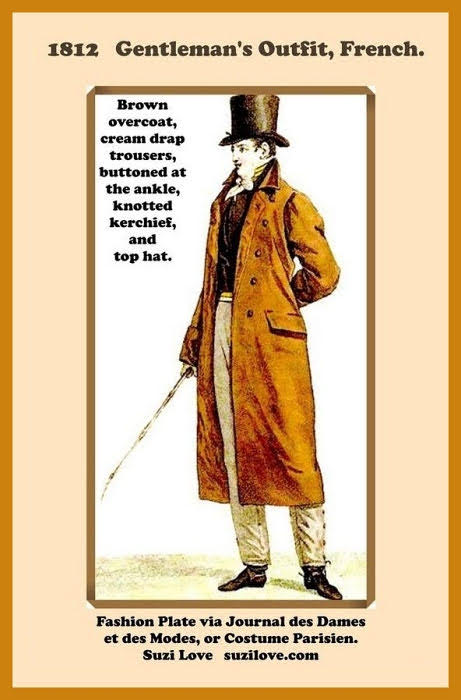
1812 Gentleman’s Outfit, French. Brown overcoat, or Redingote, with front pockets, cream Drap trousers buttoned at the ankle, knotted kerchief, top hat and holding a cane. Fashion Plate via suzilove.com and Journal des Dames et des Modes, or Costume Parisien. By 1812, men no longer wore complicated styles and extravagant fabrics. Men’s fashions had simplified and these practical and relaxed clothing items were the sort worn by Jane Austen’s male family and friends when out and about in town or on their daily excursions.

Definition Redingote Or Coat: French word developed from English words, riding coat. Long fitted outdoor coat worn over other garments for warmth. Originally made with several capes and trimmed with large buttons. French fashion plates call these coats Redingotes and they were worn by men, women, and children. English fashion plates call the coats a Pelisse, a Walking Dress, Promenade dress, or Carriage dress. Definition Drap: French equivalent for the English word cloth or stuff and generally applied to fabrics of wool or silk. 

1812 Gentleman's Outfit, French. Fashion Plate via suzilove.com and Journal des Dames et des Modes, or Costume Parisien
1812 Gentleman's Outf1812 Gentleman's Outfit Of Brown Overcoat and Cream Drap Trousers With Buttons At Ankles, French. #RegencyFashion #JaneAusten #HistoricalFashion https://books2read.com/SuziLoveFashionMen1800-1819 Share on X
HN_23_D2D_Fashion Men 1800-1819 History Notes Book 23 https://books2read.com/SuziLoveFashionMen1800-1819
Posted in 1800s, 1800s Mens Fashions, Coat or Pelisse Or Redingote, fashion accessories, France, hats, Jane Austen, pants, Regency Era, Regency Fashion, shoes, Suit, Suzi Love Images, Vest or Waistcoat | Tagged 1800s men fashion, boots, cravat, fabrics, fashion accessories, Fashion Plate, Hats And Hair, Jane Austen, Journal des Dames et des Modes, pants, Redingote Or Pelisse Or Coat, Regency Fashion, Shoes, Suzi Love Images, Vest or Waistcoat
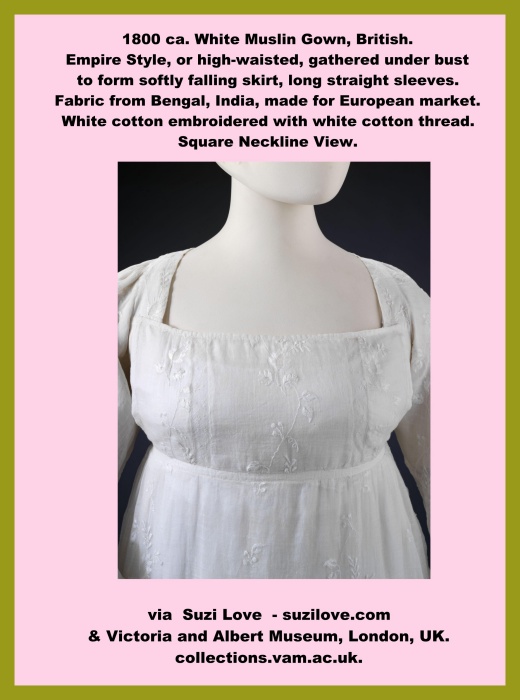
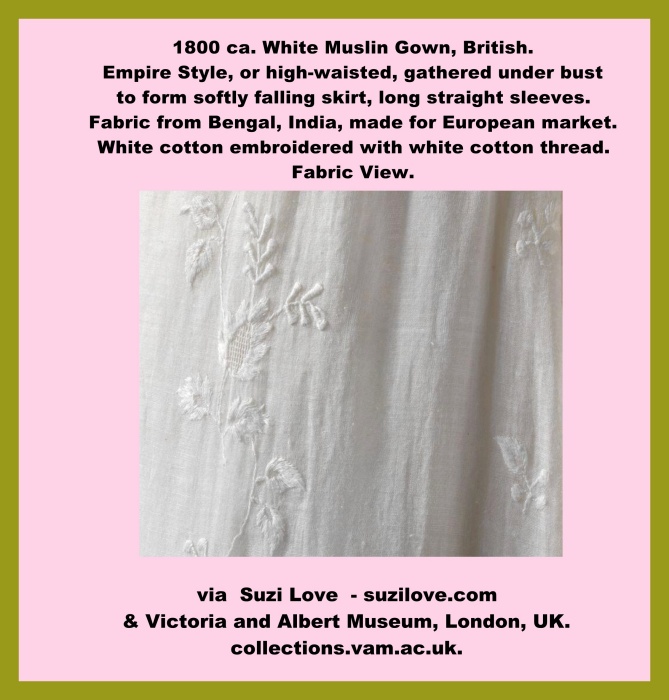
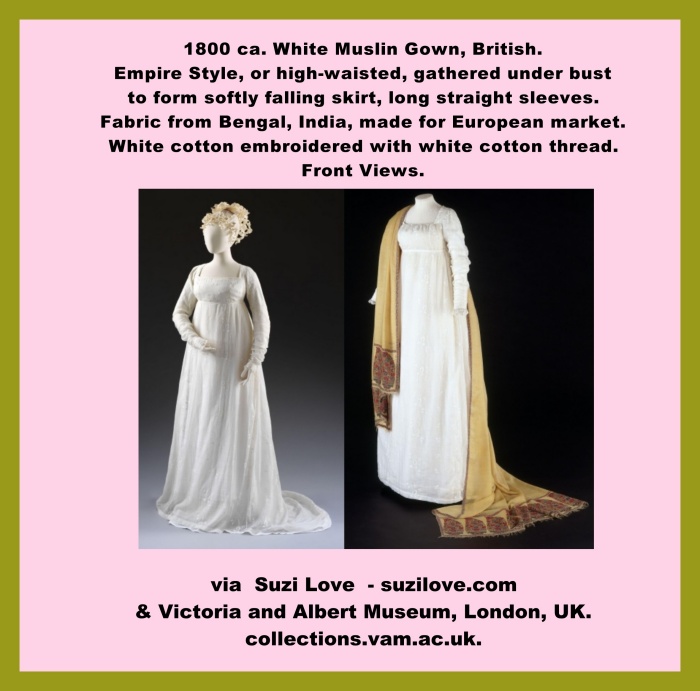
1800 ca. White Muslin Gown, British. Empire Style, or high-waisted, gathered under bust to form softly falling skirt, long straight sleeves. Fabric from Bengal, India, made for European market. White cotton embroidered with white cotton thread. via Victoria and Albert Museum, London, UK. collections.vam.ac.uk.

1800 Jane Austen Style Embroidered White On White Muslin Robe, British. #JaneAusten #RegencyFashion #HistoricalFashion

Suzi Love Posted on September 20, 2024 by Suzi LoveSeptember 20, 2024

1800 ca. White Muslin Gown, British. Empire Style, or high-waisted, gathered under bust to form softly falling skirt, long straight sleeves. Fabric from Bengal, India, made for European market. White cotton embroidered with white cotton thread.
via Victoria and Albert Museum, London, UK. collections.vam.ac.uk.

About 1800 Women’s dress changed dramatically after 1785. The rich fabrics and complicated, formal shapes of the late 18th century gave way to simple, light fabrics that draped easily. These new gowns achieved something of the effect of the simple tunics shown on classical Greek and Roman statues and vases, Muslin embroidered with cotton thread Fabric made in India, gown made in England Given by Miss Frances Vickers Museum no. 444-1888 (2013) Victoria and Albert Museum, London.

By the end of the 18th century, rigidly tailored garments for both men and women were replaced by styles made for ease and comfort, resulting in the neoclassical style of the 1780s. Inspired in part by the statuary of ancient Greece and Rome, the new fashion was epitomised by light cotton gowns falling around the body in an unstructured way, held around the high waist with a simple sash and accompanied by a soft shawl draped around exposed shoulders. This style was ideal for the Indian imports like Kashmiri shawls and Bengali muslin, as used in this embroidered gown. Championed by such influential figures as Emma Hamilton in England and Madame Récamier in France, the so-called ‘Empire’ style catapulted Indian muslin into the forefront of fashion.

Definition Empire Style Dress:  Named after the First Empire in France. Empire dresses had a low neckline and skirts started directly under the bust and flowed into the classical relaxed wide styles of Greece and Rome. This style of dress is associated with Jane Austen and her contemporaries as a high-waisted dress was worn most days. Cotton, silk or taffeta were the popular fabrics. Only the very wealthy could afford white dress in this style as the cottons were imported from India and had to be carefully cleaned, usually by a lady’s maid.

1800 ca. White Muslin Gown, British. Empire Style, or high-waisted, gathered under bust to form softly falling skirt, long straight sleeves. Fabric from Bengal, India, made for European market. White cotton embroidered with white cotton thread. via Victoria and Albert Museum, London, UK. collections.vam.ac.uk.
1800 Jane Austen Style Embroidered White On White Muslin Robe, British. #JaneAusten #RegencyFashion #HistoricalFashion books2read.com/SuziLoveFashionWomen1800 Share on X
HN_12_D2D Retailer Buy Link
books2read.com/SuziLoveFashionWomen1800
HN_12 D2D_RetailerBuyLink_HN_12 books2read.com/SuziLoveFashionWomen1800
Posted in 1800s, 1800s women's fashion, Dress Or Robe, England, Jane Austen, Regency Era, Regency Fashion, sewing, Suzi Love Images | Tagged 1800s women's fashion, Dress Or Gown, fabrics, Jane Austen, Regency Fashion, sewing, Victoria and Albert Museum | Leave a reply

1816 June Blue Wool Riding Dress With High Waist As Worn by the Bridgertons and Jane Austen. #Bridgerton #RegencyFashion #JaneAusten #RidingFashion

Suzi Love Posted on September 6, 2024 by Suzi LoveAugust 26, 2024

1816. June Blue Merino wool riding dress with high waist and embroidered and ornamented round the bust and cuffs and fastens on the back of the shoulder. Double ruff of fine Vandyke lace is separated from shirt collar by a Chinese silk handkerchief of blue and white. Small round hat made of fine beaver or moss silk, the half boots are of blue kid with Limerick gloves worked and seamed with blue and she is carrying a riding whip. These riding habits were usually designed by men and were in two pieces, a jacket and a skirt, worn over a shirt but this is in one piece and the full skirt falls from directly under the bust. Fashion Plate via John Belle’s La Belle Assemblée or, Bell’s Court and Fashionable Magazine, London. https://books2read.com/SuziLoveFashionWomen1815-1819

Typical of the riding costumes worn by Jane Austen’s female contemporaries. The style is still in the Empire fashion of a high-waist with the full skirt falling from just under the bust and with a frill and small decorations on the wrists and shoulders to make it look unique.

1816. June Blue Merino wool riding dress with high waist and embroidered and ornamented round the bust and cuffs and fastens on the back of the shoulder. Double ruff of fine Vandyke lace is separated from shirt collar by a Chinese silk handkerchief of blue and white. Small round hat made of fine beaver or moss silk, the half boots are of blue kid with Limerick gloves worked and seamed with blue and she is carrying a riding whip. These riding habits were usually designed by men and were in two pieces, a jacket and a skirt, worn over a shirt but this is in one piece and the full skirt falls from directly under the bust. Fashion Plate via John Belle's La Belle Assemblée or, Bell's Court and Fashionable Magazine, London https://books2read.com/SuziLoveFashionWomen1815-1819
1816 June Blue Wool Riding Dress With High Waist As Worn by the Bridgertons and Jane Austen. #Bridgerton #RegencyFashion #JaneAusten #RidingFashionhttps://books2read.com/SuziLoveFashionWomen1815-1819 Share on X
HN_28_D2D_Fashion Women 1815-1819
https://books2read.com/SuziLoveFashionWomen1815-1819
Fashion Women 1815-1819 History Notes Book 28 What did Jane Austen wear? . D2D_HN_28_https://books2read.com/SuziLoveFashionWomen1815-1819
Posted in 1800s, 1800s women's fashion, Bridgerton, Dress Or Robe, England, fashion accessories, hats, Jane Austen, London, Regency Era, Regency Fashion, riding, shoes, Suzi Love Images | Tagged 1800s women's fashion, Bridgerton, Dress Or Gown, fabrics, fashion accessories, Fashion Plate, gloves, Hats And Hair, Jane Austen, La Belle Assemblee, Regency Fashion, riding, sewing, Shoes | Leave a reply

1815 March Evening Full Dress For the Opera or Theatre With Vandyke Points, English. #Regency #JaneAusten #Fashion

Suzi Love Posted on April 22, 2024 by Suzi LoveApril 21, 2024

1815 March Evening Full Dress For the Opera or Theatre, English. Rich burgundy velour dress with white under dress with short puffed sleeves over long straight sleeves, rows of puffings for hem trimming, white lace shawl collar with Vandyke points, matching burgundy velvet turban with white feathers or plumes. Fashion Plate via John Belle’s La Belle Assemblée or, Bell’s Court and Fashionable Magazine, London.
Definition Van Dyke Points: V-shaped lace and trims named after a 17th Century Flemish painter, Sir Anthony Van Dyck, known for painting V-shaped lace collars and scalloped edges on sitters.

Definition Evening Dress: There were minute distinctions between ball, dinner, evening and opera gowns meant different quality of fabrics and designs. A Ball Gown differed from an evening dress as expensive silk fabrics were usually worn, light or heavy, decorated with lace, embroidery or beading, with low-cut bodice, short or no sleeves, and full skirts. In the early 1800s, white cotton dresses were considered suitable for many evening events, but not for balls. And definitely not for an evening event in a palace or at the opera or theatre.

Dress Full Dress:  The most formal and complete ensemble, worn for day or night events, and includes the fullest range of accessories that could be added to the outfit to make the most impressive display. 

1815 March Evening Full Dress For the Opera or Theatre, English. Rich burgundy velour dress with white under dress with short puffed sleeves over long straight sleeves, rows of puffings for hem trimming, white lace shawl collar with Vandyke points, matching burgundy velvet turban with white feathers or plumes. Fashion Plate via John Belle's La Belle Assemblée or, Bell's Court and Fashionable Magazine, London. Definition Van Dyke Points: V-shaped lace and trims named after a 17th Century Flemish painter, Sir Anthony Van Dyck, known for painting V-shaped lace collars and scalloped edges on sitters.
1815 March Evening Full Dress For the Opera or Theatre, English. Rich burgundy velour dress with white under dress with short puffed sleeves. Fashion Plate via John Belle’s La Belle Assemblée or, Bell’s Court and Fashionable Magazine, London.

1815 March Evening Full Dress For the Opera or Theatre With Vandyke Points. #Regency #JaneAusten #Fashion. https://books2read.com/SuziLoveFashionWomen1815-1819 Share on X
HN_28_D2D_ https://books2read.com/SuziLoveFashionWomen1815-1819
Fashion Women 1815-1819 History Notes Book 28
What did Jane Austen wear? This book looks at what was fashionable for women in the Georgian Era and at the end of the Regency Era in Britain and the reconstruction in Europe after the wars. Lifestyles were freer and fashions expressed this by becoming the focus of most women’s lives. A wardrobe full of opulent accessories was requisite. Includes mourning and riding fashion, dresses, hats, shoes, reticules or bags, underclothing, and fashion accessories.

Posted in 1800s, 1800s women's fashion, Dress Or Robe, England, fashion accessories, hats, Jane Austen, Regency Era, Regency Fashion, shoes, Suzi Love Images | Tagged 1800s women's fashion, Dress Or Gown, fabrics, fashion accessories, Fashion Plate, feathers or aigrette, gloves, Hats And Hair, Jane Austen, jewelry, La Belle Assemblee, muff, Regency Fashion, sewing, shawls, Shoes
1814 Typical Women's Daily Outfits.

1814 April White Spencer Over Morning Dress Of Jaconet Muslin Finished With Vandykes. #RegencyEra #JaneAusten #FashionPlate

Suzi Love Posted on November 29, 2023 by Suzi LoveNovember 21, 2023

1814 April Morning Dress and Lace Cap. ‘”A petticoat and bodice of fine jaconet muslin, finished round the bottom in vandykes and small buttons. The Rochelle spencer composed of the same material, appliqued with footing lace down the sleeve, and trimmed at each edge with a narrow but full border of muslin. Double fan frill of muslin round the neck, very full, continuing round the bottom of the waist, where it is gathered on a beading of needle-work. Bourdeaux mob cap, composed of lace, with treble full borders, narrowed under the chin. A small flower placed backward, on the left side. Hair much divided in front, and in full waved curls on each side. Necklace of twisted gold and pearl, with pendant cross in the center. Spring Green kid slippers and gloves of the same.”

“This dress is from Mrs. Gill, of Cork-street, to whose taste and invention this work as well as the world of fashion, are under continued obligations.” Fashion Plate via Rudolph Ackermann’s ‘The Repository of Arts’.

Definition Van Dyke Points: V-shaped lace and trims named after a 17th Century Flemish painter, Sir Anthony Van Dyck, known for painting V-shaped lace collars and scalloped edges on sitters.

Definition Jaconet:   Cotton fabric of medium thickness made in England, lighter than shirting and heavier than mull.

Definition Muslin:  Thin fabric said to take its name from Mosul or Moosul, a large town in Turkish Asia where it was first made.

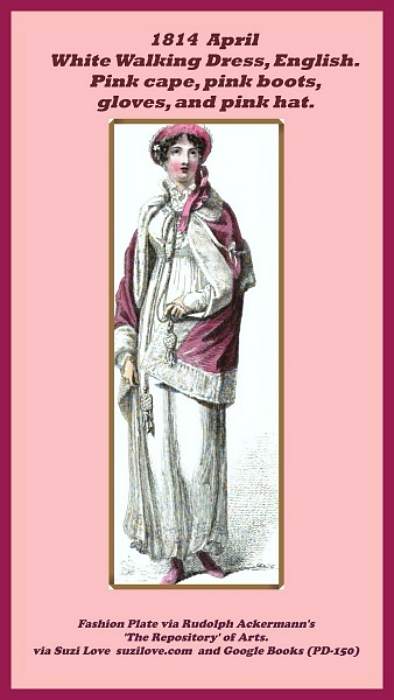
1814 April Promenade or walking dress of fine cambric with a high bodice and long sleeves, embroidered stomacher front and high collar, trimmed with muslin or lace, Tuscan border of needle-work the feet. A Cossack mantle of pink velvet lined with white sarsnet and trimmed with light sable, ermine, seal, or American squirrel. Short tippet of the same, mantle tied at throat with a silk cord and tassels. Pink velvet hat finished with narrow vandyke trimming and a small flower in the hair on the left side. Pink half boots and gloves of primrose kid or pale tan. Fashion Plate via Rudolph Ackermann's 'The Repository of Arts'.
1814 April Promenade or walking dress of fine cambric with a high bodice and long sleeves, embroidered stomacher front and high collar, trimmed with muslin or lace, Tuscan border of needle-work the feet. A Cossack mantle of pink velvet lined with white sarsnet and trimmed with light sable, ermine, seal, or American squirrel. Short tippet of the same, mantle tied at throat with a silk cord and tassels. Pink velvet hat finished with narrow vandyke trimming and a small flower in the hair on the left side. Pink half boots and gloves of primrose kid or pale tan. Fashion Plate via Rudolph Ackermann’s ‘The Repository of Arts’.
1814 April White Spencer Over Morning Dress Of Jaconet Muslin Finished With Vandykes. #RegencyEra #JaneAusten #FashionPlate https://books2read.com/SuziLoveFashion1810-1814 Share on X
HN_27_D2D_fashwomen1810-1814
Posted in 1800s, 1800s women's fashion, Coat or Pelisse Or Redingote, Dress Or Robe, England, fashion accessories, Google Books, hats, Jane Austen, London, Regency Era, Regency Fashion, Spencer, Suzi Love Images | Tagged 1800s women's fashion, Dress Or Gown, fabrics, fashion accessories, Fashion Plate, Hats And Hair, Jane Austen, jewelry, Mc Cord Museum, Regency Fashion, sewing, Shoes, Spencer, The Repository Of Arts
1795-1810 ca. Gown, English, 1810 ca. Sewing of Gown. 1795-1799 ca. Fabric Block Printing. Pattern of floral trails blends influences from Indian-painted and printed textiles, and woven silks, a style which remained popular until the end of18th century. Sleeves closed with narrow band of fabric, which fastens with hook and eye. collections.vam.ac.uk

1795-1810 ca. Roller Printed Dress. Jane Austen style Regency Fashion. 

Suzi Love Posted on July 31, 2023 by Suzi LoveJuly 30, 2023

1795-1810 ca. Roller Printed Dress, English. Empire style, high-waisted, roller printed dress with skirt gathered at the back to create a full skirt and with simple V-necked bodice and long sleeves.  Sleeves are closed with a narrow band of fabric which fastens with a hook and eye. via Victoria and Albert Museum, London, UK.  1810 ca. Sewing of Gown. 1795-1799 ca. Fabric Block Printing. Pattern of floral trails blends influences from Indian-painted and printed textiles, and woven silks, a style which remained popular until the end of18th century.

The pattern of floral trails seen on the printed fabric of this gown exhibits a blend of influences from Indian-painted and printed textiles, and woven silks, a style which remained popular until the end of the 18th century. The sleeves of this gown are closed with a narrow band of fabric, which fastens with a hook and eye.

The dress is styled with a high-waisted , fitted bodice, which fastens centrally. The neck, which is trimmed with a 1″ frill of matching material, is rounded a the back and V-shaped at the front. The bodice is lined with white cotton which extends 1/3 of the way down the full length tapered sleeves. A trimming decorations is attached to the wrist of the right sleeve (made from the same material and lined with white cotton), which fastens with a metal hook and eye at the hip. The skirt has an ‘apron’ style front with fastening tapes attached to either side, in addition to this there are vertical pocket slits situated at either side of the skirt measuring 11″. The front and rear sides of the skirt are constructed from one width of fabric – 39.5″ wide. The waistline at the back of the skirt is gathered a the centre and is constructed from two pieces of material measuring 46″ wide.

The cotton has blue threads in the selvedges denoting English origin, and is block printed in a polychrome palette with pencilled blue on a white ground. The design consists of an all-over pattern of delicate floral trails of carnations, pinks an other stylised flowers interspersed by vertical arborescent meanders bearing exotic fruits and stylised flowers. The pattern repeat measures 10.5″ by 10″.

1795-1810 ca.  Gown, English, 1810 ca.  Sewing of Gown.  1795-1799 ca. Fabric Block Printing. Pattern of floral trails blends influences from Indian-painted and printed textiles, and woven silks, a style which remained popular until the end of18th century. Sleeves closed with narrow band of fabric, which fastens with hook and eye. collections.vam.ac.uk
1795-1810 ca. Roller Printed Dress. Jane Austen style Regency Fashion. #RegencyFashion #georgianfashion #janeausten https://books2read.com/SuziLoveFashionWomen1800 Share on X
HN_12_D2D Retailer Buy Link
books2read.com/SuziLoveFashionWomen1800
HN_12 D2D_RetailerBuyLink_HN_12 books2read.com/SuziLoveFashionWomen1800
Posted in 1700s, 1700s Womens Fashion, 1800s, 1800s women's fashion, Dress Or Robe, England, Georgian Era, Georgian Fashion, Jane Austen, Regency Era, Regency Fashion, sewing, Suzi Love Images | Tagged 1700s Or Georgian Era, 1800s Or 19th Century, 1800s women's fashion, Dress Or Gown, fabrics, Georgian Fashion, Jane Austen, Regency Fashion, sewing, Victoria and Albert Museum

Post navigation

Next Post→

SUBSCRIBE TO SUZI LOVE'S NEWSLETTER.

Recent Posts

  • 1814 Jane Austen, Mansfield Park. “Give a girl an education and introduce her properly into the world, and ten to one but she has the means of settling well, without further expense to anybody.”#JaneAusten #RegencyEra #Quote
  • What shoes did the Bridgertons and Jane Austen wear? Gray Slippers, American, with long ankle ties. #JaneAusten #Bridgerton #shoes #regencyfashion
  • Book Hooks: Lady Laura Jamison believes her extraordinary olfactory senses will sniff out her perfect match, but will the Earl prove her wrong? #HistoricalRomance #RomCom #RegencyRomance
  • 1880’s Gorgeous corset of silk satin, steel busk, and bone, French. #VictorianEra #Corset #VictorianFashion
  • “Happiness in marriage is entirely a matter of chance.” Jane Austen #PrideandPrejudice (1813) #JaneAusten #Quote #RegencyEra

Recent Comments

  1. Jana Richards on Book Hooks: Lady Laura Jamison believes her extraordinary olfactory senses will sniff out her perfect match, but will the Earl prove her wrong? #HistoricalRomance #RomCom #RegencyRomance
  2. Kayelle Allen on Book Hooks: Lady Laura Jamison believes her extraordinary olfactory senses will sniff out her perfect match, but will the Earl prove her wrong? #HistoricalRomance #RomCom #RegencyRomance
  3. Tina Donahue on Book Hooks: Lady Laura Jamison believes her extraordinary olfactory senses will sniff out her perfect match, but will the Earl prove her wrong? #HistoricalRomance #RomCom #RegencyRomance
  4. Maggie Blackbird on Book Hooks: Lady Laura Jamison believes her extraordinary olfactory senses will sniff out her perfect match, but will the Earl prove her wrong? #HistoricalRomance #RomCom #RegencyRomance
  5. James DiBenedetto on Book Hooks: Lady Laura Jamison believes her extraordinary olfactory senses will sniff out her perfect match, but will the Earl prove her wrong? #HistoricalRomance #RomCom #RegencyRomance

Login

  • Log in

Archives

  • May 2026
  • April 2026
  • March 2026
  • February 2026
  • January 2026
  • December 2025
  • November 2025
  • October 2025
  • September 2025
  • August 2025
  • July 2025
  • June 2025
  • May 2025
  • April 2025
  • March 2025
  • February 2025
  • January 2025
  • December 2024
  • November 2024
  • October 2024
  • September 2024
  • August 2024
  • July 2024
  • June 2024
  • May 2024
  • April 2024
  • March 2024
  • February 2024
  • January 2024
  • November 2023
  • October 2023
  • September 2023
  • August 2023
  • July 2023
  • June 2023
  • April 2023
  • March 2023
  • February 2023
  • June 2022
  • April 2022
  • March 2022

Categories

  • 1700s
  • 1700s Mens fashion
  • 1700s Womens Fashion
  • 1800s
  • 1800s Mens Fashions
  • 1800s women's fashion
  • 1900s
  • art
  • Australia
  • Bath
  • bedroom fashion
  • Book Hooks
  • Box Or Container
  • Bridgerton
  • Bus Trips
  • Canada
  • Carriage
  • cartoon
  • Celebrity
  • Chatelaine
  • children
  • Children
  • Christmas
  • Coat or Pelisse Or Redingote
  • Contemporary
  • Corset
  • Couple
  • Customs & Manners
  • dancing
  • December Scandal
  • Decorative Item
  • Dress Or Robe
  • Easter
  • Edwardian Era
  • Embracing Scandal
  • England
  • Ester In Images
  • Europe
  • Events
  • Fashion
  • fashion accessories
  • Food and Drink
  • Four Times A Virgin
  • France
  • furniture
  • Georgian Era
  • Georgian Fashion
  • Google Books
  • Grand Tour
  • Group
  • hats
  • History
  • History Events
  • History Notes
  • History Of Christmases Past
  • household
  • Hygiene
  • Irresistible Aristocrats
  • Jane Austen
  • Keanu Reeves
  • Kellys Justice
  • Legal
  • London
  • Love After Waterloo
  • Loving Lady Katharine
  • medical
  • military
  • money
  • mourning
  • Music
  • Outback Arrival
  • pants
  • Pastimes
  • peerage
  • People
  • Petunia and Pearl Diver
  • Places
  • Pleasure House Ball
  • postal
  • Queensland
  • Quotations
  • Regency Era
  • Regency Fashion
  • Regency Life Series
  • Reticule or Bag
  • riding
  • Romantic Era
  • Royalty
  • Russia
  • Scandalous Siblings Series
  • Scenting Scandal
  • Self Publishing
  • sewing
  • Shirt
  • shoes
  • South Pacific
  • Spencer
  • sports
  • Suit
  • Sunday Snippet
  • Suzi Love
  • Suzi Love Books
  • Suzi Love Images
  • Suzi Love Writing
  • Swain Cove
  • THe Viscount's Pleasure House
  • travel
  • U.S.A
  • underclothing
  • Vest or Waistcoat
  • Victorian Era
  • Victorian Fashion
  • weapons
  • weddings
  • Writing Tools

1800s men fashion 1800s women's fashion antiques Bridgerton British history Cartoons Corset cravat decorative Dress Or Gown England europe fashion accessories Fashion Plate France Georgian era Georgian Fashion gloves google books Hats And Hair historical romance History Notes household Jane Austen jewelry Journal des Dames et des Modes London Metropolitan Museum NYC pants Redingote Or Pelisse Or Coat Regency Era Regency Fashion Regency London reticule or bag riding sewing shawls Shoes Suzi Love Books Suzi Love Images Tailcoat The Repository Of Arts underclothing Vest or Waistcoat Writing Tools

©2026 - Suzi Love - Weaver Xtreme Theme Privacy Policy
↑