1801 Young Man’s Daily Outfit, French. Blue cutaway coat with extra high collar, brown knee breeches, chin high white cravat, an all-over curly hairstyle and a round-hat with a wide brim and a low crown which is flat on the top. The hats only decoration is a narrow ribbon and buckle. Fashion Plate via Journal des Dames et des Modes, or Costume Parisien. https://books2read.com/SuziLoveFashionMen1800-1819
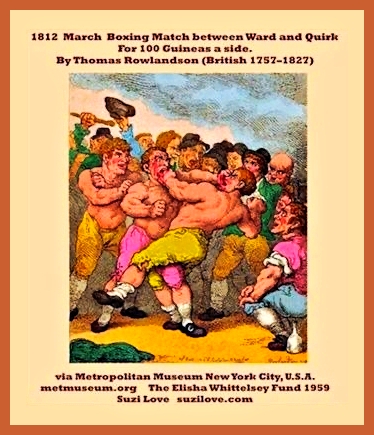
1812 March 1st Boxing Match between Ward and Quirk for 100 Guineas a side. By Thomas Rowlandson, British. via The Metropolitan Museum, New York City, U.S.A. metmuseum.org
1800 Elegant Young French Gentleman. Pulling on his top coat over a long tan coat. Tan gloves, brown hat, brown boots, cane. Fashion Plate via suzilove.com and Journal des Dames et des Modes, or Costume Parisien.
Overcoats: Called many names: Greatcoat, or Carrick, or Garrick, or Coachman’s, or Driving. Or Box Coat. Overcoats were voluminous and covered the other clothing. Usually with many capes, or collars, or pelerines covering the shoulders and with buttons down the front. Popular in the 19th century for riding, driving and travel as they kept the wearer warm and snow and rain off the body. Greatcoat: Overcoat with capes around the shoulders for men. Carrick or Garrick Coat: Other names for a gentleman’s inclement weather coat and worn for driving or travel.
1806 Waiting For the St. Cloud Coach, Place de la Concorde, Paris. Illustrations by Francis Courboin. via Les Modes de Paris. (PD-Art) This couple is depicted waiting for the coach, which was a passenger vehicle drawn by four horses. The woman is wearing a fashionable hat or “capote” that covers her face. Her dress maintains the empire waist and has very long sleeves that also have a ‘mancheron’ or a gathered sleeve at the shoulders. The man is wearing a ‘habit du gagé’ or a coat with tails, buttoned at the waist. His hat is a ‘haut-de-forme’ or what is commonly known in English as a top hat. He wears tight, short pants tucked into large, riding boots, as was the fashion for men. Illustrations by François Courboin from Octave Uzanne‘s Les Modes de Paris. Variations du goût et de l’esthétique de la femme, 1797-1897, L. Henry May, Paris, 1898, or from the English translation of the same work: Fashion in Paris : the various phases of feminine taste and aesthetics from 1797 to 1897, William Heinemann, London, 1898. Modes de Paris VIa Brown University Library .
1800 ca. Bicorn, Or Two Cornered, Black Silk Hat, Possibly Made In Great Britain or France. via Victoria and Albert Museum, London, UK. collections.vam.ac.uk.
Definition: Bicorn Or Bicorne: Two cornered, or pointed, hats often worn by military men because the rain would drain off either side of the hat and away from the body. They could also be easily flattened to carry under arm. This sort of hat would have been worn by gentlemen around the turn of the century and during Jane Austen’s writing life.
1815 The First Quadrille at Almack’s Assembly Rooms, London. Left to Right: Marquis of Worcester, Lady Jersey, Clanronald MacDonald and Lady Worcester. “It was not until 1815 that Lady Jersey introduced from Paris the favourite quadrille, which has so long remained popular. I recollect the persons who formed the very first quadrille that was ever danced at Almack’s: they were Lady Jersey, Lady Harriett Butler, Lady Susan Ryde, and Miss Montgomery; the men being the Count St Aldegonde, Mr Montgomery, Mr Montague, and Charles Standish.” From The Reminiscences of Captain Gronow 1810-1860.
The patronesses of Almack’s controlled a lot of a young lady’s acceptance into English society in Jane Austen’s times. To be given a voucher and admitted to an assembly, there was an introduction into London’s polite society.
1816 Inside a dining room by Martin Drolling. Via Wikimedia Commons commons.wikimedia.org (PD-ART) This is typical of the inside of a gentleman’s household in Jane Austen’s times.
1800 ca. Pair of Flintlock Duelling Pistols. Owned by Captain William Waller (active 1794-1807). Walnut stock, chequered grips, rounded butts, fitted with two silver pipes containing ramrods. Silver trigger guards engraved and end in pineapple shaped finials, each with flintlock containing flints. Lock plates engraved with leaf design, octagonal barrels browned with narrow gold bands near lock. via Royal Museums Greenwich collections.rmg.co.uk
During the Regency Era and Jane Austen’s writing years, dueling was illegal, although secret duels still happened. Courts were made up of peers and they rarely charged another peer for anything illegal. Honor and gentlemanly behavior were the most important things to men so if there was an offense committed, a dawn duel was arranged with seconds to check the weapons used and a doctor in case of injuries.
1814 Gentleman’s Morning Outfit, French. Green double-breasted cutaway tailcoat, cream trousers, high collared shirt, unusual black cravat, heeled black boots with small spurs, fob at his waist, black top hat with decoration. Fashion Plate via Journal des Dames et des Modes, or Costume Parisien.