Typical of the type of outfit a gentleman in the Georgian Era would wear to a wedding or important event. The jacket flares from the waist into multiple folds to give easier movement and the front has a long line of matching buttons. The breeches have a buttoning front flap. Part of the costume collection at Ham House, Surrey, UK. Part of the National Trust, UK. nationaltrustimages.org.uk
An overview of women’s fashions in the first twenty years of the 19th century. What was fashionable for women in Jane Austen’s times, or the early 1800s. Wars were being fought around the globe so women’s fashion adopted a military look in support of soldiers. In Britain, the Prince Regent ruled instead of his father, King George III, so fashions, like the lifestyle, became more extravagant and accessories went from pretty to opulent. This set includes books 12, 25, 26, 27 and 28.
What was fashionable for women in Jane Austen’s times, or 1800s, or Regency Era. High-waisted dresses were extravagantly accessorized and hats, shoes, parasols and bags were added. Set includes History Notes Books 12, 25, 26, 27 and 28.
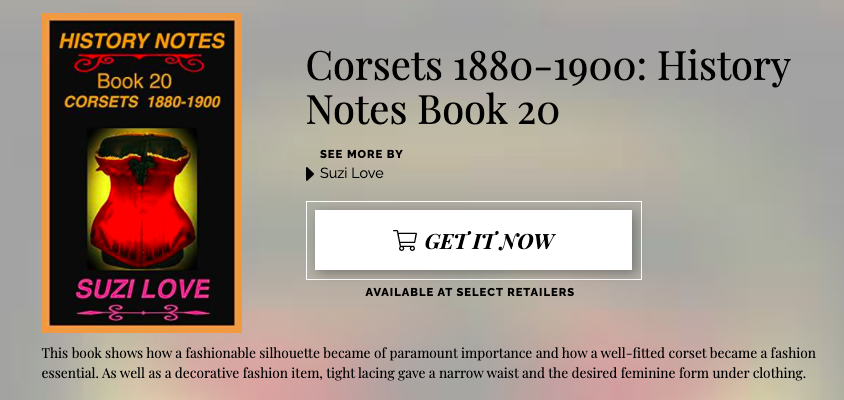
1887 Front View. Wedding Corset, American. Cotton twill, silk thread embroidery. Fully boned wedding corset with front hooks and back lacing. Every boning channel is flossed top and bottom. Via Chicago History Museum, U.S.A. digitalcollection.chicagohistory.org https://books2read.com/SuziLoveCorsetBook20
Lover of Jane Austen and the Regency Era fashions? History Notes Book 25. #JaneAusten #RegencyFashion #HistoricalFashion books2read.com/SuziLoveFashionWomen1801-1804
Writer Or Reader Of Regency Era?What did Jane Austen and friends wear? Women’s clothing changed dramatically in early 1800s. New silhouette copied simplistic styles of Greeks and Romans. High-waisted white dresses and flowing skirts with color and warmth added by outerwear and accessories. Fashion Women 1801-1804 History Notes Book 25 https://books2read.com/SuziLoveFashionWomen1801-1804
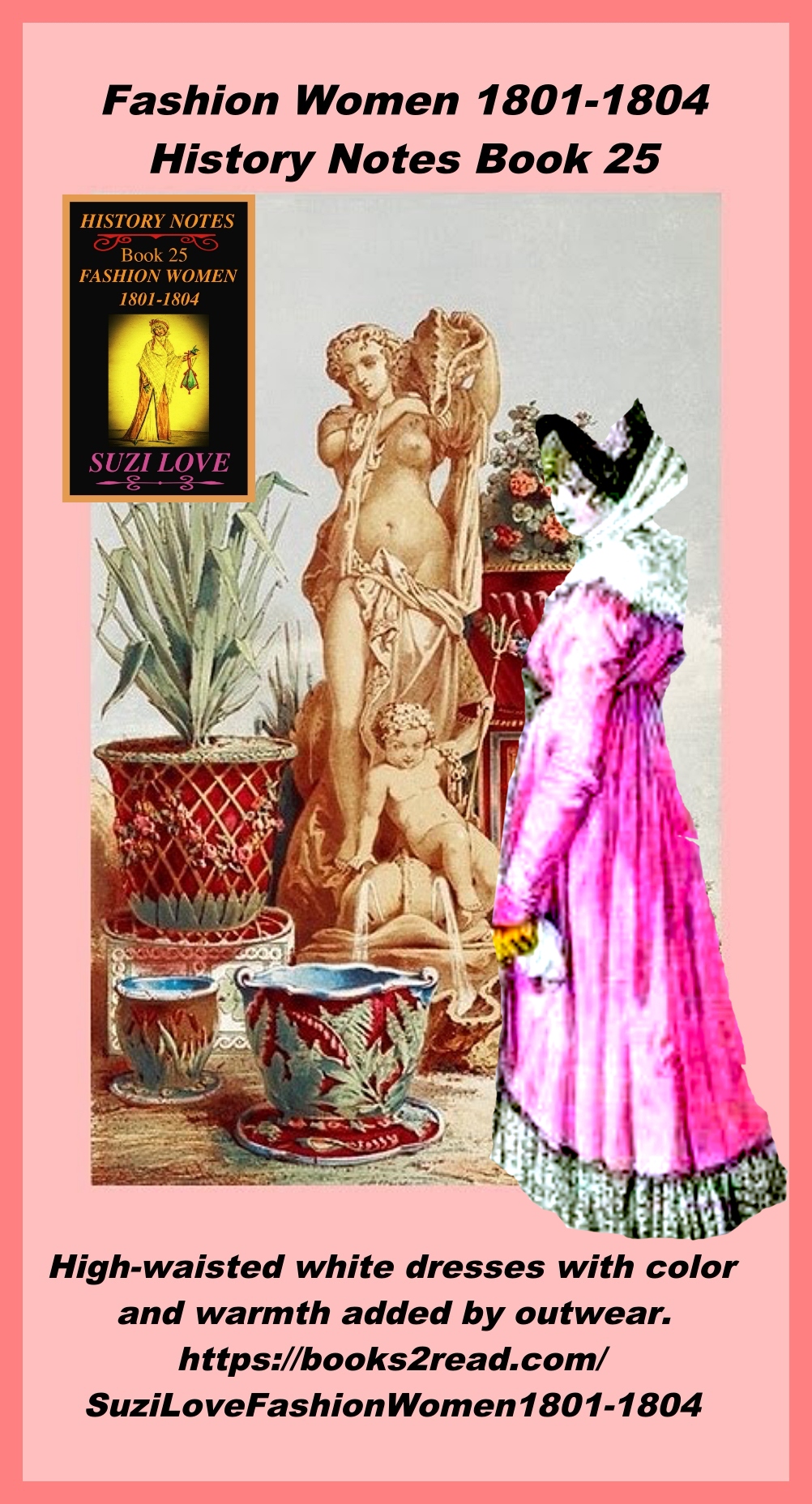
Definition Empire Style Dress: High-waisted white gowns defined women’s fashion during the Regency Era. ‘Empire’ is the name given to the period when Napoleon Bonaparte built his French Empire. High-waisted, loose gowns were adopted by the aristocracy as a symbol of turning away from the elaborate clothing worn in the 1700s. This sort of high-waisted dress would have been worn by Jane Austen and her contemporaries in England.
Definition Shawls: The shawl started off in India as a fine wool garment for men that could be worn as a scarf, turban or as a mantle: the word comes from the Persian shäl. Originally imported from the East, European Kashmir shawls were made first in Norwich and Edinburgh in Britain in the late 18th century. Shawls were an essential item in the early 1800s to cover the thin gowns women wore. They were made of muslin, gauze, silk, wool, and velvet, though cashmere shawls were the softest and most prized.
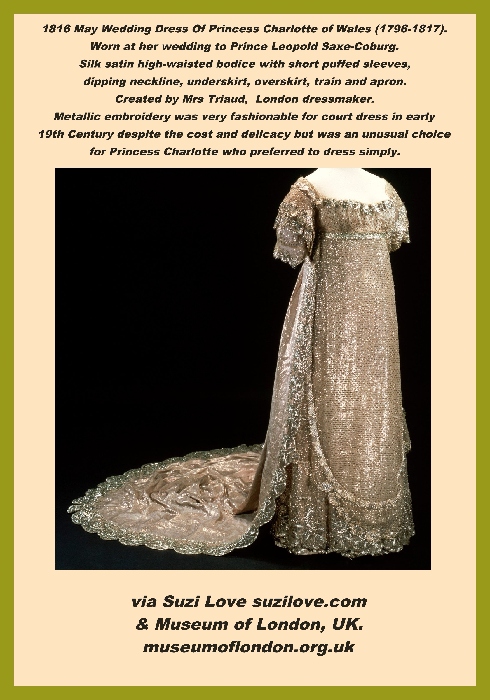
1816 May Wedding Dress Of Princess Charlotte of Wales (1796-1817). Worn at her wedding to Prince Leopold Saxe-Coburg. Silk satin high-waisted bodice with short puffed sleeves, dipping neckline, underskirt, overskirt, train and apron. Created by Mrs Triaud, London dressmaker although this may not be the original skirt. Metallic embroidery was very fashionable for court dress in early 19th Century despite the cost and delicacy but was an unusual choice for Princess Charlotte who preferred to dress simply. via Museum of London, UK. museumoflondon.org.uk
The wedding dress of Princess Charlotte Augusta as described in La Belle Assemblee magazine for May, 1816.
“As we have been gratified with a sight of the wedding dresses of this amiable and illustrious female, a particular yet concise account of them cannot but be acceptable to our fair readers. The Royal Bride, happy in obtaining him whom her heart had selected, and whom consenting friends approved, wore on her countenance that tranquil and chastened joy which a female so situated could not fail to experience.
The manteau was of silver tissue lined with white satin, with a border of embroidery to answer that on the dress, and fastened in front with a splendid diamond ornament. Such was the bridal dress … The jewellery of the royal bride is most superb; beside the wreath, are a diamond cestus, ear- rings, and an armlet of great value, with a superb set of pearls.
1820-1840 ca. Hand-Embroidered Wedding Corset, Connecticut, USA. Ivory cotton covered with hand embroidery, including love birds on hearts, front pocket for busk, eyelets for back lacing. Trapunto (to embroider) cording decorates and shapes corset. The back closure has ivory eyelets for the lacing. The center-front has a pocket panel for inserting a busk. Trapunto (to embroider) shapes the corset by outlining the design with two or more rows of running stitches and then padding from the underside which gives a raised effect.The technique was always considered very elegant. Trapunto first appeared in 14th century Sicily and was widely adopted for clothing in Tudor England, and then brought to America by the new settlers. In addition to the cording, the corset is totally covered with hand-embroidered flowers and there are two embroidered love birds on hearts at the center-front. Above the birds is a section of trapunto work. via Vintage Textiles
1816 June Bridal Dress, English A frock of striped French gauze over a white satin slip: the bottom of the frock is superbly trimmed with a deep flounce of Brussels lace, which is surmounted by a single tuck of byas white satin and a wreath of roses; above the wreath are two tucks of byas white satin. We refer our readers to our print for the form of the body and sleeve: it is singularly novel and tasteful, but we are forbidden either to describe it, or to mention the materials of which it is composed. The hair is dressed low at the side, and parted so as to entirely display the forehead: it is ornamented with an elegant aigrette of pearls in front, and a spring of French roses placed nearly at the back of the head. Necklace, ear-rings, and bracelets of pearl. White kid gloves, and white satin slippers. Fashion Plate via Rudolph Ackermann’s ‘The Repository of Arts’.
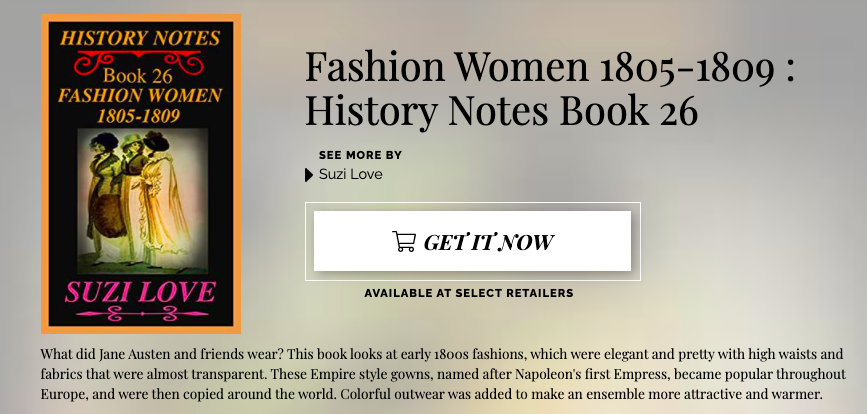
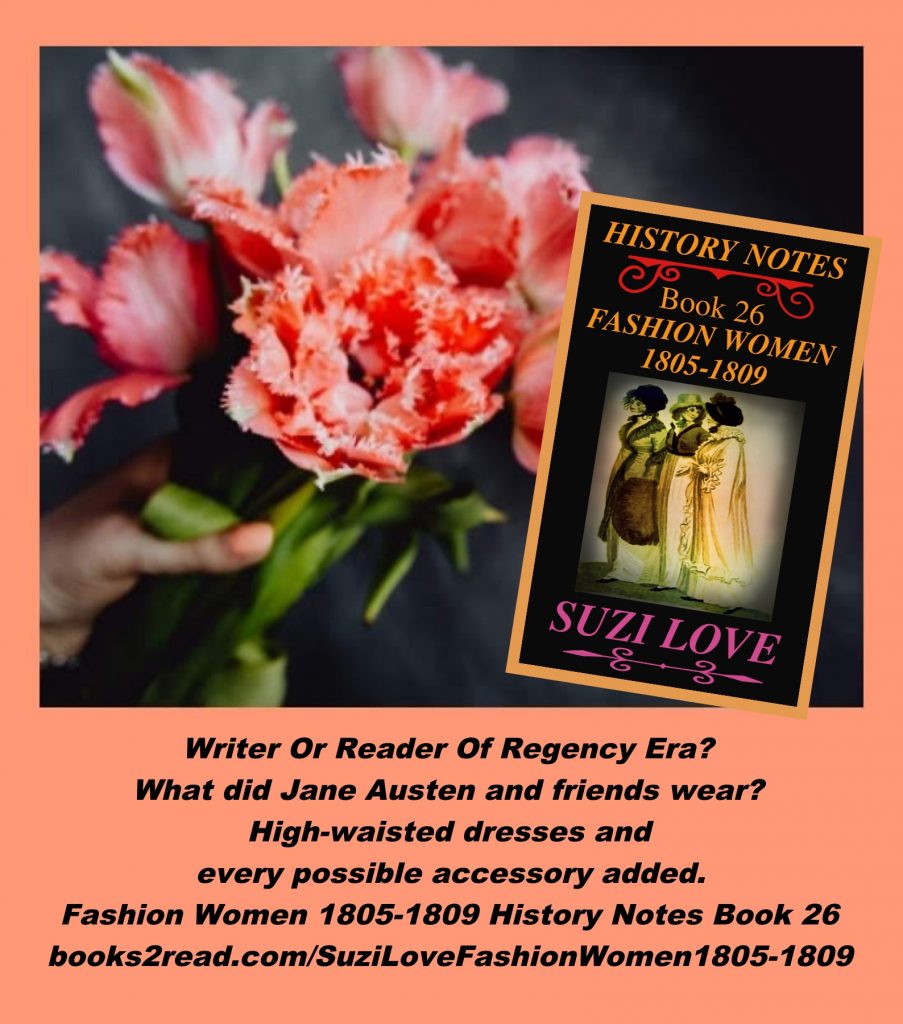
What did Jane Austen and friends wear? Early 1800s fashions were elegant and pretty with high waists and fabrics that were almost transparent. These Empire style gowns, named after Napoleon’s first Empress, became popular throughout Europe, and were then copied around the world. Colorful outwear was added to make an ensemble more attractive and warmer. History Notes Book 26 Fashion Women 1805-1809. https://books2read.com/SuziLoveFashionWomen1805-1809
The Empire waist gown defined women’s fashion during the Regency Era. ‘Empire’ is the name given in France to the period when Napoleon built his French Empire. High-waisted, loose gowns were adopted by the aristocracy as a symbol of turning away from the fussy, elaborate and expensive clothing worn in the 1700s. Jean-Jaques Rousseau advocated copying peasants and returning to a simpler life and more natural fashions. Unrestricting clothing was part of the new Democracy in France and these simpler and flowing fashions were adopted all over Europe, including Britain and despite the continual wars being fought against France during the early 1800s. Not even war stopped fashions from being copied everywhere.
What did Jane Austen and friends wear? Early 1800s fashions were elegant and pretty with high waists and fabrics that were almost transparent. These Empire style gowns, named after Napoleon’s first Empress, became popular throughout Europe, and were then copied around the world. Colorful outwear was added to make an ensemble more attractive and warmer. History Notes Book 26 Fashion Women 1805-1809. https://books2read.com/SuziLoveFashionWomen1805-1809