1805 White Morning Dress, French. White tunic over the dress, pink shawl with paisley patterned ends, white cap tied under her chin and slippers. Fashion Plate via Journal des Dames et des Modes, or Costume Parisien. This flowing white dress show the transition from the round dresses of the late 1700s to the Empire style dresses with the waistline high under the bust. Small trains were still worn in the early 1800s, but much more manageable than the larger and more elaborate trains of the late 1700s. Jane Austen and her friends would have worn dresses like this when at home with the family or close friends. It’s easy to picture Jane Austen wearing a dress like this while writing her manuscripts.
Definition Cashmere Shawl: Extremely fine, soft, handwoven shawl. Two-ply yarn in warp, single yarn in filling. May be embroidered, with pattern appearing on both sides, or woven in one or more colors. French shawl is woven in multicolored designs on jacquard loom with designs showing only on one side. Presumably originating in Kashmir region of India and Pakistan. These sort of cashmere shawls were a much-prized fashion accessory for all ladies who could afford them. Jane Austen and her family and friends would have been extremely fortunate to either buy one or have one gifted to them.
Definition Morning Dress: Worn either at home, out shopping, or for walking in the park or country. Presentable but not overly accessorized. Often a round gown where the bodice and skirt were made from one piece of material. Usually with a high-neck and long sleeves and made from sprigged or plain muslin, cotton, or wool.
Fashion Women 1805-1809 History Notes Book 26 What did Jane Austen and friends wear? https://books2read.com/SuziLoveFashionWomen1805-1809
1808 Lady In A Dancing Dress, French. Dress of Tulle Broderie, short puffed sleeves, floral embroidery, dancing slippers and upswept hairstyle. Fashion Plate via Journal des Dames et des Modes, Costume Parisien. When attending assemblies or balls, ladies in Jane Austen’s times women wore Empire style dresses which were usually made of light fabric and floaty in style and often of a shorter length suitable for dancing.
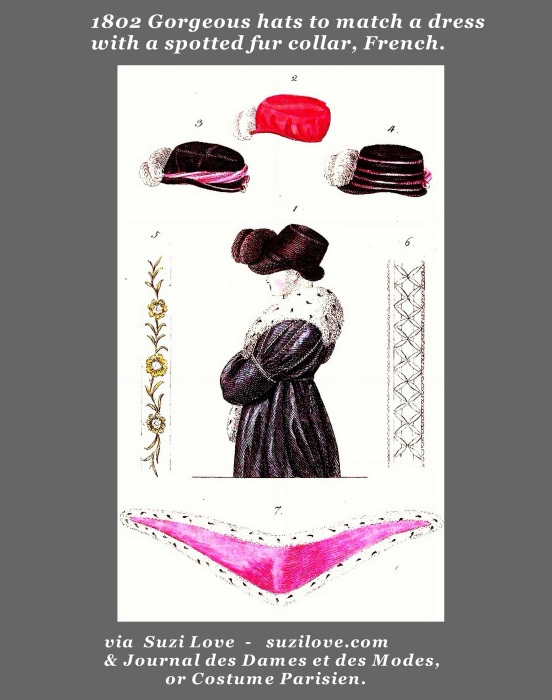
1802 Gorgeous French Hats. Bodice and Trims. To match a blue dress with a spotted fur collar. Fashion Plate via Journal des Dames et des Modes, Costume Parisien. French fashions like this were copied by English magazines so these styles of hats would have been worn by Jane Austen and her contemporaries. https://books2read.com/SuziLoveFashionWomen1801-1804
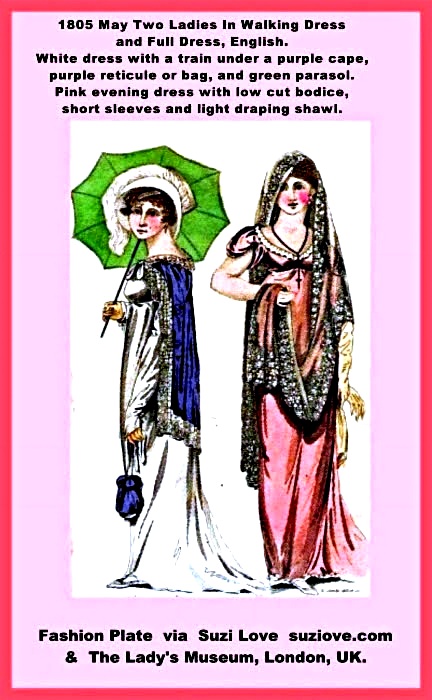
1805 May Two Ladies In Jane Austen Style Walking Dress and Full Dress, English. White dress with a train under a purple cape, purple reticule or bag, and green parasol. Pink evening full dress with low cut bodice, short sleeves and light draping shawl. via Vernon and Hood at The Lady’s Monthly Museum, London, U.K. Definition Reticule, or Ridicule, or Bag or Purse: Often with a drawstring to pull closed and usually made of cloth or covered cardboard and often decorated with beading or embroidery. A reticule, or purse, or handbag, was usually carried by a woman during the Regency period to carry all their daily necessities. Earlier, women used pockets that tied at the waistline and were hidden in the folds of their skirts. Empire style, or early 1800s, high-waisted dresses made it impossible to either sewn in a pocket or to tie on a pocket. So women began carrying small, decorated bags called Reticules, or ridicules, which generally pulled close at the top with a drawstring.
What was fashionable outdoor wear for the Bridgerton ladis, Jane Austen, and their contemporaries? Reticules, Spencers, and Pelisses, or Walking Dresses, Or Redingotes. History Notes Books 3, 4, and 5 By Suzi Love.
What was fashionable for purses in past centuries? Call them what you like: purses, bags, handbags, reticules, ridicules, clutches, or pocket replacements. They all did the same job and they changed greatly with the prevailing fashions of time. books2read.com/suziloveReticules
What was fashionable in women’s jackets in the Regency Era? Call them what you like: Spencers, short jackets, or Regency jackets. They provided modesty and warmth and they changed greatly with the prevailing fashions of the time. Take a look at the jackets being worn by women in the early 1800s. books2read.com/suziloveSpencers
What sort of coats did women wear during the Regency years? them what you like: Coat, Pelisse, Redingote, Walking Dress, Promenade Dress. Take a look at what was being worn by women, men, and children. books2read.com/suzilovePelisse
HN_4_Spencers, Or Jackets. #Regency #Georgian #Victorian #Fashion History Notes Book 4 By Suzi Love.
1813 October White Empire style, or high-waisted, Carriage Dress, English. Brown shawl, brown boots, and a lace cap tied under the chin. Typical of the carriage fashions that would have been worn by Jane Austen and her contemporaries. Fashion Plate via The Lady’s Magazine Or Entertaining Companion for the Fair Sex.
Definition Empire Style Dress: High-waisted white gown defined women’s fashion during the Regency Era. ‘Empire’ is the name given to the period when Napoleon Bonaparte built his French Empire. High-waisted, loose gowns were adopted by the aristocracy as a symbol of turning away from the fussy, elaborate and expensive clothing worn in the 1700s. https://books2read.com/SuziLoveFashion1810-1814
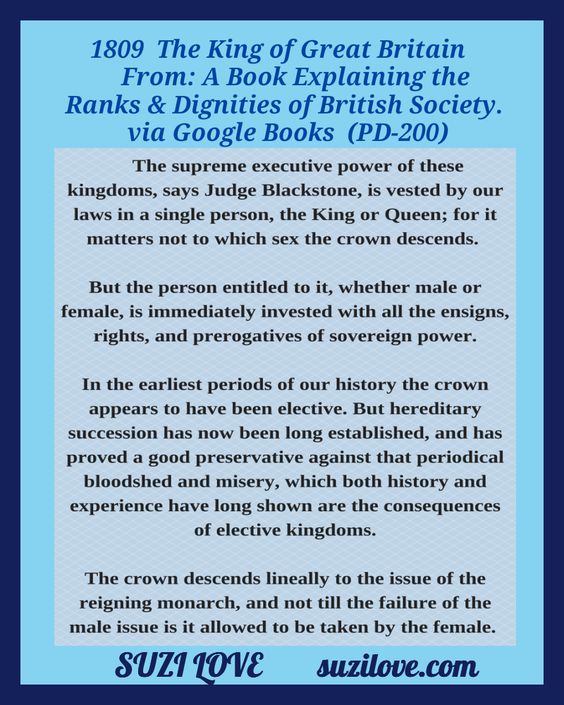
1809 The King Of Great Britain. From: 1809 A Book Explaining The Ranks and Dignities Of British Society. via Google Books. (PD-180) BRITISH RANKS, The King Of Great Britain and His Or Her Powers during Jane Austen’s lifetime.
BRITISH RANKS, THE KING .
The supreme executive power of these kingdoms is vested by our laws in a single person, the King or Queen, for it matters not to which sex the crown descends, but the person entitled to it, whether male or female, is immediately invested with all the ensigns, rights, and prerogatives of sovereign power .
In the earliest periods of our his tory the crown appears to have been elective. But hereditary succession has now been long established , and has proved a good preservative against that periodical bloodshed and misery, which both history and experience have long shewn are the consequences of elective kingdoms. The crown descends lineally to the issue of the reigning monarch , and not till the failure of the male issue is it allowed to be taken by the female.
Lawyers say the King of England is a mixed person, a priest as well as a prince and at his coronation he is anointed with oil, as the priests and kings of Israel were, to intimate that his person is sacred. The principal duty of the king is to govern his people according to law and these are the terms of the oath administered usually by the Archbishop of Canterbury at his coronation, in the presence of the people, who on their parts do reciprocally take the oath of allegiance to the crown : “ The archbishop, or bishop, shall say, Will you solemnly promise and swear to govern the people of this kingdom of England , and the dominions thereto belonging, according to the statutes in parliament agreed on and the laws and customs of the same?
The king or queen shall say , I solemnly promise so to do . Archbishop , or bishop .Will you to your power cause law and jus tice , in mercy , to be executed in all your judgments?
King or queen, I will, Archbishop , or bishop – Will you to the utmost of your power maintain the laws of God , the true profession of the gospel and the protestant reformed religion established by the law? And will you preserve unto the bishops and clergy of this realm, and to the churches com mitted to their charge, all such rights and privileges as by law do or shall appertain unto them or any of them ?
King or queen, All this I promise to do .
After this , the king or queen , laying his or her hand upon the holy gospels , shall say , The things which I have here before promised , I will perform and keep : so help me God . And then shall kiss the book .
One of the principal bulwarks of our liberty is the certain and definite limitation of the king’s prerogative, the extent and restrictions of which are marked out with the greatest clearness. But in the exertion of those powers which the LAW has given him , the king is irresistible and absolute. He is considered by the laws of England as the head and supreme governor of the national church and, in virtue of this authority, he convenes , prorogues , rogues , restrains , regulates , and dis solves all ecclesiastical synods or convocations. He has the supreme right of patronage over all ecclesiastical benefices and if they are not presented to within the time prescribed , their lapse becomes the advantage of the crown. In regard to foreign concerns, the king is the delegate or representative of his people. He has power, by his prerogative, with out any act of parliament, to make war or peace, conclude treaties, grant safe conducts, give commissions for raising and regulating fleets and armies, as well as for erecting, manning, and governing forts, and other places of strength. He can prohibit the exportation of arms and ammunition out of the kingdom, can dispose of magazines, castles, ships, public moneys, etc. and all that is done in regard to foreign powers by the royal authority, is the act of the whole nation. He has the sole power of sending ambassadors to foreign states, and receiving ambassadors at home. He convokes, adjourns, prorogues, and dissolves parliaments and may refuse his assent to any bill passed by both houses, without giving his reason for it .
He may increase the number of members of either house at plea sure, by creating new peers and bestowing privileges on other towns for sending burgesses to Parliament, but the last has by late kings been given up.
The sole power of conferring dignities and honors is entrusted to him so that all degrees of nobility and knighthood, and other titles, are received by immediate grant from the crown. And the king has also the prerogative of conferring privileges upon private persons such as granting place or precedence to any of his subjects such is also the power to enfranchise an alien and make him a denizen, and the prerogative of erecting corporations. The coining of money too, as well as the settling thedenomination or value for which it shall pass current, is the act of the sovereign power.
But to take all the characters into view in which the king is considered in domestic affairs would be almost endless for from thence an abundant number of prerogatives arise. All lands re covered from the sea , gold and silver mines, royal fishes etc. be long to him. He can unite, separate, enlarge, or contract the limits of ecclastical benefices and, by his letters, erect new bishoprics, colleges etc. He can dispense with the rigor of ecclesiastical laws except those which have been con firmed by act of parliament, or declared by the bill of rights. He has also power to moderate the rigor of the law to pardon a man condemned by law except in appeals of murder, and in case of impeachment by the house of commons, and to interpret by his judges in statutes and cases which are not defined by law.
But though he be entrusted with the whole executive power of the law, yet he cannot sit in judgment in any court for justice must be administered according to the powers committed and distributed to the several courts.
As the king is declared to be the supreme head in matters both civil and ecclesiastical so no suit can be brought against him even in civil matters because no court can have jurisdiction over him. The law also ascribes to the king in his political capacity absolute perfection. The king can do no wrong, by which ancient and fundamental maxim we are not to understand that every transaction of government is of course just and lawful but that whatever is exceptionable in the conduct of public affairs is not to be imputed to the king nor is he answerable for it personally to his people and farther that the prerogative of the crown extends not to do any injury. It is created for the benefit of the people and therefore cannot be exerted to their prejudice. In the king there can be no negligence and therefore no delay will bar his right. In the king also there can be no infamy, stain, or corruption of blood. And the law ascribes a kind of perpetuity, or immortality to him. His death is termed his demise , because the crown is thereby demised to another. He is not in law liable to Death, being a corporation of him self that lives for ever. There is no interregnum but the moment one king dies, his heir is king, fully and absolutely, without any coronation , ceremony etc. To these it may be added that by the law the king is said in a manner to be every where in all courts of judicature , which he alone has the right of erecting and therefore cannot be nonsuited.
The power of issuing proclamations is vested in the king alone, considered as the fountain of justice. The laws make it high treason barely to imagine or intend the death of the king, and because the destruction of the king may ensue that of his great counsellors or officers, it is felony in any of the king’s subjects to conspire even that. Some things the king cannot do. He cannot divest himself or successor of any part of the regal prerogative or authority and there are two things which he cannot do without the consent of Parliament:the making of new laws and the raising of new taxes. The king cannot dispense with the laws nor do any thing contrary to law. In England the law is as much superior to the king , as to any of his subjects and the obedienceof the king of England to the laws is his greatest glory while it is the security of the rights and liberties of his people who are the greatest as well as the freest people on the face of the earth , merely because their sovereigns are obliged to live insubjection to the written laws of the land.
The title of grace was first given to our kings about the time of Henry IV and that of majesty first to Henry VIII. The title of his present Majesty is , GEORGE the Third , King of the United Kingdom of Great Britain and Ireland, Defender of the Faith, Sovereign of the Orders of the Garter, Thistle, Bath and St. Patrick, Duke and Elector of Brunswick Lunenburg, Bishop of Osnaburg and Arch Treasurer of the Holy Roman Empire.
What Sort Of Pianoforte or Piano Was Played By Jane Austen and Contemporaries? Pianos, pianofortes and more. History Notes Book 7 Music Pianos books2read.com/suziloveMusicPiano
Definition Pianoforte or Piano: ‘Stringed keyboard instrument with a hammer action, as opposed to the jack and quill action of the harpsichord. Capable of gradations of soft and loud, the piano became the central instrument of music pedagogy and amateur study. By the end of the nineteenth century, no middle-class household of any stature in Europe or North America was without one.’ Definition via the Metropolitan Museum, NYC.
Around 1700, the Pianoforte, or Piano, was invented in Italy by Bartolomeo Cristofori, who created a hammer action keyboard instrument on which a musician could make changes in loudness by changing the force with which the keys were struck. He called his instrument “gravicembalo col piano e forte”, or, (harpsichord with soft and loud). Cristofori’s long name was later shortened to fortepiano or pianoforte, and finally just piano.
Musical Instruments were so important in most of the more affluent households in history that large industries grew all around the world to manufacture instruments, musical accessories, and to print sheet music. Pianos, pianofortes, harpsichords, and organs were found everywhere and were often the focus of a family gathering. By the end of the 18th Century, the pianoforte, or piano, was the leading instrument of Western music.
D2D_RetailerBuyLink_HN_7 Piano
books2read.com/suziloveMusicPiano
19th Century Early Chemise or Shift, American. White linen and embroidery. via Metropolitan Museum New York City, U.S.A. metmuseum.org
Chemise Or Shift: Sleeveless, mid-calf length garment of white cotton or muslin was worn next to the skin under stays or corset. Called ‘Shift’ from early Georgian (1700-1750) until Late Georgian (1750-1790) to replace ‘Smock’. By 1800, name replaced by ‘Chemise’. The sort of undergarment that Jane Austen would have worn next to her skin and under her stays, or corset.
1810-1815 ca. Salmon Pink Empire Style Dress, Norway. Typical Regency high-waisted dress. Long sleeves with puckered sleeve cap. Deep neckline with short shirred bodice. Long full skirt. via Digital Museum, Norway. digitalmuseum.no Regency fashion at its prettiest. The style of Empire style, or high-waisted, dress worn by Jane Austen and her contemporaries and the ladies in the Bridgerton family.
The Empire waist gown defined women’s fashion during the Regency Era. ‘Empire’ is the name given in France to the period when Napoleon built his French Empire. High-waisted, loose gowns were adopted by the aristocracy as a symbol of turning away from the fussy, elaborate and expensive clothing worn in the 1700s. Jean-Jaques Rousseau advocated copying peasants and returning to a simpler life and more natural fashions. Unrestricting clothing was part of the new Democracy in France and these simpler and flowing fashions were adopted all over Europe, including Britain and despite the continual wars being fought against France during the early 1800s. Not even war stopped fashions from being copied everywhere.
This book looks at what was fashionable for women in Jane Austen’s or the Bridgerton family’s times, or the early 1800s, or the Regency Era in Britain. Wars were being fought around the globe so women’s fashion adopted a military look in support of soldiers. Fashions, like the lifestyle, became progressively more extravagant and accessories went from colorful to over-the-top.