1811 White Dress, French. Dress with scalloped hem, pink Redingote, green paisley shawl and white hat. Fashion Plate via Journal des Dames et des Modes, or Costume Parisien.
Definition Redingote Or Pelisse Or Walking Dress Or Coat: Long fitted outdoor coat worn over other garments for warmth. Often left open at the front to show off the dress underneath. French word developed from English words, riding coat. Jane Austen and her contemporaries wore long coats like these to keep warm when out and about, visiting, shopping etc. The thin muslin dresses worn in the early 1800s were little protection against European winters.
1800-1820 ca. Woman’s Gloves, Spanish. Repeating pattern of concentric ovals across fingers shows their high quality and workmanship. Scalloped, pierced, pinked edges of cuff have geometric elements with floral garlands. Scene of gentleman presenting a gift to a young seated woman. European etiquette allowed a woman to receive gloves as a gift from men other than her husband so gloves were carefully chosen for their novelty. Spain produced high quality printed leather gloves using intaglio process. via Cooper Hewitt, New York City, USA. collection.cooperhewitt.org
Now surviving in museum collections throughout Europe and North America, this style of glove must have been a brief, but very popular fad of the last years of the 18th century. As gloves were one of the few gifts a man could give to a single woman he was not engaged to marry, new designs and colours were eagerly sought after to provide variety in this staple form of present.
Printed kidskin gloves of this type were fashionable from the last decade of the 18th century until the 1820s. They were suitable for wearing with the long sleeved day dresses which women adopted in the last decade of the century. Long gloves continued to be required for court dress which retained its short sleeves. By this date many European countries were manufacturing gloves, both in leather and in woven or knitted textiles made of silk, cotton, linen or wool. Printed kidskin was used for gloves and for the backing for fans. English fan makers were printing on leather before 1720. The intaglio method of printing used a copper plate. The design was engraved with a buril or dry point into the plate, then the plate was immersed in ink and the leather placed on it in a screw press. Several different pairs of gloves could be printed at a time and if the pattern wore off with use, they could be reprinted.
1811 White Dress, French. Worn under a white spotted tunic with yellow over dress with long sleeves. White gloves, shoes and hat with plume, or feathers, or aigrette. Fashion Plate via Journal des Dames et des Modes, or Costume Parisien. Even though this is a French fashion plate, Jane Austen and her contemporaries would have worn long coats like these to keep warm when out and about, visiting, shopping etc. The thin muslin dresses worn in the early 1800s were little protection against European winters so warmth and color was added by tunics and coats in a huge variety of styles.
Definition Aigret, aigrette, egret: Plume of feathers or jeweled ornament in shape of feathers worn on head or hats. During the early 19th century., or Jane Austen’s lifetime, the favorite feathers were osprey and heron.
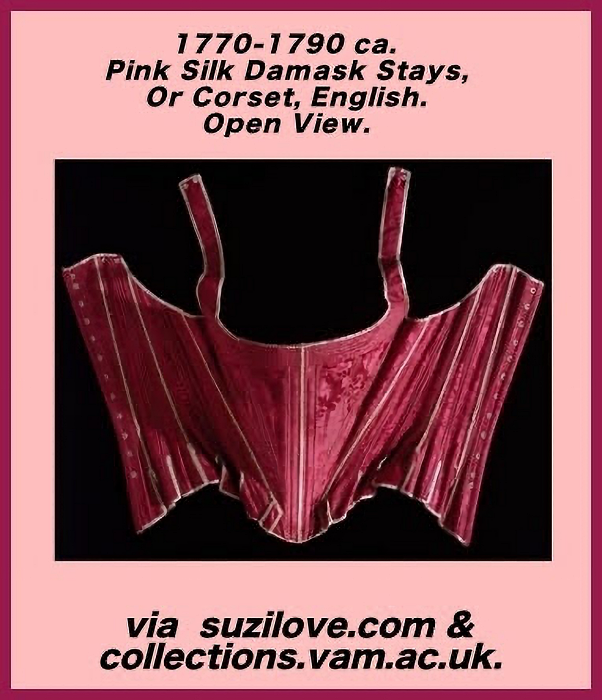
1770-1790 ca. Stays, or Corset, English. Pink silk damask, lined with linen, reinforced with whalebone, fingers spread over hips. via Victoria and Albert Museum, London, UK. collections.vam.ac.uk. https://books2read.com/SuziLoveCorsetBook15
1770-1790 ca. Front View. Pink Silk Damask Stays, Or Corset, English. via Victoria and Albert Museum, London, UK.
collections.vam.ac.uk.1770-1790 ca. Side View. Pink Silk Damask Stays, Or Corset, English. via Victoria and Albert Museum, London, UK.
collections.vam.ac.uk.1770-1790 ca. Back View. Pink Silk Damask Stays, Or Corset, English. via Victoria and Albert Museum, London, UK.
collections.vam.ac.uk.1770-1790 ca. Open View. Pink Silk Damask Stays, Or Corset, English. via Victoria and Albert Museum, London, UK.
collections.vam.ac.uk.1770-1790 ca. Side and Back Views. Pink Silk Damask Stays, Or Corset, English. via Victoria and Albert Museum, London, UK.
collections.vam.ac.uk.1770-1790 ca. Collage View. Pink Silk Damask Stays, Or Corset, English. via Victoria and Albert Museum, London, UK.
collections.vam.ac.uk.1770-1790 Pink Silk Damask Stays, Or Corset, English. #Georgian #Corset #BritishHistory1770-1790 Pink Silk Damask Stays, Or Corset, English. #Georgian #Corset #BritishHistory https://books2read.com/SuziLoveCorsetBook15 Share on XHN_15_D2D_Corsets 1700-1790
https://books2read.com/SuziLoveCorsetBook15
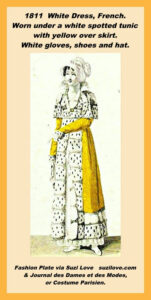
1811 White Dress, French. Worn under a white spotted tunic with yellow over skirt. White gloves, shoes and hat with drooping white feathers. Fashion Plate via Journal des Dames et des Modes, or Costume Parisien.
Although this is a French fashion plate, Jane Austen and her contemporaries wore a variety of tunics, spencers, and long coats to keep warm when out and about, visiting, shopping etc. Their thin muslin dresses weren’t any protection against harsh European winters or wet English weather.
1826 Sights Jane Austen Saw Around Regency England. 1826 From Regency Life Around England. The sights that Jane Austen and her friends and family would have seen around England. via 1826 The English Spy By Robert Cruikshank via Google Books (PD-150)
1826 Royal Wells At Cheltenham, England. Regency life around England. via 1826 The English Spy By Robert Cruikshank via Google Books (PD-150)
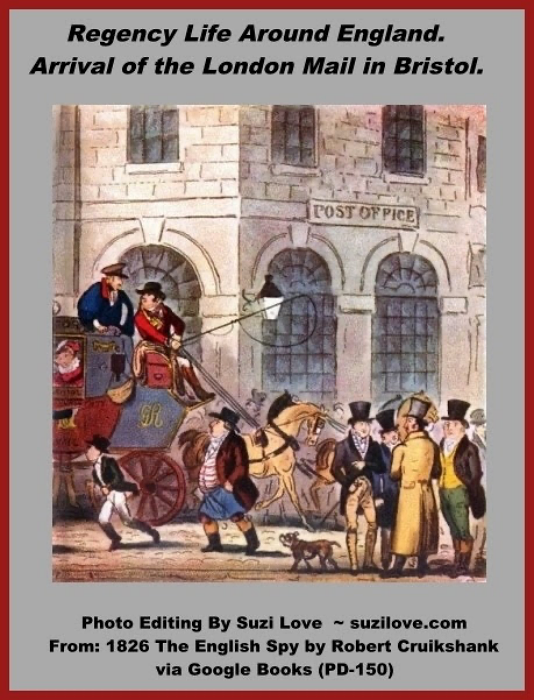
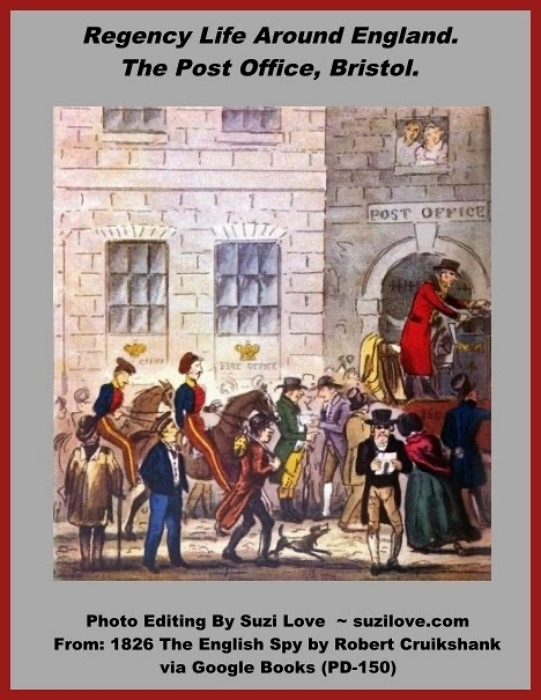
1826 Arrival of the London Mail in Bristol. Regency life around England. via 1826 The English Spy By Robert Cruikshank via Google Books (PD-150)
1826 Procession from Gloucester to Berkeley. Regency life around England. via 1826 The English Spy By Robert Cruikshank via Google Books (PD-150)
The Promenade At Cowes, England. Regency life around England. via 1826 The English Spy By Robert Cruikshank via Google Books (PD-150)
1826 The Post Office, Bristol. Regency life around England. via 1826 The English Spy By Robert Cruikshank via Google Books (PD-150)
1826 Point Street, Portsmouth, England. Regency life around England. via 1826 The English Spy By Robert Cruikshank via Google Books (PD-150)
1826 Gate House, Highgate, England. Regency life around England. via 1826 The English Spy By Robert Cruikshank via Google Books (PD-150)
1826 Oakland cottages were a well-known place to stay at Cheltenham Spa, England. Regency life around England. via 1826 The English Spy By Robert Cruikshank via Google Books (PD-150)
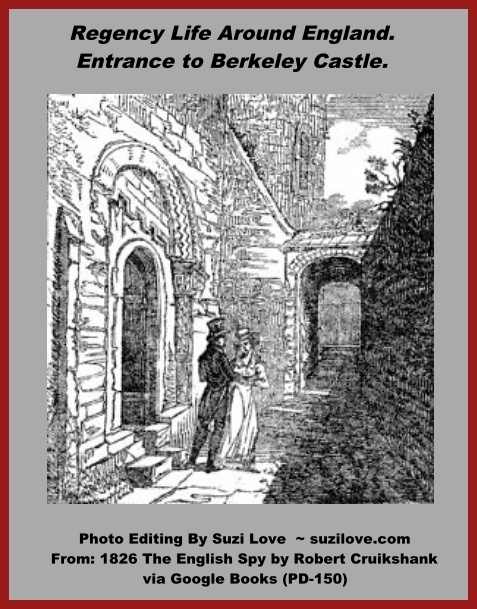
1826 Entrance to Berkeley Castle, England. Regency life around England. via 1826 The English Spy By Robert Cruikshank via Google Books (PD-150)
“The more I know of the world the more I am convinced that I shall never see a man whom I can really love. I require so much!” Jane Austen ~ Sense and Sensibility (1811)
1811 Woman Carrying Cloth and a Package. Sewing a dress? Green dress with a white bodice, green spotted cornet for a hat. Fashion Plate via Journal des Dames et des Modes, or Costume Parisien. Even though this a French fashion plate, this is typical of the Empire dresses worn by Jane Austen and her contemporaries. Low necklines and skirts that started directly under the bust and flowed into the classical relaxed wide styles of Greece and Rome. These high-waisted dresses were worn most days and cotton, silk or taffeta were the popular fabrics.
1790-1810 ca. Linen and Metal Corset, American Or European. Front Lacing. #Corset #RegencyEra #GeorgianEra #JaneAusten. https://books2read.com/SuziLoveCorsetBook16
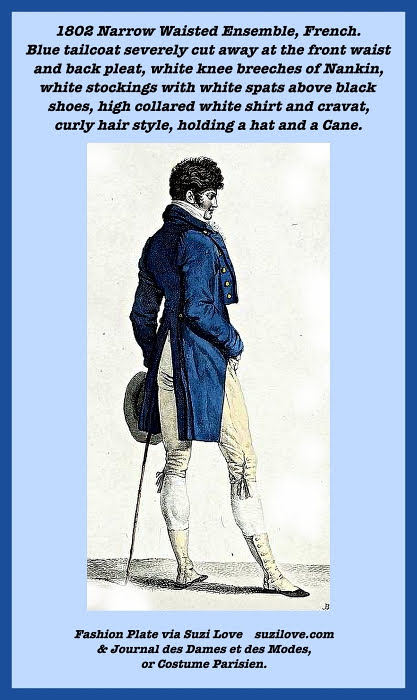
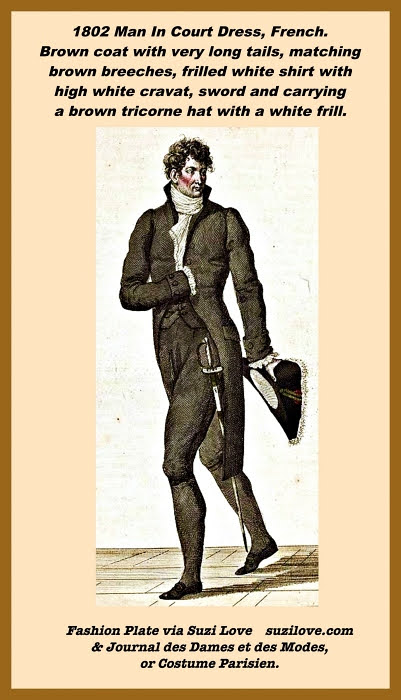
1802 Typical Gentlemen’s Fashions worn during the early 1800s, or Regency Era, or Jane Austen’s times. Fashion Plates via Journal des Dames et des Modes, Costume Parisien.
Regency Menswear: Typical menswear in the early 1800s included a tailcoat, a vest or waistcoat, either breeches, pants, or the newer trousers, stockings, shoes or boots, all worn with an overcoat and hat. This basic ensemble was accessorized with some form of neckcloth or cravat, gloves, a walking stick, cane or riding crop, handkerchief, fobs, a watch and perhaps a quizzing glass or eye glass.
From the finish of the 18th century until 1820, men’s fashions in European and European-influenced countries moved away from the formal wear of brocades, lace, wigs and powder to more informal and relaxed styles. Focus was on undress rather than formal dress. Typical menswear in the early 1800s included a tailcoat, a vest or waistcoat, either breeches, pants, or the newer trousers, stockings, shoes or boots, all worn with an overcoat and hat. This basic ensemble was accessorized with some form of neckcloth or cravat, gloves, walking stick, cane or riding crop, handkerchief, fobs, watch and perhaps a quizzing glass or eye glass.
Skirted coats were replaced with short-fronted, or cutaway, tailcoats worn over fitted waistcoats and plain, white linen shirts. Knee breeches were gradually replaced by tight-fitting pantaloons and later trousers, decorative shoes with buckles were replaced with a variety of boot styles, and fussy and ruffled neckwear gave way to intricately tied, white linen neck cloths. A Regency Era, or early 1800s, gentleman was outfitted in more practical fabrics, such as wool, cotton and buckskin rather than the fussy brocades and silks of the late 1700s.