1820 July 6th View of London Bridge and Custom House with Margate steam yachts, London, U.K. Hand colored By artists and Engravers, P. and D. Colnaghi and Co Ltd and Co (publishers) and R. Havell and Son. via Royal Museums Greenwich. collections.rmg.co.uk
1815 June 15th ‘Behold at Brook’s Club, London. By George Cruikshank. Sir Thomas Stepney standing under the porch of Brooks’s Club in St. James’s Street, London. Double door with glass panels is behind him. Right hand in his breeches pocket, round hat with low crown, double-breasted tail-coat, double-breasted waistcoat, small stock, knee-breeches, and striped stockings with pumps. Via British Museum, London, UK. britishmuseum.org (PD-Art)
Caricatures were pasted to the windows of newspapers and shops in the Era of Jane Austen and the Bridgertons.
1800s Early Women’s Half Boots, British, as worn by Jane Austen and her family and the Bridgerton ladies. Walking was encouraged for women so lace-up half-boots became a popular replacement for flimsy slippers for outdoor wear. Made of nankeen, a durable, yellow-colored, natural cotton from China or from colored leather. via Victoria and Albert Museum, London, UK. collections.vam.ac.uk
In Bridgerton and Jane Austen years, people were encouraged to partake in outdoor pursuits to maintain good health so walking became a daily pastime. Fragile slippers were worn for balls and evening events but for walking sturdier shoes were needed, In the early 1800s, these were typically made of leather, had a very small heel, slightly rounded toes and were laced up on the top.
1804 Royal Mint, Stamping Room, London, U.K. As Jane Austen would have known it. From Ackermann’s Microcosm of London by A.C. Pugin and Thomas Rowlandson.
1804 Royal Mint, Stamping Room, London, U.K. From Ackermann’s Microcosm of London by A.C. Pugin and Thomas Rowlandson. RL_1_D2D_Regency Overview RetailerLinks
https://books2read.com/suziloveROver
1800 North Side Of Cavendish Square, London, U.K. By Thomas Malton (1748-1804) British. Aquatint of the north side of the square. (PD-Art)
1800 North Side Of Cavendish Square, London, U.K. By Thomas Malton (1748-1804) British. Aquatint of the north side of the square. (PD-Art)RL_1_D2D_Regency Overview RetailerLinks
https://books2read.com/suziloveROver
Regency London 1820 The English Metropolis By John Corry Via Google Books (PD-180)
This great metropolis is sixty miles distant from the sea; it is built on the banks of the river Thames; is about seven miles in length, from east to west, but of an irregular breadth, being in some parts two miles, in others three, and at the broadest part four miles. Its three distinct and municipal divisions are, the city of London, the city of Westminster, and the borough of Southwark, which, with their extensive suburbs, cover a space of more than twenty miles in circumference. According to the Population Return of 1811, this metropolis then contained 149,430 houses, including those building and uninhabited; and since that period there have been but few new houses built, so that the real number is probably not more than 150,000.
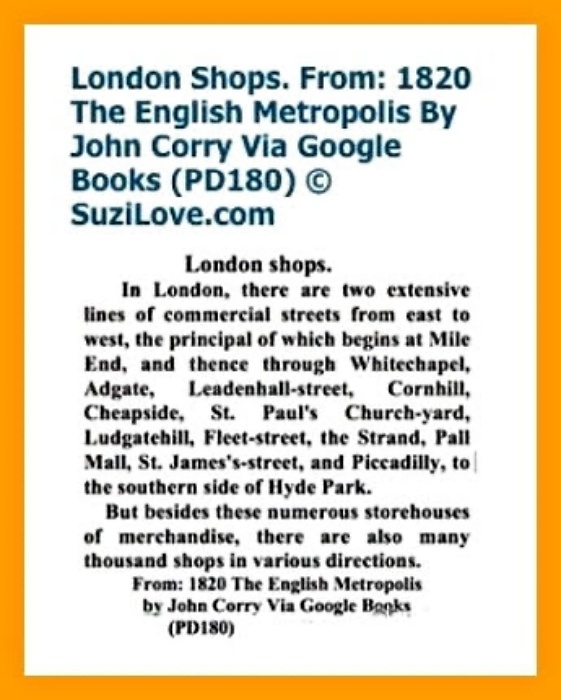
In the year 1801, the population of London was ascertained to be 900,000. The number in 1811, amounted to 1,009,546. Beneath the pavement large arched sewers communicate with the houses by smaller ones, with the street by small openings covered with iron grating, and with the Thames, which contributes much to the cleanliness and health of the inhabitants of this populous place. Houses on each side of these streets are lofty, spacious, and commodious, generally four stories high, and chiefly occupied by tradesmen, whose shops present the most beautiful and perfect productions of nature and art for the general accommodation of man, There are two extensive lines of commercial streets from east to west, the principal of which begins at Mile End, and thence through Whitechapel, Aldgate,Leadenhall-street, Cornhill, Cheapside, St. Paul’s Church-yard,Ludgatehill, Fleet-street, the Strand, Pall Mall, St. James’s-street, and’ Piccadilly, to the southern side of Hyde Park. But besides these numerous storehouses of merchandise, there are also many thousand shops in various directions. Ample supplies of water afforded by the Thames And New River Water-works, are essentially conducive to the health and comfort of the inhabitants.
St. Paul’s Church is the most magnificent. It is situated near the northern bank of the Thames, and when viewed from Blackfriar’s Bridge in the vicinity, presents one of the noblest ornaments of superb architecture ever beheld by the human eye. This beautiful cathedral is built of Portland stone, in the form of a. cross, adorned in the central part by a lofty dome, on the summit of which is a light and elegant lantern, ornamented with Corinthian columns, and surrounded by a balcony. Next to St. Paul’s cathedral for magnificence, and even greater in extent, is that fine monument of gothic architecture Westminster Abbey, or the collegiate church of St. Peter.Among the modern churches that of St. Mary-le-Bone is remarkable for a spacious and stately portico composed of eight columns and two pilasters of Portland stone, in the Corinthian order. This church is built north and south, and the northern front, which is opposite the Regent’s Park.
The Tower of London, which has been the scene of many a tragic and affecting event, is the only fortress in the city. It is situated on the northern bank of the Thames, eastward of London Bridge, contains the Jewel Office, Mint, three armouries, and the royal train of artillery. The menagerie, near the west entrance, has for ages been a principal object of attraction to rustic visitors, who on their arrival considered it indispensable to see the lions.
1818 November ‘Fashionables Of 1818’ By George Cruikshank.Couple walk arm-in-arm with the man wearing Dandy costume of bell-shaped top-hat, trousers strapped under high-heeled boots without spurs and jauntily carried cane. Much shorter lady wears enormously high bonnet, striped over-dress over frilled white muslin, skirt above ankles, and carries a large ermine muff. Via British Museum, London, UK. britishmuseum.org (PD-Art)
These are the sort of outfits a couple would wear in Jane Austen’s times although these are exaggerated in caricatures to poke fun at the extremes of Regency fashion when women’s hats were so large and high that a lady was dwarfed by her devotion to fashion and a gentleman’s collar and neckcloth were so high he couldn’t turn his head to speak to the lady.
1818 November ‘Fashionables Of 1818’ By George Cruikshank.Couple walk arm-in-arm with the man wearing Dandy costume of bell-shaped top-hat, trousers strapped under high-heeled boots without spurs and jauntily carried cane.Much shorter lady wear enormously high bonnet, striped over-dress over frilled white muslin, skirt above ankles, and carries a large ermine muff. Via British Museum, London, UK. britishmuseum.org (PD-Art)23_d2d_fashionmen1800-1819https://books2read.com/SuziLoveFashionMen1800-1819
1804 September Exhibition of Water Coloured Drawings, Old Bond Street, London, U.K. Designed and etched by Thomas Rowlandson. Via Wikimedia Commons commons.wikimedia.org (PD-ART)
1804 September Exhibition of Water Coloured Drawings, Old Bond Street, London, U.K. Designed and etched by Thomas Rowlandson. Via Suzi Love suzilove.com
& Wikimedia Commons commons.wikimedia.org (PD-ART)RL_1_D2D_Regency Overview RetailerLinks
https://books2read.com/suziloveROver
On January 27th, 1772, The Pantheon opened on Oxford Street, London. Designed by James Wyatt, The Pantheon featured a rotunda which was one of the largest rooms in England at the time. The Pantheon was intended as London’s answer to Ranelagh Gardens for winter entertainment and opened to a crush when nearly “two thousand persons of rank and fashion assembled.” The Pantheon officially closed for public entertainments in 1814, after Lord Chamberlain restrictions on the building’s use as a theatre made the final venture unprofitable. It was converted to a bazaar in 1833 and in 1867 became a winemakers office and showrooms until being demolished in 1937.
From 1819 Ackermann: The Pantheon was built “for the purpose of public evening entertainments” and was a “superb and beautiful structure” with elegant interiors furnished with fine paitnings, gilt vases, and statues depicting gods and goddesses. The building consisted of a suite of fourteen rooms, and between 1789-1792 (until a fire) was used as an exhibition space for Italian operas after the destruction by fire of the King’s Theatre in Haymarket.
1814 January The Pantheon via Ackermann’s Repository : This once noble structure, situated on the south side of Oxford-street, was originally built by Mr. James Wyatt, for the purpose of public evening entertainments. It was a most superb and beautiful structure, the admiration of all connoisseurs, foreigners as well as natives. The interior was fitted up in such a magnificent style, that it is scarcely possible for those who never saw it to conceive the elegance and grandeur of the apartments, the boldness of the paintings, or the effect produced by the disposition of the lights, which were reflected from gilt vases. Below the dome were a number of statues, representing most of the heathen gods and goddesses, supposed to be the ancient Pantheon at Rome, from which it derived its name. To these were added three beautiful statues of white porphyry, representing the King and Queen and Britannia.
The whole building formed a suite of fourteen rooms, each affording a striking specimen of taste and splendor. After the destruction of the King’s Theatre in the Haymarket by fire in June 1789, the Pantheon was used for the exhibition of Italian operas, and was frequently honored with the presence of their Majesties; till on the 14th of January, 1792, this beautiful structure also fell a prey to the same devouring element.
The fire broke out in the new buildings which had been added for the most convenient performance of operas; and before any engine reached the spot, the flames had gained such a height, that all attempts to save the building were in vain. Owing to the scenery, oil, paint and other combustible materials in the house, the conflagration was so rapid that not a single article could be saved. Persons who witnessed the progress of this tremendous fire, declare that the appearances exhibited through the windows, the lofty pillars enveloped in flames and smoke, the costly damask curtains waving from the rarefaction of the air, and the superb chandeliers turning round from the same circumstance, together with the successive crashing and falling of different portions of the building, furnished to their minds a more lively representation of Pandemonium than the imagination alone cam possibly supply.
The effects, too, of the intense frost which then prevailed, upon the water poured from the engines upon the blazing pile, are described as equally singular and magnificent. The loss occasioned by this catastrophe amounted to £60,000; only one fourth of which sum was insured. The height of the walls fortunately prevented the conflagration from spreading to the contiguous houses.
The Pantheon has been rebuilt; the original elegant front and portico still remain, but the rest of the edifice exhibits not eve a shadow of its former magnificence. Since its re-edification, it has been used principally for exhibitions, and occasionally for masquerades. Various plans have at different times been brought forward for opening it for dramatic representations; and this was actually done a few months since under a license from the magistrates, by a Mr. Condy, who is understood to have embarked a considerable fortune in the concern; but whose right has been contested by the winter theatres, and is likely to become a subject of legal discussion.
1800 Pantheon Masquerade, London, U.K. via Rudolph Ackermann’s Microcosm of London. Engraved by John Bluck. (1791-1831)
1818 May ‘Beau’s of 1818’ By George Cruikshank. Two Dandies shake hands while third watches. All wearing bell-shaped top-hats, extra high collars, short waists, long spurs and yellow gloves. One with moustache wears wide and short white trousers, one wears top-boots and riding-breeches and has monocle in his eye and third has very full trousers gathered above ankle. These are the sort of outfits that the Bridgerton men and Jane Austen’s male contemporaries would have worn. Hand colored etching. Via British Museum, London, UK. britishmuseum.org (PD-Art)
1818 May ‘Beau’s of 1818’ By George Cruikshank. Two Dandies shake hands while third watches. All wearing bell-shaped top-hats, extra high collars, short waists, long spurs and yellow gloves. One with moustache wears wide and short white trousers, one wears top-boots and riding-breeches and has monocle in his eye and third has very full trousers gathered above ankle. Hand colored etching. Via British Museum, London, UK. britishmuseum.org (PD-Art)