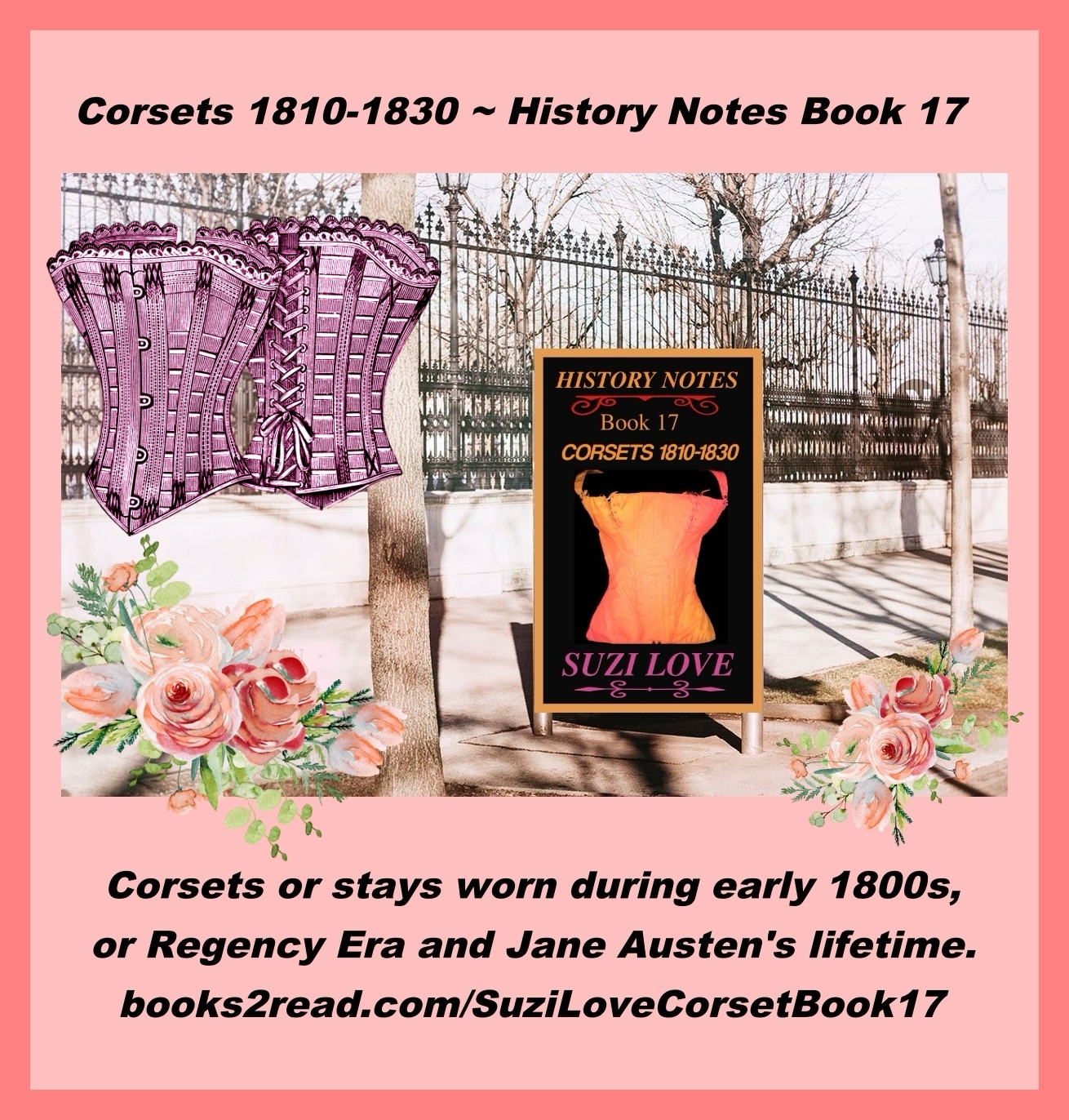
This book shows how corsets changed to fit well under clothing, give maximum support and comfort. Corsets pushed up breasts and showed off the bust line beneath a square-cut and low-cut neckline as in the early 1800s, or Regency years. Jane Austen and her female and friends wore these corsets. Corsets or stays worn during the early 1800s, or Jane Austen’s lifetime. https://books2read.com/SuziLoveCorsetBook17
Are you a Reader or Writer of Regency Era Fashions? Jane Austen and Bridgerton corsets. #corsets #historicalfashion #RegencyFashion #JaneAusten #Bridgerton https://books2read.com/SuziLoveCorsetBook17
Love After. Waterloo: Blurb: When Lady Melton and her son, Daniel, are forced to join antagonistic Captain Belling and the last group of wounded British soldiers evacuating Waterloo and traveling back to London, she expects clashes with army deserters. What she doesn’t anticipate is how much she and her son will need the belligerent Captain after they reach London. https://books2read.com/suziloveLAW
Book Hook: “I remember who you are, Lady Melton,” Captain Belling said in a cold voice, barely glancing over his shoulder at them. “The only thing I don’t know is why the hell you and that child are still anywhere near Waterloo, when all women were ordered to evacuate a week ago.”
“That child has a name, Captain. His name is Daniel, or if you are a stickler for formality, Viscount Melton.”The captain turned and frowned down at her son, who stared back at him with blatant curiosity and a small amount of animosity, as forthright as any young and intelligent child. Even at his young age, Daniel was a shrewd judge of character, and had been instructed by his uncles to be careful about trusting strangers. When the Captain turned back to the tattered maps spread over his makeshift desk, Anne ignored his unspoken dismissal and used the time to observe the infuriating man without having his condemning gaze fixed on her, as it had been a week earlier at the Duke and Duchess of Richmond’s extravagant Brussels ball. If she and Daniel were to travel with his group of wounded soldiers, Anne wanted to learn as much as possible about their leader. Her son’s survival depended on her being well informed and prepared for any eventuality.
Dust filtered down through a gaping hole in the high roof and settled in the Captain’s hair, turning it a darker brown than his normal golden yellow, though a bucketful of dust wouldn’t make any difference to the state of his stained uniform. His left pants’ leg had been sliced open to the knee, the two sides pinned clear of the large bandage winding down most of his leg, while a spindly wooden crutch was propped against the table.
His large physique had attracted her even before their dance at the ball, though his striking physical attributes didn’t compensate for his belligerent attitude, or for his obvious displeasure at encountering her both in Brussels and near the battlefield. Still, the Captain had undoubtedly scowled in a similar fashion at many women he’d met either in Brussels or at Waterloo, as she’d heard him spout his narrow-minded view at the ball to his fellow officers. The Captain believed that in the vicinity of battles only men should be allowed. Not women, and especially not ladies.
Book Hooks: Captain Belling said in a cold voice, “The only thing I don’t know is why the hell you and that child are still near Waterloo.” #MilitaryRomance #RegencyRomance #BattleofWaterloo books2read.com/suziloveLAW
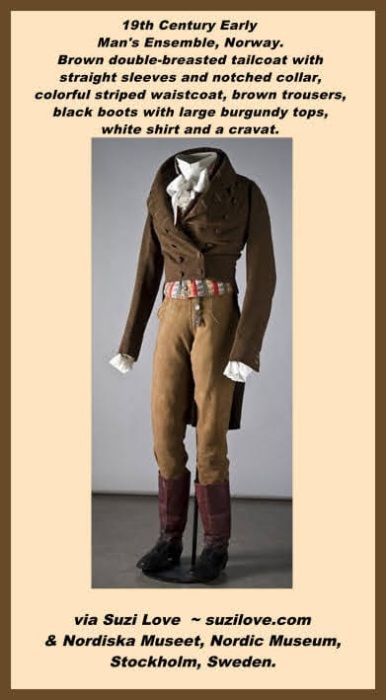
19th Century Early Man’s Ensemble, Norway. Brown double-breasted tailcoat with straight sleeves and notched collar, colorful striped waistcoat, brown trousers, black boots with large burgundy tops, white shirt and a cravat. via Nordiska Museet, Nordic Museum, Stockholm, Sweden.
19th Century Early Typical Man’s Ensemble: tailcoat, trousers, shirt, cravat etc. in Bridgerton and Jane Austen years. #Bridgerton #RegencyFashion #JaneAustenhttps://books2read.com/SuziLoveFashionMen1800-1819
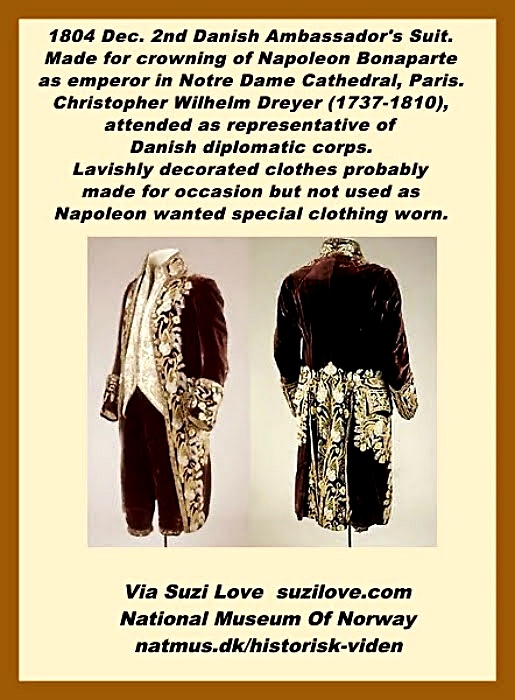
1804 December 2nd. Danish Ambassador’s Suit made for the crowning of Napoleon Bonaparte as emperor in Notre Dame Cathedral, Paris. Christopher Wilhelm Dreyer (1737-1810), attended the pompous event as a representative of the Danish diplomatic corps. Lavishly decorated clothes probably made for occasion but not used as Napoleon wanted special clothing worn. natmus.dk/historisk-viden
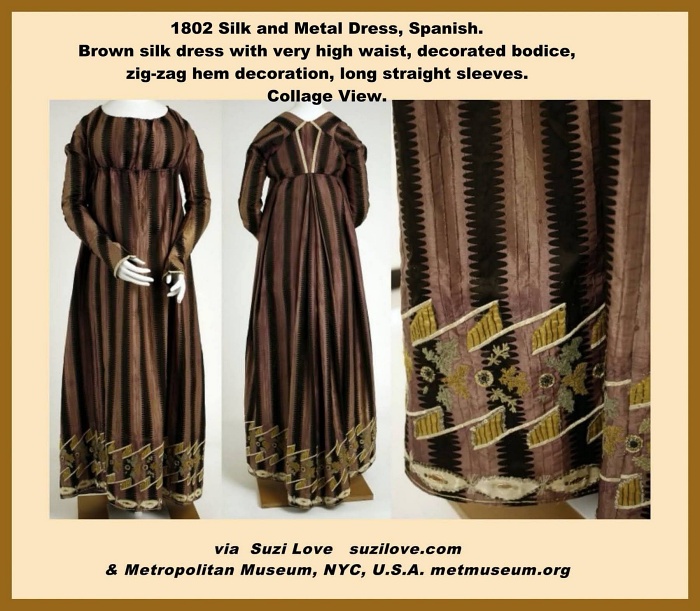
1802 Silk and Metal Dress, Spanish. Brown silk dress with very high waist, decorated bodice, zig-zag hem decoration, long straight sleeves. I can picture Jane Austen and her female friends and family wearing this sort of dress to a dinner party or musical evening. via Metropolitan Museum, NYC, U.S.A. metmuseum.org
1802 Silk and Metal Dress, Spanish. 1802 Silk and Metal Dress, Spanish. Front View. 1802 Silk and Metal Dress, Spanish. Back View. 1802 Silk and Metal Dress, Spanish. Fabric View. HN_25_D2D_fashwomen1801-1804 https://books2read.com/SuziLoveFashionWomen1801-1804
1810 Couple In Walking Dress, French. Lady in a jade green Redingote, or coat, with paisley skirt, worn over a white dress with sleeves caught up, and hat tied under her chin. Man in a brown tailcoat, tight white pants that button down the sides, black hat and shoes and carrying a walking stick. Fashion Plate via Journal des Dames et des Modes, or Costume Parisien.
The sort of outfits a lady and gentleman in Jane Austen’s times would have worn while out walking, shopping, or going to visit friends.
Pelisse, or Walking Dress, or Redingote. The Fashion Dictionary description of a Redingote is (réd’ing-göt; red ing gote). Pronounced: red ing gote Woman’s long, fitted coat often cut Princess style and worn open in front to show off the dress underneath. Sometimes cut away in front. Originally made for men with several capes and trimmed with large buttons. French word developed from English words, riding coat. reefer. Single- or double-breasted, fitted, tailored, over-all coat usually made from sturdy fabric but in the British Regency Era a Pelisse was often made from a lighter fabric, such as cotton.
HN_23_D2D_Fashion Men 1800-1819 History Notes Book 23
https://books2read.com/SuziLoveFashionMen1800-1819
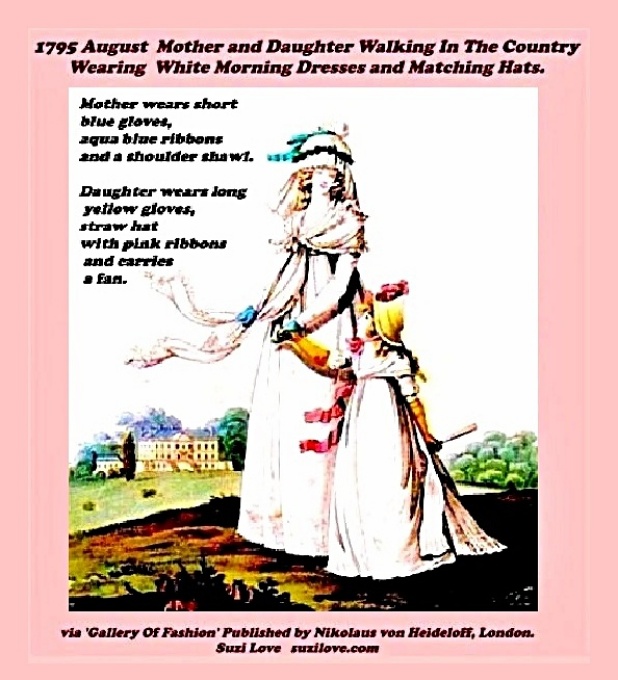
1795 August Mother and Daughter walking in the country wearing white morning dresses and matching hats. Mother wears short blue gloves, aqua blue ribbons and a shoulder shawl, or fichu. Daughter wears long yellow gloves, a straw hat with pink ribbons and carries a fan. via Nikolaus Heideloff’s Gallery of Fashion.
HN_1 Fashion Women Late 1700s History Notes Book 1 by Suzi Love.
What was fashionable for women in the late 1700s? Extravagant colors and fabrics and outrageous styles were all seen in these flamboyant fashions.
books2read.com/suziloveFashWomen1700s
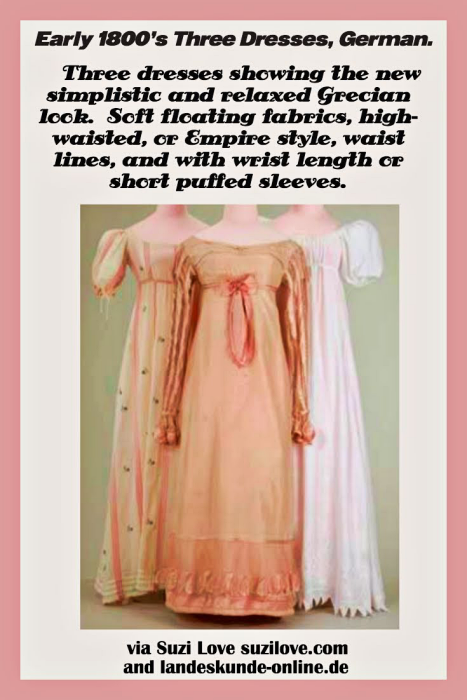
Early 1800’s Three Dresses, German. Three dresses showing the new simplistic and relaxed Grecian look. Soft floating fabrics, high- waisted, or Empire style, waist lines with wrist length or short puffed sleeves. Via landeskunde-online.de.
Definition Empire Style: Named after the First Empire in France, by 1800 Empire dresses had a very low décolleté, or neckline and a short narrow backed bodice attached to a separate skirt. Skirts started directly under the bust and flowed into the classical relaxed wide styles of Greece and Rome. This style of dress is associated with Jane Austen and her contemporaries as a simple cotton high-waisted dress was worn most days and accessorized according to the importance of the occasion.
Love After Waterloo by Suzi Love. Despite Wellington’s victory over Napoleon four days earlier, soldiers, to use the term loosely, still lingered around Waterloo. They and deserters from both sides had joined local famers in picking through the remains of bodies, uniforms, and armory to pilfer anything of value. There’d been nowhere safe to hide her and her son, Daniel, so Lady Melton’s’ brothers had packed what remained of their equipment and taken them, along with a few wounded British soldiers, to the Captain’s quarters, knowing that his orders were to protect whoever remained of French stragglers and deserters.
Anne’s twin brothers hadn’t lingered, because Wellington and what was left of his British troops were marching back towards Brussels and Brendon’s skills as a physician were urgently needed. Benjamin, an aide to Wellington, had stayed to organize the repatriation of their soldiers and the departure of their sister and nephew. Neither twin had understood her reluctance to join Captain Belling and his group and had ignored her pleas to stay with them in Europe, stating firmly that it was time that she and Daniel returned to London.
They hoped that Anne could reopen their townhouse in London and prepare for when they could join her, optimistically within a few weeks. She wasn’t quite so optimistic. Napoleon was an egotist. He wasn’t the type to accept defeat easily, and she imagined he’d already be making plans for a triumphant return in the future, despite the carnage left behind at Waterloo when he and his remaining troops retreated. Her brothers had reported that the plains had been covered with the dead and the dying, both men and horses.
1860–1870 ca. Pink Silk Bag, Or Reticule, Italian. Two layers of contrasting pink silk with tassels and a drawstring. via Metropolitan Museum New York City, U.S.A. metmuseum.org
Definition Ridicule, Reticule, Indispensable, or Handbag: From the late 1700s, pockets could no longer be sewn into gowns, as skirts fell from just under the bust and were full and flowing. Instead, women began carrying small bags, known at first as ridicules and later as reticules, to keep necessary items on their person e.g. handkerchiefs, coins, vinaigrettes, calling cards, glasses etc. http://books2read.com/suziloveReticules
The term ‘ridicule’ derived from the Latin ‘ridiculum’ and first used in France during the 17th century and meant subjecting something or someone to mockery. As women’s tiny bags were mocked, or ridiculed, for being a useless fashion accessory carried outside when they were first used in the late 1700s, it’s likely this is how the name ‘ridicule’ started. The later term ‘reticule’ derived from the Latin reticulum, meaning ‘netted bag’ and was applied when bags became larger and often made from netting. In the late 1700s and early 1800s, they were also known as indispensables as they carried all the personal items a lady needed upon her person every day. They were easily made by ladies, easy to carry and became an indispensable fashion accessory.
In the early nineteenth century, reticules started to look like future handbags as they were often made from rigid card or molded mâché or card into a variety of shapes. Early bags were circular and with a drawstring but as women wanted their reticules to look individual they could be made with two halves and a hinged metal closure or with concertina sides. Materials varied from silk, cotton and string and shapes were round, hexagonal or lozenge shapes with shell shaped bags becoming very popular during the Regency and Romantic Eras.
1800s magazines were written for well bred women who could read, so they gave plenty of ideas for how ladies could make and embellish reticules for their own use and as pretty gifts. Needlework was highly encouraged as a pastime for a lady so bags were frequently embroidered or decorated with beading. By the 1820s, reticules became more like our modern handbags using soft leather gathered at the top or hard leather with a rigid fastener and metal chain for carrying.
1860–1870 ca. Pink Silk Bag, Or Reticule, Italian. Two layers of contrasting pink silk with tassels and a drawstring. via Suzi Love suzilove.com andMetropolitan Museum New York City, U.S.A. metmuseum.org
HN _3_D2D_RetailerBuyLink_HN_3