1810 Les Invisibles. By James Gillray. Two men walk towards each other, each with a lady hanging to each arm, all have their faces concealed by some part of their dress, hat, or collar, or both. One man has a round hat, with a fantastically curved brim projecting downwards. The other has a huge crescent-shaped cocked hat with the peaks dipping over face and back. Via British Museum, London, UK. britishmuseum.org (PD-Art)
1810 Les Invisibles. By James Gillray. Two men walk towards each other, each with a lady hanging to each arm, all have their faces concealed by some part of their dress, hat, or collar, or both. One man has a round hat, with a fantastically curved brim projecting downwards. The other has a huge crescent-shaped cocked hat with the peaks dipping over face and back. Via British Museum, London, UK.RL_2_D2D_RetailerBuyLink_RL_2
https://books2read.com/suziloveYGD
1798 Gentleman’s Outfit, French. Long green overcoat with yellow buttons, tan gloves, black boots topped with yellow band, gloves with three seams across the back of the hand, high white cravat, black hat, fob at his waist and holding a cane. Fashion Plate via Journal des Dames et des Modes, or Costume Parisien.
HN_2_D2D_Fashion Men 1700s
books2read.com/suziloveFashMen1700
1814 Couple In Walking Ensembles, French. Gentleman in a brown tailcoat with a notched collar and back pockets, vest, white breeches tied under his knees, red fob at the waist, white stockings, high white shirt collar, white cravat, top hat and cane. Lady in adorable pink Redingote with capes.
1775-1825 ca. Bridgerton and Jane Austen Style Black Silk Breeches, American or European. #Bridgerton #JaneAusten #GeorgianEra #RegencyFashion books2read.com/SuziLoveFashionMen1800-1819
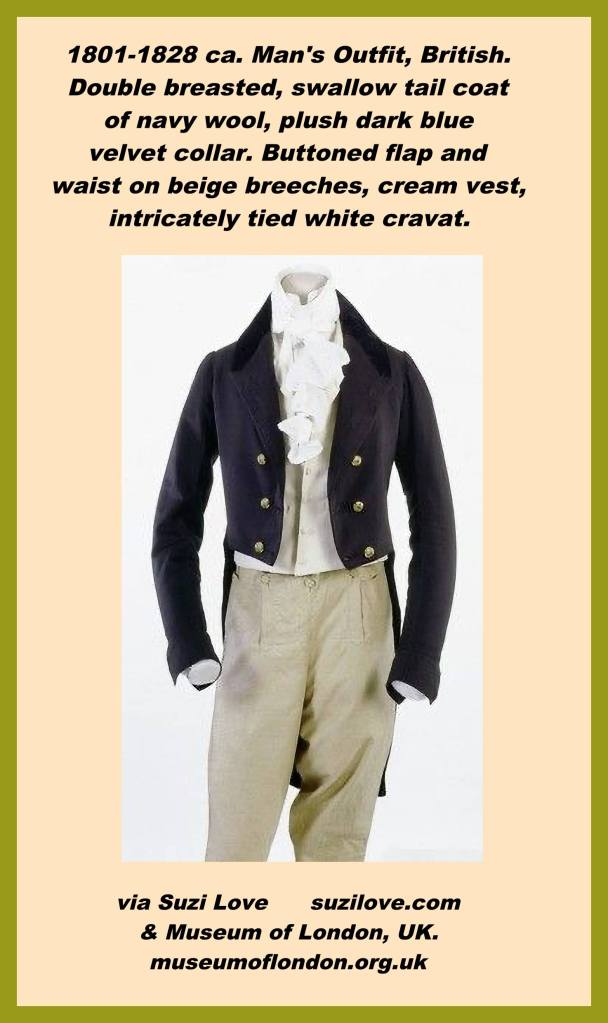
1801-1828 ca. Man’s Outfit, British. Double breasted, swallow tailcoat of navy wool, plush dark blue velvet collar. Buttoned flap and waist beige breeches, cream vest, intricately tied white cravat. via museumoflondon.com
In the early 1800s, men no longer wore complicated styles and extravagant fabrics. Men’s fashion simplified and became more conservative. A well cut tailcoat, vest, pantaloons and an immaculate cravat of beautiful white linen in the style of George Bryan, or Beau, Brummell. Clothes were a status symbol and indicated a man’s social position. These clothing items were the sort worn by Jane Austen’s male family and friends.
From the finish of the 18th century until 1820, men’s fashions in European and European-influenced countries moved away from the formal wear of brocades, lace, wigs and powder to more informal and relaxed styles. Focus was on undress rather than formal dress. Typical menswear in the early 1800s included a tailcoat, a vest or waistcoat, either breeches, pants, or the newer trousers, stockings, shoes or boots, all worn with an overcoat and hat. This basic ensemble was accessorized with some form of neckcloth or cravat, gloves, walking stick, cane or riding crop, handkerchief, fobs, watch and perhaps a quizzing glass or eye glass.
Skirted coats were replaced with short-fronted, or cutaway, tailcoats worn over fitted waistcoats and plain, white linen shirts. Knee breeches were gradually replaced by tight-fitting pantaloons and later trousers, decorative shoes with buckles were replaced with a variety of boot styles, and fussy and ruffled neckwear gave way to intricately tied, white linen neck cloths. A Regency Era, or early 1800s, gentleman was outfitted in more practical fabrics, such as wool, cotton and buckskin rather than the fussy brocades and silks of the late 1700s.
1808 Gentleman’s Ball Outfit, French. Long tailcoat, black knee breeches, white stockings, high white cravat, white stockings, black shoes and gloves. Fashion Plate via Journal des Dames et des Modes, or Costume Parisien. Typical Gentleman’s outfit as worn by men to balls and evening events in Jane Austen’s Times.
From the finish of the 18th century until 1820, men’s fashions in European and European-influenced countries moved away from the formal wear of brocades, lace, wigs and powder to more informal and relaxed styles. Focus was on undress rather than formal dress. Typical menswear in the early 1800s included a tailcoat, a vest or waistcoat, either breeches, pants, or the newer trousers, stockings, shoes or boots, all worn with an overcoat and hat. This basic ensemble was accessorized with some form of neckcloth or cravat, gloves, walking stick, cane or riding crop, handkerchief, fobs, watch and perhaps a quizzing glass or eye glass.
Skirted coats were replaced with short-fronted, or cutaway, tailcoats worn over fitted waistcoats and plain, white linen shirts. Knee breeches were gradually replaced by tight-fitting pantaloons and later trousers, decorative shoes with buckles were replaced with a variety of boot styles, and fussy and ruffled neckwear gave way to intricately tied, white linen neck cloths. A Regency Era, or early 1800s, gentleman was outfitted in more practical fabrics, such as wool, cotton and buckskin rather than the fussy brocades and silks of the late 1700s.
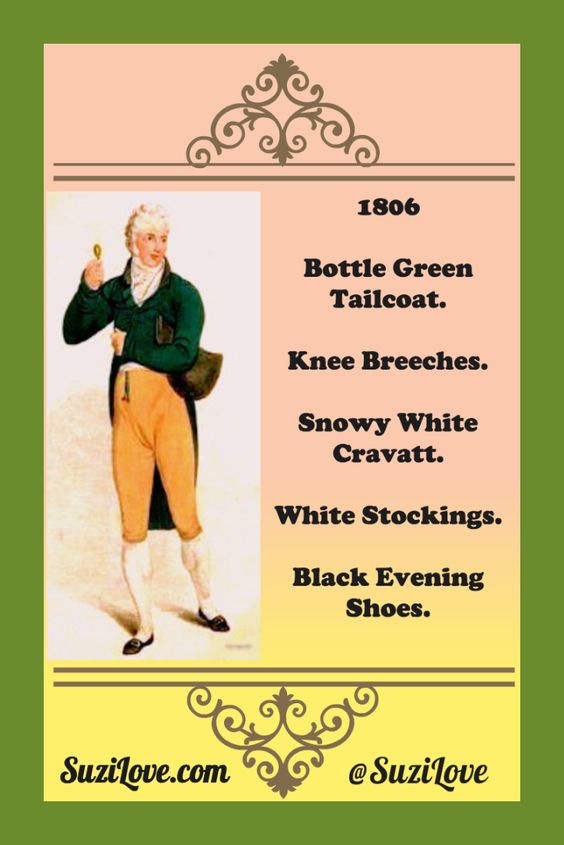
1806 Gentleman’s Daily Outfit, French. Bottle green tailcoat, knee breeches, snowy white cravat, white stockings, flat black shoes. Fashion Plate via Journal des Dames et des Modes, or Costume Parisien. French fashions and Georgian and Regency Era fashions from Great Britain were copied around the world. This is the normal daily outfit for a gentleman in the early 1800s, or in the times of Jane Austen, for daily city and country life. https://books2read.com/SuziLoveFashionMen1800-1819
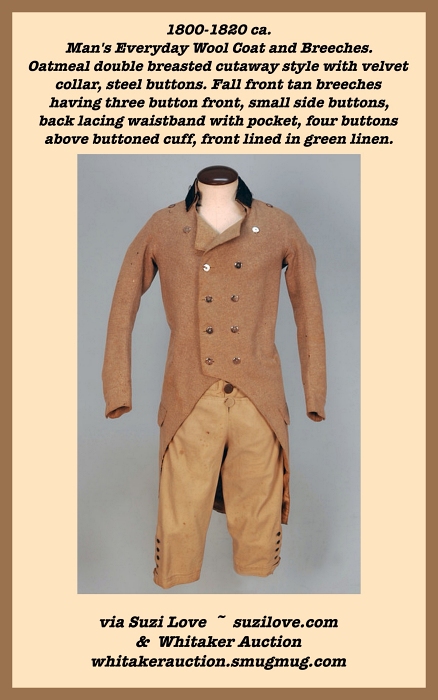
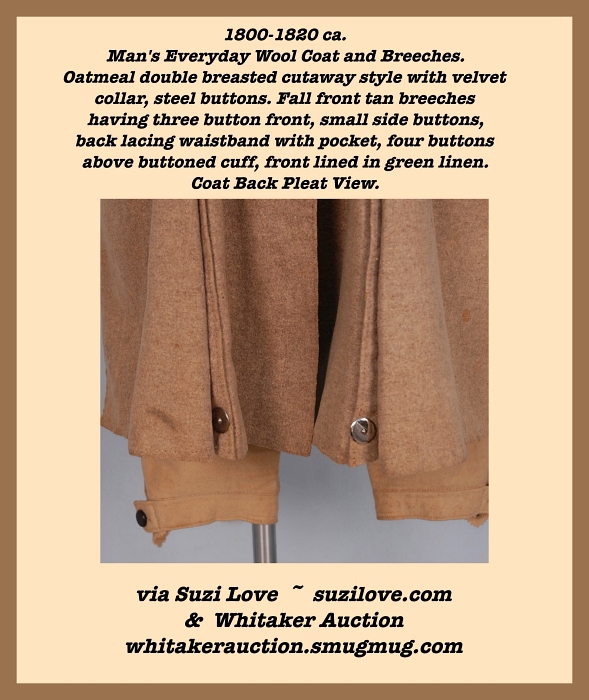
1800-1820 ca. Man’s Everyday Oatmeal Colored Wool Suit With Breeches. Can you picture Jane Austen’s male relatives and friends wearing this? Oatmeal colored double breasted cutaway style coat with velvet collar, steel buttons, rear flap pockets, back vent flanked by stitched down pleats having top and bottom button detail, glazed linen lining. Fall front tan breeches having three button front, small side buttons, back lacing waistband with pocket, four buttons above buttoned cuff, front lined in green linen. via Whitaker Auction whitakerauction.smugmug.com
1797 Elegant Couple Dancing At A Ball. Man: Bottle green tailcoat, yellow knee breeches, white stockings, red vest and black dancing slippers. Lady: White spotted dress with a pale pink overdress open at the front, high belted waist, red and green turban and a parure, or jewelry set. via Fashion Plate via Journal des Dames et des Modes, or Costume Parisien.
HN_2_D2D_Fashion Men 1700s
books2read.com/suziloveFashMen1700
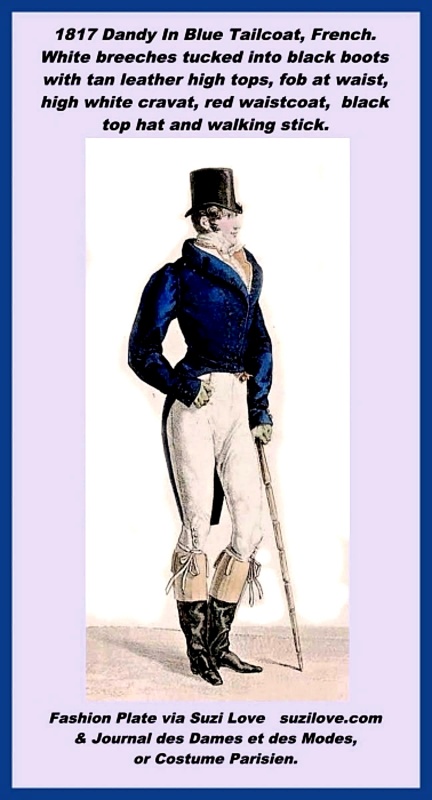
1817 Dandy In Blue Tailcoat, French. White breeches tucked into black boots with tan leather high tops, fob at waist, high white cravat, red waistcoat, black top hat and walking stick. Fashion Plate via Journal des Dames et des Modes, or Costume Parisien.
Dandy: The author of The Hermit in London, a series of sketches published in 1819—1820 observed: ‘A distinguished Exquisite is padded all over to-day; and all the other foplings are, on the morrow, mere walking pin-cushions. A fat prince, or a fat dandy, requires confinement in his limbs; and all his subjects are immediately restrained within the same limits. One day, the back is to be as broad as an Irish chairman’s, and the shoulders to be bolstered up to imitate a hod-man; and the next, the shoulders are to be flat, and a man is to be pinched in and laced up until he resembles an earwig. All these are Master Snip’s maneuvers, who continues to make his bill equally long, whether the spencer or the box-coat be in vogue.
Beau Brummell was one of the most celebrated dandies of all time. Cartoonists ridiculed these high-in-the-instep gentlemen who wore the most fashionable clothes and set the fashion trends for the Regency years, the years when Jane Austen was writing her famous novels and the years when the Bridgerton series is set.