1810 ca. Pineapple Dress, French. High-waisted, Empire style dress with embroidered pineapple motifs, short wide neckline, puffed sleeves and long train. via Palais Galliera, Musée de la Mode de la Ville de Paris.



1810 ca. Pineapple Dress, French. High-waisted, Empire style dress with embroidered pineapple motifs, short wide neckline, puffed sleeves and long train. via Palais Galliera, Musée de la Mode de la Ville de Paris.
1808 Gentleman’s Ensemble, French. Drap Redingote or coat, black hessian boots with heart shaped front, black top hat. Fashion Plate via suzilove.com and Journal des Dames et des Modes, or Costume Parisien. Typical gentleman’s outdoor ensemble as worn by men in Jane Austen’s time, or the Regency Era. https://books2read.com/SuziLoveFashionMen1800-1819
Hessian Boots: Named after German mercenaries who fought alongside British. Soft, highly polished calfskin, knee high, heart-shaped top and decorated with tassel. Boot shaped like stirrup so rider could insert feet into stirrups and be kept securely in place. Tassels were designed to wear with breeches and didn’t suit tight fitting new trousers that dandies like Beau Brummell wore in 1800s so Hessians replaced by other boots e.g. Wellington.


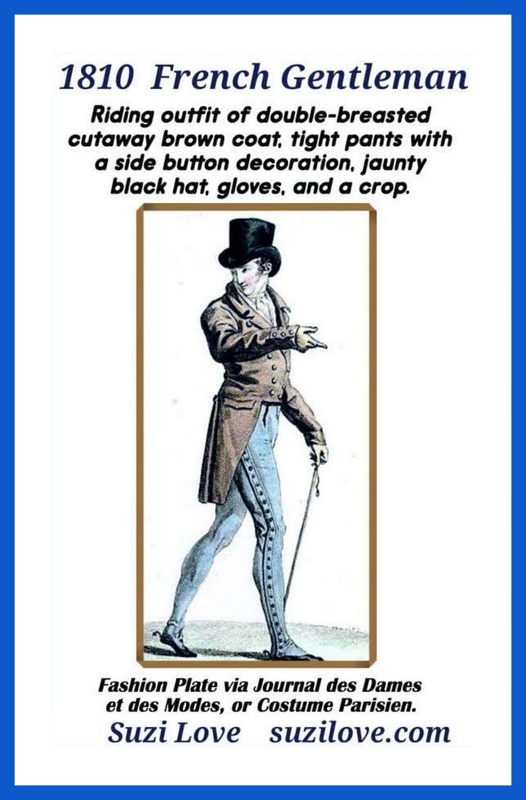
1810 French Gentleman. Riding outfit of double-breasted brown coat, tight pants with a side button decoration, jaunty black hat, gloves, and a crop. As Worn by Gentleman in the Bridgerton and Jane Austen Families. Fashion Plate via Journal des Dames et des Modes, or Costume Parisien.
Pantaloons: When tailcoats lengthened, breeches extended below the knees to accommodate the longer tails and were gradually replaced with slimmer fitting, longer pants, or pantaloons, that ended at the ankle. Pantaloons were close-fitting and sometimes buttoned all the way down the leg. To make them hug the leg tighter, knitted fabrics were used, or fabrics like nankin and kerseymere were cut on the bias.
In the early 1800s, men no longer wore complicated styles and extravagant fabrics. Men’s fashion simplified and became more conservative. A well cut tailcoat, vest, pantaloons and an immaculate cravat of beautiful white linen in the style of George Bryan, or Beau, Brummell. Clothes were a status symbol and indicated a man’s social position. These clothing items were the sort worn by Jane Austen’s male family and friends.

1813 French Couple In Morning Dress. Man: Brown overcoat and tan trousers. Lady: White dress and bonnet, long yellow gloves and holding a watering can. Fashion Plate via Journal des Dames et des Modes, or Costume Parisien. books2read.com/SuziLoveFashionMen1800-1819

1802 Full Dress of Blue Court Suit, French. Man’s grand parure, or full dress, with white lace on the tailcoat and ruffles on the shirt, jewels, white stockings, black dress shoes, sword and a bicorn hat under his arm. Fashion Plate via Journal des Dames et des Modes, Costume Parisien. Typical menswear for court in most parts of Europe in the early 1800s, or Regency Era, or Jane Austen’s times, included a tailcoat, a vest or waistcoat, breeches, stockings, dress shoes, and hat.

1805-1808 ca. Man’s three-part court suit of coat, waistcoat, and breeches, French. Wool broadcloth embroidered with silk and metallic threads, spangles, and glass. Plum colored broadcloth embroidered with plum colored and white silk and chenille, silver thread, spangles and brilliants. Supposed to have been worn by the Hon. James Bowdoin, U.S. Minister to Spain, 1805-1808, at a ball given by Napoleon at the Tuileries. Worn with 01.110 and 01.111. Said to have been worn by the Hon. James Bowdoin, U.S. Minister to Spain from 1805-1808; to his grand-nephew, James Bowdoin Winthrop by inheritance; to James Bowdoin Winthrop’s nephew, Robert C. Winthrop, Jr. by inheritance; gift of Robert C. Winthrop, Jr. to MFA, February 1, 1901.
DIMENSIONS Coat: center back (collar to bottom of coat): 106 cm (41 3/4 in.)
Waistcoat: center front: 55.2 cm (21.75 in.)
Breeches: center front: 67.9 cm (26.75 in.)
CREDIT LINEGift of Robert C. Winthrop. ACCESSION NUMBER01.110-112 via Museum Of Fine Arts, Boston, U.S.A.

1799-1805 ca. Gold dress with small train and very small bodice.. via musee des tissus et des arts decoratifs de lyon. https://books2read.com/SuziLoveFashionWomen1801-1804


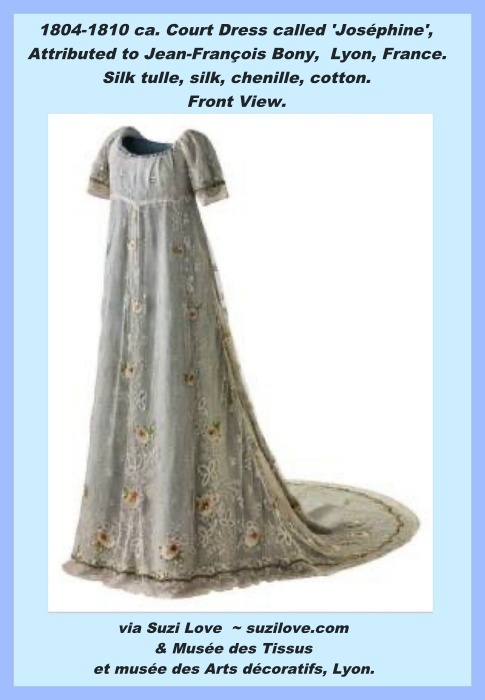
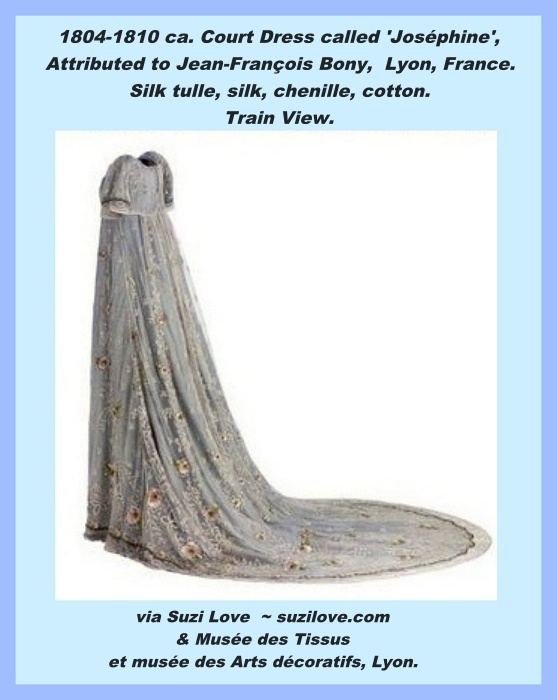
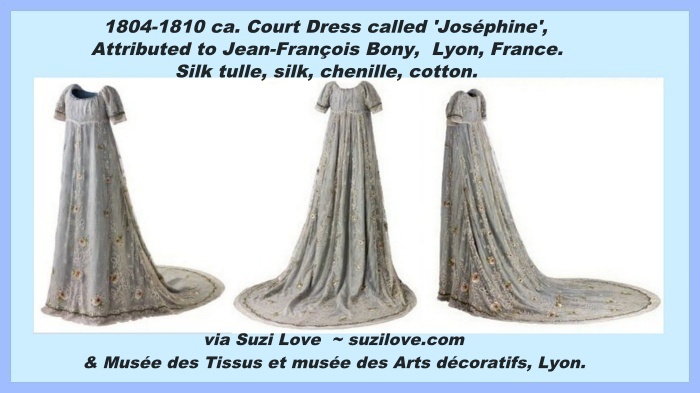
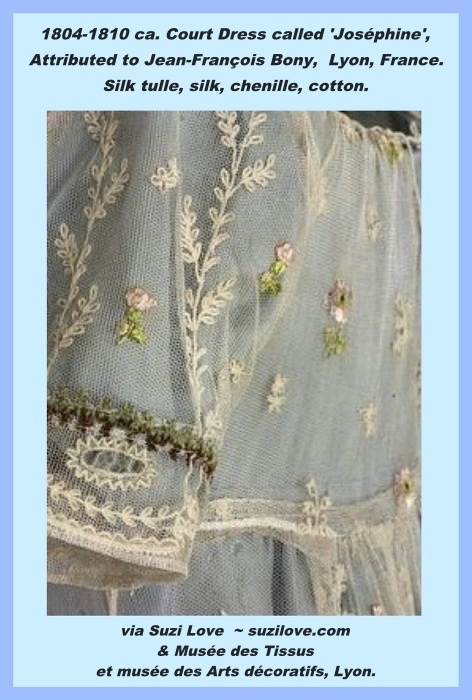
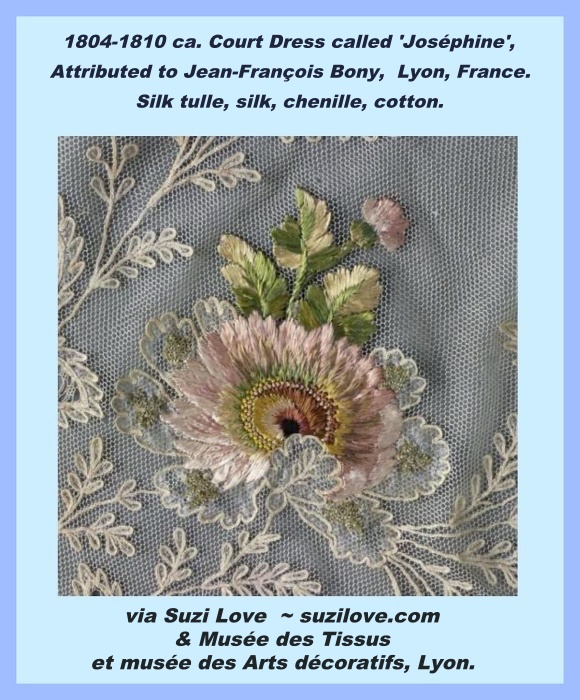
1804-1810 ca. Empire style, or high-waisted, French Court Dress called ‘Joséphine’, Attributed to embroiderer Jean-François Bony, Lyon, France. Silk tulle, silk, chenille, and cotton. via Musée des Tissus et musée des Arts décoratifs, Lyon. via Musée des Tissus et musée des Arts décoratifs, Lyon.
Definition Empire Style: Named after the First Empire in France, by 1800 Empire dresses had a very low décolleté, or neckline and a short narrow backed bodice attached to a separate skirt. Skirts started directly under the bust and flowed into the classical relaxed wide styles of Greece and Rome. This style of dress is associated with Jane Austen and her contemporaries as a simple cotton high-waisted dress was worn most days and accessorized according to the importance of the occasion.





1815 French Couple. Lady in evening dress with scooped neckline on low-cut pink bodice, floral headpiece and long white gloves. Gentleman in brown tailcoat and stirrup trousers, vest, and casual necktie. Fashion Plate via Journal des Dames et des Modes, or Costume Parisien.
The sort of fashionable outfits and items worn or carried by Jane Austen and her contemporaries when out in public. Ladies outfits for evening were accessorized with gloves, headdresses and jewelry and often dresses were of this shorter length for dancing. Gentlemen were always heavily accessorized as well with the essential of gloves, coats, waistcoats and neatly tied cravats. For more about the fashions of 1815, take a look at History Notes Books 23 and 28 men’s and women’s regency Era fashions.
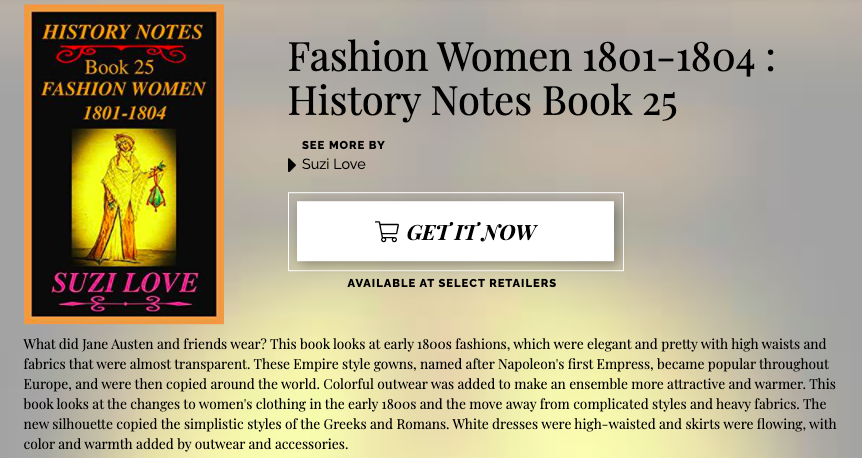
Fashion Women 1815-1819 History Notes Book 28 What did Jane Austen wear? What was fashionable for women at the end of the Regency Era in Britain and the reconstruction in Europe after the wars. Book 28 for 1815-1819 in History Notes Includes fashions for mourning, riding, dresses, hats, shoes, reticules or bags, underclothing, accessories.
Fashion Men 1800-1819 History Notes Book 23 What was fashionable for men in early 1800s, or Jane Austen’s time, or Regency Era? Suits, hats, shoes, underclothing, fashion accessories, military and bedroom fashions. French fashions and Georgian and Regency Era fashions from Great Britain were copied around the world.


1800 Elegant Young French Gentleman. Pulling on his top coat over a long tan coat. Tan gloves, brown hat, brown boots, cane. Fashion Plate via suzilove.com and Journal des Dames et des Modes, or Costume Parisien.
Overcoats: Called many names: Greatcoat, or Carrick, or Garrick, or Coachman’s, or Driving. Or Box Coat. Overcoats were voluminous and covered the other clothing. Usually with many capes, or collars, or pelerines covering the shoulders and with buttons down the front. Popular in the 19th century for riding, driving and travel as they kept the wearer warm and snow and rain off the body. Greatcoat: Overcoat with capes around the shoulders for men. Carrick or Garrick Coat: Other names for a gentleman’s inclement weather coat and worn for driving or travel.
