1805-1810 ca. Red Shoes With Laces. via Museum of Fine Arts, Boston. mfa.org
In Jane Austen’s years, she and her contemporaries spent a lot of time walking outdoors. People were encouraged to partake in outdoor pursuits to maintain good health. Fragile slippers were worn for balls and evening events but for walking sturdier shoes were needed, In the early 1800s, these were typically made of leather, had a very small heel, slightly rounded toes and were laced up on the top.
1805-1810 ca. Red Shoes With Laces. via suzilove.com and Museum of Fine Arts, Boston. mfa.org Fashion Women 1805-1809 History Notes Book 26 What did Jane Austen and friends wear? https://books2read.com/SuziLoveFashionWomen1805-1809
1805-1810 ca. High-Waisted White Muslin Evening Dress, Possibly Made in France. Embroidered in white cotton in French knots, with collars, border, and vertical stripe in chain stitch with a design down the front of vine tendrils and acorns. Low square neck with draw-cord, ‘stomacher’ front closing over inner lining flaps. Straight cut skirt gathers at back and fastens with tape tie. Long oval train, short sleeves with ‘vandyke’ trimming. An evening ensemble typical of the early 19th century love of Neo-classical where this high-waisted dress with short sleeves copies Greek and Roman shape and dress as seen in sculptures from the time. White muslin fabric was usually imported from India but in the case, made in Europe to imitate Indian materials. via Victoria and Albert Museum, London, UK. collections.vam.ac.uk. https://books2read.com/SuziLoveFashionWomen1805-1809
Definition Van Dyke Points: V-shaped lace and trims named after a 17th Century Flemish painter, Sir Anthony Van Dyck, known for painting V-shaped lace collars and scalloped edges on sitters.
Definition Empire Style: Named after the First Empire in France, by 1800 Empire dresses had a very low décolleté, or neckline and a short narrow backed bodice attached to a separate skirt. Skirts started directly under the bust and flowed into the classical relaxed wide styles of Greece and Rome. This style of dress is associated with Jane Austen and her contemporaries as a simple cotton high-waisted dress was worn most days and accessorized according to the importance of the occasion.
1805-1810 ca. High-Waisted White Muslin Evening Dress, Possibly Made in France. #Regency #JaneAusten #Fashion
https://books2read.com/SuziLoveFashionWomen1805-1809 Fashion Women 1805-1809 History Notes Book 26 What did Jane Austen and friends wear? https://books2read.com/SuziLoveFashionWomen1805-1809
1800 ca. White Silk Reticule. Gathered into square top with filigree edge, piped with green satin. Embroidered with green velvet ivy sprays applied with gold couching. Lined with white silk. Handmade. bowesmuseum.org.uk http://books2read.com/suziloveReticules
1800 ca. White Silk Reticule. Gathered into square top with filigree edge, piped with green satin. Embroidered with green velvet ivy sprays applied with gold couching. Lined with white silk. Handmade. bowesmuseum.org.uk
The term ‘ridicule’ derived from the Latin ‘ridiculum’ and first used in France during the 17th century and meant subjecting something or someone to mockery. As women’s tiny bags were mocked, or ridiculed, for being a useless fashion accessory carried outside when they were first used in the late 1700s, it’s likely this is how the name ‘ridicule’ started. The later term ‘reticule’ derived from the Latin reticulum, meaning ‘netted bag’ and was applied when bags became larger and often made from netting. In the late 1700s and early 1800s, they were also known as indispensables as they carried all the personal items a lady needed upon her person every day. They were easily made by ladies, easy to carry and became an indispensable fashion accessory.
In the early nineteenth century, reticules started to look like future handbags as they were often made from rigid card or molded mâché or card into a variety of shapes. Early bags were circular and with a drawstring but as women wanted their reticules to look individual they could be made with two halves and a hinged metal closure or with concertina sides. Materials varied from silk, cotton and string and shapes were round, hexagonal or lozenge shapes with shell shaped bags becoming very popular during the Regency and Romantic Eras.
1800s magazines were written for well bred women who could read, so they gave plenty of ideas for how ladies could make and embellish reticules for their own use and as pretty gifts. Needlework was highly encouraged as a pastime for a lady so bags were frequently embroidered or decorated with beading. By the 1820s, reticules became more like our modern handbags using soft leather gathered at the top or hard leather with a rigid fastener and metal chain for carrying.
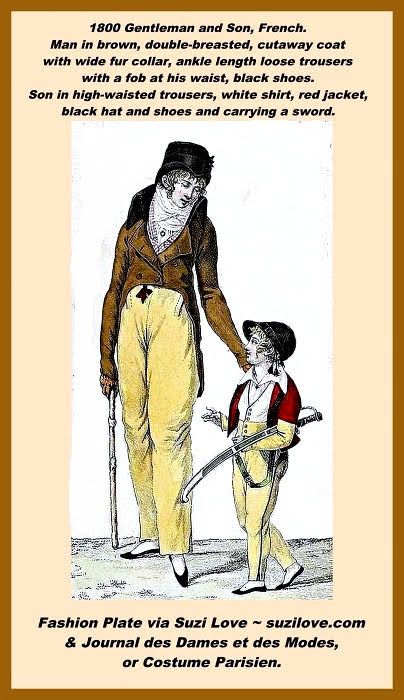
1807 Gentleman’s Blue Tailcoat, French. White breeches, black boots topped with large tan strip, black hat and a cane. Plate via Journal des Dames et des Modes, or Costume Parisien.
French fashions and Georgian and Regency Era fashions from Great Britain were copied around the world. This is what men wore in the times of Jane Austen for city and country life.
1800-1815 ca. Vest, Or Waistcoat, French. Embroidery with spangles and a standing collar. Vests gave a layer of protection from the elements and a fashion arena, as early 1800s coats were either cutaway or designed to be left open in the front. Typical Style of Early 1800s Vest: Standing collar, straight cut, front pockets, heavily embroidered and with tiny spangles to accentuate. via Metropolitan Museum, N.Y.C., U.S.A. metmuseum.org
Typical of a gentleman’s waistcoat, or vest, worn during the early 1800s, or Regency Era, or Jane Austen’s times with a standing collar, straight cut, front pockets, and heavily embroidered with tiny spangles to accentuate.
1795-1805 ca. Green Silk and Metal Vest, Or Waistcoat, Probably French. The style of waistcoat worn by men in Jane Austen’s times. Interesting cross-over front and tasteful embroidery, standing collar, back has ties to adjust the fit. via Metropolitan Museum, N.Y.C., U.S.A. metmuseum.org
1908 Silk and Rubber Corset, French. Front fastening, front suspenders, and back lacing. Made For C. F. Hovey & Co., Boston. Label: The Paris. Marking: label “7.50, Made in France, Véritable Baleine, Brévété S.G.D.G., Best Whalebone THE PARIS, Made in France, expressly or C.F. Hovey and Co., Boston.” stamped on bone lining of corset]; “Corset de Paris” paper label via Metropolitan Museum, NYC, USA Credit Line: Gift of Mrs. Earl Rowe, 1951 Accession Number: C.I.51.15.25a, b
1908 Front Fastening View Of Corset, French. Made For C. F. Hovey & Co., Boston. Label: The Paris. Silk and Rubber. Front fastening and back lacing. via Suzi Love suzilove.com & Metropolitan Museum, NYC, U.S.A. metmuseum.org1908 Front Fastening View Of Corset, French. Made For C. F. Hovey & Co., Boston. Label: The Paris. Silk and Rubber. Front fastening and back lacing. via Suzi Love suzilove.com & Metropolitan Museum, NYC, U.S.A. metmuseum.org1908 Back Lacing Of Corset, French. Made For C. F. Hovey & Co., Boston. Label: The Paris. Silk and Rubber. Front fastening and back lacing. via Metropolitan Museum, NYC, U.S.A. metmuseum.org1908 Label For Front Fastening and Back Lacing Silk and Rubber Corset, French. Front fastening and back lacing. Made For C. F. Hovey & Co., Boston.1908 Front Suspenders and Back Lacing Silk and Rubber Corset, French. Front fastening and back lacing. Made For C. F. Hovey & Co., Boston.1908 Front Suspenders and Fastenings and Back Lacing Silk and Rubber Corset, French. Front fastening and back lacing. Made For C. F. Hovey & Co., Boston.Corsets 1900s History Notes Book 21
Corsets during early 1900s when a fashionable
silhouette became of paramount importance
and a well-fitted corset a fashion essential.
books2read.com/SuziLoveCorsetBook21
1820 Gentleman’s Cream Redingote, Or Long Overcoat, French. Long pants, or trousers, buttoned at the ankles, frilled shirt, high cravat, vest, red fob hanging at his waist. via L’Observateur des Modes, French.
19th Century Writing Set, French. Old Paris porcelain pot with ormolu fittings, set on a pen tray that is papier mache and hand painted in Chinoiserie, Or Japonaise, Style. The type of writing sets that households would have in Jane Austen’s times for writing letters and keeping track of estate matters. Chinese and Japanese styles of household goods were very fashionable during the English Regency and Victorian years. via Ruby Lane Antiques. rubylane.com
HN_13_D2D_WritingTools Book 13 What did the lady of the house use to pen notes? What sat on the desk of the man of the house when managing his accounts? #History #Nonfiction #travel books2read.com/SuziLoveWritingTools
1725-1730 ca. Gold Double-Opening Snuffbox, France. Two tortoiseshell pique panels and two miniatures inside, of Louis XV of France and his wife Marie Leczinska. Made by Jean Baptiste Massé, painter.
Varicolored gold seascape of dolphin and ship with beach littered with shells and rocks, plus ruins, birds, and an island. Inside the box are miniature portraits of Louis XV of France and his wife Marie Leczinska. It has been suggested that the box commemorates the birth of the ‘dauphin’ Louis in 1729, the royal couple’s fourth child, and first son, heir to the throne. A few elements contradict this suggestion: the dolphin does not bear any regal symbol such as a crown, the marks that date the box indicate that it was initiated before the birth of Louis, when the arrival of a son was unknown. It is most probable that these delicate panels, together with the miniature of Louis XV, date from 1725-1730 and have been associated later into this gold snuffbox, and a later miniature of Queen Marie Leczinska.The miniature of the king may have been painted by Jean-Baptiste Massé – he is recorded as supplying miniatures of the king for boxes intended as diplomatic gifts from 1720-26-, or by his lesser known contemporary Jean-Baptiste Ducanel.
The lid is hinged to reveal a miniature, under glass, of Marie Leczinska, queen of France, probably 19th century or heavily restored, wearing a cloak of blue embroidered with gold fleurs-de-lis and lined with ermine overa lace-trimmed dress of red embroidered with gold. In the base is a panel of tortoiseshell pique with a cornucopia of small shells, also hinged to reveal a contemporary miniature of Louis XV of France in armour, wearing a whitestock and the sash of the Order of the Holy Ghost. The gold box, probably early 19th century or later, has plain walls, reeded borders, and a double thumbpiece.
Sir Arthur Gilbert and his wife Rosalinde formed one of the world’s great decorative art collections, including silver, mosaics, enamelled portrait miniatures and gold boxes. Arthur Gilbert donated his extraordinary collection to Britain in 1996.
Snuff Boxes: Decorative boxes of all types were prized, especially in the 18th Century when everything decorative and extravagant was in vogue and taking a pinch of snuff was fashionable. Snuff is made from ground or pulverized tobacco leaves, flavorings added, and then a pinch of snuff is placed on the back of the hand and sniffed.