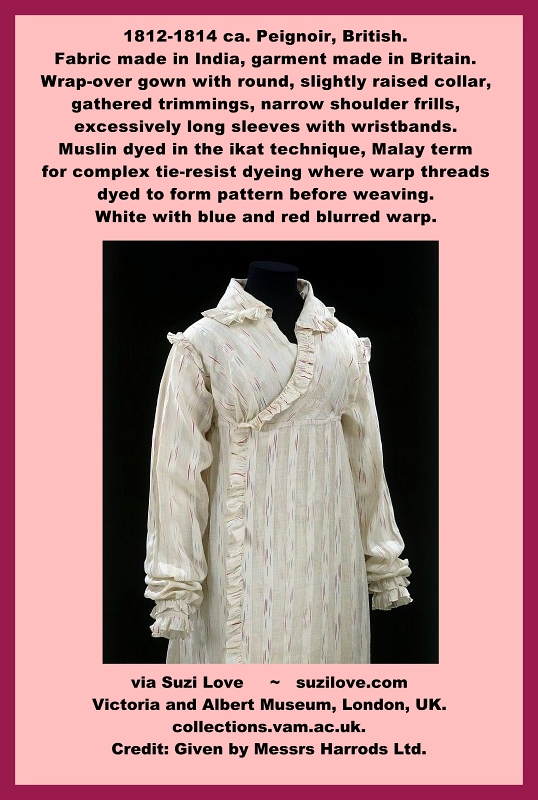
1812-1814 Ca. White Muslin Peignoir Or Dressing Gown, British. The sort of robe Jane Austen would have worn. Fabric made in India, Garment made in Britain. Wrap-over gown with round, slightly raised collar, gathered trimmings, narrow shoulder frills, excessively long sleeves with wristbands. Muslin dyed in the ikat technique, Malay term for complex tie-resist dyeing where warp threads dyed to form pattern before weaving. White with blue and red blurred warp.
via Victoria & Albert Museum, London, UK. collections.vam.ac.uk Credit: Given by Messrs Harrods Ltd.
1817 December Black Walking Mourning Dress, English. Black bombazine dress with a black crepe hem, with tight bodice wrapping across to the right side, trimmed with a piping of black crape that looks like braiding and finished by rosettes of crape, in the center of each of which is a small jet ornament. Long sleeves trimmed similarly at the wrists, half-sleeve of a new form trimmed with crape, high standing collar displaying a mourning ruff. Claremont bonnet, named because it is the same shape as one worn by the Princess, whose home with her husband, Prince Leopold, was called Claremont. Black crape over black sarsnet and lined with double white crape. Low crown but large front and tastefully finished by black crape with a bunch of crape flowers on one side. Black shamois gloves, and black shoes. “We have again to acknowledge our obligations to the lady who favored us last month; and we understand that the dresses from which our prints this month have been taken were also purchased from Mrs. Bell of St. James’s-street.” Fashion Plate via Rudolph Ackermann’s ‘The Repository of Arts’.
Mrs. Bell ‘invented’ fashion plates and as well as publishing in La Belle assemblee, she also sold them to other magazines. Hence the crossover we often see where the same plate, or a similar version, appears in different magazines.
Fashion Women 1815-1819 History Notes Book 28 https://books2read.com/SuziLoveFashionWomen1815-1819
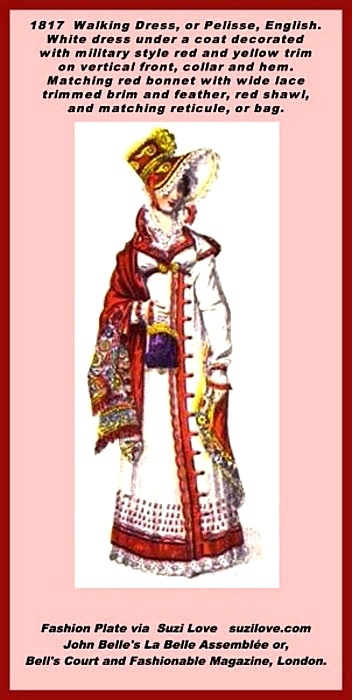
1817 November Autumnal Carriage Walking Dress or Pelisse, or Redingote, English. Pelisse of Cashmere with a white background, trimmed with vermillion red, vermillion belt and a gold and Ceylon ruby broach or clasp. Lyonese shawl with a rich border of various colors. Bonnet of vermillion satin, embossed with straw, decorated with straw colored ribbons and a bouquet of full blown damask rose, buds, and ears of ripe corn and edge of the bonnet finished by blond lace. White kid half-boots, Limerick gloves, vermillion satin ridicule, or bag, with gold tassels and spring. Fichu frilled with fine lace and left open at the throat. Fashion Plate via John Belle’s La Belle Assemblée or, Bell’s Court and Fashionable Magazine, London.
Jane Austen: This is a fashionable ensemble as would have been worn by Jane Austen and her family and friends. Walking dress such as this would have been worn when out shopping, walking in a park or the country estate. This sort of outfit needed to be presentable and warm but not overly accessorized with jewelry etc..
Definition Coat, or Redingote Or Pelisse: Long fitted outdoor coat worn over other garments for warmth. Redingote is the French word developed from English words for riding coat. Usually called Walking Dress Or Pelisse in English fashion plates.
Definition Reticule: Bag or purse, often with a drawstring to pull closed and usually made of cloth or covered cardboard and often decorated with beading or embroidery. A reticule, or purse, or handbag, was usually carried by a woman during the Regency period to carry all their daily necessities. Earlier, women used pockets that tied at the waistline and were hidden in the folds of their skirts. Empire style, or early 1800s, high-waisted dresses made it impossible to either sewn in a pocket or to tie on a pocket. So women began carrying small, decorated bags called Reticules, or ridicules, which generally pulled close at the top with a drawstring.
Fashion Women 1815-1819 History Notes Book 28 https://books2read.com/SuziLoveFashionWomen1815-1819
1811 White Dress, French. Dress with scalloped hem, pink Redingote, green paisley shawl and white hat. Fashion Plate via Journal des Dames et des Modes, or Costume Parisien.
Definition Redingote Or Pelisse Or Walking Dress Or Coat: Long fitted outdoor coat worn over other garments for warmth. Often left open at the front to show off the dress underneath. French word developed from English words, riding coat. Jane Austen and her contemporaries wore long coats like these to keep warm when out and about, visiting, shopping etc. The thin muslin dresses worn in the early 1800s were little protection against European winters.
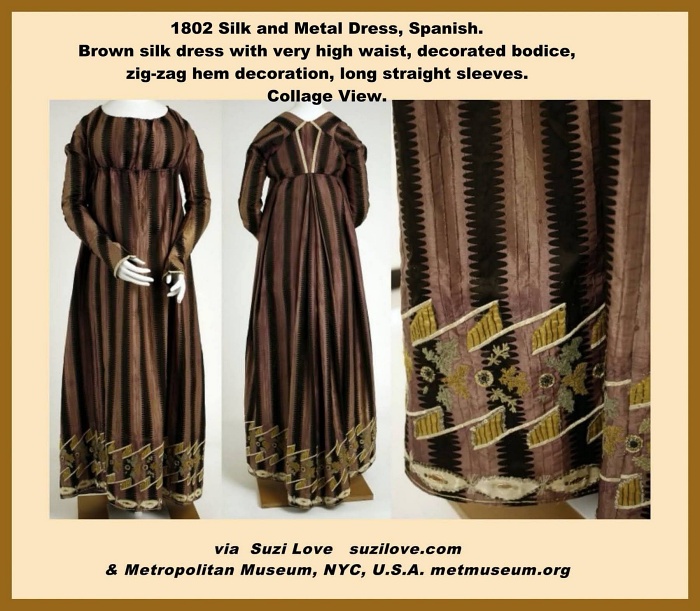
1802 Silk and Metal Dress, Spanish. Brown silk dress with very high waist, decorated bodice, zig-zag hem decoration, long straight sleeves. I can picture Jane Austen and her female friends and family wearing this sort of dress to a dinner party or musical evening. via Metropolitan Museum, NYC, U.S.A. metmuseum.org
1802 Silk and Metal Dress, Spanish. 1802 Silk and Metal Dress, Spanish. Front View. 1802 Silk and Metal Dress, Spanish. Back View. 1802 Silk and Metal Dress, Spanish. Fabric View. HN_25_D2D_fashwomen1801-1804 https://books2read.com/SuziLoveFashionWomen1801-1804
1809 Messrs. Harding Howell and Co., London, UK. View of interior of Harding Howell and Co., draper’s shop on Pall Mall. Ladies examine latest fashions and fabrics which they could then request of their dressmakers. This house extended 150 feet from front to back and was divided by glass petitions into four departments, furs and fans, haberdashery, jewellery, ornaments and perfumes, and millinery. bl.uk
1809 Interior of Messrs. Harding Howell and Co. Draper’s Shop, Pall Mall, London, U.K.
Love the charming chatelaines and chains women wore in Jane Austen’s and Bridgerton’s times? Check out this fascinating read! #bridgerton #janeausten #chatelaine #suzilovebooks books2read.com:SuziLoveChatelaines
The Bridgerton women and Jane Austen and contemporaries carried keys, writing tools, sewing items and other personal necessities on their person by long chains, or a chatelaine, that hung from their waist. Early chatelaines were simple essentials but later chatelaines were decorative and expensive. http://books2read.com/SuziLoveChatelaines
Definition Chatelaine: The word Chatelaine is French and means the keeper of the keys. Chatelaine” derives from the Latin word for castle. In Medieval times, the chatelaine was in charge of the day-to-day running of the castle. Women in charge of households dangled long chains from their waists to keep essentials within easy reach e.g. keys, notebook and pen, watch, sewing items, vinaigrette or perfume, or magnifying glass. Early chatelaine were simple essentials. Later chatelaine were decorative and expensive.books2read.com/SuziLoveChatelaines
What did a chatelaine do? Most important task was keeper of the keys. Also ordered supplies, did bookkeeping, supervised servants, taught castle children, and organized guests.
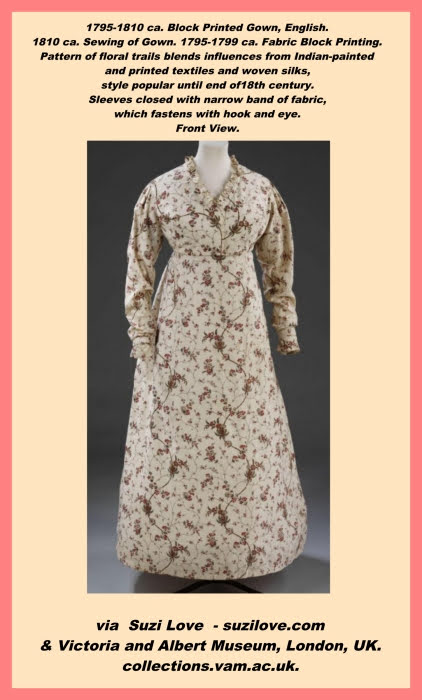
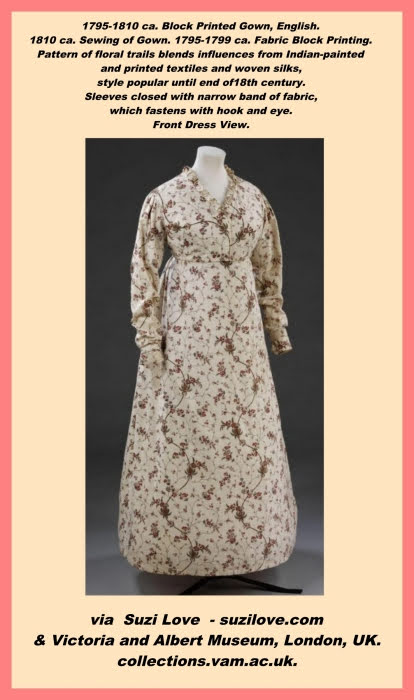
1795-1810 ca. Roller Printed Dress, English. Empire style, high-waisted, roller printed dress with skirt gathered at the back to create a full skirt and with simple V-necked bodice and long sleeves. Sleeves are closed with a narrow band of fabric which fastens with a hook and eye. via Victoria and Albert Museum, London, UK. 1810 ca. Sewing of Gown. 1795-1799 ca. Fabric Block Printing. Pattern of floral trails blends influences from Indian-painted and printed textiles, and woven silks, a style which remained popular until the end of18th century.
The pattern of floral trails seen on the printed fabric of this gown exhibits a blend of influences from Indian-painted and printed textiles, and woven silks, a style which remained popular until the end of the 18th century. The sleeves of this gown are closed with a narrow band of fabric, which fastens with a hook and eye.
The dress is styled with a high-waisted , fitted bodice, which fastens centrally. The neck, which is trimmed with a 1″ frill of matching material, is rounded a the back and V-shaped at the front. The bodice is lined with white cotton which extends 1/3 of the way down the full length tapered sleeves. A trimming decorations is attached to the wrist of the right sleeve (made from the same material and lined with white cotton), which fastens with a metal hook and eye at the hip. The skirt has an ‘apron’ style front with fastening tapes attached to either side, in addition to this there are vertical pocket slits situated at either side of the skirt measuring 11″. The front and rear sides of the skirt are constructed from one width of fabric – 39.5″ wide. The waistline at the back of the skirt is gathered a the centre and is constructed from two pieces of material measuring 46″ wide.
The cotton has blue threads in the selvedges denoting English origin, and is block printed in a polychrome palette with pencilled blue on a white ground. The design consists of an all-over pattern of delicate floral trails of carnations, pinks an other stylised flowers interspersed by vertical arborescent meanders bearing exotic fruits and stylised flowers. The pattern repeat measures 10.5″ by 10″.
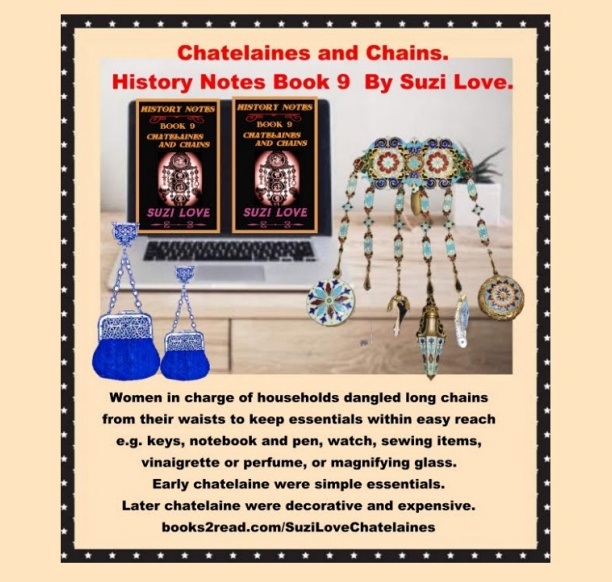
Jane Austen’s and the Bridgerton ladies personal necessities, keys, or chatelaines was a set of useful items hung from waist by decorative chain. Chatelaines and Chains. History Notes Book 9 By Suzi Love. Women in charge of households dangled long chains from their waists to keep essentials within easy reach e.g. keys, notebook and pen, watch, sewing items, vinaigrette or perfume, or magnifying glass. Early chatelaine were simple essentials. Later chatelaine were decorative and expensive. http://books2read.com/SuziLoveChatelaines
Definition Chatelaine: The word Chatelaine is French and means the keeper of the keys. Chatelaine” derives from the Latin word for castle. In Medieval times, the chatelaine was in charge of the day-to-day running of the castle. Women in charge of households dangled long chains from their waists to keep essentials within easy reach e.g. keys, notebook and pen, watch, sewing items, vinaigrette or perfume, or magnifying glass. Early chatelaine were simple essentials. Later chatelaine were decorative and expensive.books2read.com/SuziLoveChatelaines
What did a chatelaine do? Most important task was keeper of the keys. Also ordered supplies, did bookkeeping, supervised servants, taught castle children, and organized guests.
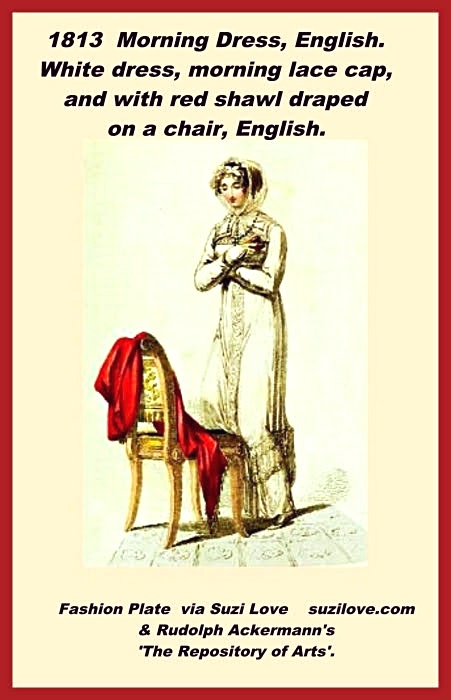
1813 October Morning Dress, English. Jane Austen and her family and friends would have worn this style of relaxed dress and cap. White At-Home dress with morning lace cap and a red shawl. Plain cambric underdress, three-quartered muslin or Chinese silk robe trimmed round the bottom and up the front with Indian border, or needle-work, and finished with a deep flounce of lace. Convent hood and pelerine of white net lace, confined under the chin with a silk cord and tassel. Hair in irregular curls with a fancy flower in the front. Short rosary and cross, plus bracelets, of coquilla beads. Buff or lemon kid slippers and pale tan gloves. Fashion Plate via Rudolph Ackermann’s ‘The Repository of Arts’.
This is a typical outfit worn at home in the morning in the house, to be seen only by family or close friends. A lady might wear this while writing having breakfast, writing letters, or reading. Called by the various names of Undress, to At-Home dress, or Morning dress, it is the most relaxed ensemble a lady will wear all day. The sort of outfit Jane Austen would have worn when writing her books.
1812 Red Dress, French. High-waisted red Merino wool dress with short puffed sleeves, high Chako hat with a plume long white gloves and white shoes. Fashion Plate via Journal des Dames et des Modes, or Costume Parisien.HN_27_D2D_fashwomen1810-1814
https://books2read.com/SuziLoveFashion1810-1814