1829 July 4th George Shillibeer’s Omnibus, London, U.K. First Omnibus between Paddington and Bank of England via the New Road, now Marylebone Rd., Somers Town and City Rd. Via Wikimedia Commons. books2read.com/SuziLoveTravel



1829 July 4th George Shillibeer’s Omnibus, London, U.K. First Omnibus between Paddington and Bank of England via the New Road, now Marylebone Rd., Somers Town and City Rd. Via Wikimedia Commons. books2read.com/SuziLoveTravel
1808 Richard Trevithick’s Steam Circus, Bloomsbury, London, U.K. Site where Trevithick ran his locomotive ‘Catch Me Who Can’. Trevithick wanted to prove that traveling by train was faster than on horseback. Locomotive ran at top speed of 19 km per hour and people paid a shilling to sit in an attached car and be pulled around. Via Wikimedia Commons commons.wikimedia.org (PD-ART) This was the start of the railway expansions across England in Jane Austen’s time.

Early 1800s Typical Regency Couple in a Curricle. The sort of vehicle Jane Austen and her contemporaries would have driven in. Young men loved them and occasionally women drove them.



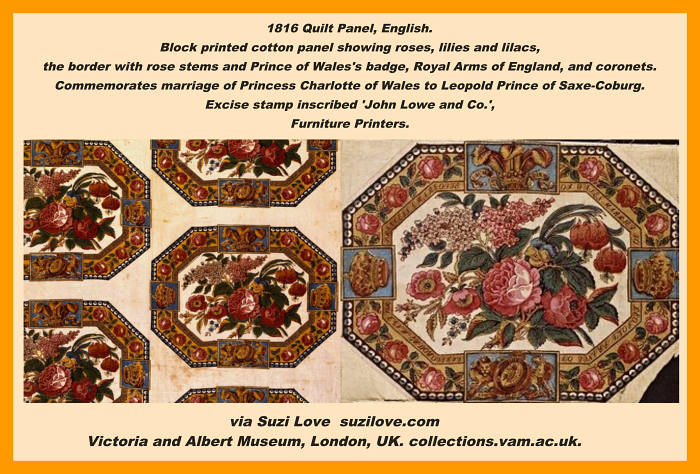
Textile of block-printed white cotton in madder colours with pencilled blue. The cotton is printed with 9.5 octagonal panels intended to be cut out and applied to patchwork quilts. Each panels contains a bunch of flowers. Around the inner border is an inscription of Princess Charlotte of Wales married to Leopold Prince of Saxe-Coburg May 2, 1816. In the borders are three Prince of Wales feathers, the Royal Arms, and a crown on each side. At the end of the textile is printed a rectangular panel containing the manufacturers name and in a corner is the name ‘G. Swindels’.
This quilt has an excise stamp for 1816 and is inscribed ‘John Lowe and Co. Furniture Printers, Shepley Hall’, providing the name of the only identifiable manufacturer of these panels, although there are likely to have been others. John Lowe was a well-known firm of calico printers with large cotton factories and extensive bleaching grounds close to the River Tame near Ashton-under-Lyne in Lancashire.
Hand-quilting is done on a frame using needles called ‘betweens’. The stitches are executed with one hand; the other hand is kept underneath the quilt to feel for the needle. Small, uniform stitches (usually a ‘running stitch’) are taken through the three layers to form a decorative design. In ‘piecing’ or ‘patchwork’, small pieces of fabric are sewn together to produce a decorative design. The most enduring method in Britain is done by hand, and is known as ‘piecing over paper’. The pattern is first drawn onto paper and then accurately cut. Small pieces of fabric are tacked round each of the shapes, and then joined together from the back using overstitch. Most of the quilt top visible here has been pieced over paper, but in some areas the fabrics have been applied directly on to the earlier quilt that forms the wadding.
Victoria and Albert Museum, London, England.



1820 ca. Writing Box, English. Rosewood and brass inlaid writing box by William Dobson, The Strand, London. Makers label, gilded candle holders, ink wells. via antiques-atlas.com. Portable boxes for writing materials existed for many centuries but in the last decades of the 18th century socio-economic circumstances in England necessitated the wide use of a portable desk in the form of a box which could be used on a table or on one’s lap. Hence “Lap Desk”.


