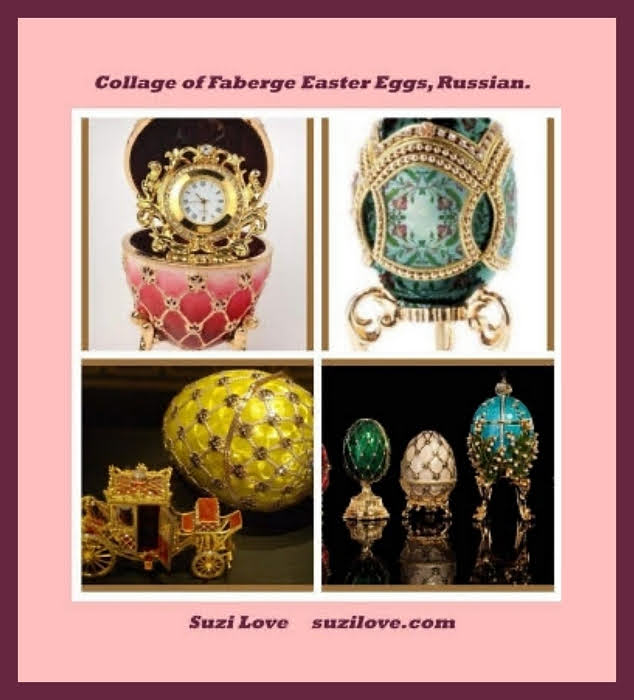
1916 Steel Military Surprise Faberge Easter Egg, Russia. Gift from Nicholas II to his wife Tzaritsa Alexandra Fyodorovna. Surprise is a miniature painting on an easel of the Tzarin planning with his generals in field. Faberge Easter Egg, Russia.
The name Faberge is associated with the Russian Imperial family for whom most of the world’s most famous eggs were created. In 1870, Faberge inherited his father’s jewelry business and quickly became known for his brilliant designs. A display of his work and the gold medal he was awarded in Moscow’s Pan-Russian Exhibition of 1882 brought him to the attention of the Russian nobility. In 1885, Faberge was commissioned by Tsar Alexander III of Russia to create an Easter egg for his wife, the Empress Maria Fedorovna. This became known as The Hen Egg, the first Imperial Faberge Egg, and is made of gold. The Empress was so happy with the gift that Alexander appointed Fabergé a ‘Goldsmith by Special Appointment to the Imperial Crown’ and the following year commissioned another egg. From then on, Faberge was given complete freedom with future Imperial designs which become even more elaborate every year. A famous Fabergé egg is one of sixty eight jeweled eggs made by Fabergé and his assistants for the Russian Tzars and private collectors between 1885 and 1917. After the Russian Revolution, the House of Faberge was nationalized by the Bolsheviks and the Faberge family fled to Switzerland where Peter Carl Faberge died in 1920. Several of the Faberge Imperial eggs are still missing.
The name Faberge is associated with the Russian Imperial family for whom most of the world’s most famous eggs were created. In 1870, Faberge inherited his father’s jewelry business and quickly became known for his brilliant designs. A display of his work and the gold medal he was awarded in Moscow’s Pan-Russian Exhibition of 1882 brought him to the attention of the Russian nobility.
In 1885, Faberge was commissioned by Tsar Alexander III of Russia to create an Easter egg for his wife, the Empress Maria Fedorovna. This became known as The Hen Egg, the first Imperial Faberge Egg, and is made of gold. The Empress was so happy with the gift that Alexander appointed Fabergé a ‘Goldsmith by Special Appointment to the Imperial Crown’ and the following year commissioned another egg. From then on, Faberge was given complete freedom with future Imperial designs which become even more elaborate every year. A famous Fabergé egg is one of sixty eight jeweled eggs made by Fabergé and his assistants for the Russian Tzars and private collectors between 1885 and 1917.
After the Russian Revolution, the House of Faberge was nationalized by the Bolsheviks and the Faberge family fled to Switzerland where Peter Carl Faberge died in 1920. Several of the Faberge Imperial eggs are still missing.
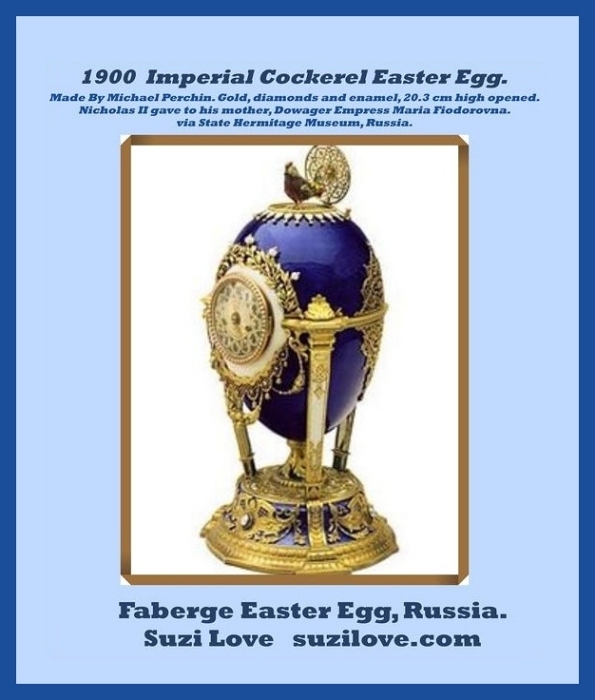
1900 Cockerel Faberge Easter Egg, or, Cuckoo Clock Egg was given by Tsar Nicholas II to Empress Maria Feodoronova. Mechanism on top rear enables its bird to come out and move. The egg is part of the Viktor Vekselberg Collection, owned by The Link of Times Foundation, and housed in the Fabergé Museum in Saint Petersburg, Russia. Faberge Easter Egg, Russia.
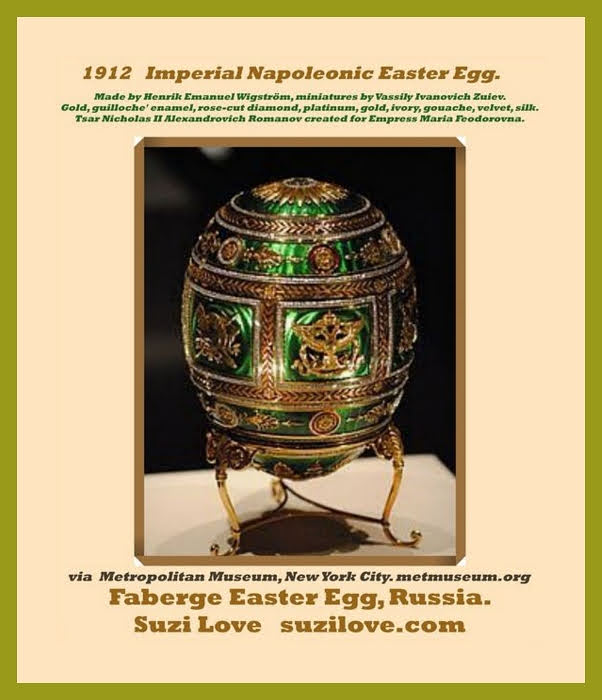
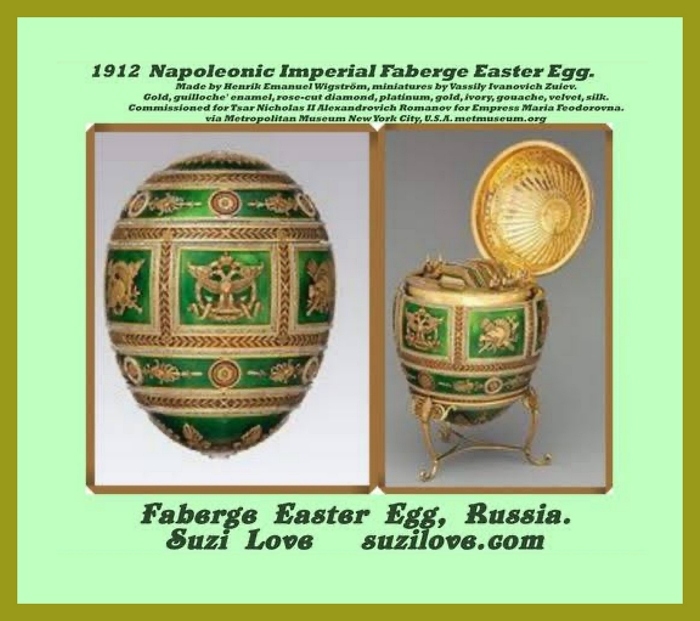
1912 Imperial Napoleonic Faberge Surprise Egg. Made by Henrik Emanuel Wigström, miniatures by Vassily Ivanovich Zuiev. Gold, guilloch enamel, rose-cut diamond, platinum, gold, ivory, gouache, velvet, silk. For Tsar Nicholas II Alexandrovich Romanov to give to Empress Maria Feodorovna. via Metropolitan Museum New York City, U.S.A. metmuseum.org
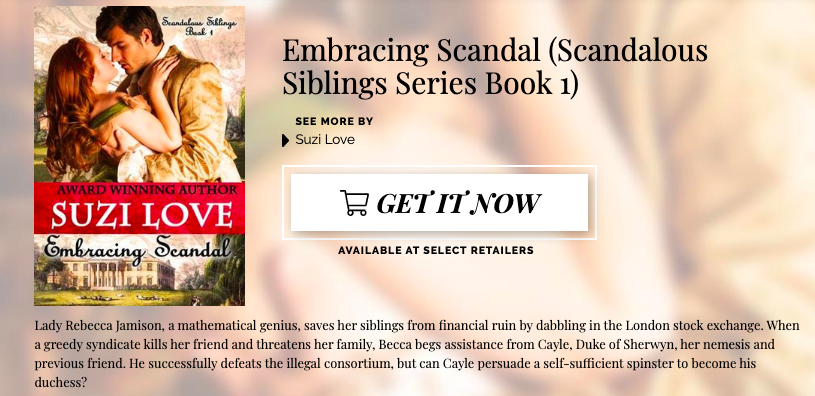
Embracing Scandal Book 1, Scandalous Siblings Series. Lady Rebecca Jamison sneaks into the house of the Duke of St. Martin to beg his assistance to combat a rogue and murderous group of railway investors.
Lady Rebecca Jamison told The Duke of St. Martin. ‘We utilize Foster and Braithwaite as our stock trading agents and invest through them using the minimum identification on any documents.”
“Impressive. I heard that Foster and Braithwaite’s business grew twelve fold in the last few years by riding on railway stocks.”
“Hence, our problem. Their profits, our profits, became legendary. People speculated about the mysterious names on share certificates.” At his puzzled look she added, “Simple enough. We draw up letters. Ladies sign with their initials and family name, nothing more, so no one realizes the investors aren’t men. Or rather, no one did before.”
“And now?”
“Two weeks ago, some members of the outer circle approached my brother, Michael. They believe him to be personally responsible for our own change in fortune.”
“How big a change in fortune?”
“Oh, nothing too major.” She waved a hand in a vague manner and hoped her face didn’t flush. “Modest successes. Dividend rates in excess of six percent in some situations.”
His eyebrows shot upwards. “Six percent! Nobody I do business with calls that modest. No wonder they wish to obliterate all reference to your family, and your Society.”
“Yes, if only we’d been able to keep our good fortune a secret. We take the uttermost care with our clandestine activities, as we value our privacy and our reputations.”
The Duke raised a brow and pointed at his clock. “Oh, yes. Great care with your reputation!”
She chose to ignore him. “Michael laughed it off. Refused to join their so-called group of friends who dabbled in investing. So they raised the stakes. If he refuses to hand over m … his calculations for all the new railway share ventures opening, within the next two weeks, they vowed to destroy the members of his family. One by one, until he gives in.”
“Ah, now I understand. That’s why they’re keeping you alive. They’re waiting to acquire the records. They assume as eldest, and involved in a charitable society, you hold the most knowledge of…” When he mumbled, she stiffened. Did he guess? “Of Michael’s future stock predictions. Then, when they have all they require, they’ll kill all–”
“Yes, yes, I know. They’ll dispense with us regardless.”
She lifted her chin a notch. “But I can resolve this situation. Given a little more time, plus a little assistance from you.”
“Ah! Back to the crux of the matter. What you require from me.”
ES_ Embracing Scandal Book 1 Scandalous Siblings Series D2D_ES_ https://books2read.com/suziloveES
1897 The Imperial Coronation Egg With A Surprise.Made By Mikhail Pushkin. Presented by Emperor Nicholas II to his wife Empress Alexandra Feodorovna as memento of entry to Moscow on May 26th, the day of the Coronation, in Uspensky Cathedral. Gold embellished with translucent yellow guilloché enamel.
Many Russian Easters were celebrated with Imperial monogramed eggs as the royals were very involved with both the religious celebrations of Easter and the family traditions. Fabergé eggs were jeweled eggs created by Peter Carl Fabergé and his company in Russia from 1885 to 1917. The most famous of the eggs are the ones made for the Russian Tsars, Alexander III and Nicholas II, as Easter gifts for their wives and mothers, often called the ‘Imperial’ Fabergé eggs. The House of Fabergé made about 50 eggs and 43 have survived. Another two were planned for Easter 1918, but because of the Russian Revolution were not delivered. After the Revolution, the Fabergé family left Russia and the Fabergé trademark has been sold several times since then. Several companies have sold Easter egg merchandise using the Fabergé name. The trademark is now owned by Fabergé Limited, which makes egg-themed jewelry.
As some of my historical romance books are set in a house in Grosvenor Square, its history fascinates me. How about you? Do you love the history associated with Grosvenor Square? The Jamison family in Embracing Scandal and Scenting Scandal live in Grosvenor Square.
Grosvenor Square - Pronounced ˈɡrovna’, is a large garden square in the exclusive Mayfair district and the centrepiece of the Mayfair property of the Duke of Westminster and takes its name from their surname, “Grosvenor”.
In 1710, Sir Richard Grosvenor obtained a licence to develop Grosvenor Square and the surrounding streets and development started around 1721. Grosvenor Square became one of the most fashionable residential addresses in London from its construction until the Second World War, with numerous leading members of the aristocracy in residence. The early houses had five or seven bays, basement, three main stories, and an attic. Colen Campbell produced a design for a palatial east side to the square featuring thirty Corinthian columns but this was not carried out and in the end most of the houses were built to individual designs. There were mews behind all four sides. Many houses were rebuilt later and acquired an extra storey. Number 23 (later 26) was rebuilt in 1773–74 for the 11th Earl of Derby by Robert Adam and shows how grandeur of effect and sophisticated planning might be achieved on a confined site. It was demolished and rebuilt again in the 1860s.
1761 – Sir Richard Grosvenor, the 7th Baronet, was created Baron Grosvenor of Eaton in the County of Chester
1784 – Became Viscount Belgrave and Earl Grosvenor under George III.
1831- At coronation of William IV, Robert Grosvenor, the 2nd Earl Grosvenor, became Marquess of Westminster
1874 – Queen Victoria created the title Duke of Westminster and bestowed it upon Hugh Grosvenor, 3rd Marquess of Westminster.
Current title holder is Gerald Grosvenor, 6th Duke of Westminster and his seat is at Eaton Hall, Cheshire The Dukedom and Marquessate are in the Peerage of the United Kingdom The rest are in the Peerage of Great Britain. The courtesy title of the eldest son and heir to the Duke is Earl Grosvenor.
Nearly all of the older houses were demolished during the 20th century and replaced with blocks of flats in a neo-Georgian style, hotels and embassies. The central garden was originally reserved for the occupants of the houses but is now a public park managed by The Royal Parks. Grosvenor Square. Grosvenor Square has been the traditional home of the official American presence in London since John Adams established the first American mission to the Court of St. James’s in 1785. Adams lived, from 1785 to 1788, in the house which still stands on the corner of Brook and Duke Streets. During World War II, Eisenhower established a military headquarters at 20 Grosvenor Square, and during this time the square was nicknamed “Eisenhower Platz”.
The former American Embassy of 1938–1960 on the square was purchased by the Canadian government and renamed Macdonald House. In 1960, a modern USA Embassy was built on the western side of Grosvenor Square and caused controversy in the mainly Georgian and neo-Georgian area. In 2008, the United States Government chose a site for a new embassy in the Nine Elms area, south of the River Thames with with relocation completed by 2016 or 2017. In October, 2009, English Heritage granted Grade II listed status to the building which means new owners will not be allowed to change the facade.
Grosvenor Square in Literature In Little Dorrit by Charles Dickens the Barnacles are said to live at “four Mews Street Grosvenor” which “was not absolutely Grosvenor Square itself but it was very near it”. Caroline Bingley makes a comment regarding the local dance in Pride and Prejudice ”We are a long way from Grosvenor Square, are we not, Mr Darcy”. It appears in the title of several novels including The Lonely Lady of Grosvenor Square by Mrs. Henry De La Pasture (1907) and The House in Grosvenor Square by Linore Rose Burkard (2009) In Oscar Wilde’s play Lady Windermere’s Fan, the Duchess of Berwick says, “I think on the whole that Grosvenor Square would be a more healthy place to reside in. There are lots of vulgar people live in Grosvenor Square, but at any rate there are no horrid kangaroos crawling about.”
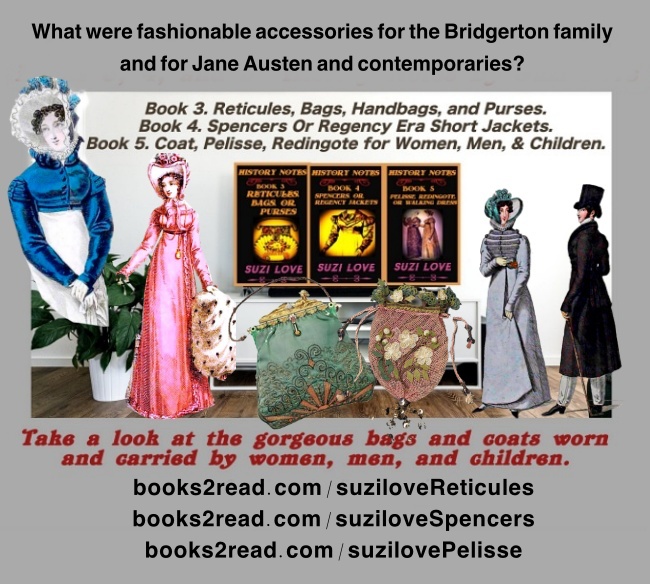
Fashion Must Haves In Jane Austen’s Times: Reticules, Spencers, Redingotes. History Notes Series Books 3, 4, and 5.
Reticule Or Bag: Purse, often with a drawstring to pull closed and usually made of cloth or covered cardboard and often decorated with beading or embroidery. Carried by a woman during the Regency period to carry all their daily necessities. in the place of pockets.
Spencer: Short jacket, cropped at the waist, worn over a dress, or gown. Delicate and regency dresses provided so little protection from the cold, so over garments were essential for warmth, modesty and good health.
Pelisse Or redingote Or Walking Dress: Coat worn over clothing of both sexes for warmth and protection from the elements.
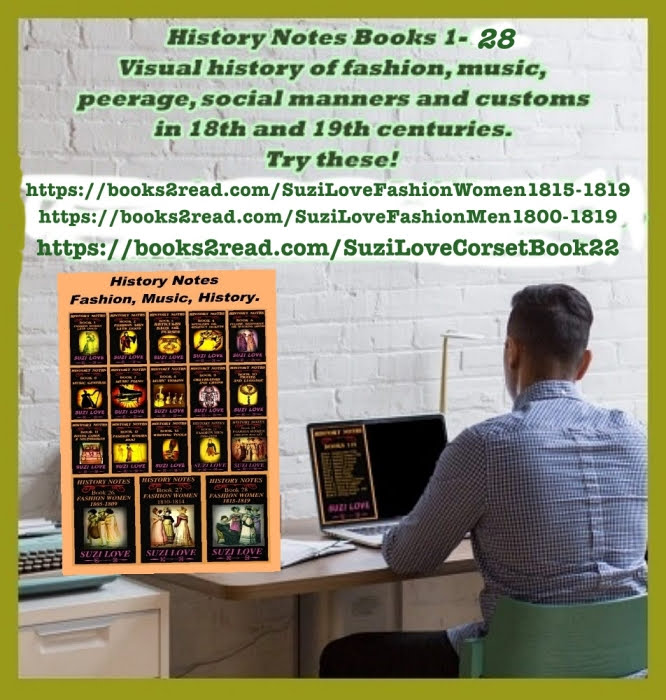
Do you need more factual and visual information for your historical fiction? Try History Notes Books 1-13. Non-fiction Series: Fashion, music and social manners in the 18th and 19th centuries e.g.
The Duke of St. Martin asks Lady Rebecca Jamison, “Who protects you from the current set of fire-breathing dragons?” #HistoricalRomance #Mystery https://books2read.com/suziloveES
“And who protects you from the current set of fire-breathing dragons?”
She raised her chin. “I’ve outgrown such childishness.”
She lowered herself to the closest settee, a demonstration of ladylike maturity and a reprieve for her trembling knees.
“Pity.” His forehead furrowed into a pained frown. “Ah.
That’s why you wore a disguise. And why you came so late at night.”
She nodded. “The consortium watches our house and tracks our movements. In order to speak with you alone, I was forced to dress like this and sneak out the servant’s entrance in the dark. Although luckily, the syndicate’s inner circle doesn’t want me dead. Not yet.
“Wonderful!” He glared at her. “Your blithe not yet offers such comfort to my nerves.”
She glared back. “Oooh! I cannot explain if you interrupt with your sarcastic jabs.”
He dipped his head, and then waved a hand. “I apologize for my uncertain temperament this evening. Please, tell me about Peggy, and what she did at your Women’s Society.”
“She writes — No, she wrote the letters for women who wish to invest in stock ventures. We were trying to keep their identities, and their objectives, a secret.”
“Why? Because they’re women? Because jobbers stood for them in the Exchange?”
She raised a brow. “For someone only recently returned to London, you appear exceedingly well acquainted with the inside activities at the Exchange.”
He shrugged. “I’ve spent every spare moment since my return settling the family’s finances. Naturally, I’ve looked in at the Foreign Funds Room a time or two. Nobody in my position can afford to let bank balances sit idle, despite some labeling it as trade.”
“I’m impressed, Cayle. You detested accounts when your father wanted you to learn.”
Once more he shrugged, yet his show of nonchalance appeared overdone. “Perhaps it was more of not liking the methods of the educator, rather than the subject being taught.”
She shuddered at her recollection of the late duke’s disciplinary methods. “But you’re correct,” she said, pushing away images of birch rods twanging on bare flesh. “Some in our prudish society frown upon a gentleman of your caliber frequenting auction rooms. But, for a woman, it’d be an outrage.”
His eyes fixed upon her, all signs of his earlier fatigue vanished. “I can well imagine.”
“Though legally nothing prevents a woman from owning shares,” she said, assessing his concentration by the tense way he held his long, muscled body. “Visiting members are vetted at the door. Bank managers and jobbers pay eight guineas a year to enter the main Exchange room, yet self-righteous men evict females.”
“So, is it your gender that sees you under threat?”
“Not merely our gender. When the consortium heard we invested in secret, and often did very well, at first they became alarmed. Then, they became angry. Very angry indeed.”
“I can well imagine men abhorring being bested by a female.”
ES_ Embracing Scandal Book 1 Scandalous Siblings Series D2D_ES_ https://books2read.com/suziloveES
Want a glimpse into the life of a young lady in Jane Austen and the Bridgerton years? #bridgerton #RegencyEra #JaneAusten
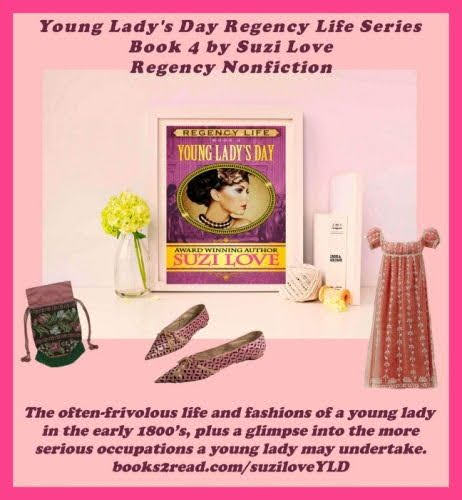
Young Lady’s Day is Book 4 in the Regency Life Series. This book depicts the often-frivolous life and fashions of a young lady in the early 1800’s, but also gives a glimpse into the more serious occupations a young lady may undertake. Through historic images, historical information, and funny anecdotes, it shows how a young lady fills her day, where she is permitted to go, and who she is allowed spend time with. These light-hearted looks at the longer Regency years are an easy to read overview of what people did and wore, and where they worked and played. There is plenty of information to interest history buffs, and lots of pictures to help readers and writers of historical fiction visualize the people and places from the last years of the 18th Century until Queen Victoria took the throne. https://books2read.com/suziloveYLD
Outback Arrival : A contemporary medical set in an outback Australian hospital. A city nurse follows the doctor she loves to the bush town where he manages his family’s cattle properties, determined to prove her love for him. But can he accept that she is carrying his baby and that those he trusts have lied?
‘No, no, no! Bodies don’t stand up and walk out of hospitals.’
‘I’m real sorry, Nurse Kristie.’ The weather beaten grounds-man shuffled his feet in front of her office desk, distress adding a decade to his sixty something years.‘Looked everˈwhere. Can’t find it.’
‘This can’t be happening, Joey. A corpse cannot just disappear. Somebody must have noticed something.’
‘Sure ain’t sometin´ no normal person’d tuck un’erneath their arm. Walk out with, when visitors go ‘ome.’
Kristie adopted the calm and confident demeanor that had helped her tackle hundreds of emergency room dramas without showing a moment of panic. Casualty nurses joked that no matter how many crazy things you’d dealt with, something stranger was always about to walk in your door. Or in today’s case, walk out of the morgue’s door.
She hauled in a deep breath, while mentally chastising herself for not making more time to attend yoga classes, for Joey’s sake if not her own. She faked a confident smile. ‘We have to find his body, Joey. Quickly. Before the board’s fusspots hear what’s happened. Or we’ll have them arriving, en masse, and breathing down our necks.’
When she’d arrived four weeks earlier, the majority of the board members had welcomed her with open arms. Enticing an experienced nurse away from a city hospital to a remote outback town didn’t happen every day and the town had seen them as heroes saving their stretched outback health system. The few remaining few board members, however, were old-fashioned, staid, and highly suspicious of her motives.
Kristie had learned to be vigilant at work and circumspect when off duty. During her three months’ probation as Director of Nursing, she couldn’t afford any slip ups or she wouldn’t be contracted for a permanent position, no matter how desperate rural towns were to keep medical staff.. Those board members, the ones lacking a sense of humor, would be horrified that a recently deceased member of their small community had mysteriously disappeared from the hospital’s morgue. Although morgue was a loose term for a brick shed which housed a refrigerator, a work bench, and was supposedly cooled by a temperamental air-conditioner. Misplacing a body, without any of her rostered staff noticing, would be classified by the board as her first mistake, a huge mistake.
I’m participating in MFRW Book Hooks—browse the current hop