↓
 

Suzi Love

Making history fun, one year at a time.

Header_
  • Home
  • Newsletter
  • Pre order form
  • Shop
    • Cart
    • Checkout
    • My account
    • Refund and Returns Policy
  • Blog
  • BOOKS
    • History Events
    • Kelly’s Justice
    • Outback Arrival
    • Irresistible Aristocrats
    • History Notes
    • Scandalous Siblings
    • Love After Waterloo
    • Regency Life Series
  • Privacy Policy
  • EVENTS
Home » British history » Page 13 << 1 2 … 11 12 13

Tag Archives: British history

Post navigation

Next Post→

1810 ca. Muslin Bodiced Petticoat With Sleeves, British. #RegencyFashion #JaneAusten #underclothing

Suzi Love Posted on June 12, 2024 by Suzi LoveJune 10, 2024

1810 ca. Muslin, or Cotton, Bodiced Petticoat With Sleeves, British.The sort of petticoat Jane Austen wore beneath her dresses, for both modesty and warmth. via Killerton House. National Trust, U.K. nationaltrustcollections.org.uk

In Jane Austen’s years of the early nineteenth century, women often wore light-weight dresses under which was worn a range of underclothing to stop gowns appearing transparent and sticking to a lady’s body. To preserve modesty, underclothing included a chemise next to the skin, then a corset, and then petticoats to give shape to a dress and to keep it away from her body.

1810 ca. Muslin, or Cotton, Bodiced Petticoat With sleeves, British. via Killerton House. National Trust, U.K. nationaltrustcollections.org.uk
1810 ca. Muslin Bodiced Petticoat With Sleeves, British. #RegencyEra #JaneAusten #underclothing https://books2read.com/SuziLoveFashion1810-1814 Share on X
HN_27_D2D_fashwomen1810-1814
https://books2read.com/SuziLoveFashion1810-1814
HN_27_D2D_fashwomen1810-1814 https://books2read.com/SuziLoveFashion1810-1814
Posted in 1800s, 1800s women's fashion, England, Jane Austen, London, Regency Era, Regency Fashion, Suzi Love Images, underclothing | Tagged 1800s women's fashion, British history, England, Jane Austen, National Trust U.K., petticoat, Regency Fashion, underclothing

18th-19th Century Sedan Chair Travel In Jane Austen’s Times. #JaneAusten #BritishHistory #Travel #GeorgianEra

Suzi Love Posted on May 25, 2024 by Suzi LoveMay 25, 2024

A sedan chair is a portable enclosed chair for a single passenger. It was generally carried by two “chairmen” holding poles attached to either side of the chair. Sedan chairs were fashionable in England and Europe during the 17th, 18th and early 19th centuries and were an important part of the social life of the times. They were very useful for negotiating crowded, unsafe, narrow, winding and often filthy streets and were particularly used by “invalids, ladies and party goers”. Sedan chairs had the advantage of being able to be carried up and down stairs and could deliver the passenger from inside their own home to inside their destination without having to step outside.

1784 Sedan Chair. ‘The return from a masquerade. A morning scene.’ A young lady dressed as shepherdess with staff slumps in a sedan chair. Asleep or drunk her head and shoulders hang outside window. Two porters smile and dwarf chimney sweep carries a mask.’ By Robert Dighton and Cari.

1784 Sedan Chair. ‘The return from a masquerade. A morning scene.' A young lady dressed as shepherdess with staff slumps in a sedan chair. Asleep or drunk her head and shoulders hang outside window. Two porters smile and dwarf chimney sweep carries a mask.’ By Robert Dighton and Cari.
1784 Sedan Chair. ‘The return from a masquerade. A morning scene.’ A young lady dressed as shepherdess with staff slumps in a sedan chair. Asleep or drunk her head and shoulders hang outside window. Two porters smile and dwarf chimney sweep carries a mask.’ By Robert Dighton and Cari.

The 19th century English author, Elizabeth Gaskell, described the use and function of the sedan perfectly in her novel “Wives and Daughters” when she reminisced how the Browning sisters chose to be transported to a ball by sedan chair, which ‘came into the parlor, and got full of the warm air, and nipped you up, and carried you tight and cosy into another warm room, where you could walk out without having to show your legs by going up steps, or down steps.’

The Bath Chair was invented in Bath, England, in the mid 18th Century to transport the wealthy and the sick around the city.  It could be steered by the passenger and rivaled and then outdid the Sedan Chair as only one chairman was needed to operate it. The last Bath Chairman retired in 1949. 

Typical 1700s, or Eighteenth Century Sedan Chair. Portable enclosed chair for single passenger usually carried by two chairmen holding poles attached to either side of chair. Fashionable during 17th, 18th and early 19th centuries when needed to negotiate crowded, unsafe, narrow, and dirty streets. Used by invalids, ladies and party goers. The sedan chair comprises a small kiosk with a curved timber roof which is covered with leather and studded with brass nails. The front and side panels are painted in green with floral decorations of cherubs and flowers. The back panel is of plain timber. Access to the chair was via a hinged door at the front. Inside, the chair is upholstered in silk and features padded upholstered arm rests. The windows have raw silk curtains which are gathered with tassels. The present brackets and poles are reproductions made in 1986 prior to display in the Transport exhibition. The total length of the new poles are 80 inches. The sedan chair door lock features the initials “V.F.” and a set of crossed keys with the wording “PARIS” and the number “34”. Via Powerhouse Museum, Sydney, Australia.

Typical 1700s, or Eighteenth Century Sedan Chair. Portable enclosed chair for single passenger usually carried by two chairmen holding poles attached to either side of chair. Fashionable during 17th, 18th and early 19th centuries when needed to negotiate crowded, unsafe, narrow, and dirty streets. Used by invalids, ladies and party goers. The sedan chair comprises a small kiosk with a curved timber roof which is covered with leather and studded with brass nails. The front and side panels are painted in green with floral decorations of cherubs and flowers. The back panel is of plain timber. Access to the chair was via a hinged door at the front. Inside, the chair is upholstered in silk and features padded upholstered arm rests. The windows have raw silk curtains which are gathered with tassels. The present brackets and poles are reproductions made in 1986 prior to display in the Transport exhibition. The total length of the new poles are 80 inches. The sedan chair door lock features the initials "V.F." and a set of crossed keys with the wording "PARIS" and the number "34". Via Powerhouse Museum, Sydney, Australia.
Typical 1700s, or Eighteenth Century Sedan Chair. Portable enclosed chair for single passenger usually carried by two chairmen holding poles attached to either side of chair. Fashionable during 17th, 18th and early 19th centuries when needed to negotiate crowded, unsafe, narrow, and dirty streets. Used by invalids, ladies and party goers. The sedan chair comprises a small kiosk with a curved timber roof which is covered with leather and studded with brass nails. The front and side panels are painted in green with floral decorations of cherubs and flowers. The back panel is of plain timber. Access to the chair was via a hinged door at the front. Inside, the chair is upholstered in silk and features padded upholstered arm rests. The windows have raw silk curtains which are gathered with tassels. The present brackets and poles are reproductions made in 1986 prior to display in the Transport exhibition. The total length of the new poles are 80 inches. The sedan chair door lock features the initials “V.F.” and a set of crossed keys with the wording “PARIS” and the number “34”. Via Powerhouse Museum, Sydney, Australia.

Typical 1700s, or Eighteenth Century Sedan Chair. Portable enclosed chair for single passenger usually carried by two chairmen holding poles attached to either side of chair. Fashionable during 17th, 18th and early 19th centuries when needed to negotiate crowded, unsafe, narrow, and dirty streets. Used by invalids, ladies and party goers. The sedan chair comprises a small kiosk with a curved timber roof which is covered with leather and studded with brass nails. The front and side panels are painted in green with floral decorations of cherubs and flowers. The back panel is of plain timber. Access to the chair was via a hinged door at the front. Inside, the chair is upholstered in silk and features padded upholstered arm rests. The windows have raw silk curtains which are gathered with tassels. The present brackets and poles are reproductions made in 1986 prior to display in the Transport exhibition. The total length of the new poles are 80 inches. The sedan chair door lock features the initials “V.F.” and a set of crossed keys with the wording “PARIS” and the number “34”. Via Powerhouse Museum, Sydney, Australia. 

The longest journey recorded in a sedan chair was made by Princess Amelia, youngest daughter of King George III, who in 1728 was carried by 8 chairmen working in reliefs from London to Bath, a distance of 172 kms (107 miles). This sedan chair door lock features the initials “V.F.” and a set of crossed keys with the wording “PARIS” and the number “34”.

18th-19th Century Sedan Chair Travel In Jane Austen's Times. #JaneAusten #BritishHistory #Travel #GeorgianEra books2read.com/SuziLoveTravel Share on X
HN_10_D2D_RetailerBuyLink

books2read.com/SuziLoveTravel
HN_10_D2D_RetailerBuyLink_ History Notes Book 10 books2read.com/SuziLoveTravel
Posted in 1700s, 1700s Mens fashion, 1700s Womens Fashion, 1800s, Box Or Container, Carriage, cartoon, Customs & Manners, England, Europe, fashion accessories, France, Georgian Era, Georgian Fashion, hats, History, Jane Austen, London, Regency Era, Romantic Era, Suzi Love Books, Suzi Love Images, travel, U.S.A | Tagged 1700s Mens Fashion, 1700s Women's Fashion, British history, carriages, Customs and Traditions, europe, Georgian era, Georgian Fashion, google books, Jane Austen, Regency Era, travel

1808 Richard Trevithick’s Steam Circus, Bloomsbury, London, U.K. Railway in Jane Austen and the Bridgerton times. #travel #JaneAusten #Bridgerton #railway

Suzi Love Posted on January 26, 2024 by Suzi LoveDecember 28, 2023

1808 Richard Trevithick’s Steam Circus, Bloomsbury, London, U.K. Site where Trevithick ran his locomotive ‘Catch Me Who Can’. Trevithick wanted to prove that traveling by train was faster than on horseback. Locomotive ran at top speed of 19 km per hour and people paid a shilling to sit in an attached car and be pulled around. Via Wikimedia Commons commons.wikimedia.org (PD-ART) This was the start of the railway expansions across England in Jane Austen’s time.

1808 Richard Trevithick's Steam Circus, Bloomsbury, London, U.K. Site where Trevithick ran his locomotive 'Catch Me Who Can'. Trevithick wanted to prove that traveling by train was faster than on horseback. Locomotive ran at top speed of 19 km per hour and people paid a shilling to sit in an attached car and be pulled around. Via Wikimedia Commons commons.wikimedia.org (PD-ART)
1808 Richard Trevithick’s Steam Circus, Bloomsbury, London, U.K. Site where Trevithick ran his locomotive ‘Catch Me Who Can’. Trevithick wanted to prove that traveling by train was faster than on horseback. Locomotive ran at top speed of 19 km per hour and people paid a shilling to sit in an attached car and be pulled around. Via Wikimedia Commons commons.wikimedia.org (PD-ART)
1808 Richard Trevithick's Steam Circus, Bloomsbury, London, U.K. Railway in Jane Austen and the Bridgerton times. #travel #JaneAusten #Bridgerton #railway books2read.com/SuziLoveTravel  Share on X
HN_10_D2D_RetailerBuyLink_HN_10.books2read.com/SuziLoveTravel
D2D_RetailerBuyLink_HN_10.books2read.com/SuziLoveTravel
Posted in 1800s, Bridgerton, Jane Austen, London, Regency Era, Suzi Love Images, travel | Tagged Bridgerton, British history, Jane Austen, railway, Regency Era, Regency Life, Regency London, travel, WikiMedia Commons
corset_1770-1790 ca. Collage View. Pink Silk Damask Stays, Or Corset, English. via Victoria and Albert Museum, London, UK. collections.vam.ac.uk.

1770-1790 Pink Silk Damask Stays, Or Corset, English. #Georgian #Corset #BritishHistory

Suzi Love Posted on October 6, 2023 by Suzi LoveAugust 11, 2023

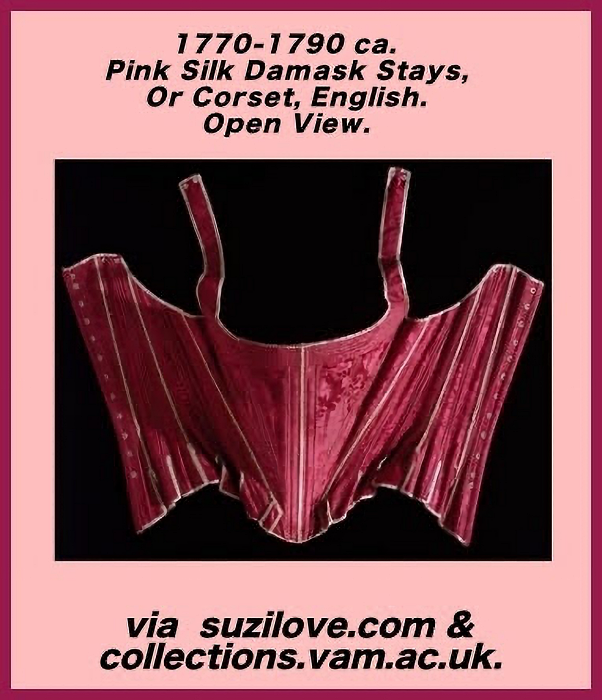
1770-1790 ca. Stays, or Corset, English. Pink silk damask, lined with linen, reinforced with whalebone, fingers spread over hips. via Victoria and Albert Museum, London, UK. collections.vam.ac.uk. https://books2read.com/SuziLoveCorsetBook15

corset_1770-1790 ca. Front View. Pink Silk Damask Stays, Or Corset, English. via Victoria and Albert Museum, London, UK. collections.vam.ac.uk.
1770-1790 ca. Front View. Pink Silk Damask Stays, Or Corset, English. via Victoria and Albert Museum, London, UK. collections.vam.ac.uk.
corset_1770-1790 ca. Side View. Pink Silk Damask Stays, Or Corset, English. via Victoria and Albert Museum, London, UK. collections.vam.ac.uk.
1770-1790 ca. Side View. Pink Silk Damask Stays, Or Corset, English. via Victoria and Albert Museum, London, UK. collections.vam.ac.uk.
corset_1770-1790 ca. Back View. Pink Silk Damask Stays, Or Corset, English. via Victoria and Albert Museum, London, UK. collections.vam.ac.uk.
1770-1790 ca. Back View. Pink Silk Damask Stays, Or Corset, English. via Victoria and Albert Museum, London, UK. collections.vam.ac.uk.
corset_1770-1790 ca. Open View. Pink Silk Damask Stays, Or Corset, English. via Victoria and Albert Museum, London, UK. collections.vam.ac.uk.
1770-1790 ca. Open View. Pink Silk Damask Stays, Or Corset, English. via Victoria and Albert Museum, London, UK. collections.vam.ac.uk.
corset_1770-1790 ca. Side and Back Views. Pink Silk Damask Stays, Or Corset, English. via Victoria and Albert Museum, London, UK. collections.vam.ac.uk.
1770-1790 ca. Side and Back Views. Pink Silk Damask Stays, Or Corset, English. via Victoria and Albert Museum, London, UK. collections.vam.ac.uk.
corset_1770-1790 ca. Collage View. Pink Silk Damask Stays, Or Corset, English. via Victoria and Albert Museum, London, UK. collections.vam.ac.uk.
1770-1790 ca. Collage View. Pink Silk Damask Stays, Or Corset, English. via Victoria and Albert Museum, London, UK. collections.vam.ac.uk.
1770-1790 Pink Silk Damask Stays, Or Corset, English. #Georgian #Corset #BritishHistory
1770-1790 Pink Silk Damask Stays, Or Corset, English. #Georgian #Corset #BritishHistory https://books2read.com/SuziLoveCorsetBook15 Share on X
HN_15_D2D_Corsets 1700-1790
https://books2read.com/SuziLoveCorsetBook15
HN_15_D2D_Corsets 1700-1790 https://books2read.com/SuziLoveCorsetBook15
Posted in 1700s, 1700s Womens Fashion, Corset, England, Georgian Era, Georgian Fashion, Jane Austen, Suzi Love Images, underclothing | Tagged 1700s Women's Fashion, British history, Corset, Georgian Fashion, Jane Austen, Suzi Love Images, Suzi Love Research, underclothing, Victoria and Albert Museum

1800 ca. Jane Austen’s Era Man’s Bicorn, Or Two Cornered, Black Silk Hat. #RegencyEra #mensfashion #HistoricalFashion #Hats

Suzi Love Posted on August 23, 2023 by Suzi LoveAugust 23, 2023

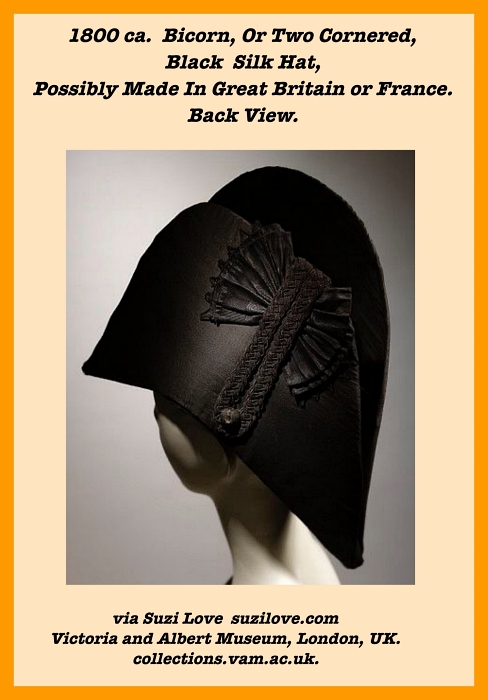
1800 ca. Bicorn, Or Two Cornered, Black Silk Hat, Possibly Made In Great Britain or France. via Victoria and Albert Museum, London, UK. collections.vam.ac.uk. The type of hats worn by the men in Jane Austen’s family around the turn of the century.

Definition: Bicorn Or Bicorne: Two cornered, or pointed, hats often worn by military men because the rain would drain off either side of the hat and  away from the body. They could also be easily flattened to carry under arm. 

1800 ca. Bicorn, Or Two Cornered, Black Silk Hat, Possibly Made In Great Britain or France. via Victoria and Albert Museum, London, UK. collections.vam.ac.uk.
1800 ca. Jane Austen's Era Man's Bicorn, Or Two Cornered, Black Silk Hat. #RegencyEra #mensfashion #HistoricalFashion #Hats https://books2read.com/SuziLoveFashionMen1800-1819 Share on X
HN_23_D2D_Fashion Men 1800-1819
https://books2read.com/SuziLoveFashionMen1800-1819
23_d2d_fashionmen1800-1819 https://books2read.com/SuziLoveFashionMen1800-1819
Posted in 1800s, 1800s Mens Fashions, England, Europe, fashion accessories, France, hats, Jane Austen, Regency Era, Regency Fashion, Suzi Love Images, U.S.A | Tagged 1800s men fashion, British history, England, fashion accessories, Hats And Hair, Jane Austen, Regency Fashion, Victoria and Albert Museum

Wedding ring customs that originated in long ago history. #weddings #Customs #history

Suzi Love Posted on June 2, 2022 by Suzi LoveMay 15, 2022

Wedding ring customs that originated in long ago history.

The first wedding rings can be traced back to the Ancient Egyptians when they exchanged rings made from braided reeds and hemp. The tradition of exchanging rings dates back 3,000 years. The first diamond wedding ring was recorded in the will of a widow who died in 1417. The ancient Egyptians believed in the vena amoris, literally the “vein of love” that runs directly from the heart to the fourth finger on the left hand. For the Ancient Greeks, the engagement ring was symbolized with a plain gold band worn on the left hand and at the marriage the same band was shifted to the right hand.

An engagement ring is given at a proposal or when a couple decides to get married whereas a wedding ring is exchanged at the wedding ceremony and represents the official bond of marriage and the binding pledge between spouses. Wedding rings symbolise eternal love and commitment within a relationship and are worn to show the world they are married. During the wedding service, the couple will say their vows to each other while exchanging rings.

Is a wedding ring biblical? : The use of wedding ring is not commanded in the Bible, and there is no indication that it was ever practised in the New Testament. The use of finger ring in the Bible was as a symbol of authority.

Betrothal ring: An old Roman custom confirming that the marriage contract would be carried out. It was the first part of a dowry given, and meant the woman was no longer for sale as the first part of the monetary settlement had been paid. The first betrothal, or engagement, rings were given because there was often a long time between betrothals and weddings. These were usually simple bands of gold, silver, or iron as on royalty or very wealthy people could afford gemstones and diamonds. In 1477, Archduke Maximillian of Austria commissioned the very first diamond engagement ring for his betrothed, Mary of Burgundy, and many of the European aristocracy and nobility followed his lead.

Wedding ring: Many primitive peoples who believed in magic used a rope around the waist or the hand and feet, and later  a ring, to symbolise that the bride was captured and spoken for, and also to ward off any evil spirits hovering around the bride and ensure marital bliss.

The ring hand: A symbol of the humiliating tradition of the man as the master – the right hand of the family –  and the woman being the slave .  The right hand stood for power and authority while the left hand expressed submission and serfdom.

The ring finger : Ancient Greek and Roman anatomists  believed a vein, the vena amoris or the “vein of love”, or a nerve led from the heart to the third finger, the healing finger , so they romantically linked this finger to the heart. Now we know that this is not true and there is no vein that runs from our ring fingers to our hearts. There are also some more practical reasons the third finger continues to be used. It’s the most prominent for displaying a ring and it cannot be extended to its full length on its own and usually remains slightly bent, preventing the ring slipping off.

The Wedding Ring: Also goes on the left ring finger because it is the only finger with a vein that connects to the heart although some countries, such as India, Germany, Spain, Norway, and Russia traditionally wear their wedding rings on their right hand.

Viking Wedding Rings: These were mostly made of silver and bronze and rarely of gold with the designs inspired by Norse Gods, geometric shapes, runes, and animal totems

Gimmel Rings: In the 16th and 17th centuries, European husbands gave their bride a gimmel ring with two interlocking bands. The bride and groom both wore one after their engagement and during the wedding ceremony the rings were joined and the wife wore the ring.

World Wars: During the first World War, many men on the front began wearing wedding rings as a remembrance of their wives and families at home. That custom carried through to World War Two so in the 1950s wedding rings for men became common practice.

Tri-Gold Rings: Gold is the traditional ring metal but some people prefer a mix of colors. Yellow gold represents fidelity, rose gold romantic love, and white gold friendship, so a tri-gold ring symbolizes your shared past, present, and future path. ding ring to symbolize all three, as well as your shared past, present, and future path.

Black Wedding Rings: Some couples choose black wedding bands because they represent everlasting commitment and the color can also mean power, strength and sophistication.

Anniversary or Push Ring: Given on the birth of a first child or an anniversary, usually an important one such as the first, five-year or 10-year anniversary.

Wedding ring customs that originated in long ago history. #weddings #Customs #history Share on X
Posted in 1700s, 1800s, 1900s, Australia, Canada, Customs & Manners, Decorative Item, Edwardian Era, England, Europe, Georgian Era, Regency Era, Romantic Era, South Pacific, Suzi Love Images, U.S.A, Victorian Era, weddings | Tagged British history, Customs and Traditions, Georgian era, Regency Era, Regency Life, Romantic Era, Suzi Love Research, Victorian Era, weddings | Leave a reply

Post navigation

Next Post→

SUBSCRIBE TO SUZI LOVE'S NEWSLETTER.

Recent Posts

  • 1715-1775 ca. Flat Drawstring Bag, French. Strung glass beads held together by looping stitches. #Reticule #GeorgianFashion #GeorgianEra
  • 1806 Waiting For the St. Cloud Coach, Place de la Concorde, Paris. #RegencyEra #JaneAusten #Paris #Art
  • Book Hooks: “Oh, dear. I’ve taken your bed. I’ve forced you to use a mattress on the floor.” #Waterloo #regencyromance #historicalromance #BookHook #MFRW
  • 1790-1810 ca. Linen and Metal Corset, American Or European. Front Lacing. #Corset #RegencyEra #GeorgianEra #JaneAusten
  • 1808 Two Ladies in Jane Austen style high-waisted dresses, white and blue. #RegencyFashion #JaneAusten #HistoricalFashion

Recent Comments

  1. Jana Richards on Book Hooks: “Oh, dear. I’ve taken your bed. I’ve forced you to use a mattress on the floor.” #Waterloo #regencyromance #historicalromance #BookHook #MFRW
  2. Kayelle Allen on Book Hooks: “Oh, dear. I’ve taken your bed. I’ve forced you to use a mattress on the floor.” #Waterloo #regencyromance #historicalromance #BookHook #MFRW
  3. Lisabet Sarai on Book Hooks: “Oh, dear. I’ve taken your bed. I’ve forced you to use a mattress on the floor.” #Waterloo #regencyromance #historicalromance #BookHook #MFRW
  4. Suzi Love on Book Hooks: “Oh, dear. I’ve taken your bed. I’ve forced you to use a mattress on the floor.” #Waterloo #regencyromance #historicalromance #BookHook #MFRW
  5. James DiBenedetto on Book Hooks: “Oh, dear. I’ve taken your bed. I’ve forced you to use a mattress on the floor.” #Waterloo #regencyromance #historicalromance #BookHook #MFRW

Login

  • Log in

Archives

  • August 2026
  • July 2026
  • June 2026
  • May 2026
  • April 2026
  • March 2026
  • February 2026
  • January 2026
  • December 2025
  • November 2025
  • October 2025
  • September 2025
  • August 2025
  • July 2025
  • June 2025
  • May 2025
  • April 2025
  • March 2025
  • February 2025
  • January 2025
  • December 2024
  • November 2024
  • October 2024
  • September 2024
  • August 2024
  • July 2024
  • June 2024
  • May 2024
  • April 2024
  • March 2024
  • February 2024
  • January 2024
  • November 2023
  • October 2023
  • September 2023
  • August 2023
  • July 2023
  • April 2023
  • March 2023
  • June 2022
  • April 2022

Categories

  • 1700s
  • 1700s Mens fashion
  • 1700s Womens Fashion
  • 1800s
  • 1800s Mens Fashions
  • 1800s women's fashion
  • 1900s
  • art
  • Australia
  • Bath
  • bedroom fashion
  • Book Hooks
  • Box Or Container
  • Bridgerton
  • Bus Trips
  • Canada
  • Carriage
  • cartoon
  • Celebrity
  • Chatelaine
  • children
  • Children
  • Christmas
  • Coat or Pelisse Or Redingote
  • Contemporary
  • Corset
  • Couple
  • Customs & Manners
  • dancing
  • December Scandal
  • Decorative Item
  • Dress Or Robe
  • Easter
  • Edwardian Era
  • Embracing Scandal
  • England
  • Ester In Images
  • Europe
  • Events
  • Fashion
  • fashion accessories
  • Food and Drink
  • Four Times A Virgin
  • France
  • furniture
  • Georgian Era
  • Georgian Fashion
  • Google Books
  • Grand Tour
  • Group
  • hats
  • History
  • History Events
  • History Notes
  • History Of Christmases Past
  • household
  • Hygiene
  • Irresistible Aristocrats
  • Jane Austen
  • Keanu Reeves
  • Kellys Justice
  • Legal
  • London
  • Love After Waterloo
  • Loving Lady Katharine
  • medical
  • military
  • money
  • mourning
  • Music
  • Outback Arrival
  • pants
  • Pastimes
  • peerage
  • People
  • Places
  • Pleasure House Ball
  • postal
  • Queensland
  • Quotations
  • Regency Era
  • Regency Fashion
  • Regency Life Series
  • Reticule or Bag
  • riding
  • Romantic Era
  • Royalty
  • Russia
  • Scandalous Siblings Series
  • Scenting Scandal
  • Self Publishing
  • sewing
  • Shirt
  • shoes
  • Shopping
  • South Pacific
  • Spencer
  • sports
  • Suit
  • Sunday Snippet
  • Suzi Love
  • Suzi Love Books
  • Suzi Love Images
  • Suzi Love Writing
  • Swain Cove
  • THe Viscount's Pleasure House
  • travel
  • U.S.A
  • underclothing
  • Vest or Waistcoat
  • Victorian Era
  • Victorian Fashion
  • weapons
  • weddings
  • Writing Tools

1800s men fashion 1800s women's fashion antiques Bridgerton British history Cartoons Corset cravat decorative Dress Or Gown England europe fashion accessories Fashion Plate France Georgian era Georgian Fashion gloves google books Hats And Hair historical romance History Notes household Jane Austen jewelry Journal des Dames et des Modes London Metropolitan Museum NYC pants Redingote Or Pelisse Or Coat Regency Era Regency Fashion Regency London reticule or bag riding Romantic Era sewing shawls Shoes Suzi Love Books Suzi Love Images Tailcoat The Repository Of Arts underclothing Vest or Waistcoat

©2026 - Suzi Love - Weaver Xtreme Theme Privacy Policy
↑