1815 Blue Dress Bodice, French. Layers of frills on dress back. Hairstyle and Various Bonnets as Jane Austen would have worn. Fashion Plate via Journal des Dames et des Modes, or Costume Parisien.



1815 Blue Dress Bodice, French. Layers of frills on dress back. Hairstyle and Various Bonnets as Jane Austen would have worn. Fashion Plate via Journal des Dames et des Modes, or Costume Parisien.
1815 May. Walking Dress, or Pelisse, or Redingote, English. Purple walking dress with wide collar, high white lace neck frill, and white trim down the vertical opening, white reticule, and a high white plumed hat. Fashion Plate via Rudolph Ackermann’s ‘The Repository of Arts’. Google Books (PD-180) suzilove.com Fashion Plate via Rudolph Ackermann’s ‘The Repository of Arts’.
Definition: Walking Dress Or Pelisse Or Redingote Woman’s long, fitted coat often worn open in front to show off the dress underneath. Walking Dress Or Pelisse are the terms used in English fashion plates, while Redingote is seen in European fashion plates, especially the French one, Journal des Dames et des Modes, or Costume Parisien.

1815 July Seaside Walking Dress. A high dress, of short walking length, made of French cambric or jaconot muslin, trimmed at the feet with treble flounces of French work, gathered into a rich bead heading, and laid upon the dress, at a suitable distance, one above the other, the body made with open fronts, worn with a full ruff of the French work, corresponding to the trimming at the feet; a long sleeve, drawn alternately across the arm, terminates with a broad wristband, worn plain over the hand. French bonnet of white satin, edged and tied under the chin with satin ribbon of celestial blue; ornamented with a rich plume of white feathers, edged to correspond. French mantle of the twilled silk en suite, richly embroidered at the ends in shaded silks, composing roses or lilies of the valley. Patent silk stockings. Slippers, or half-boots, or blue kid, or primrose colour. Gloves to correspond.
The bodies of the morning and promenade costume continue to be worn with cross or handkerchief fronts, and are generally trimmed, agreeably to the texture of the dress, with quilled tull or ribbon. The quilled ribbon is also predominant in single rows at the feet of all dresses composed of silk, bombazeen, or fancy prints. The prevailing colours are primrose, celestial blue, and evening primrose; the waist short, and the fullness of the petticoat carried to the back. Ruffs of French work are universally worn, except in full dress. The length of the petticoat continues not to exceed meeting the top of the boot and the color of the latter corresponds with the glove, mantle, and trimming of the bonnet.
via Rudolph Ackermann’s ‘The Repository of Arts’.


1819 Gardens of the Tuileries Near the Rue de Rivoli, Paris, France. Woman in a red walking dress, or Redingote, or Pelisse, modeled after British riding dresses and worn with a high white bonnet with feathers, or plumes. The skirt remains fairly narrow and the waist is fairly low, indicating the transition into 1820 styles. In the background are women walking with children. From Illustrations by François Courboin from Octave Uzanne’s Les Modes de Paris.
Variations du goût et de l’esthétique de la femme, 1797-1897, L. Henry May, Paris, 1898, or from the English translation of the same work: Fashion in Paris : the various phases of feminine taste and aesthetics from 1797 to 1897, William Heinemann, London, 1898.

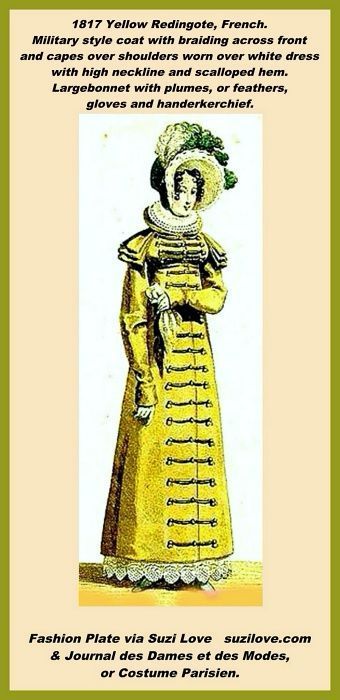
1817 Yellow Redingote, or Pelisse, or Walking Dress, French. Yellow military style pelisse with braiding across the front and capes across the shoulders and worn over a white dress with a high neckline and a scalloped hem. Large and high bonnet with plume, or feathers, and green flowers, gloves and a handkerchief. Although this is a French fashion plate, similar styles were worn everywhere and Jane Austen would have worn a Pelisse like this before her death on the 18th July, 1817. Fashion Plate via Journal des Dames et des Modes, or Costume Parisien.
The ongoing years of wars followed by the victories of Wellington’s armies brought the military into fashion in England and there was a rush of fashion articles named after him e.g. Wellington hat, Wellington bonnet, Wellington jacket and Wellington Boot. In other European countries, military headwear was copied from military helmets and hats and frogging and epaulettes added a further patriotic touch to women’s clothing. And as always, fashions were copied and spread around the world, despite the battles being fought.
Definition Redingote Or Coat Or Pelisse: Long fitted outdoor coat worn over other garments for warmth. French word developed from English words, riding coat. French fashion plates call these coats a Redingote and English plates call them a Pelisse, Or Walking Dress, or Carriage Costume.
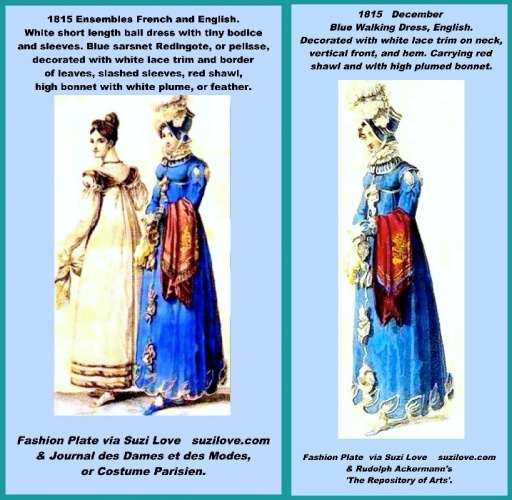
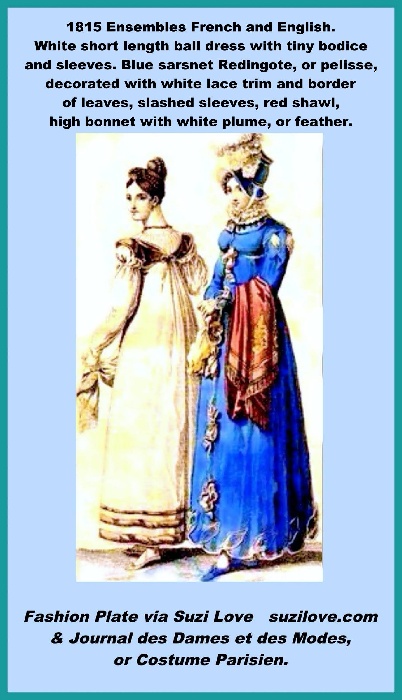
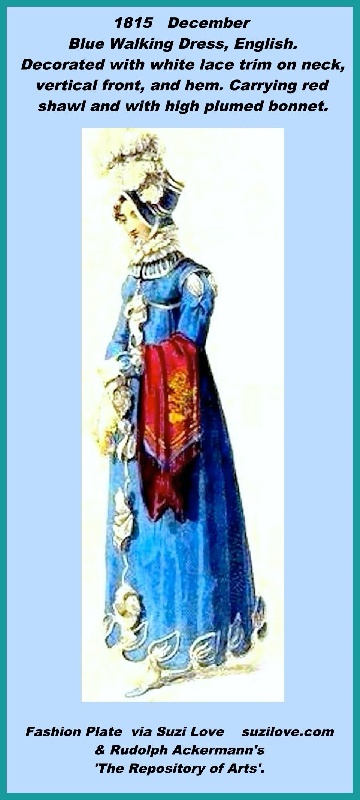
Here is an example of when English magazines copied French fashion plates. 1815 December Left: French fashion plate Ensembles French and English via Journal des Dames et des Modes. White short length ball dress with tiny bodice. Right: English fashion plate by Rudolph Ackermann in the Repository Of arts. Blue sarsnet Pelisse, or Walking dress, or Redingote. Decorated with white lace trim on neck, vertical front, and hem. Carrying red shawl and with high plumed bonnet.
Typical of the outfits worn by Jane Austen and her contemporaries for daytime and evening activities. An Empire style, or high-waisted white dress with jewelry for evening and for daytime a Pelisses or Walking Dress or Redingote or coat for warmth and with pretty hats, shawls and shoes.