↓
 

Suzi Love

Making history fun, one year at a time.

Header_
  • Home
  • Newsletter
  • Pre order form
  • Shop
    • Cart
    • Checkout
    • My account
    • Refund and Returns Policy
  • Blog
  • BOOKS
    • History Events
    • Kelly’s Justice
    • Irresistible Aristocrats
    • History Notes
    • Scandalous Siblings
    • Love After Waterloo
    • Regency Life Series
  • Privacy Policy
  • EVENTS
Home » Suzi Love Research » Page 2 << 1 2

Tag Archives: Suzi Love Research

Post navigation

Next Post→

Are you following my Pinterest Boards? Images galore for history, books, Regency Era, fashion and writing. #JaneAusten #Pinterest #RegencyEra #amreading #Romance

Suzi Love Posted on September 1, 2024 by Suzi LoveAugust 31, 2024

Pinterest Boards By Suzi Love.

I love Pinterest for keeping thousands of historical images in some sort of order. And I love using Pinterest Boards as inspiration for my romance books. What about you? Do you use Pinterest for planning something, or just for fun? Need more hints for what to do with your boards and pins? Take a look at these fascinating articles on Pinterest. if you want even more Pinterest information and tips for becoming a power user, check out my Suzi Love Pinterest Boards

Are you following my Pinterest Boards? Images galore for history, books, Regency Era, fashion and writing. #Regency #books #History
Are you following my Pinterest Boards? Images galore for history, books, Regency Era, fashion and writing. #JaneAusten #Bridgerton #RegencyEra #HistoricalFashion #books https://au.pinterest.com/suziloveoz Share on X

Suzi Love Book Bub
https://www.bookbub.com/profile/suzi-love?list=about
Posted in 1700s, 1800s, 1900s, Bridgerton, Contemporary, Edwardian Era, Events, Georgian Era, History, Jane Austen, Keanu Reeves, People, Places, Regency Era, Romantic Era, Suzi Love, Suzi Love Books, Suzi Love Images, Suzi Love Writing, Victorian Era | Tagged 1800s men fashion, 1800s women's fashion, Bridgerton, fashion accessories, History, Jane Austen, Regency Fashion, Romantic Era Fashion, Suzi Love Books, Suzi Love Event, Suzi Love Images, Suzi Love Research | Leave a reply

When Corsets Saved Lives. #historicalfashion #underclothing #Victorian #Corset

Suzi Love Posted on June 27, 2024 by Suzi LoveJune 27, 2024

When Corsets Saved Lives.

During the Victorian Era, the tight lacing of corsets became known for damaging women’s bodies. However, the whalebone used to stiffen corsets was also a protector of the chest and rib area.

1833 Morning Post: HATTON-GARDEN. ATTEMPTED MURDER. George Bailey, a youth about seventeen, was charged with having attempted to murder Mary Prendergast, a young woman, by stabbing her with a large knife. It appeared in evidence that on Thursday morning, last, about five o’clock, the Prisoner, who sells fish in a basket near Portpool-lane, Leather-lane, Holborn, was standing before his basket when the Prosecutrix asked him the price of his fish. He told her, and she refused to purchase, but laughed at him and jeered him.. . . . In the course of the evening the Prosecutrix was passing by, when the Prisoner rushed upon her with a knife which he uses to cut up the fish and, while in a great passion, he pluinged the knife several times at her heart, and the last thrust the point of the knife dug into her clothes, and would have entered her body had it not been that the bone of her stays prevented it …

1837 The Standard: MARLBOROUGH-STREET. – AN UNNATURAL SON – Alfred Grant, a lad about nineteen years of age, of sullen aspect, was brought before Mr. Dyer, charged with having attempted to stab his own mother . . . James Grant, the brother of the prisoner, about sixteen years of age, said the prisoner came home to Grafton-street, Soho, on Monday afternoon, and some words having ensued between him and his mother, he seized a knife and made a stab at her. Fortunately the bone of his mother’s stays turned the point of the knife …

1841 The Morning Post: Catherine Connor, the person alluded to by the last witness, and who is in a state of pregnancy, deposed that she kept a fruit stall opposite to the Phoenix public-house and that on seeing the young man so savagely treated, she made use of the expersions just named, when Hill called her a ——–, and kicked at her violently. Fortunately for her, she received two of the worse kicks aimed at her on the bone of her stays, otherwise they would, she had no doubt, have proved most serious to her from the situation she was then in.

When Corsets Saved Lives. #historicalfashion #underclothing #Victorian #Corset https://books2read.com/SuziLoveCorsetBook22 Share on X
HN_22_D2D_CorsetBoxedSet
Box Set combining Corset books 14-21 to give a complete picture of the progression of corset styles from 1700 through to the 1900s, including Jane Austen’s lifetime. https://books2read.com/SuziLoveCorsetBook22
Posted in 1800s, 1800s women's fashion, Corset, Victorian Era | Tagged Corset, Jane Austen, Regency Fashion, Suzi Love Research, underclothing, Victorian fashion | Leave a reply

1804 Jane Austen Style London Hairstyles and Gorgeous Gold Hats. #RegencyEra #Hats #JaneAusten

Suzi Love Posted on June 13, 2024 by Suzi LoveJune 10, 2024

1804 London Hairstyles, Gorgeous Gold Hats. via Fashion Plate via Fashions of London and Paris, Published By Richard Phillips, St. Paul’s Church Yard, London, UK.  These styles of hats and hairstyles would have been worn by Jane Austen and her contemporaries as hats were an essential fashion item during the Regency years.

1804 London Hairstyles, Gorgeous Gold Hats. via Fashion Plate via Fashions of London and Paris, Published By Richard Phillips, St. Paul's Church Yard, London, UK.  These styles of hats and hairstyles would have been worn by Jane Austen and her contemporaries as hats were an essential fashion item during the Regency years.
1804 London Hairstyles, Gorgeous Gold Hats. via Fashion Plate via Fashions of London and Paris, Published By Richard Phillips, St. Paul’s Church Yard, London, UK.
1804 Jane Austen Style London Hairstyles and Gorgeous Gold Hats. #RegencyEra #Hats #JaneAusten https://books2read.com/SuziLoveFashionWomen1801-1804 Share on X
HN_25_D2D_Fashion Women 1801-1804 
https://books2read.com/SuziLoveFashionWomen1801-1804
25_D2D_Corset_1790-1810
Posted in 1800s, 1800s women's fashion, England, hats, Jane Austen, London, Regency Era, Suzi Love Images | Tagged 1800s women's fashion, fashion accessories, Fashions Of London and Paris, Hats And Hair, Jane Austen, Regency Era, Regency Fashion, sewing, Suzi Love Images, Suzi Love Research

18th Century Taking Snuff and Pretty Snuff Boxes. #Georgian #Antiques #BritishHistory

Suzi Love Posted on June 6, 2024 by Suzi LoveJune 4, 2024

18th Century Snuff Boxes. Not only were boxes made to serve a purpose, but decorative boxes of all types were prized, especially in the 18th Century when everything decorative and extravagant was in vogue and taking a pinch of snuff was fashionable. Snuff is made from ground or pulverized tobacco leaves and is sniffed from a pinch of snuff placed on the back of the hand. Flavorings were added to the tobacco to give a fast hit of nicotine and a lasting scent. Snuff began in the Americas and was used in Europe by the 17th Century.

Snuff became popular from the mid 1600s to the mid 1800s and was more popular than smoking. Inhaling snuff, or snuffing, was first seen by a European missionary in 1493 in Christopher Columbus’s new world within Haiti’s indigenous Taino. Until then, tobacco had been unknown to Europeans, but its use spread quickly throughout Europe during the 1500s.  By the second half of the 17th century, ornate boxes started being produced to keep the precious powder dry and an entire industry making accessories blossomed around the fashion of taking snuff.  Noblemen, and some women, carried extravagantly decorated snuff boxes with them at all times and would offer a pinch of their own particular blend to friends and family. Therefore, these boxes were always on display and so it became a competition to see who could have the most bejeweled or expensive box possible. books2read.com/suziloveFashMen1700

1770-1771 ca. Gold and Enamel Snuffbox With Three Putti Playing cards. By Nicholas Prevost, Paris, France. via suzilove.com Victoria and Albert Museum, London, UK. collections.vam.ac.uk.
1770-1771 ca. Gold and Enamel Snuffbox
18th Century ca. Gold and Enamel Snuff Box, Europe. Cartouche-form, cover with courtship scene in stylized rococo setting, ground later enameled in translucent colors. via suzilove.com and Christie’s Auction Rooms. christies.com
18th Century ca. Gold and Enamel Snuff Box, Europe.
1759 Gold Snuff Box, English. By John Barbe, London, UK. Jason and the Gold Fleece to King Pelias on lid, sides with picturesque ruins and flowers in rococo scrollwork. via suzilove.com and Sotheby's Auctions. sothebys.com
1759 Gold Snuff Box, English.
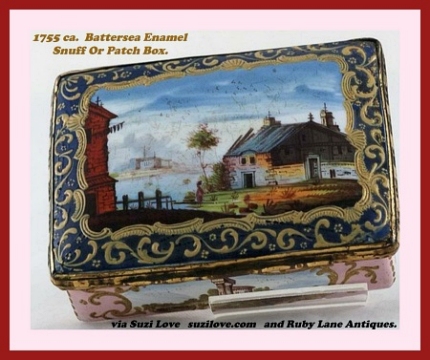
1755 Battersea Enamel Snuff Or Patch Box. via suzilove.com and Ruby Lane Antiques. rubylane.com
1755 Battersea Enamel Snuff Or Patch Box.
1754-1755 ca. Gold Snuffbox, French. Engine-turned overall with undulating ribbons, for two types of powdered tobacco, By Jean Ducrollay, 1754-1755, Paris, France. via suzilove.com Victoria and Albert Museum, London, UK. collections.vam.ac.uk.
1754-1755 ca. Gold Snuffbox, French.
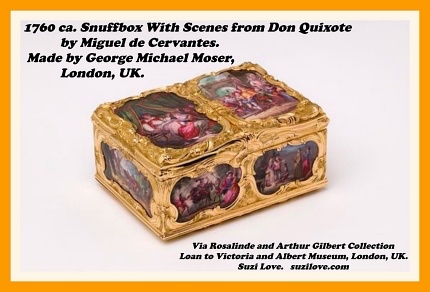
1760 ca. Snuffbox With Scenes from Don Quixote by Miguel de Cervantes, George Michael Moser, London via suzilove.com Victoria and Albert Museum, London, UK. collections.vam.ac.uk.
1760 ca. Snuffbox With Scenes from Don Quixote
1760 ca. Gold Mounted Lapis Lazuli Snuff Box with Shell Inlays, probably Dresden, Germany. By Heinrich Taddel. museum no. Loan-Gilbert.404-2008 suzilove.com
1760 ca. Gold Mounted Lapis Lazuli Snuff Box
1700s Portrait Miniature Snuff Box of Gold and Tortoiseshell, French. via suzilove.com and 1st Dibs Auctions 1stdibs.com
1700s Portrait Miniature Snuff Box of Gold and Tortoiseshell
1750 ca. Carved Agate Snuffbox, Germany. via suzilove.com Victoria and Albert Museum, London, UK. collections.vam.ac.uk.
1750 ca. Carved Agate Snuffbox, Germany.
1749-1750 ca. Double Snuff Box, French. By Jean Ducrollay (French, born 1709, master 1734, recorded 1760) Paris. via suzilove.com and Metropolitan Museum New York City, U.S.A. metmuseum.org
1749-1750 ca. Double Snuff Box, French.
1728-1729 ca. Snuffbox With Dolphin and Ship, Paris, France. via suzilove.com Victoria and Albert Museum, London, UK. collections.vam.ac.uk.
1728-1729 ca. Snuffbox With Dolphin and Ship,
18th Century Taking Snuff and Pretty Snuff Boxes. #Georgian #Antiques #BritishHistory books2read.com/suziloveFashMen1700 Share on X
RL_2_D2D_RetailerBuyLink_RL_2
RL_2_D2D_RetailerBuyLink_RL_2 https://books2read.com/suziloveYGD
Posted in 1700s, art, Box Or Container, Customs & Manners, Decorative Item, England, Europe, Georgian Era, History, Suzi Love Images, U.S.A | Tagged 1700s Or Georgian Era, antiques, art, Box Or Container, decorative, Georgian era, snuff, Suzi Love Images, Suzi Love Research

1800 ca. Pair of Flintlock Duelling Pistols Owned by Captain William Waller (active 1794-1807) #Regency #Weapon #JaneAusten #duel

Suzi Love Posted on March 28, 2024 by Suzi LoveMarch 27, 2025

1800 ca. Pair of Flintlock Duelling Pistols. Owned by Captain William Waller (active 1794-1807). Walnut stock, chequered grips, rounded butts, fitted with two silver pipes containing ramrods. Silver trigger guards engraved and end in pineapple shaped finials, each with flintlock containing flints. Lock plates engraved with leaf design, octagonal barrels browned with narrow gold bands near lock. via Royal Museums Greenwich collections.rmg.co.uk

During the Regency Era and Jane Austen’s writing years, dueling was illegal, although secret duels still happened. Courts were made up of peers and they rarely charged another peer for anything illegal. Honor and gentlemanly behavior were the most important things to men so if there was an offense committed, a dawn duel was arranged with seconds to check the weapons used and a doctor in case of injuries.

1800 ca. Pair of Flintlock Duelling Pistols. Owned by Captain William Waller (active 1794-1807). Walnut stock, chequered grips, rounded butts, fitted with two silver pipes containing ramrods. Silver trigger guards engraved and end in pineapple shaped finials, each with flintlock containing flints. Lock plates engraved with leaf design, octagonal barrels browned with narrow gold bands near lock. via Royal Museums Greenwich collections.rmg.co.uk
1800 ca. Pair of Flintlock Duelling Pistols Owned by Captain William Waller (active 1794-1807) #Regency #Weapon #JaneAusten #duel https://books2read.com/suziloveYGD Share on X
RL_2_D2D_RetailerBuyLink_RL_2
RL_2_D2D_RetailerBuyLink_RL_2 https://books2read.com/suziloveYGD
RL_1_D2D_Regency Overview RetailerLinks
https://books2read.com/suziloveROver
RL_1_D2D_Regency Overview RetailerLinks https://books2read.com/suziloveROver
Posted in 1800s, Customs & Manners, England, History, Jane Austen, Pastimes, Regency Era, Suzi Love Images, weapons | Tagged duelling, Jane Austen, London, Pistols, Regency Life, Regency Men, Royal Museums Greenwich, Suzi Love Images, Suzi Love Research, weapons
corset_1770-1790 ca. Collage View. Pink Silk Damask Stays, Or Corset, English. via Victoria and Albert Museum, London, UK. collections.vam.ac.uk.

1770-1790 Pink Silk Damask Stays, Or Corset, English. #Georgian #Corset #BritishHistory

Suzi Love Posted on October 6, 2023 by Suzi LoveAugust 11, 2023

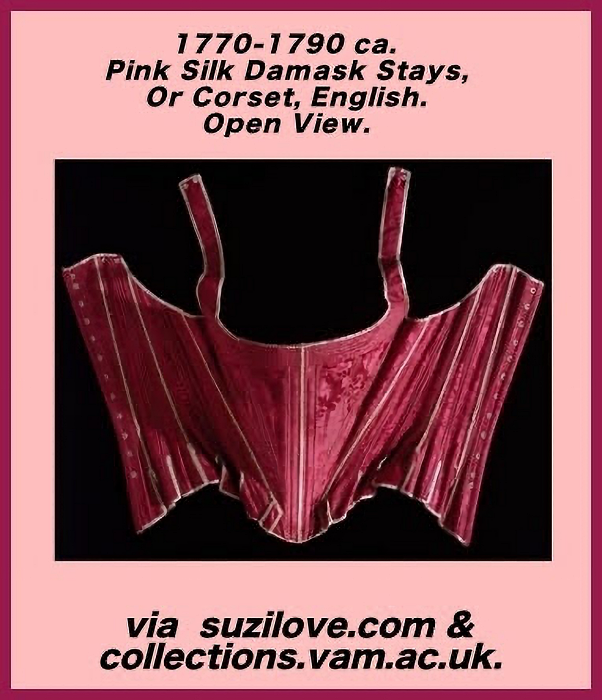
1770-1790 ca. Stays, or Corset, English. Pink silk damask, lined with linen, reinforced with whalebone, fingers spread over hips. via Victoria and Albert Museum, London, UK. collections.vam.ac.uk. https://books2read.com/SuziLoveCorsetBook15

corset_1770-1790 ca. Front View. Pink Silk Damask Stays, Or Corset, English. via Victoria and Albert Museum, London, UK. collections.vam.ac.uk.
1770-1790 ca. Front View. Pink Silk Damask Stays, Or Corset, English. via Victoria and Albert Museum, London, UK. collections.vam.ac.uk.
corset_1770-1790 ca. Side View. Pink Silk Damask Stays, Or Corset, English. via Victoria and Albert Museum, London, UK. collections.vam.ac.uk.
1770-1790 ca. Side View. Pink Silk Damask Stays, Or Corset, English. via Victoria and Albert Museum, London, UK. collections.vam.ac.uk.
corset_1770-1790 ca. Back View. Pink Silk Damask Stays, Or Corset, English. via Victoria and Albert Museum, London, UK. collections.vam.ac.uk.
1770-1790 ca. Back View. Pink Silk Damask Stays, Or Corset, English. via Victoria and Albert Museum, London, UK. collections.vam.ac.uk.
corset_1770-1790 ca. Open View. Pink Silk Damask Stays, Or Corset, English. via Victoria and Albert Museum, London, UK. collections.vam.ac.uk.
1770-1790 ca. Open View. Pink Silk Damask Stays, Or Corset, English. via Victoria and Albert Museum, London, UK. collections.vam.ac.uk.
corset_1770-1790 ca. Side and Back Views. Pink Silk Damask Stays, Or Corset, English. via Victoria and Albert Museum, London, UK. collections.vam.ac.uk.
1770-1790 ca. Side and Back Views. Pink Silk Damask Stays, Or Corset, English. via Victoria and Albert Museum, London, UK. collections.vam.ac.uk.
corset_1770-1790 ca. Collage View. Pink Silk Damask Stays, Or Corset, English. via Victoria and Albert Museum, London, UK. collections.vam.ac.uk.
1770-1790 ca. Collage View. Pink Silk Damask Stays, Or Corset, English. via Victoria and Albert Museum, London, UK. collections.vam.ac.uk.
1770-1790 Pink Silk Damask Stays, Or Corset, English. #Georgian #Corset #BritishHistory
1770-1790 Pink Silk Damask Stays, Or Corset, English. #Georgian #Corset #BritishHistory https://books2read.com/SuziLoveCorsetBook15 Share on X
HN_15_D2D_Corsets 1700-1790
https://books2read.com/SuziLoveCorsetBook15
HN_15_D2D_Corsets 1700-1790 https://books2read.com/SuziLoveCorsetBook15
Posted in 1700s, 1700s Womens Fashion, Corset, England, Georgian Era, Georgian Fashion, Jane Austen, Suzi Love Images, underclothing | Tagged 1700s Women's Fashion, British history, Corset, Georgian Fashion, Jane Austen, Suzi Love Images, Suzi Love Research, underclothing, Victoria and Albert Museum
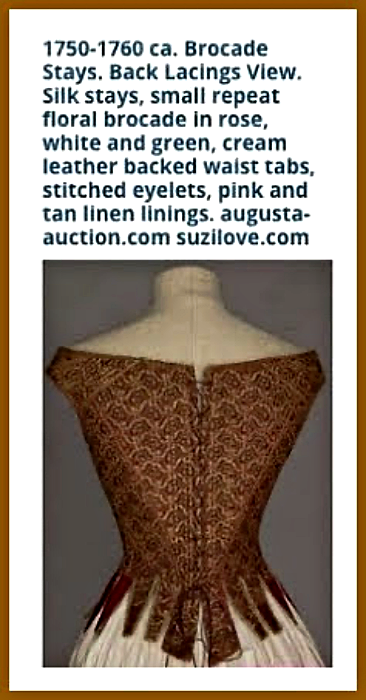
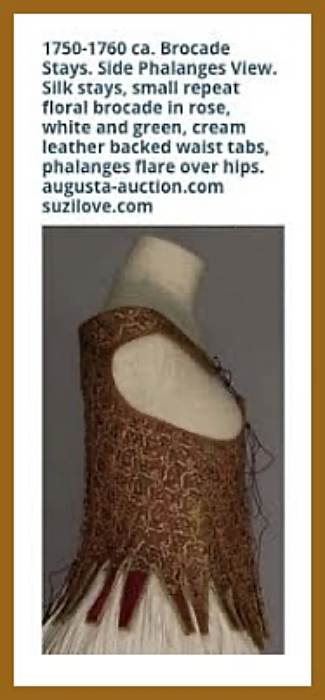
1750-1760 ca. Brown Silk Brocade Stays With Front and Back Lacings. Collage View. via Augusta Auctions. augusta-auction.com

1750-1760 ca. Brown Silk Brocade Stays With Both Front and Back Lacings #Georgian #History #Corset

Suzi Love Posted on October 1, 2023 by Suzi LoveAugust 11, 2023

1750-1760 ca. Brown Silk Brocade Stays With Both Front and Back Lacings. 

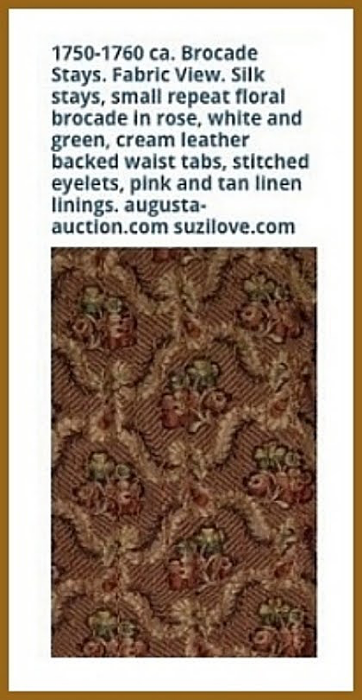
These silk stays have a small repeat floral brocade in rose, white, and green. There are cream, leather-backed waist tabs, stitched eyelets, and pink and tan linings.  These stays, or corset, are unusual because they have both front and back lacings.  This means that a lady could step in and out of her stays and then tighten the front lacing herself, thereby eliminating the need for assistance from a  maid or dresser. 

Women of the middle and lower classes needed to be able to dress themselves as they have no one to assist in tightening their lacings when they dressed. Most upper class ladies would be able to call upon a maid to help and would therefore generally use back lacing stays.

corset_1750-1760 ca. Brown Silk Brocade Stays With Front and Back Lacings. Front Lacing View. via Augusta Auctions. augusta-auction.com
1750-1760 ca. Brown Silk Brocade Stays With Front and Back Lacings. Front Lacing View. via Augusta Auctions. augusta-auction.com
corset_1750-1760 ca. Brown Brocade Stays With Front and Back Lacings_via Augusta Auctions. augusta-auction.com
1750-1760 ca. Brown Brocade Stays With Front and Back Lacings. Back Lacing View. via Augusta Auctions. augusta-auction.com
corset_1750-1760 ca. Brown Silk Brocade Stays With Front and Back Lacings. Side View. via Augusta Auctions. augusta-auction.com
1750-1760 ca. Brown Silk Brocade Stays With Front and Back Lacings. Side View. via Augusta Auctions. augusta-auction.com
1750-1760 ca. Brown Silk Brocade Stays With Front and Back Lacings. Eyelet View. via Augusta Auctions. augusta-auction.com
corset_1750-1760 ca. Brown Silk Brocade Stays With Front and Back Lacings. Fabric View. via Augusta Auctions. augusta-auction.com
1750-1760 ca. Brown Silk Brocade Stays With Front and Back Lacings. Fabric View. via Augusta Auctions. augusta-auction.com
1750-1760 ca. Brown Silk Brocade Stays With Both Front and Back Lacings #Georgian #History #Corset https://books2read.com/SuziLoveCorsetBook15 Share on X
HN_15_D2D_Corsets 1700-1790
https://books2read.com/SuziLoveCorsetBook15

Corsets 1700-1790  History Notes Book 15
By Suzi Love ~ Award Winning Writer and Researcher.
https://books2read.com/SuziLoveCorsetBook15
Posted in 1700s, 1700s Womens Fashion, Corset, England, Europe, Georgian Era, Georgian Fashion, Suzi Love Images, underclothing | Tagged 1700s Women's Fashion, Augusta Auctions, Corset, Georgian Fashion, Suzi Love Images, Suzi Love Research, underclothing

Claridge’s Hotel, Mayfair, London, U.K. London’s Historic Places. #London #BritishHistory #ClaridgesHotel #travel

Suzi Love Posted on August 27, 2023 by Suzi LoveAugust 7, 2023

Claridge’s Hotel – London’s Historic Places Claridge’s was founded in 1812, during the Regency Era, as Mivart’s Hotel at 51 Brook Street, Mayfair, London, UK.
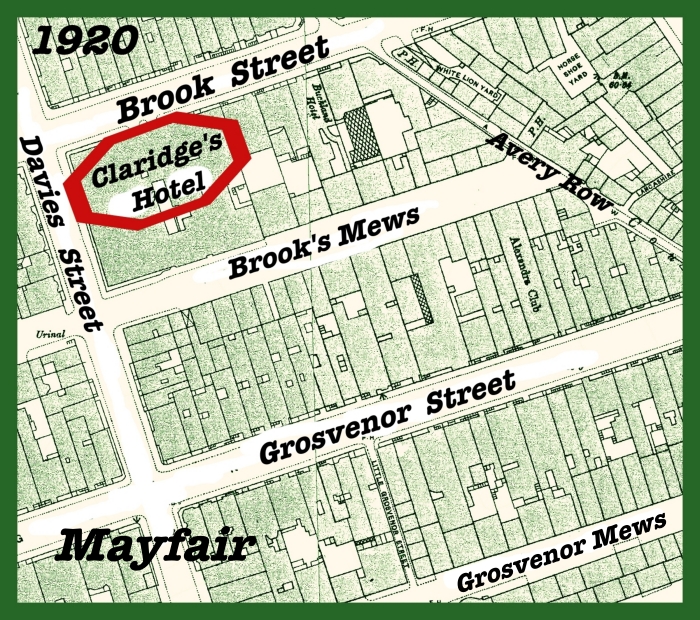
Claridge's 1920 Hotel Map, London, U.K

Lord William Beauclerk leased the terrace house from the Grosvenor Estate with permission to turn it into a hotel run by James Edward Mivart, the anglicized name for French chef Jacques Mivart.  By 1838, the hotel grew to buy five consecutive houses along Brook Street, knocking down the walls to create one large hotel and Mivart prospered by introducing English county families to subtle French cooking to replace their traditional stodgy fare. Mivart designed the hotel for guests who wished to stay longer, so apartments were let by the month to foreign royalty and nobility who enjoyed the ambiance of the well-run hotel yet had the privacy of their own suites. The Prince Regent, who succeeded to the throne as King George IV in 1820, had a suite of rooms permanently reserved for him so he could discreetly carry on his playboy lifestyle. 

Claridges_Red Brick Claridge's Hotel, London, U.K.

In 1827, The Morning Post noted that Mivart’s was the fashionable rendezvous for the high Corps Diplomatique. In 1854, the hotel was sold to Mr and Mrs Claridge who ran a separate hotel at 49 Brook Street. They combined the two operations to trade as “Mivart’s at Claridge’s” until, after Mivart’s death, the hotel changed its name to Claridge’s in 1856, adding “late Mivart’s” underneath. 

In 1860, Queen Victoria and Prince Albert visited the Empress Eugènie of France, who had made Claridge’s her winter quarters, and Queen Victoria was so impressed that she wrote to her uncle, Leopold I, King of the Belgians, in glowing terms of Claridge’s. The hotel became so connected to royalty it was called an “extension to Buckingham Palace”.including the Grand Duke Alexander of Russia and King William III of the Netherlands, until by 1853, The Times decided London had just three first-class hotels- Mivart’s, The Clarendon in Bond Street and Thomas’s in Berkeley Square.

In 1881, William Claridge’s failing health forced them to sell to a consortium, but the hotel consisted of several private houses and couldn’t be upgraded to compete with purpose built hotels cropping up all over London. The Savoy for example, built in 1889, offered lifts to all floors, electricity, en suite bathrooms and the best chef in Europe, Auguste Escoffier.  So in 1894, Richard D’ Oyly Carte, founder of the rival Savoy Hotel, purchased Claridge’s and commissioned CW Stephens, designer of Harrods, to rebuild the hotel from the ground up. The new Claridge’s opened in November 1898. 

Claridges_1897 Claridge's Hotel, Mayfair, London, U.K. A perspective view of the new building showing the front entrance in Brook Street and the return front in Davies Street. Drawn by C. W. Stephens, architect.

1897 Claridge’s Hotel, Mayfair, London, U.K. A perspective view of the new building showing the front entrance in Brook Street and the return front in Davies Street. Drawn by C. W. Stephens, architect.

After World War I, Claridge’s flourished due to demand from aristocrats who no longer maintained a London house and Carte’s son, Rupert D’ Oyly Carte, added a new extension. During World War II, Peter II of Yugoslavia and his wife spent their exile at Claridge’s until on 17th June 1945, suite 212 was ceded by the UK to Yugoslavia for a single day to allow their heir, Crown Prince Alexander, to be born on Yugoslav soil.

Claridges_Travel Poster for Claridge's Hotel, London, U.K.
Claridges_Portrait of Mrs. Marianne Claridge.
Claridge's Hotel, London, U.K.

Claridge's Hotel Dining Room.
Claridge's Hotel Foyer
Claridges_2007 December. Claridge's Entrance At Christmas.
Claridge's Hotel, Mayfair, London, U.K. London's Historic Places. #London #BritishHistory #ClaridgesHotel #travelhttps://books2read.com/suziloveROver Share on X
RL_1_D2D_Regency Overview RetailerLinks
https://books2read.com/suziloveROver
RL_1_D2D_Regency Overview RetailerLinks https://books2read.com/suziloveROver
Posted in Suzi Love | Tagged London, Regency London, Suzi Love Images, Suzi Love Research, travel

Wedding ring customs that originated in long ago history. #weddings #Customs #history

Suzi Love Posted on June 2, 2022 by Suzi LoveMay 15, 2022

Wedding ring customs that originated in long ago history.

The first wedding rings can be traced back to the Ancient Egyptians when they exchanged rings made from braided reeds and hemp. The tradition of exchanging rings dates back 3,000 years. The first diamond wedding ring was recorded in the will of a widow who died in 1417. The ancient Egyptians believed in the vena amoris, literally the “vein of love” that runs directly from the heart to the fourth finger on the left hand. For the Ancient Greeks, the engagement ring was symbolized with a plain gold band worn on the left hand and at the marriage the same band was shifted to the right hand.

An engagement ring is given at a proposal or when a couple decides to get married whereas a wedding ring is exchanged at the wedding ceremony and represents the official bond of marriage and the binding pledge between spouses. Wedding rings symbolise eternal love and commitment within a relationship and are worn to show the world they are married. During the wedding service, the couple will say their vows to each other while exchanging rings.

Is a wedding ring biblical? : The use of wedding ring is not commanded in the Bible, and there is no indication that it was ever practised in the New Testament. The use of finger ring in the Bible was as a symbol of authority.

Betrothal ring: An old Roman custom confirming that the marriage contract would be carried out. It was the first part of a dowry given, and meant the woman was no longer for sale as the first part of the monetary settlement had been paid. The first betrothal, or engagement, rings were given because there was often a long time between betrothals and weddings. These were usually simple bands of gold, silver, or iron as on royalty or very wealthy people could afford gemstones and diamonds. In 1477, Archduke Maximillian of Austria commissioned the very first diamond engagement ring for his betrothed, Mary of Burgundy, and many of the European aristocracy and nobility followed his lead.

Wedding ring: Many primitive peoples who believed in magic used a rope around the waist or the hand and feet, and later  a ring, to symbolise that the bride was captured and spoken for, and also to ward off any evil spirits hovering around the bride and ensure marital bliss.

The ring hand: A symbol of the humiliating tradition of the man as the master – the right hand of the family –  and the woman being the slave .  The right hand stood for power and authority while the left hand expressed submission and serfdom.

The ring finger : Ancient Greek and Roman anatomists  believed a vein, the vena amoris or the “vein of love”, or a nerve led from the heart to the third finger, the healing finger , so they romantically linked this finger to the heart. Now we know that this is not true and there is no vein that runs from our ring fingers to our hearts. There are also some more practical reasons the third finger continues to be used. It’s the most prominent for displaying a ring and it cannot be extended to its full length on its own and usually remains slightly bent, preventing the ring slipping off.

The Wedding Ring: Also goes on the left ring finger because it is the only finger with a vein that connects to the heart although some countries, such as India, Germany, Spain, Norway, and Russia traditionally wear their wedding rings on their right hand.

Viking Wedding Rings: These were mostly made of silver and bronze and rarely of gold with the designs inspired by Norse Gods, geometric shapes, runes, and animal totems

Gimmel Rings: In the 16th and 17th centuries, European husbands gave their bride a gimmel ring with two interlocking bands. The bride and groom both wore one after their engagement and during the wedding ceremony the rings were joined and the wife wore the ring.

World Wars: During the first World War, many men on the front began wearing wedding rings as a remembrance of their wives and families at home. That custom carried through to World War Two so in the 1950s wedding rings for men became common practice.

Tri-Gold Rings: Gold is the traditional ring metal but some people prefer a mix of colors. Yellow gold represents fidelity, rose gold romantic love, and white gold friendship, so a tri-gold ring symbolizes your shared past, present, and future path. ding ring to symbolize all three, as well as your shared past, present, and future path.

Black Wedding Rings: Some couples choose black wedding bands because they represent everlasting commitment and the color can also mean power, strength and sophistication.

Anniversary or Push Ring: Given on the birth of a first child or an anniversary, usually an important one such as the first, five-year or 10-year anniversary.

Wedding ring customs that originated in long ago history. #weddings #Customs #history Share on X
Posted in 1700s, 1800s, 1900s, Australia, Canada, Customs & Manners, Decorative Item, Edwardian Era, England, Europe, Georgian Era, Regency Era, Romantic Era, South Pacific, Suzi Love Images, U.S.A, Victorian Era, weddings | Tagged British history, Customs and Traditions, Georgian era, Regency Era, Regency Life, Romantic Era, Suzi Love Research, Victorian Era, weddings | Leave a reply

Post navigation

Next Post→

SUBSCRIBE TO SUZI LOVE'S NEWSLETTER.

Recent Posts

  • 18th-20th Centuries The Bath Assembly Rooms in Jane Austen and Bridgerton years. #bridgerton #JaneAusten #RegencyEra #Bath
  • 1810 ca. Full Dress Jacket, East Lothian Yeomanry British Cavalry Uniform, as worn in Jane Austen times. #JaneAusten #RegencyEra #Military #BritishHistory
  • Book Hooks: Earl of Winchester has no time for mad scientist Lady Jamison yet when he’s with her, desire explodes. #HistoricalMystery #RomCom #VictorianRomance #RegencyRomance
  • 1826 Chaos In The Household from Regency Family Life. #RegencyEra #Cartoon #England
  • 1810 Jane Austen Era Man’s Cotton Waistcoat, Or Vest. #RegencyEra #HistoricalFashion #JaneAusten

Recent Comments

  1. Suzi Love on Book Hooks: Earl of Winchester has no time for mad scientist Lady Jamison yet when he’s with her, desire explodes. #HistoricalMystery #RomCom #VictorianRomance #RegencyRomance
  2. Suzi Love on Book Hooks: Earl of Winchester has no time for mad scientist Lady Jamison yet when he’s with her, desire explodes. #HistoricalMystery #RomCom #VictorianRomance #RegencyRomance
  3. Maggie Blackbird on Book Hooks: Earl of Winchester has no time for mad scientist Lady Jamison yet when he’s with her, desire explodes. #HistoricalMystery #RomCom #VictorianRomance #RegencyRomance
  4. Suzi Love on Book Hooks: Earl of Winchester has no time for mad scientist Lady Jamison yet when he’s with her, desire explodes. #HistoricalMystery #RomCom #VictorianRomance #RegencyRomance
  5. Jana Richards on Book Hooks: Earl of Winchester has no time for mad scientist Lady Jamison yet when he’s with her, desire explodes. #HistoricalMystery #RomCom #VictorianRomance #RegencyRomance

Login

  • Log in

Archives

  • April 2026
  • March 2026
  • February 2026
  • January 2026
  • December 2025
  • November 2025
  • October 2025
  • September 2025
  • August 2025
  • July 2025
  • June 2025
  • May 2025
  • April 2025
  • March 2025
  • February 2025
  • January 2025
  • December 2024
  • November 2024
  • October 2024
  • September 2024
  • August 2024
  • July 2024
  • June 2024
  • May 2024
  • April 2024
  • March 2024
  • February 2024
  • January 2024
  • November 2023
  • October 2023
  • September 2023
  • August 2023
  • July 2023
  • June 2023
  • May 2023
  • April 2023
  • March 2023
  • February 2023
  • June 2022
  • April 2022
  • March 2022

Categories

  • 1700s
  • 1700s Mens fashion
  • 1700s Womens Fashion
  • 1800s
  • 1800s Mens Fashions
  • 1800s women's fashion
  • 1900s
  • art
  • Australia
  • Bath
  • bedroom fashion
  • Book Hooks
  • Box Or Container
  • Bridgerton
  • Bus Trips
  • Canada
  • Carriage
  • cartoon
  • Celebrity
  • Chatelaine
  • children
  • Children
  • Christmas
  • Coat or Pelisse Or Redingote
  • Contemporary
  • Corset
  • Couple
  • Customs & Manners
  • dancing
  • December Scandal
  • Decorative Item
  • Dress Or Robe
  • Easter
  • Edwardian Era
  • Embracing Scandal
  • England
  • Ester In Images
  • Europe
  • Events
  • Fashion
  • fashion accessories
  • Food and Drink
  • Four Times A Virgin
  • France
  • furniture
  • Georgian Era
  • Georgian Fashion
  • Google Books
  • Grand Tour
  • Group
  • hats
  • History
  • History Events
  • History Notes
  • History Of Christmases Past
  • household
  • Hygiene
  • Irresistible Aristocrats
  • Jane Austen
  • Keanu Reeves
  • Kellys Justice
  • Legal
  • London
  • Love After Waterloo
  • Loving Lady Katharine
  • medical
  • military
  • money
  • mourning
  • Music
  • Outback Arrival
  • pants
  • Pastimes
  • peerage
  • People
  • Petunia and Pearl Diver
  • Places
  • Pleasure House Ball
  • postal
  • Queensland
  • Quotations
  • Regency Era
  • Regency Fashion
  • Regency Life Series
  • Reticule or Bag
  • riding
  • Romantic Era
  • Royalty
  • Russia
  • Scandalous Siblings Series
  • Scenting Scandal
  • Self Publishing
  • sewing
  • Shirt
  • shoes
  • South Pacific
  • Spencer
  • sports
  • Suit
  • Sunday Snippet
  • Suzi Love
  • Suzi Love Books
  • Suzi Love Images
  • Suzi Love Writing
  • Swain Cove
  • THe Viscount's Pleasure House
  • travel
  • U.S.A
  • underclothing
  • Vest or Waistcoat
  • Victorian Era
  • Victorian Fashion
  • weapons
  • weddings
  • Writing Tools

1800s men fashion 1800s women's fashion antiques Bridgerton British history Cartoons Corset cravat decorative Dress Or Gown England europe fashion accessories Fashion Plate France Georgian era Georgian Fashion gloves google books Hats And Hair historical romance History Notes household Jane Austen jewelry Journal des Dames et des Modes London Metropolitan Museum NYC pants Redingote Or Pelisse Or Coat Regency Era Regency Fashion Regency London reticule or bag riding sewing shawls Shoes Suzi Love Books Suzi Love Images Tailcoat The Repository Of Arts underclothing Vest or Waistcoat Writing Tools

©2026 - Suzi Love - Weaver Xtreme Theme Privacy Policy
↑