1821 December Green Promenade Dress, English. High waisted coat over white dress with ruffled collar, vertical front bows, short puffed sleeves over long straight sleeves, matching ruffled bonnet and yellow gloves. Fashion Plate via Rudolph Ackermann’s ‘The Repository of Arts’, London, U.K.
Love the Bridgerton Series? Fan of Jane Austen? What did men wear in the early 1800s? Suits, hats, shoes, underclothing, military and bedroom fashions. #Bridgerton #RegencyFashion #JaneAusten #BritishHistory.
The Regency Era saw a wide variety of acceptable pants for men. Breeches were worn as part of a man’s daily outfit during the early 1800s and were necessary for formal occasions, such as court appearances, during the entire Regency Era. However, younger gentlemen moved away from breeches for daytime wear around 1807 and adopted a variety of long pants called trousers, pantaloons, buckskins or inexpressables. Knee-length breeches, worn with stockings, continued to be worn by older gentlemen through the entire Regency Era.
Around 1807, upper class gentlemen wore trousers held up by suspenders or pantaloons, which were closely fitted and worn with tall boots. Buckskins, made from deerskin, were comfortable to wear for riding. Inexpressibles were very tight leggings that left little to the imagination of young ladies. Every Regency man’s outfit included a hat, gloves, shoes or boots, and a selection of added accessories from a walking stick, watch on a chain, fobs, coin purse and a handkerchief.
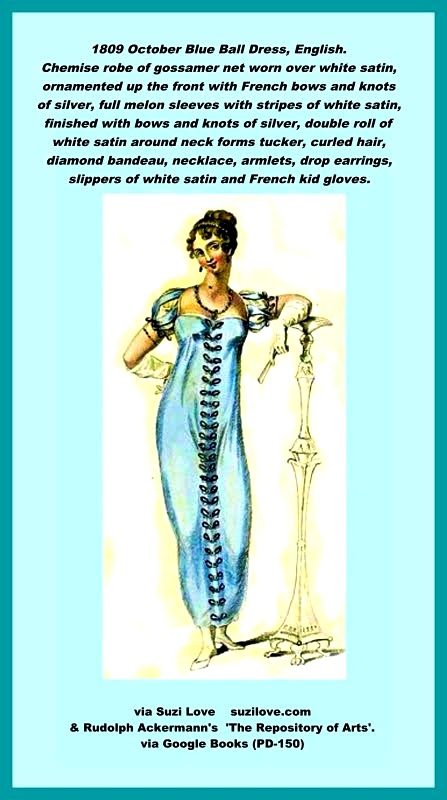
1809 October Blue Ball Dress, English. A light blue, or grey chemise robe, of gossamer net, imperial crape, worn over white satin, ornamented up the front with French bows and knots of silver. A full melon sleeve, formed of the same material as the dress, and alternate stripes of white satin, finished with bows and knots of silver. A double roll of white satin around the neck by way of a tucker. Hair falling in natural and irregular curls on the forehead, confined in a bow and curled ends, or in plaited braids, at the back of the head with a diamond comb. Diamond bandeau, with necklace, armlets, and drop earrings of the same. Slippers of white satin, with silver clasps, French kid gloves, just escaping the elbow. Fan of carved ivory. Fashion Plate via Rudolph Ackermann’s ‘The Repository of Arts’.
Definition Bandana Or Bandeau: Narrow strip or band worn around head to confine hair. Made of either twisted fabric, length of pearls, flowers, jewels or feathers. From the French word for “strip.
1817 December Black Walking Mourning Dress, English. Black bombazine dress with a black crepe hem, with tight bodice wrapping across to the right side, trimmed with a piping of black crape that looks like braiding and finished by rosettes of crape, in the center of each of which is a small jet ornament. Long sleeves trimmed similarly at the wrists, half-sleeve of a new form trimmed with crape, high standing collar displaying a mourning ruff. Claremont bonnet, named because it is the same shape as one worn by the Princess, whose home with her husband, Prince Leopold, was called Claremont. Black crape over black sarsnet and lined with double white crape. Low crown but large front and tastefully finished by black crape with a bunch of crape flowers on one side. Black shamois gloves, and black shoes. “We have again to acknowledge our obligations to the lady who favored us last month; and we understand that the dresses from which our prints this month have been taken were also purchased from Mrs. Bell of St. James’s-street.” Fashion Plate via Rudolph Ackermann’s ‘The Repository of Arts’.
Mrs. Bell ‘invented’ fashion plates and as well as publishing in La Belle assemblee, she also sold them to other magazines. Hence the crossover we often see where the same plate, or a similar version, appears in different magazines.
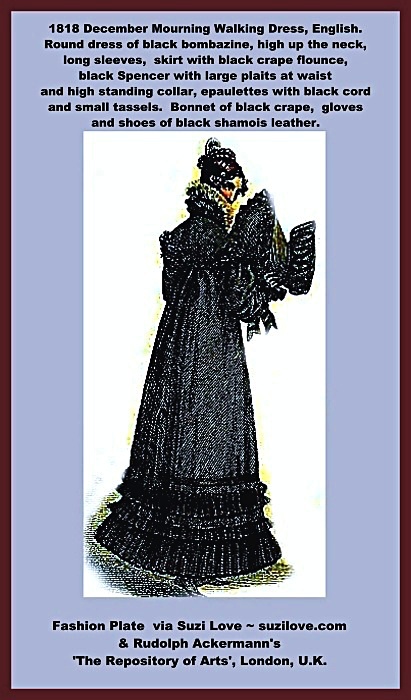
1818 December Mourning Walking Dress. Round dress of black bombazine, body tight to the shape and up to the throat but without a collar, long sleeves, with white crape weepers, skirt is finished at the bottom with a broad black crape flounce, disposed in large plaits. Over this is a very narrow flounce, which is also plaited to correspond; a little above this is a third flounce, which is quilled in the middle to correspond, and the whole is surmounted by a broad band of bias crape. The spencer worn with this dress is composed of black clothing; it is cut without a seam, and ornamented with a fullness of black crape, disposed in large plaits at the bottom of the waist: a high standing collar rounded in front, made to stand out from the neck, and edged with a light trimming of black crape: long loose sleeves, finished at the hands with black crape trimming, and surmounted by epaulettes draperied with black cord and ornamented with small tassels. Head-dress, a bonnet of black crape of a moderate size; the edge of the brim is finished with a row of large hollow plaits; the crown is trimmed to correspond. A white crape frill stands up round the throat. Gloves and shoes black shamois leather. Fashion Plate via Rudolph Ackermann’s ‘The Repository of Arts’, London, U.K.
1811 January Walking Dress, or Pelisse, English. Jane Austen and her contemporaries wore long coats like these to keep warm when out and about, visiting, shopping etc. Their thin muslin dresses worn in the early 1800s were little protection against European winters.
Round high morning robe of cambric with deep full-trimmed collar. Swedish coat of velvet, trimmed with swansdown or blue fox fur. Spanish pelerine of the same, fastened in front of the throat with a mother-of-pearl brooch, clasps to correspond for the bottom of the waist. Traveller’s, or slouch, hat of velvet turned up with shell ornament, half-boots of grey cloth, laced and bound with black velvet. Chinese ridicule, or reticule, or bag, of grey satin, embellished with black medallions and tassels. Gold chain and eye-glass, or quizzing glass.. Fashion Plate via Rudolph Ackermann’s ‘The Repository’ of Arts.
Definition Redingote Or Coat Or Pelisse Or Walking Dress: Long fitted outdoor coat worn over other garments for warmth. French word developed from English words, riding coat. French fashion plates call these coats a Redingote and English plates call them a Pelisse, Or Walking Dress, or Carriage Costume. For more of these, try my book on Pelisses, History Notes Book 5 . books2read.com/suzilovePelisse
Definition Swansdown: Fine down of a swan, used for trimmings on clothing and for making powder puffs.
Definition Velvet or Velour: Silk with short, dense and smooth pile produced by pile warp raised in loops above ground weave through introduction of rods during the weaving.
Definition Ridicule, Reticule, Indispensable, or Handbag: From the late 1700s, pockets could no longer be sewn into gowns nor could separate pockets be tied around their waists and accessed by slits in the gown and petticoats, as skirts fell from just under the bust and were full and flowing. Instead, women began carrying small bags, known at first as ridicules and later as reticules, to keep necessary items on their person e.g. handkerchiefs, coins, vinaigrettes, calling cards, glasses etc. For more on reticules, try my History Notes book 3 http://books2read.com/suziloveReticules
1812 June Green Riding Dress, English. Fashion Plate via Rudolph Ackermann’s ‘The Repository of Arts’. This riding habit was probably made in two pieces. It has a vertical front decoration and is embroidered with black at the cuffs à la militaire. The small riding hat from black beaver is adorned with gold cordon and tassels and with a long ostrich feather of green in the front, or a green hat with black tassels and black feather. Black half boots, laced and fringed with green, York tan gloves, and riding crop. When this dress is worn as a carriage or walking costume, it is made as a pelisse without the riding jacket, and confined round the waist by a fancy belt of black and green. This habit was made by Mr. S. Clark, 37 Golden Square.” Riding habits and accessories were generally the only ladies’ clothing made by tailors rather than dressmakers.
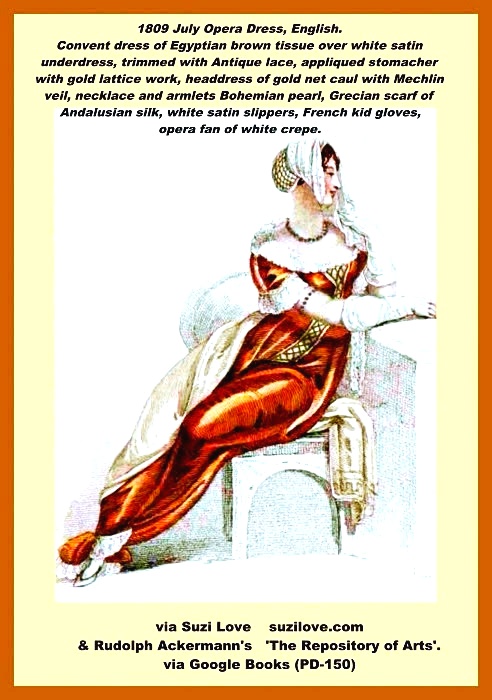
1809 July Opera Dress. I can picture aristocratic women wearing this sort of gorgeous outfit to the opera or an evening event.
Round convent robe of Egyptian brown tissue worn over white satin underdress, ornamented at feet, bosom and sleeves with broad Antique lace, out on full, and narrowing in front, white satin appliqued stomacher embellished with gold lattice work and continued in a straight line down to the hem. Headdress is a gold net caul, enclosing the hair at the back and finished in front with a Mechlin veil displaying the hair on the forehead and falling over the left shoulder. Necklace and armlets are a single row of Bohemian pearl with topaz or diamond snaps. Grecian scarf of rich Andalusian silk, contrasted with the robe and wrought at the ends in a deep Tuscan border of gold or colored silks. White satin slippers, trimmed with brown foil or gold, French kid gloves, opera fan of white crepe with a border of jessamine. Fashion Plate via Rudolph Ackermann’s ‘The Repository of Arts’.
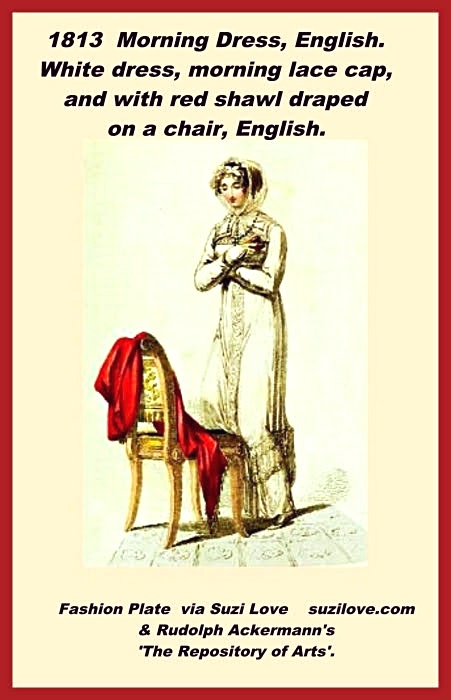
1813 October Morning Dress, English. Jane Austen and her family and friends would have worn this style of relaxed dress and cap. White At-Home dress with morning lace cap and a red shawl. Plain cambric underdress, three-quartered muslin or Chinese silk robe trimmed round the bottom and up the front with Indian border, or needle-work, and finished with a deep flounce of lace. Convent hood and pelerine of white net lace, confined under the chin with a silk cord and tassel. Hair in irregular curls with a fancy flower in the front. Short rosary and cross, plus bracelets, of coquilla beads. Buff or lemon kid slippers and pale tan gloves. Fashion Plate via Rudolph Ackermann’s ‘The Repository of Arts’.
This is a typical outfit worn at home in the morning in the house, to be seen only by family or close friends. A lady might wear this while writing having breakfast, writing letters, or reading. Called by the various names of Undress, to At-Home dress, or Morning dress, it is the most relaxed ensemble a lady will wear all day. The sort of outfit Jane Austen would have worn when writing her books.
What did Jane Austen and friends wear? Early 1800s fashions were elegant and pretty with high waists and fabrics that were almost transparent. These Empire style gowns, named after Napoleon’s first Empress, became popular throughout Europe, and were then copied around the world. Colorful outwear was added to make an ensemble more attractive and warmer. History Notes Book 26 Fashion Women 1805-1809. https://books2read.com/SuziLoveFashionWomen1805-1809
The Empire waist gown defined women’s fashion during the Regency Era. ‘Empire’ is the name given in France to the period when Napoleon built his French Empire. High-waisted, loose gowns were adopted by the aristocracy as a symbol of turning away from the fussy, elaborate and expensive clothing worn in the 1700s. Jean-Jaques Rousseau advocated copying peasants and returning to a simpler life and more natural fashions. Unrestricting clothing was part of the new Democracy in France and these simpler and flowing fashions were adopted all over Europe, including Britain and despite the continual wars being fought against France during the early 1800s. Not even war stopped fashions from being copied everywhere.