1771 Tattersall’s Horse Training School, London, U.K. via Yale Center for British Art, Paul Mellon Collection.
Tattersall’s was founded in 1766 by Richard Tattersall (1724–1795), the Duke Of Kingston’s stud groom in premises near Hyde Park Corner, London. Two Subscription rooms were designated for members of the Jockey Club and became a meeting place for sporting and betting men. ‘Old Tatt’ conducted sales for the Duke of Kingston’s stud in 1774 and the Prince of Wales, or Prinny, in 1786. The prince often visited Richard Tattersall who was succeeded by his son, Edmund Tattersall (1758–1810), who extended the business to France.
Do you need more factual and visual information for your historical fiction? Try History Notes Books 1-28. Non-fiction Series: Fashion, corsets, Regency Era, music and social manners in the 18th and 19th centuries e.g.
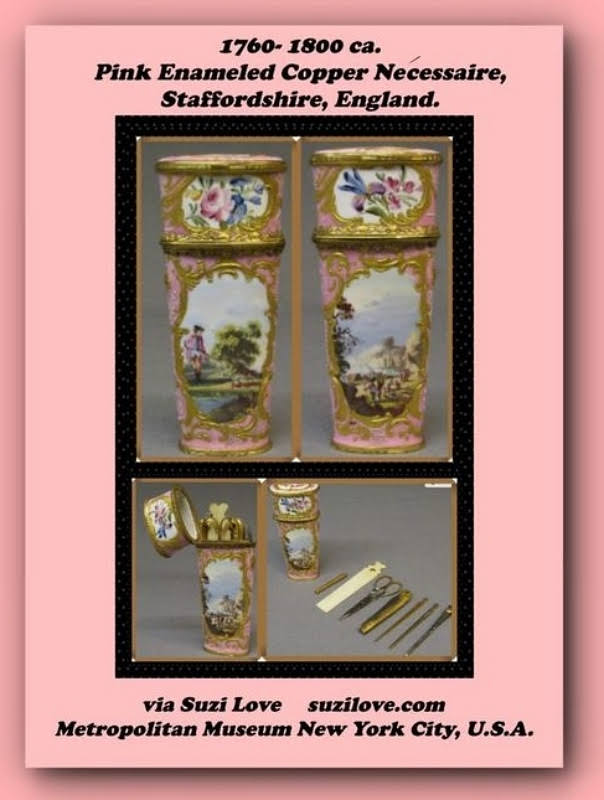
1760-1800 ca. Pink Enamel and Copper Necessaire Or Etui, Staffordshire, England. Dimensions: 3 3/4 x 1 5/8 in. (9.5 x 4.1 cm) Credit: Pierpont Morgan, 1917 via Metropolitan Museum, N.Y.C., U.S.A. metmuseum.org
Definition Necessaire Or Etui: Small toiletry, writing, or sewing containers were called Necessaire or Etui: Tiny boxes or containers were carried in large castles or sprawling manor houses so a lady or gentleman had their essentials with them all day. They were also important when traveling by coach, trains, or on ships where space was always limited. A necessaire or Etui was easily carried in a bag, reticule, or pocket so essentials were on hand for personal grooming, to repair a ripped hem, replace a button, to embroider, or to write a note or letter.
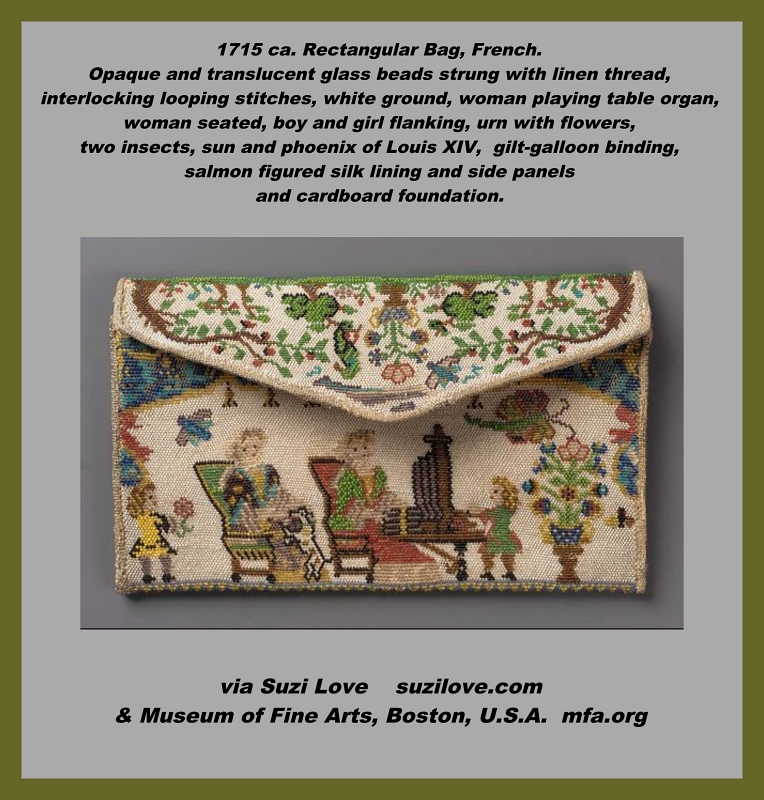
1715 ca. Rectangular Envelope Style Bag, French. Polychrome opaque and translucent glass beads strung with linen thread, held together by interlocking looping stitches (sablé). Design on white ground: woman playing table organ, woman seated, boy and girl flanking, urn with flowers right, two insects and curtain above (obv.); sun and phoenix of Louis XIV, ribbon above inscribed IE VIS SANS MOURIR, inscribed at bottom and right SI IE MEURS CE NEST QUE POVR REVIVRE (rev.); vegetative scene (flap). Gilt-galloon binding. Salmon figured silk lining and side panels. Cardboard foundation. via Los Angeles County Museum of Art, California, USA. collections.lacma.org
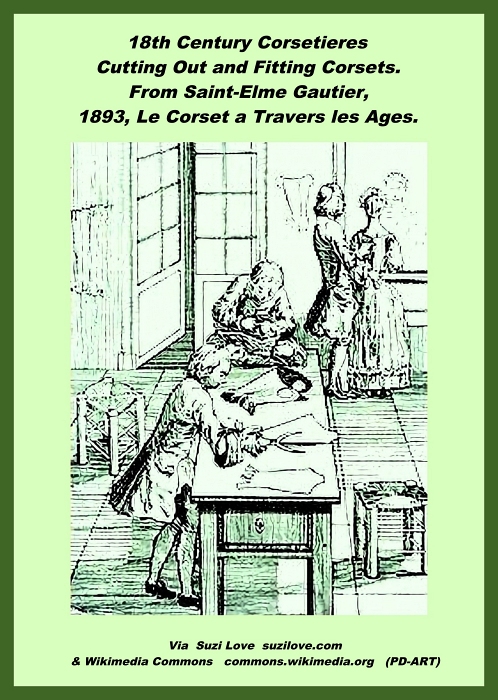
There has been some discussion on the names for Corset Makers. I’ve seen lots of names, including Stay Maker, Stay Manufacturer, Corset Maker, Body Tailor and Milliner. It was mainly men who were Stay Makers, but there were also some women who included stay making with their millinery.
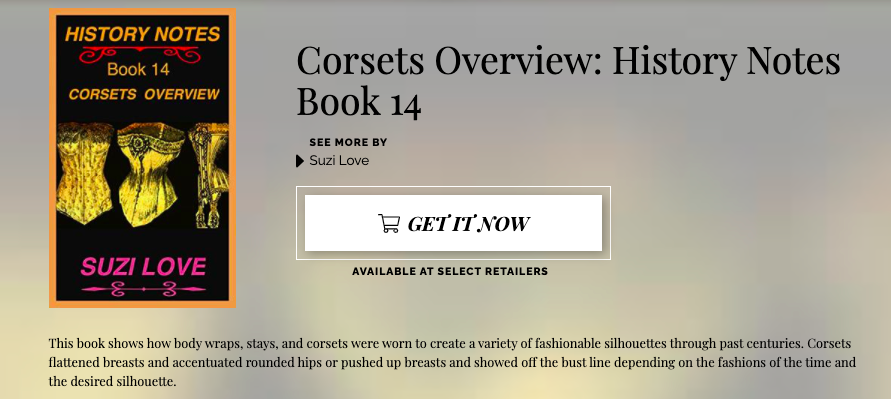
Corsets Overview History Notes Nonfiction Book 14. This book shows how body wraps, stays, and corsets were worn to create a variety of fashionable silhouettes through past centuries. Corsets flattened breasts and accentuated rounded hips or pushed up breasts and showed off the bust line depending on the fashions of the time and the desired silhouette. Includes corsets through the Georgian, Regency, Victorian and Edwardian Eras and Jane Austen’s lifetime. Overview of corsets through history, including the Georgian, Regency, Victorian and Edwardian Eras and Jane Austen’s lifetime.
1776 April 28th John McQueen, Stay Maker., New York. At the sign of the White Stays in Smith Street,near the Mayor’s baths, New York. Making all sorts of stays in the newest fashion that is worn by the ladies of Great Britain or France. Packthread stays for babies from one month to seven years, stays for children of Tabby, Ruffled Canvas, Or Buckram, and for older girls an assortment of thin boned stays of different sorts and sizes.1835 Milliner, Dress and Corset Maker to the Royal Family. Mrs. Langdon. 37 Milson Street, Bath, U.K. Local Trade Advertisements. From 1835 The Historical and Local New Bath Guide By C. Duffield. via Google Books (PD- 150)18th Century Interior of the shop of a body tailor, or corset maker. From 1893 The Art of the Tailor of the Bodies of Women and Children.1835 Fashionable Long and Short Stay Manufacturer. Robert Drew & Co. Local Trade Advertisements. From- 1835 The Historical and Local New Bath Guide. Published by C. Duffield via Google Books (PD-150)18th Century Corset Maker From 1893 Le Corset, A Travers Les Ages.18th Century Corsetieres cutting out and fitting. From Saint-Elme Gautier, Le Corset a Travers les Ages. en.wikipedia.orgNames For Corset Makers in Jane Austen and Bridgerton times? Lots of them including Stay Maker, Corset Maker, Body Tailor and Milliner. #janeausten #bridgerton #Corset https://books2read.com/SuziLoveCorsetBook14 Share on X
1795-1805 ca. Green Silk and Metal Vest, Or Waistcoat, Probably French. The style of waistcoat worn by men in Jane Austen’s times. Interesting cross-over front and tasteful embroidery, standing collar, back has ties to adjust the fit. via Metropolitan Museum, N.Y.C., U.S.A. metmuseum.org
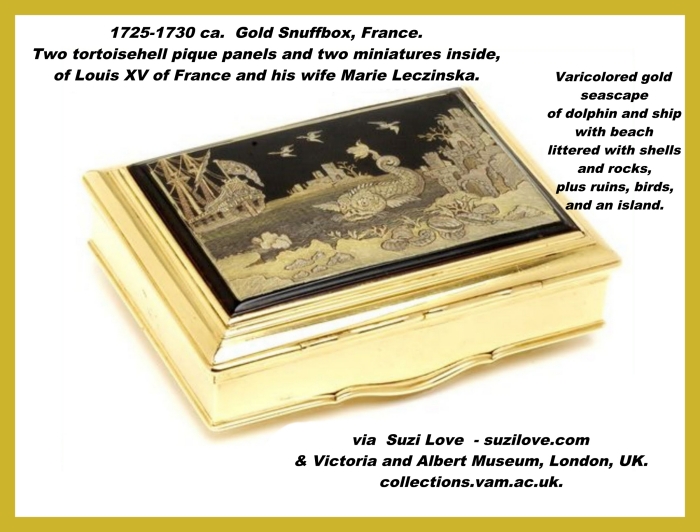
1725-1730 ca. Gold Double-Opening Snuffbox, France. Two tortoiseshell pique panels and two miniatures inside, of Louis XV of France and his wife Marie Leczinska. Made by Jean Baptiste Massé, painter.
Varicolored gold seascape of dolphin and ship with beach littered with shells and rocks, plus ruins, birds, and an island. Inside the box are miniature portraits of Louis XV of France and his wife Marie Leczinska. It has been suggested that the box commemorates the birth of the ‘dauphin’ Louis in 1729, the royal couple’s fourth child, and first son, heir to the throne. A few elements contradict this suggestion: the dolphin does not bear any regal symbol such as a crown, the marks that date the box indicate that it was initiated before the birth of Louis, when the arrival of a son was unknown. It is most probable that these delicate panels, together with the miniature of Louis XV, date from 1725-1730 and have been associated later into this gold snuffbox, and a later miniature of Queen Marie Leczinska.The miniature of the king may have been painted by Jean-Baptiste Massé – he is recorded as supplying miniatures of the king for boxes intended as diplomatic gifts from 1720-26-, or by his lesser known contemporary Jean-Baptiste Ducanel.
The lid is hinged to reveal a miniature, under glass, of Marie Leczinska, queen of France, probably 19th century or heavily restored, wearing a cloak of blue embroidered with gold fleurs-de-lis and lined with ermine overa lace-trimmed dress of red embroidered with gold. In the base is a panel of tortoiseshell pique with a cornucopia of small shells, also hinged to reveal a contemporary miniature of Louis XV of France in armour, wearing a whitestock and the sash of the Order of the Holy Ghost. The gold box, probably early 19th century or later, has plain walls, reeded borders, and a double thumbpiece.
Sir Arthur Gilbert and his wife Rosalinde formed one of the world’s great decorative art collections, including silver, mosaics, enamelled portrait miniatures and gold boxes. Arthur Gilbert donated his extraordinary collection to Britain in 1996.
Snuff Boxes: Decorative boxes of all types were prized, especially in the 18th Century when everything decorative and extravagant was in vogue and taking a pinch of snuff was fashionable. Snuff is made from ground or pulverized tobacco leaves, flavorings added, and then a pinch of snuff is placed on the back of the hand and sniffed.
Corsets originated in the beginning of the 16th century, when aristocratic Spanish women first adopted “whalebone bodies.” Stays (later known as corsets) rapidly became fashionable throughout Europe. In 1588, the French essayist Michel de Montaigne wrote, “To get a slim body, Spanish style, what torture do women not endure, so tightly tied and bound . . . ” Although doctors and moralists remonstrated, women continued to wear some form of corset until the middle of the 20th century, because corsetry was associated with feminine beauty, aristocratic display, and self-discipline.
1780 Watch on a Chatelaine, Germany. Silver Repousse Verge With four chain chatelaine. via Heritage Auction H.A.com.
Definition Chatelaine: The word Chatelaine is French and means the keeper of the keys. Chatelaine” derives from the Latin word for castle. In Medieval times, the chatelaine was in charge of the day-to-day running of the castle. What did a chatelaine do? Most important task was keeper of the keys. Also ordered supplies, did bookkeeping, supervised servants, taught castle children, and organized guests. books2read.com/SuziLoveChatelaines
By 1700’s, a metal jeweled ornament hung from pockets, attached to belts, or by hooks into skirt waistbands
During 1800’s, women wore large collections of tools hung from chains
Young girls sewed and did needlework and needed to carry sewing notions eg scissors, thimbles
Worn by women of all classes, from workers to nobility
Varied depending on class and finances.
Made of silver, brass, steel, leather, or fabric
During 19th century, fashionable dresses often had no waist and nowhere to hang chatelaines
Chatelaines became decorative brooches
Often given as a wedding present from a husband to bride
Later became fashion accessories.
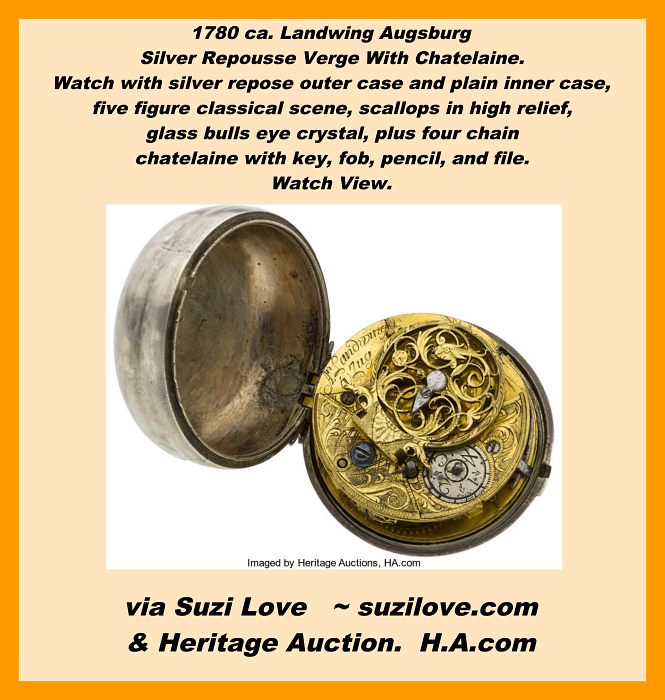
1780 ca. Watch. Landwing Augsburg
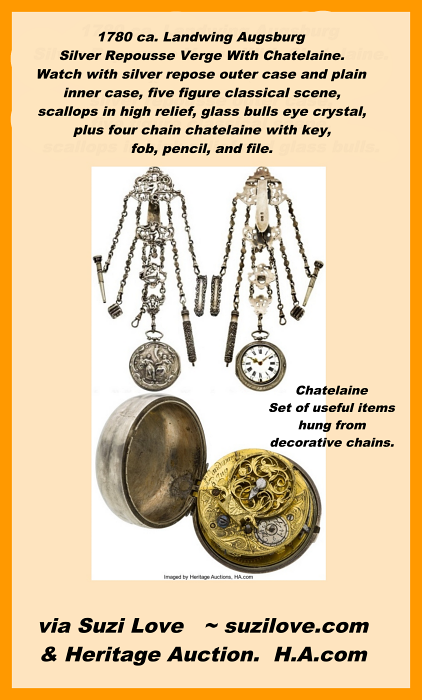
Silver Repousse Verge With Chatelaine. Watch with silver repose outer case and plain inner case, five figure classical scene, scallops in high relief, glass bulls eye crystal, plus four chain chatelaine with key, fob, pencil, and file. via Heritage Auctions
Chatelaine: Set of useful items hung from decorative chains.1780 Watch On Four Chain Chatelaine, Germany. #GeorgianEra #Antiques #Watch #Chatelaine. books2read.com/SuziLoveChatelaines Share on XChatelaines and Chains History Notes Book 9 By Suzi Love. #regency Women in charge of houses wore long chains holding important household items around their waist e.g. keys, pen, notebook, sewing. books2read.com/SuziLoveChatelaines
1798 Woman’s Light Blue Douillette, Or Housecoat, French. Trimmed with pink velvet, pink fan, black slave sandals, apricot hat with black trim. Fashion Plate via Journal des Dames et des Modes, or Costume Parisien.
Description Douillette: A coat or housecoat, sometimes quilted, worn in France.