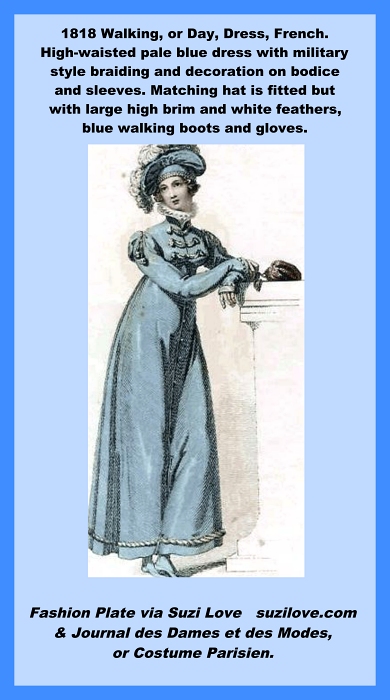
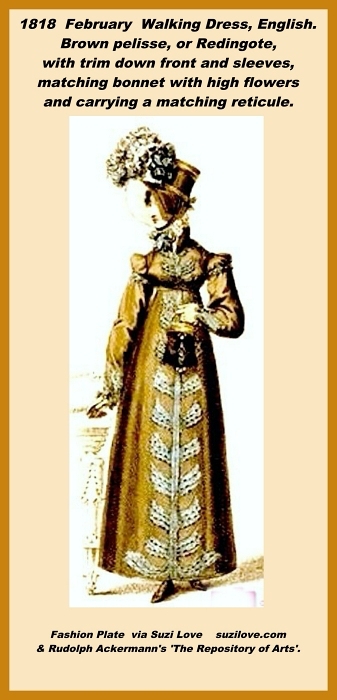
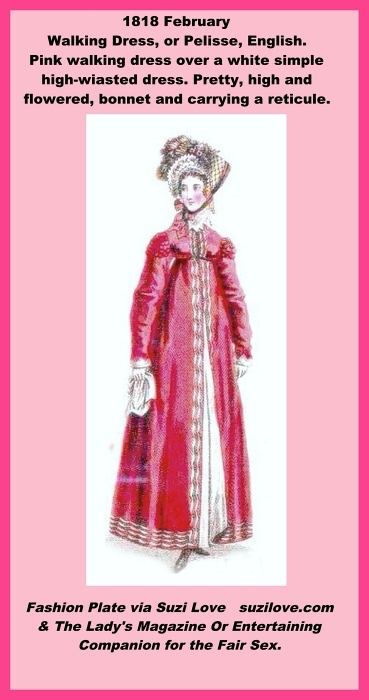
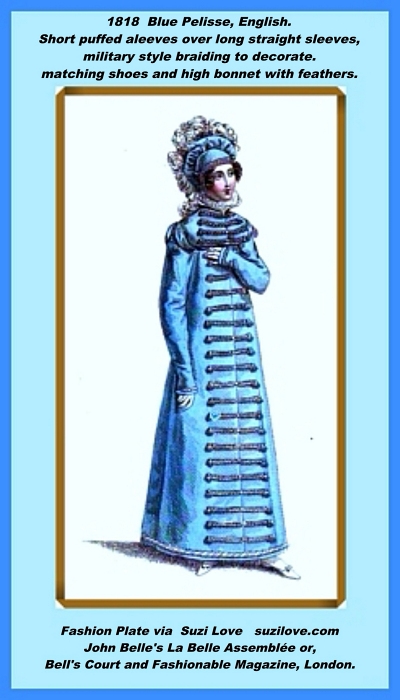
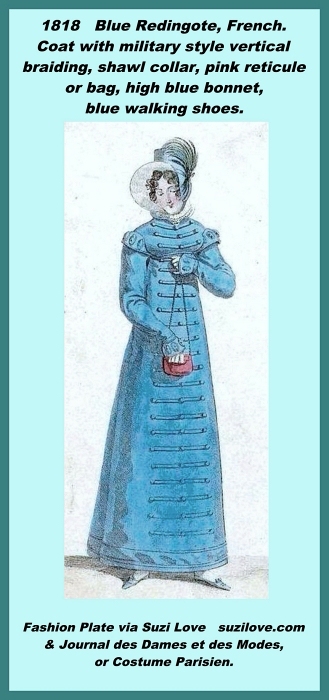
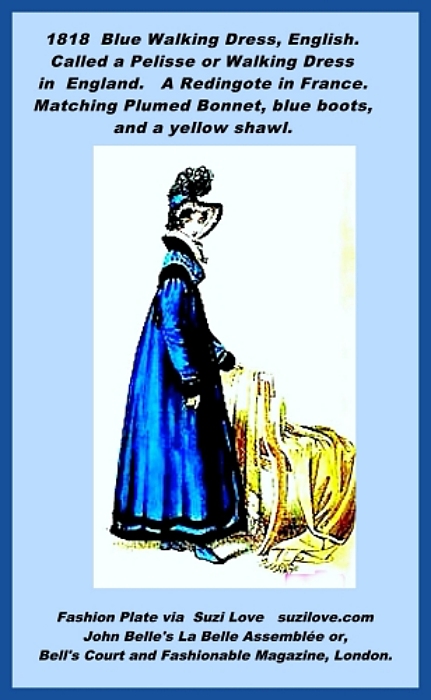
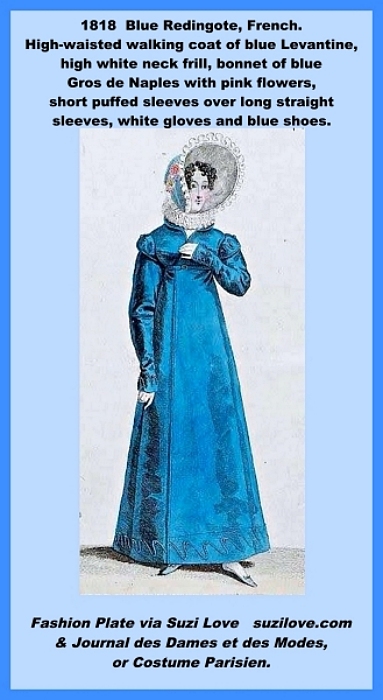
1817 February Pelisse, or Redingote, English. Carriage dress of white poplin with a deep blond flounce. Blue levantine pelisse or walking dress, or Redingote in France, shorter than the dress and edged with floss silk. Coburg cap of black velvet turns up on one side in front and is lined and edged with blue satin. The head-dress worn with it has a profusion of white ostrich feathers. Ruff is of plain blond, edged with narrow white satin ribbon, and a pink Indian scarf over the shoulders. An ermine muff, gloves and slippers of blue kid, complete the elegant dress. Fashion Plate via John Belle’s La Belle Assemblée or, Bell’s Court and Fashionable Magazine, London.
Definition Coat or Redingote Or Pelisse: Long fitted outdoor coat worn over other garments for warmth. French word developed from English words, riding coat.
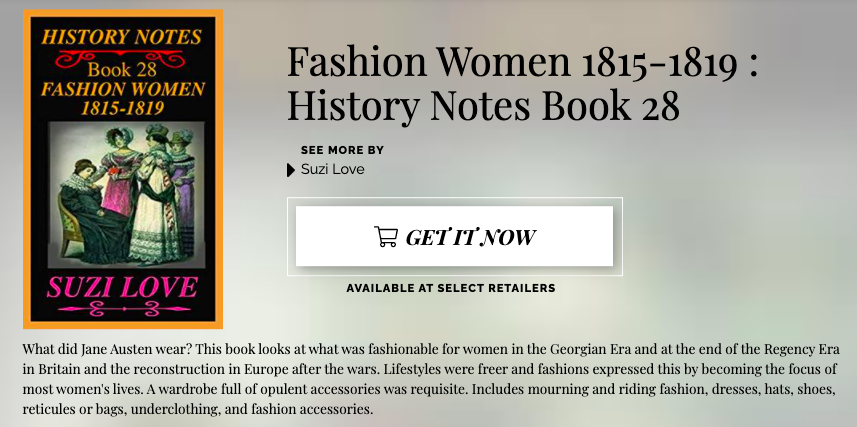
1817 February Pelisse, or Redingote, English. Carriage dress of white poplin with a deep blond flounce. Blue levantine pelisse or walking dress, or Redingote in France, edged with floss silk, blonde lace neck ruff, ermine ruff and a pink shawl. Fashion Plate via John Belle’s La Belle Assemblée or, Bell’s Court and Fashionable Magazine, London. Fashion Women 1815-1819 History Notes Book 28 https://books2read.com/SuziLoveFashionWomen1815-1819
1816 May Wedding Dress Of Princess Charlotte of Wales (1796-1817). Worn at her wedding to Prince Leopold Saxe-Coburg. Silk satin high-waisted bodice with short puffed sleeves, dipping neckline, underskirt, overskirt, train and apron. Created by Mrs Triaud, London dressmaker although this may not be the original skirt. Metallic embroidery was very fashionable for court dress in early 19th Century despite the cost and delicacy but was an unusual choice for Princess Charlotte who preferred to dress simply. via Museum of London, UK. museumoflondon.org.uk
The wedding dress of Princess Charlotte Augusta as described in La Belle Assemblee magazine for May, 1816.
“As we have been gratified with a sight of the wedding dresses of this amiable and illustrious female, a particular yet concise account of them cannot but be acceptable to our fair readers. The Royal Bride, happy in obtaining him whom her heart had selected, and whom consenting friends approved, wore on her countenance that tranquil and chastened joy which a female so situated could not fail to experience.
Her fine fair hair, elegantly yet simply arranged, owed more to its natural beautiful wave than to the art of the friseur; it was crowned with a most superb wreath of brilliants, forming rosebuds with their leaves. Her dress was silver lama [lamé] on net, over a silver tissue slip, embroidered at the bottom with silver lama in shells and flowers. Body and sleeves to correspond, elegantly trimmed with point Brussels lace.
The manteau was of silver tissue lined with white satin, with a border of embroidery to answer that on the dress, and fastened in front with a splendid diamond ornament. Such was the bridal dress … The jewellery of the royal bride is most superb; beside the wreath, are a diamond cestus, ear- rings, and an armlet of great value, with a superb set of pearls.
Fashion Women 1815-1819 History Notes Book 28 https://books2read.com/SuziLoveFashionWomen1815-1819
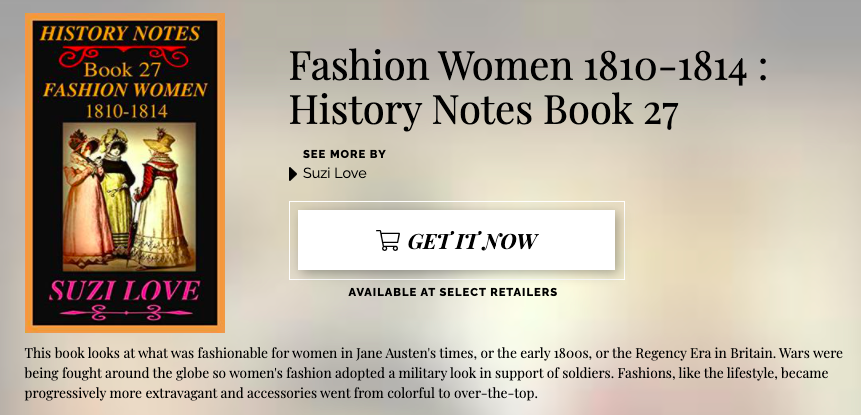
Are you a reader or writer of Regency Romance? Love Jane Austen’s books? Want to know more about the mourning, riding, underclothing and other Regency Era women’s fashions in Regency romances? What was fashionable for women in Jane Austen’s times? Mourning, riding, daytime, evening clothing, plus underclothing, corsets and accessories. This book looks at what was fashionable for women in Jane Austen’s times, or the early 1800s, or the Regency Era in Britain. Wars were being fought around the globe so women’s fashion adopted a military look in support of soldiers. Fashions, like the lifestyle, became progressively more extravagant and accessories went from colorful to over-the-top. https://books2read.com/SuziLoveFashion1810-1814
An overview of women’s fashions in the first twenty years of the 19th century. What was fashionable for women in Jane Austen’s times, or the early 1800s. Wars were being fought around the globe so women’s fashion adopted a military look in support of soldiers. In Britain, the Prince Regent ruled instead of his father, King George III, so fashions, like the lifestyle, became more extravagant and accessories went from pretty to opulent.
Reader Or Writer of Regency Era? Love Jane Austen and Bridgerton fashions? What was fashionable for women in Jane Austen’s times, or 1800s, or Regency Era. High-waisted dresses were extravagantly accessorized and hats, shoes, parasols and bags were added. Set includes History Notes Books 12, 25, 26, 27 and 28. https://books2read.com/SuziLoveFashionWomenBoxSet
Ladies clothing in the early 1800’s featured a high waist line called an Empire Line, or Empire style dress, with a waist line just under the natural bust line and much higher than the natural waist. The high-waisted, or short-bodied, Regency styles shifted focus away from the natural waist and so left the natural waist unconstricted, in direct contrast to previous and future styles. Britain took these simple European styles and progressively made them more elaborate by adding more and more complicated embroidery onto white fabrics to create the white on white look popular for many years.
The empire look of fine muslin dresses left women more exposed than in the Georgian Era when fabrics had been thicker and styles bulkier. Women, especially in England, preserved their modesty by adding lace, frills, flounces, ruches, and fabric plaits to dresses to adequately cover any parts that might inadvertently be exposed. Outer layers, such as Spencers, Redingotes or Pelisses or coats, and shawls, were also added for warmth and to brighten outfits. This Empire fashion was totally dependent on a supply of fine, translucent cotton muslin – at first imported from India, then later, less exclusive imitations often woven and printed or embroidered in Britain. Fabrics were soft and lightweight and muslins and other cotton fabrics from India and other Asian countries were in high demand.
1809 September. Garden Promenade Dresses. Empire style gowns, shawls, hats, and parasols for walking in the park, to see and be seen, in London or at fashionable resorts. More elegant than walking dresses, which are usually morning dresses with outerwear and more elaborate headdresses. These are the sort of ensembles that Jane Austen and her family and friends would have gone walking in. Foreground lady has a silk shawl mantelet trimmed with an amber silk fringe and fastened on the bosom with a pebble brooch, amber hoop earrings, white Morocco leather shoes, York tan gloves and a blue parasol with a fringe. Straw hat with flowers. Background lady wears a Nun’s hood that falls over her shoulders and holds a purple parasol. Fashion Plate via John Belle’s La Belle Assemblée or, Bell’s Court and Fashionable Magazine, London.
Fashion Women 1805-1809 History Notes Book 26 What did Jane Austen and friends wear? https://books2read.com/SuziLoveFashionWomen1805-1809
1809 February Walking or Carriage Dress, English. Polanese coat, Saragossa mantle of spring green Virgnia cloth, trimmed round the edges and up the front of the coat with black velvet bindings, and edgings of gold lace. High puckered collar, confined round the throat with a gold cord and acorn tassels. Belt of black velvet, and rich gold clasp. Military cap formed of the same material, and trimmed also with black velvet and gold. Short white lace veil falling from the edge of the cap just below the chin. Half-boots of green kid or cloth, calashed and bound with black, and laced with gold cord. Fashion Plate via John Belle’s La Belle Assemblée or, Bell’s Court and Fashionable Magazine, London.
Fashion Women 1805-1809 History Notes Book 26
What did Jane Austen and friends wear? This book looks at early 1800s fashions, which were elegant and pretty with high waists and fabrics that were almost transparent. These Empire style gowns, named after Napoleon’s first Empress, became popular throughout Europe, and were then copied around the world. Colorful outwear was added to make an ensemble more attractive and warmer.
https://books2read.com/SuziLoveFashionWomen1805-1809
1810 White Promenade Half Dress, English, In Jane Austen Style. Draped yellow shawl and yellow parasol and a fitted hat with a long lace veil. A muslin dress with long sleeves and low neck, a French scarf of yellow silk, yellow silk bonnet with lace veil, yellow Parasol with a white fringe, gloves and shoes of yellow kid. Fashion plate via John Belle’s ‘La Belle Assemblee’, England. Typical of the outdoor outfit worn by Jane Austen and her contemporaries. An Empire style, or high-waisted white dress worn with a gorgeous yellow scarf and matching yellow fringed parasol.
Dress – Half Dress: Between undress and full dress, half dress is a respectable outfit but without an excess of formal accessories. Can be worn either during the day or evening.
1810 White Promenade Half Dress, English. Draped yellow shawl and parasol, fitted hat with a long veil. Fashion plate via suzilove.com and John Belle’s ‘La Belle Assemblee’, EnglandHN_27_D2D_fashwomen1810-1814
https://books2read.com/SuziLoveFashion1810-1814
I love Pinterest for keeping thousands of historical images in some sort of order.And I love using Pinterest Boards as inspiration for my romance books.What about you? Do you use Pinterest for planning something, or just for fun?Need more hints for what to do with your boards and pins? Take a look at these fascinating articles on Pinterest. if you want even more Pinterest information and tips for becoming a power user, check out my Suzi Love Pinterest Boards
1819 February Pink Ball Dress, English. Underskirt with white lace hem, pink layer with intricate decoration, short puffed sleeves, low décolletage, or neckline, white shawl and white hat with pink feather. Fashion Plate via John Belle’s La Belle Assemblée or, Bell’s Court and Fashionable Magazine, London. Women’s clothing came in the late 1810s came in a wide range of styles to suit every season and occasion. When attending assemblies or balls, ladies in Jane Austen’s times women wore Empire style dresses which were usually made of light fabric and floaty in style and often of a shorter length suitable for dancing. https://books2read.com/SuziLoveFashionWomen1815-1819
Definition Ball Dress: At the end of the 1810s, ball or dancing dresses had higher hemlines that rose several inches above the ankle so ladies wouldn’t trip on their hens or flounces and make a spectacle of themselves.
Definition Aigret, aigrette, egret: Plume of feathers or jeweled ornament in shape of feathers worn on head or hats. During the early 19th century, or Jane Austen’s lifetime, or during the years of the Bridgerton series, the favorite feathers were osprey and heron.
1819 February Pink Ball Dress, English. Underskirt with white lace hem
What did Jane Austen and friends wear? Early 1800s fashions were elegant and pretty with high waists and fabrics that were almost transparent. These Empire style gowns, named after Napoleon’s first Empress, became popular throughout Europe, and were then copied around the world. Colorful outwear was added to make an ensemble more attractive and warmer. History Notes Book 26 Fashion Women 1805-1809. https://books2read.com/SuziLoveFashionWomen1805-1809
The Empire waist gown defined women’s fashion during the Regency Era. ‘Empire’ is the name given in France to the period when Napoleon built his French Empire. High-waisted, loose gowns were adopted by the aristocracy as a symbol of turning away from the fussy, elaborate and expensive clothing worn in the 1700s. Jean-Jaques Rousseau advocated copying peasants and returning to a simpler life and more natural fashions. Unrestricting clothing was part of the new Democracy in France and these simpler and flowing fashions were adopted all over Europe, including Britain and despite the continual wars being fought against France during the early 1800s. Not even war stopped fashions from being copied everywhere.
Fashion Women 1805-1809 History Notes Book 26
What did Jane Austen and friends wear? This book looks at early 1800s fashions, which were elegant and pretty with high waists and fabrics that were almost transparent. These Empire style gowns, named after Napoleon’s first Empress, became popular throughout Europe, and were then copied around the world. Colorful outwear was added to make an ensemble more attractive and warmer.
https://books2read.com/SuziLoveFashionWomen1805-1809HN_26_D2D_FsshionWomen1805-1809