↓
 

Suzi Love

Making history fun, one year at a time.

Header_
  • Home
  • Newsletter
  • Pre order form
  • Shop
    • Cart
    • Checkout
    • My account
    • Refund and Returns Policy
  • Blog
  • BOOKS
    • History Events
    • Kelly’s Justice
    • Irresistible Aristocrats
    • History Notes
    • Scandalous Siblings
    • Love After Waterloo
    • Regency Life Series
  • Privacy Policy
  • EVENTS
Home » Regency Royalty » Page 3 << 1 2 3 4 >>

Tag Archives: Regency Royalty

Post navigation

← Previous Post
Next Post→

Christmas: How did they celebrate Christmas in Bridgerton and Jane Austen times? #Christmas #Christianity #Bridgerton #JaneAusten #holidays

Suzi Love Posted on December 10, 2025 by Suzi LoveDecember 9, 2025

How did they celebrate Christmas in Bridgerton and Jane Austen times? Historical information about the traditions of Christmas through the centuries, including the religious aspects, decorations, games, food and plays. History Of Christmases Past has lots of information and images about Christmas through the centuries, including religious aspects, decorations, games, food and plays. Historic images show how some traditions have changed while many have remained the same through the centuries. books2read.com/suziloveHOCP


How did they celebrate Christmas in Bridgerton and Jane Austen times? Historical information about the traditions of Christmas through the centuries, including the religious aspects, decorations, games, food and plays. #holidays #Christmas #Christianity #Bridgerton #JaneAusten http://books2read.com/suziloveHOCP
How did they celebrate Christmas in Bridgerton and Jane Austen times? Historical information about the traditions of Christmas. #holidays #Christmas #Christianity #Bridgerton #JaneAusten http://books2read.com/suziloveHOCP Share on X


Posted in 1700s, 1800s, 1900s, Australia, Bridgerton, Canada, Christmas, Customs & Manners, Edwardian Era, England, Europe, Events, Food and Drink, Georgian Era, History Of Christmases Past, household, Jane Austen, Music, Regency Era, Romantic Era, Royalty, South Pacific, Suzi Love Books, Suzi Love Images, U.S.A, Victorian Era | Tagged Book 1, Bridgerton, British history, Christmas, Customs and Traditions, drinks, Edwardian Era, Food, Georgian era, History Events, History Of Christmases Past, household, Jane Austen, music, Queen Victoria, Regency Era, Regency Royalty, Suzi Love Books, Victorian Era

Christmas: Tree History #Christmas #holidays #Traditions #RegencyEra

Suzi Love Posted on December 1, 2025 by Suzi LoveDecember 1, 2025

Christmas Trees and Their History

Our modern Christmas tree tradition probably began in Germany in the 18th century, though some argue that Martin Luther began the tradition in the 16th century. An  evergreen fir tree was used to celebrate winter festivals (pagan and Christian) for thousands of years. Nobody is really sure when Fir trees were first used as Christmas trees but it probably began 1000 years ago in Northern Europe. Many early Christmas Trees seem to have been hung upside down from the ceiling using chains.

The English phrase “Christmas tree”, first recorded in 1835, came from the German words Tannenbaum (fir tree) or Weinachtenbaum (Christmas tree). The Christmas tree is often explained as a Christianization of pagan tradition and ritual surrounding the Winter Solstice, which included the use of evergreen boughs, and an adaptation of pagan tree worship.   At first, a figure of the Baby Jesus was put on the top of the tree. Over time it changed to an angel or fairy that told the shepherds about Jesus, or a star like the Wisemen saw.

Christian tradition associates the holly tree with the crown of thorns, and says that its leaves were white until stained red by the blood of Christ. Along with a Christmas tree, the interior of homes were decorated with plants, garlands, and evergreen foliage and in Victorian times, Christmas trees were decorated with candles to represent stars.

The early Germans conceived of the world as a great tree whose roots were hidden deep under the earth, but whose top, flourishing in the midst of Walhalla, the old German paradise, nourished the she-goat upon whose milk fallen heroes restored themselves. Yggdnafil was the name of this tree, and its memory was still green long after Christianity had been introduced into Germany, when much of its symbolic character was transferred to the Christmas-tree. At first fitted up during the Twelve Nights in honor of Berchta, the goddess of spring, it was subsequently transferred to the birthday of Christ, who, as the God-man, is become the “resurrection and the life.”

Queen Victoria saw a Christmas tree as a girl in 1832. The little princess wrote excitedly in her diary that her Aunt Sophia had set up two “trees hung with lights and sugar ornaments. All the presents being placed around the tree.” In 1841, Prince Albert, Queen Victoria’s German husband, arranged for a fir tree to be brought from Germany and decorated. By 1850, Victoria and Albert had Christmas trees erected in the British Royal Palaces and their children started the tradition of gathering around the tree.

Xmas_Christmas Tree
Xmas_Christmas Tree
Xmas_Christmas Tree
Xmas_Christmas Tree
Xmas_Christmas Tree
Xmas_Christmas Tree
Xmas_Christmas Tree
Xmas_Christmas Tree
Xmas_Christmas Tree
Xmas_Christmas Tree
Xmas_Christmas Tree
Xmas_Christmas Tree

‘The Christmas-tree is doubtless of German origin. Though in its present form it is comparatively of recent date, yet its pagan prototype enjoyed a very high antiquity.’ From 1873 Harper’s Bazaar, America.

A print of the royal family gathered about the Christmas tree at Windsor Castle appeared in the Illustrated London News in 1848, then in Godey’s Lady’s Book in 1850, and was reprinted again ten years later. The six-foot fir sits on a table, each tier laden with a dozen or more lighted wax tapers. An angel with outstretched arms poses at the top. Gilt gingerbread ornaments and tiny baskets filled with sweets hang by ribbons from the branches. Clustered around the base of the tree are dolls and soldiers and toys.

Christmas trees did exist in America before Queen Victoria made them famous, but mainly only amongst migrant groups from Europe. The writer of an 1825 article in The Saturday Evening Post mentions seeing trees in the windows of many houses in Philadelphia, a city with a large German population. He wrote, Their “green boughs laden with fruit, richer than the golden apples of the Hesperides, or the sparkling diamonds that clustered on the branches in the wonderful cave of Aladdin.” Gilded apples and nuts hung from the branches as did marzipan ornaments, sugar cakes, miniature mince pies, spicy cookies cut from molds in the shape of stars, birds, fish, butterflies, and flowers. A woman visiting German friends in Boston in 1832 wrote about their unusual tree hung with gilded eggshell cups filled with candies.

Not until the mid-nineteenth century did Christmas trees start spreading to homes with no known German connection.  But once Queen Victoria approved of the custom of a Christmas tree,  the practice spread throughout England and America and, to a lesser extent, to other parts of the world, through magazine pictures and articles. Upper-class Victorian Englishmen loved to imitate the royal family, and other nations copied the custom. Late in the century, larger floor-to-ceiling trees replaced the tabletop size.  

Christmas: Tree History #Christmas #holidays #Traditions #RegencyEra https://books2read.com/suziloveHOCP Share on X
Posted in 1700s, 1800s, 1900s, Australia, Bridgerton, Canada, Christmas, Customs & Manners, Edwardian Era, Europe, Georgian Era, History Of Christmases Past, household, Jane Austen, Pastimes, Regency Era, Romantic Era, South Pacific, Suzi Love Images, U.S.A, Victorian Era | Tagged British history, Christmas, Customs and Traditions, europe, History Of Christmases Past, household, Regency Life, Regency Royalty, Suzi Love Research, Victorian Era

Fan of Regency London in the times of Jane Austen and Bridgertons? Regency Overview Book 1 Regency Life Series #JaneAusten #RegencyEra #Bridgerton #Nonfiction #amwriting

Suzi Love Posted on August 12, 2025 by Suzi LoveAugust 9, 2025

Fan of Regency London in the times of Jane Austen and Bridgertons? Regency Overview Book 1 Regency Life Series #JaneAusten #RegencyEra #Bridgerton #Nonfiction #amwriting https://books2read.com/ROver

Continue reading →
Posted in 1800s, Carriage, cartoon, Customs & Manners, Decorative Item, Food and Drink, History, household, Legal, military, money, Pastimes, peerage, Regency Era, Regency Life Series, riding, sports, Suzi Love Books, Suzi Love Images, travel, weapons | Tagged 1800s men fashion, Book 1, Bridgerton, British history, fashion accessories, Fashion Plate, gloves, Hats And Hair, Jane Austen, King George IV, peerage, Regency Era, Regency Fashion, Regency Life, Regency Life Series, Regency London, Regency Men, Regency Overview, Regency People, Regency Royalty, Regency Women, Shoes, Suzi Love Books

1816 May. Wedding Dress of Princess Charlotte as Worn in Bridgerton and Jane Austen Years. #Bridgerton #JaneAusten #Royalty #WeddingDress

Suzi Love Posted on August 3, 2025 by Suzi LoveJuly 12, 2025

1816 May Wedding Dress Of Princess Charlotte of Wales (1796-1817). Worn at her wedding to Prince Leopold Saxe-Coburg. Silk satin high-waisted bodice with short puffed sleeves, dipping neckline, underskirt, overskirt, train and apron. Created by Mrs Triaud, London dressmaker although this may not be the original skirt. Metallic embroidery was very fashionable for court dress in early 19th Century despite the cost and delicacy but was an unusual choice for Princess Charlotte who preferred to dress simply. via Museum of London, UK. museumoflondon.org.uk

The wedding dress of Princess Charlotte Augusta as described in La Belle Assemblee magazine for May, 1816.

“As we have been gratified with a sight of the wedding dresses of this amiable and illustrious female, a particular yet concise account of them cannot but be acceptable to our fair readers. The Royal Bride, happy in obtaining him whom her heart had selected, and whom consenting friends approved, wore on her countenance that tranquil and chastened joy which a female so situated could not fail to experience.

 Her fine fair hair, elegantly yet simply arranged, owed more to its natural beautiful wave than to the art of the friseur; it was crowned with a most superb wreath of brilliants, forming rosebuds with their leaves. Her dress was silver lama [lamé] on net, over a silver tissue slip, embroidered at the bottom with silver lama in shells and flowers.  Body and sleeves to correspond, elegantly trimmed with point Brussels lace.  

The manteau was of silver tissue lined with white satin, with a border of embroidery to answer that on the dress, and fastened in front with a splendid diamond ornament. Such was the bridal dress … The jewellery of the royal bride is most superb; beside the wreath, are a diamond cestus, ear- rings, and an armlet of great value, with a superb set of pearls. 
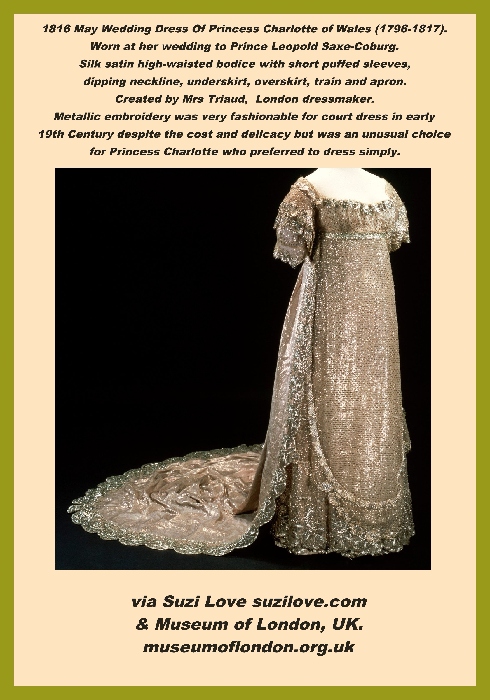
1816 May Wedding Dress Of Princess Charlotte of Wales (1796-1817). Worn at her wedding to Prince Leopold Saxe-Coburg. Silk satin high-waisted bodice with short puffed sleeves, dipping neckline, underskirt, overskirt, train and apron. Created by Mrs Triaud, London dressmaker. Metallic embroidery was very fashionable for court dress in early 19th Century despite the cost and delicacy but was an unusual choice for Princess Charlotte who preferred to dress simply. via Suzi Love suzilove.com & Museum of London, UK. museumoflondon.org.uk
1816 May. Wedding Dress of Princess Charlotte as Worn in Bridgerton and Jane Austen Years. #Bridgerton #JaneAusten #Royalty #WeddingDress https://books2read.com/SuziLoveFashionWomen1815-1819 Share on X
HN_28_D2D_Fashion Women 1815-1819
https://books2read.com/SuziLoveFashionWomen1815-1819
Fashion Women 1815-1819 History Notes Book 28 https://books2read.com/SuziLoveFashionWomen1815-1819
Posted in 1800s, 1800s women's fashion, Bridgerton, Dress Or Robe, England, Jane Austen, London, Regency Era, Regency Fashion, Royalty, weddings | Tagged 1800s women's fashion, Bridgerton, Dress Or Gown, Jane Austen, La Belle Assemblee, Museum Of London, Princess Charlotte, Regency Era, Regency Fashion, Regency Royalty, weddings

Cheltenham, Spa Town In Jane Austen and Bridgerton Years. #janeAusten #Bridgerton #RegencyEra #HistoricTravel #BritishHistory #England

Suzi Love Posted on July 22, 2025 by Suzi LoveJuly 19, 2025

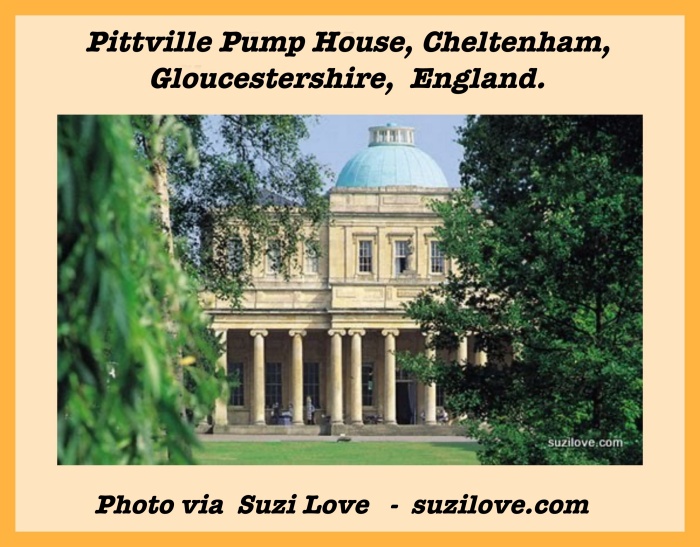
Cheltenham Spa, England: Pittville Pump Room: Cheltenham is a famous spa town within easy reach of the Cotswolds in in the county of Gloucestershire, England, and was a popular Georgian and Regency spa town where one could rest and recuperate. It became famous as a Spa town following the discovery of mineral springs in 1716, and claims to be the most complete Regency town in Britain. The Pittville Pump Room is an elegant Grade 1 listed Regency building and perhaps the most famous example of Regency architecture in Cheltenham, despite the town being filled Regency buildings. The Pittville Pump Room was the last and largest of the spa buildings to be built in Cheltenham.

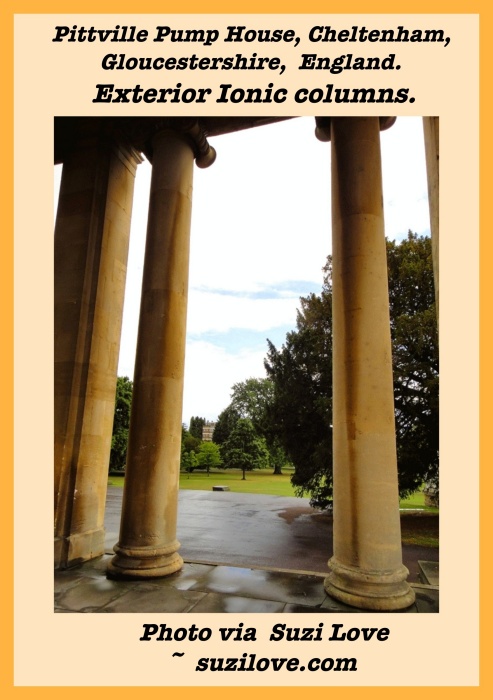
Location: The Pump Room stands at one end of Pittville Park,  about two miles from Cheltenham’s town centre, and is a monument to more than 100 years of fame which Cheltenham enjoyed as a Spa town. The building is set in beautiful parkland and is surrounded on three sides by a grand colonnade of ionic columns opening into the impressive hall with its domed ceiling and original crystal chandeliers. The park has extensive open lawns surrounded by trees and ornate bridges and pathways lead around the lakes where swans and ducks swim.

Cheltenham Tour Map. Pittville Pump House, Cheltenham, Gloucestershire, England.

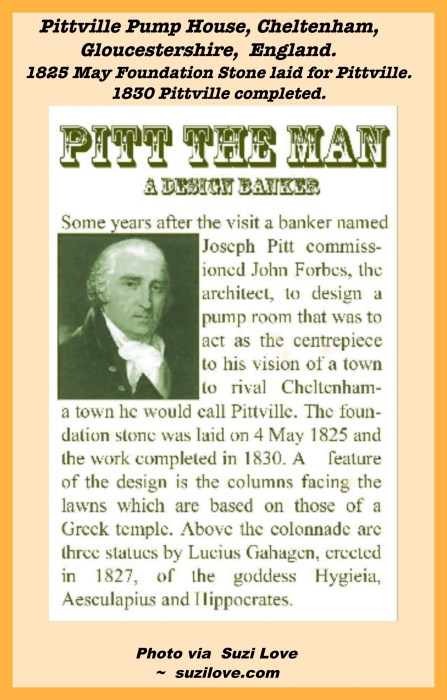
History: The waters were first discovered in around 1715 on a site now occupied by Cheltenham Ladies’ College. In 1788 George III and Queen Charlotte came to take the waters and it was their visit that set the seal on Cheltenham’s future. After a visit to Cheltenham, a banker named Joseph Pitt commissioned the architect John Forbes to design a pump room that was to act as the centrepiece to his vision of a town to rival Cheltenham – a town he would call Pittville.

The foundation stone was laid on 4 May 1825 and the work completed in 1830. The laying of the foundation was celebrated by the ringing of the bells, firing of cannons, as well as a Masonic Procession which set out from the Masonic Hall in Portland Street. In the evening banquets were held at two of the town’s hotels and grand fireworks display was to be seen at Pittville. The building took five years to complete. Following disagreements between Forbes and the builder, a second architect, John Clement Mead from London, was employed to finish the interior. He designed the elaborate stoves which heated the building. The original official opening on 6th July, 1830 was postponed until 20th July, 1830 because of the death of George IV. A grand public breakfast and ball marked the occasion.
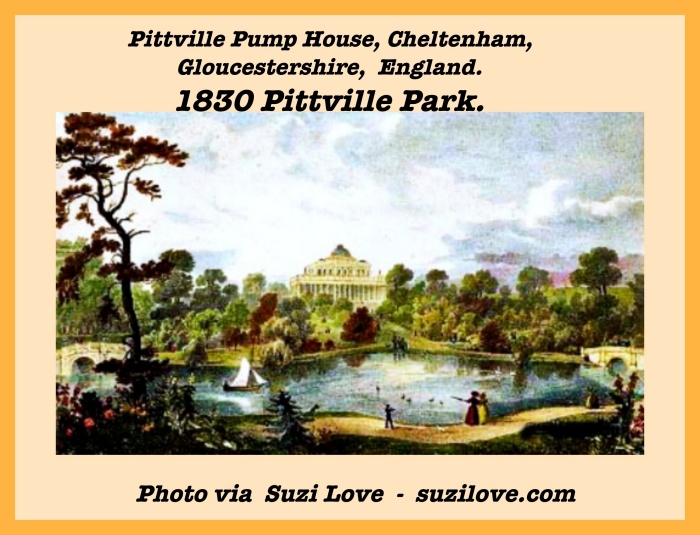
1830 Pittville Park. Pittville Pump House, Cheltenham, Gloucestershire, England.
1831 Pittville Park. Pittville Pump House, Cheltenham, Gloucestershire, England.
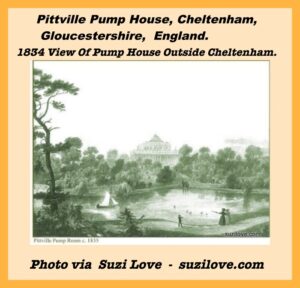
1834 View Of Pump House Outside Cheltenham. Pittville Pump House, Cheltenham, Gloucestershire, England.
Pittville Pump House, Cheltenham, Gloucestershire, England.
Poster: Pittville Pump Room latest and grandest water spas built in Cheltenham.
1820s Early Joseph Pitt, Banker. Commissioned architect John Forbes to design a pump room as centrepiece to his vision of a town to rival Cheltenham, a town he would call Pittville.
1825 May Foundation Stone laid for Pittville. 1830 Pittville completed.Pittville Pump House, Cheltenham, Gloucestershire, England.

Building the Pump Room: The total cost of the project was over £40,000, and incredible price for that time. Like many bankers of his time, Pitt ran into financial difficulties, the building went out of favour and was sold in 1890 to the Borough of Cheltenham for £5,400, a fraction of the original cost. The building is decorated in Ionic style and the great hail reflects the genius of John Forbes with the spa opening on the north side and the gallery and dome surmounting the hall.

The grand building is 92 feet long by 43 feet, surrounded by a colonnade 13 feet wide the roof of which are supported by fluted Ionic columns 22 feet high. Along the facade stand three figures representing Aesculapius, Hygeia and Hippocrates, originally made by Lucius Gahagan of Bath. In its design, the building combines elements of both Greek and Roman architecture. It was modelled on the temple on Illisus in Athens, the engravings of which appeared in Stuart and Revett’s Antiquities of Athens (1762).

The inspiration for the dome probably came from the Panthenon in Rome. A large ballroom was situated on the ground floor where even today visitors can attend music concerts, dances and other events. With a capacity of 400 and remarkable acoustics, it is Cheltenham’s finest concert venue. The spa with an oval pump room to the rear of the building are still there for the visitors to enjoy, available from a marbled pump and counter. A reading room, library and billiard room occupied the first floor.
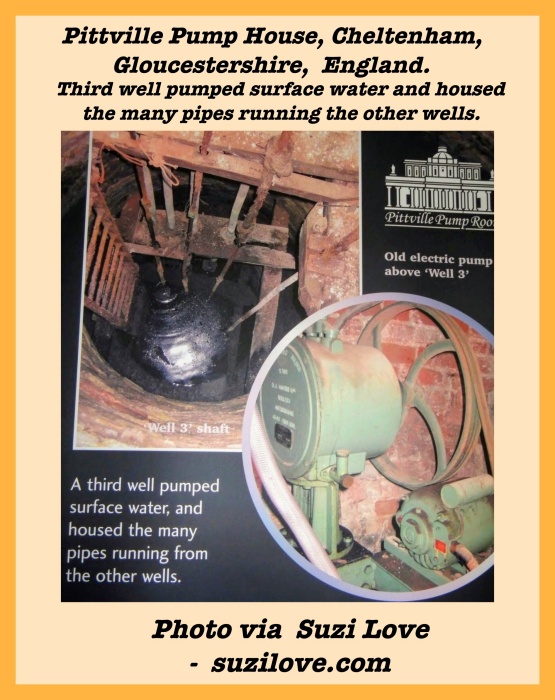
Third well pumped surface water and housed the many pipes running the other wells. Pittville Pump House, Cheltenham, Gloucestershire, England.
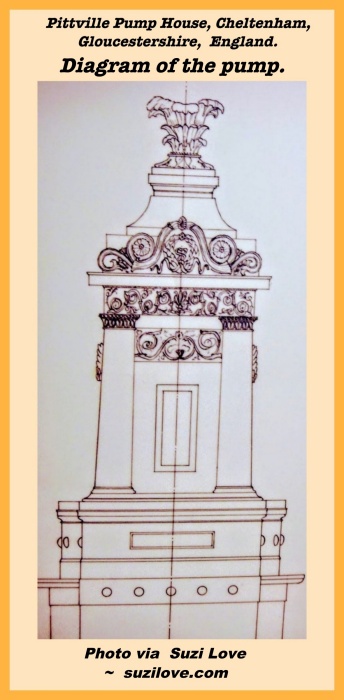
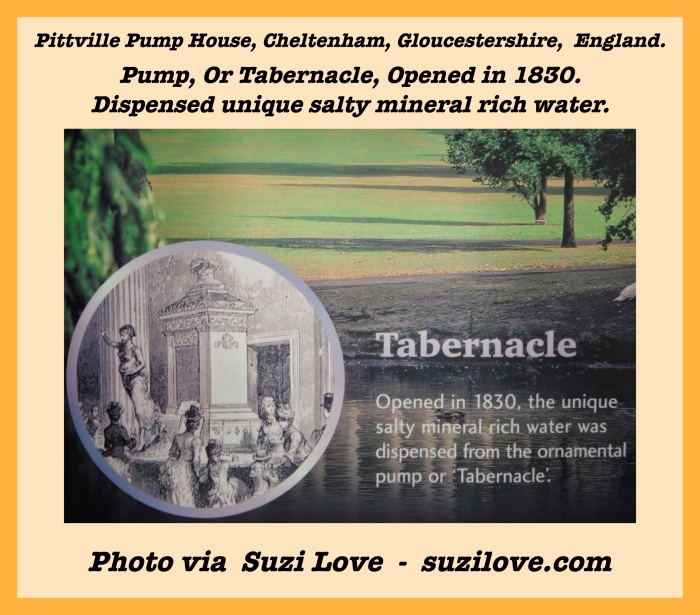
Pump, Or Tabernacle, Opened in 1830. Dispensed unique salty mineral rich water. Pittville Pump House, Cheltenham, Gloucestershire, England.
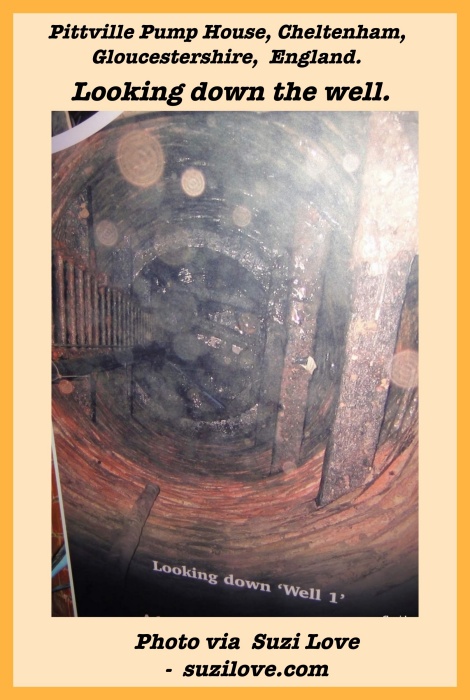
Looking down the well. Pittville Pump House, Cheltenham, Gloucestershire, England.
Two wells with side tunnels supplied spa water. Pittville Pump House, Cheltenham, Gloucestershire, England.
Diagram of the pump.Pittville Pump House, Cheltenham, Gloucestershire, England.
View from pump house upper level.
Side View. Pittville Pump House, Cheltenham, Gloucestershire, England.
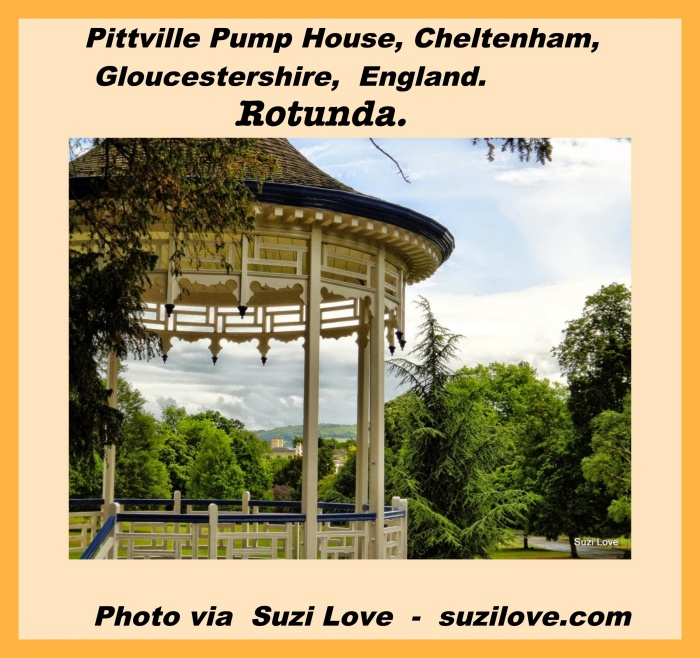
Rotunda. Pittville Pump House, Cheltenham, Gloucestershire, England.
Rotunda and exterior of building. Rotunda. Pittville Pump House, Cheltenham, Gloucestershire, England.
Ionic columns surrounding the Pump House. Pittville Pump House, Cheltenham, Gloucestershire, England.
Exterior with Ionic columns. Pittville Pump House, Cheltenham, Gloucestershire, England.
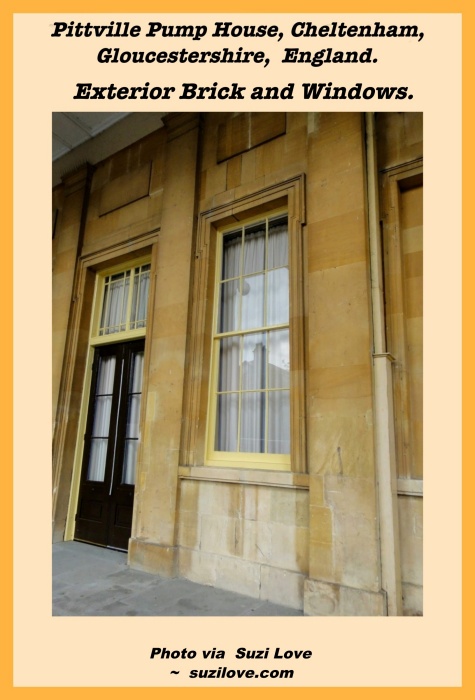
Exterior Brick and Windows. Pittville Pump House, Cheltenham, Gloucestershire, England.

Fashion History: “Cheltenham will be the summer village of all that is fashionable and all that is dignified; the residence of the royal ” family being a thing quite new so far from the metropolis . Already we hear of nothing but Cheltenham modes — the Cheltenham cap — the Cheltenham bonnets — the Cheltenham buttons — the Cheltenham buckles , in short all the fashions are completely Cheltenhamized throughout Great Britain.” via 1826 Griffith’s New Historical Description of Cheltenham and Its Vicinity.

Second World War: The Pump Room housed British and American army personnel, when dry rot was allowed to creep through the structure unchecked, and only after the war was the full extent of the damage revealed. Plaster, brickwork, timber: nearly everything had been affected. The dome was only held in position by a shell of plaster; the timber had been eaten away by the fungus.

The Duke of Wellington: Public subscriptions carne to the rescue, which were accompanied by Public Works grants and Historic Building Council contributions. A total of £43,250 was raised and by 1960 the building was partially restored to its former glory and reopened in 1960 by the Duke of Wellington. The old card room had been replaced by a new foyer, cloakrooms and second staircase, and heating and new lighting were in stalled.

Recent History: In 2003, the old Victorian wells were leaking and allowing ground water to dilute the natural mineral water so Pittville Pump Room no longer qualified as a spa and the well was shut down. The spa was then repaired and reopened so visitors can taste the only alkaline spa water in the country. The Pump Room’s old maple-strip floor was replaced with a stunning English oak floor, better flooring found for the ball room, and old pipes replaced. Nowadays the Pittville Pump Room is in use most days of the year for private and public functions and is one of Cheltenham’s most popular wedding venues. The venue is also used frequently by orchestras, choirs and chamber groups because it has stunning acoustics.

Cheltenham Spa, England: Pittville Pump Room. #England #Cotswolds #BritishHistory #HistoricTravel https://books2read.com/suziloveROver Share on X
RL_1_D2D_Regency Overview RetailerLinks
https://books2read.com/suziloveROver
RL_1_D2D_Regency Overview RetailerLinks https://books2read.com/suziloveROver
Posted in 1700s, 1800s, Bridgerton, Customs & Manners, England, Georgian Era, Google Books, Grand Tour, History, Jane Austen, Regency Era, Suzi Love Images, travel | Tagged Bridgerton, British history, cheltenham, Customs and Traditions, England, Jane Austen, Regency Era, Regency Life, Regency Royalty, travel

What Did the Bridgerton’s and Jane Austen’s Carriages Look Like? #Bridgerton #RegencyEra #JaneAusten #Carriage #travel

Suzi Love Posted on July 20, 2025 by Suzi LoveJuly 1, 2025

What sort of carriages were used in the early 1800s, or Regency Era, or during Jane Austen’s lifetime?

Carriage Line Drawing. Photo Editing by Suzi Love ~ suzilove.com via Pearson Scott Foresman donation to Wikimedia Commons.
What Did the Bridgerton's and Jane Austen's Carriages Look Like? #Bridsgerton #RegencyEra #JaneAusten #Carriage #travel https://books2read.com/suziloveROver Share on X
RL_1_D2D_Regency Overview RetailerLinks
https://books2read.com/suziloveROver
RL_1_D2D_Regency Overview RetailerLinks https://books2read.com/suziloveROver

Posted in 1800s, Australia, Bridgerton, Canada, Carriage, England, Europe, History, Jane Austen, Regency Era, Suzi Love Images, travel, U.S.A | Tagged Bridgerton, carriages, Jane Austen, Regency Era, Regency Royalty, travel

1800-1810 ca. Flat Silk Slippers With Ankle Ties Worn By Empress Josephine Bonaparte and As Worn By Jane Austen And friends. #Regency #Shoes #JaneAusten #France

Suzi Love Posted on May 10, 2025 by Suzi LoveMay 10, 2025

1800-1810 ca. Flat Silk Slippers With Ankle Ties Worn By Empress Josephine Bonaparte and As Worn By Jane Austen And friends. #Regency #Shoes #JaneAusten #France

Shoes in the early 1800s were flat or low heeled and occasionally decorated with a bow or floral embellishments and it wasn’t until the 1820s that square, rather than rounded or pointed toes became fashionable. Made of soft kid or cloth, these delicate shoes were flimsy and wore out quickly. There was often no difference between a left or right shoe, so when one slipper had a hole it was easily replaced. Slippers were often bought in multiples at a time so there were spares.

1800-1810 ca. Flat Silk Slippers, French. \With Ankle ties and front bow. Worn by Empress Josephine Bonaparte. via Châteaux de Malmaison et Bois-Préau
1800-1810 ca. Flat Silk Slippers With Ankle Ties Worn By Empress Josephine Bonaparte and As Worn By Jane Austen And friends. #Regency #Shoes #JaneAusten #France https://books2read.com/suziloveYLD Share on X
D2D_RL_4_YLD_Young Lady's Day Regency Life Series Book 4 by Suzi Love. A light-hearted look at the longer Regency years and an easy to read view of what a young lady did, wore, and lived. https://books2read.com/suziloveYLD
Posted in 1800s, 1800s women's fashion, fashion accessories, France, Jane Austen, Regency Fashion, Royalty, shoes | Tagged 1800s women's fashion, fashion accessories, France, Jane Austen, Regency Fashion, Regency Royalty, Shoes | Leave a reply

1809 White Court Dress with lavishly decorated train in Jane Austen Style. #RegencyEra #JaneAusten #Fashion

Suzi Love Posted on November 29, 2024 by Suzi LoveNovember 26, 2024

1809 White Court Dress, French. Long train lavishly decorated with blue flowers, long white gloves and evening hairstyle. Fashion Plate via Journal des Dames et des Modes, or Costume Parisien.

Definition Court Dress: Usually, the difference between a court dress and a ball dress was in the quality of fabrics used, how elaborate the design, and the number and quality of the accessories. Plus, in England in the early 1800s court dresses were required by Queen Charlotte to have hoops and in France and other European countries court dresses a long train, usually expensively decorated. During the Regency Era, white cotton dresses were considered suitable for many evening events, but definitely not for an evening event in a palace.

1809 White Court Dress, French. Long train lavishly decorated with blue flowers, long white gloves and evening hairstyle. Fashion Plate via Journal des Dames et des Modes, or Costume Parisien.
1809 White Court Dress, French.
1809 White Court Dress with lavishly decorated train in Jane Austen Style. #RegencyFashion #JaneAusten #HistoricalFashion https://books2read.com/SuziLoveFashionWomen1805-1809 Share on X
HN_26_D2D Fashion Women 1805-1809
books2read.com/SuziLoveFashionWomen1805-1809
Fashion Women 1805-1809 History Notes Book 26 What did Jane Austen and friends wear? This book looks at early 1800s fashions, which were elegant and pretty with high waists and fabrics that were almost transparent. These Empire style gowns, named after Napoleon’s first Empress, became popular throughout Europe, and were then copied around the world. Colorful outwear was added to make an ensemble more attractive and warmer. https://books2read.com/SuziLoveFashionWomen1805-1809
Posted in 1800s, 1800s women's fashion, Dress Or Robe, fashion accessories, France, Jane Austen, Regency Era, Regency Fashion, Suzi Love Images | Tagged 1800s women's fashion, Dress Or Gown, fashion accessories, Fashion Plate, gloves, Hats And Hair, Jane Austen, Journal des Dames et des Modes, Regency Fashion, Regency Royalty, Shoes
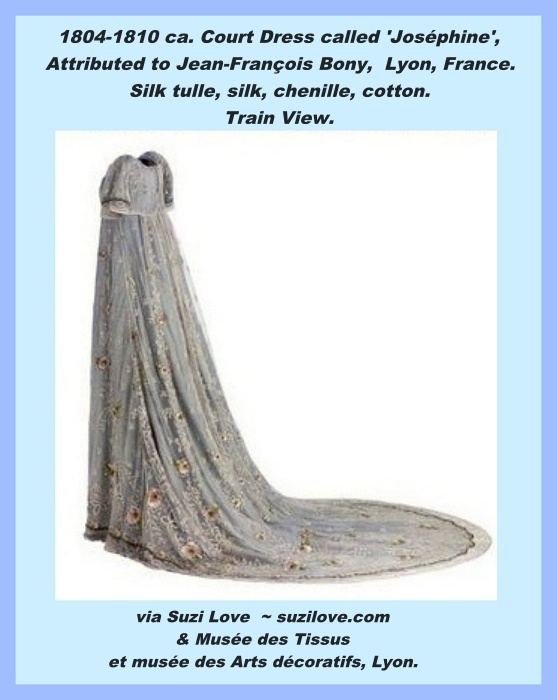
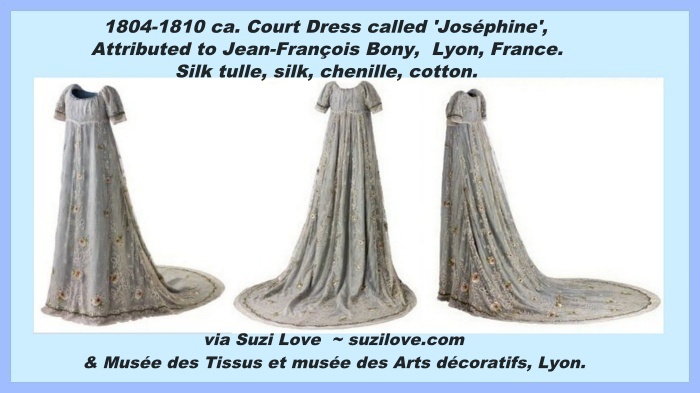
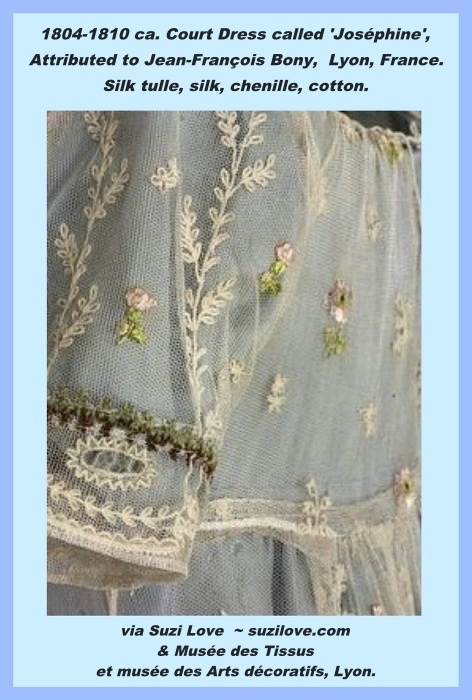
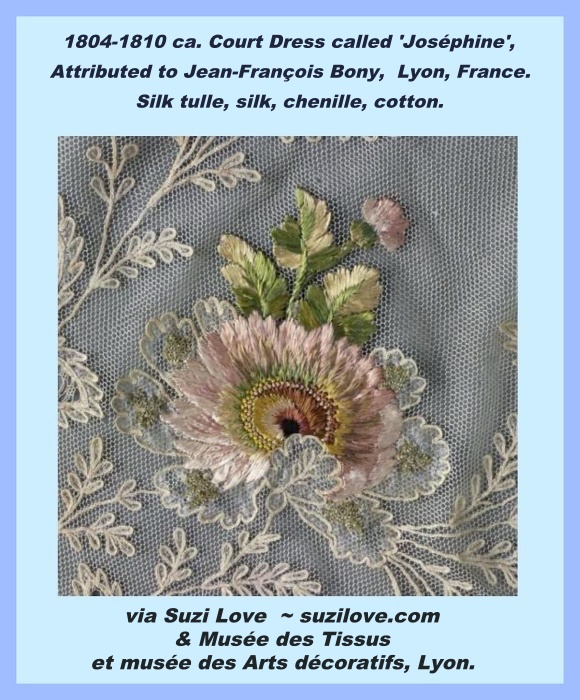
1804-1810 ca. Court Dress called 'Joséphine', Attributed to Jean-François Bony, Lyon, France. Silk tulle, silk, chenille, cotton. via Musée des Tissus et musée des Arts décoratifs, Lyon. via Suzi Love ~ suzilove.com & Musée des Tissus et musée des Arts décoratifs, Lyon.

1804-1810 ca. Embroidered Court Dress called ‘Joséphine’ As Worn In Jane Austen’s Times. #JaneAusten #RegencyFashion #France #Royalty

Suzi Love Posted on September 21, 2024 by Suzi LoveSeptember 20, 2024

1804-1810 ca. Empire style, or high-waisted, French Court Dress called ‘Joséphine’, Attributed to embroiderer Jean-François Bony, Lyon, France. Silk tulle, silk, chenille, and cotton. via Musée des Tissus et musée des Arts décoratifs, Lyon. via Musée des Tissus et musée des Arts décoratifs, Lyon.

Definition Empire Style:  Named after the First Empire in France, by 1800 Empire dresses had a very low décolleté, or neckline and a short narrow backed bodice attached to a separate skirt. Skirts started directly under the bust and flowed into the classical relaxed wide styles of Greece and Rome. This style of dress is associated with Jane Austen and her contemporaries as a simple cotton high-waisted dress was worn most days and accessorized according to the importance of the occasion.
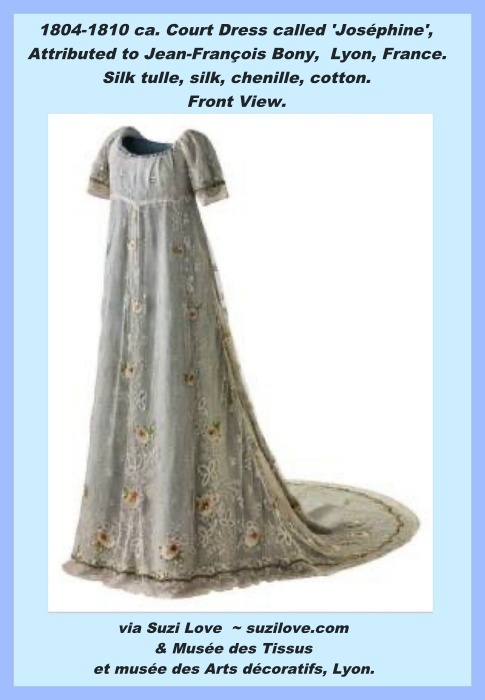
1804-1810 ca. Court Dress called 'Joséphine', Attributed to Jean-François Bony, Lyon, France. Silk tulle, silk, chenille, cotton. via Musée des Tissus et musée des Arts décoratifs, Lyon. via Suzi Love ~ suzilove.com & Musée des Tissus et musée des Arts décoratifs, Lyon.
1804-1810 ca. Embroidered Court Dress called 'Joséphine' As Worn In Jane Austen's Times. #JaneAusten #RegencyFashion #France #Royalty https://books2read.com/SuziLoveFashionWomen1805-1809 Share on X
HN_26_D2D Fashion Women 1805-1809
https://books2read.com/SuziLoveFashionWomen1805-1809
Fashion Women 1805-1809 History Notes Book 26 What did Jane Austen and friends wear? https://books2read.com/SuziLoveFashionWomen1805-1809
Posted in 1800s, 1800s women's fashion, Dress Or Robe, France, Jane Austen, Regency Era, Regency Fashion, Royalty, Suzi Love Images | Tagged 1800s women's fashion, Dress Or Gown, France, Jane Austen, Musee des Tissus France, Regency Era, Regency Fashion, Regency Royalty, sewing | Leave a reply

1809 The King Of Great Britain and His Powers In the Bridgerton and Jane Austen Years. #Bridgerton #JaneAusten #RegencyEra #BritishRoyalty

Suzi Love Posted on August 18, 2024 by Suzi LoveAugust 17, 2024

1809 The King Of Great Britain. From: 1809 A Book Explaining The Ranks and Dignities Of British Society. via Google Books. (PD-180) BRITISH RANKS,  The King Of Great Britain and His Or Her Powers during Jane Austen’s lifetime.

1809 The King Of Great Britain 1809 The King Of Great Britain. From: 1809 A Book Explaining The Ranks and Dignities Of British Society. via Google Books. (PD-180)

BRITISH RANKS,  THE KING . 

The supreme executive power of these kingdoms is vested by our laws in a single person, the King or Queen, for it matters not to which sex the crown descends, but the person entitled to it, whether male or female, is immediately invested with all the ensigns, rights, and prerogatives of sovereign  power . 

In the earliest periods of our his tory the crown appears to have been elective. But hereditary succession has now been long established , and has proved a good preservative against that periodical bloodshed and misery, which both history and experience have long shewn are the consequences of elective kingdoms. The crown descends lineally to the issue of the reigning monarch , and not till the failure of the male issue  is it allowed to be taken by the female. 

Lawyers say the King of England is a mixed person, a priest as well as a prince and at his coronation he is anointed with oil, as the priests and  kings of Israel were, to intimate that his person is sacred. The principal duty of the king is to govern his people according to law and these are the terms of the oath administered usually by the Archbishop of 

Canterbury at his coronation, in the presence of the people, who on their parts do reciprocally take the oath of allegiance to the crown : 

“ The archbishop, or bishop, shall say, Will you solemnly promise and swear to govern the people of this kingdom of England , and the dominions thereto belonging, 

according to the statutes in parliament agreed on and the laws and customs of the 

same? 

The king or queen shall say , I solemnly promise so to do . 

Archbishop , or bishop .– Will you to your power cause law and jus tice , in mercy , to be executed in all your judgments? 

King or queen, I will, 

Archbishop , or bishop – Will you to the utmost of your power maintain the laws of God , the true profession of the gospel and the protestant reformed religion 

established by the law? And will you preserve unto the bishops and clergy of this realm, and to the churches com mitted to their charge, all such rights and privileges as by law do or shall appertain unto them or any of them ? 

King or queen, All this I promise to do .

After this , the king or queen , laying his or her hand upon the holy gospels , shall say , The things which I have here before promised , I will perform and keep : so help me God . And then shall kiss the book . 

One of the principal bulwarks of our liberty is the certain and definite limitation of the king’s prerogative, the extent and 

restrictions of which are marked out with the greatest clearness. But in the exertion 

of those powers which the LAW has given him , the king is irresistible and absolute. He is considered by the laws of England as the head and supreme governor of the national church and, in virtue of this authority, he convenes , prorogues 

rogues , restrains , regulates , and dis solves all ecclesiastical synods or 

convocations. He has the supreme right of patronage over all ecclesiastical benefices and if they are not presented to within the time prescribed , their lapse becomes the 

advantage of the crown. In regard to foreign concerns, the king is the delegate or 

representative of his people. He has power, by his prerogative, with out any act of 

parliament, to make war or peace, conclude treaties, grant safe conducts, give 

commissions for raising and regulating fleets and armies, as well as for erecting, 

manning, and governing forts, and other places of strength. He can prohibit the 

exportation of arms and ammunition out of the kingdom, can dispose of magazines, castles, ships, public moneys, etc. and all that is done in 

regard to foreign powers by the royal authority, is the act of the whole nation. He has the sole power of sending ambassadors to foreign states, and receiving ambassadors at home. He convokes, adjourns, prorogues, and dissolves parliaments  and may 

refuse his assent to any bill passed by both houses, without giving his reason for it . 

He may increase the number of members of either house at plea sure, by creating 

new peers and bestowing privileges on other towns for sending burgesses to 

Parliament, but the last has by late kings been given up. 

The sole power of conferring dignities and honors is entrusted to him so that all 

degrees of nobility and knighthood, and other titles, are received by immediate grant from the crown. And the king has also the prerogative of conferring privileges upon private persons  such as granting place or precedence to any of his subjects such is also the power to enfranchise an alien and make him a denizen, and the prerogative of 

erecting corporations. The coining of money too, as well as the settling the 

denomination or value for which it shall pass current, is the act of the sovereign 

power. 

But to take all the characters into view in which the king is considered in domestic 

affairs would be almost endless for from thence an abundant number of prerogatives arise. All lands re covered from the sea , gold and silver mines, royal fishes etc. 

be long to him. He can unite, separate, enlarge, or contract the limits of ecclastical 

benefices and, by his letters, erect new bishoprics, colleges etc. He can dispense with the rigor of ecclesiastical laws except those which have been con firmed by act of 

parliament, or declared by the bill of rights. He has also power to moderate the

 rigor of the law to pardon a man condemned by law except in appeals of murder, 

and in case of impeachment by the house of commons, and to interpret by his 

judges in statutes and cases which are not defined by law. 

But though he be entrusted with the whole executive power of the law, yet he cannot sit in judgment in any court for justice must be administered according to the powers committed and distributed to the several courts. 

As the king is declared to be the supreme head in matters both civil and ecclesiastical so no suit can be brought against him even in civil matters because no court can 

have jurisdiction over him. The law also ascribes to the king in his political capacity  absolute perfection. The king can do no wrong, by  which ancient and fundamental maxim we are not to understand that every transaction of government is of course just and lawful but that whatever is exceptionable in the conduct of public affairs is not to be 

imputed to the king nor is he answerable for it personally to his people and farther that the prerogative of the crown extends not to do any injury. It is

 created for the benefit of the people and therefore cannot be exerted to their 

prejudice. In the king there can be no negligence and therefore no delay will bar his 

right. In the king also there can be no infamy, stain, or corruption of blood. And the 

law ascribes a kind of perpetuity, or immortality to him. His death is termed his 

demise , because the crown is thereby demised to another. He is not in law liable to 

Death, being a corporation of him self that lives for ever. There is no interregnum but the 

moment one king dies, his heir is king, fully and absolutely, without any coronation , ceremony etc. To these it may be added that by the law the king is said in a manner 

to be every where in all courts of judicature , which he alone has the right of erecting and therefore cannot be nonsuited. 

The power of issuing proclamations is vested in the king alone, considered as the fountain of justice. The laws make it high treason barely to imagine or intend the death of the king, and because the destruction of the king may ensue 

that of his great counsellors or officers, it is felony in any of the king’s subjects to 

conspire even that. Some things the king cannot do. 

He cannot divest himself or successor of any part of the regal prerogative or 

authority and there are two things which he cannot do without the consent of 

Parliament: the making of new laws and the raising of new taxes. 

The king cannot dispense with the laws nor do any thing contrary to law. In England the law is as much superior to the king , as to any of his subjects and the obedience

of the king of England to the laws is his greatest glory while it is the security of the 

rights and liberties of his people who are the greatest as well as the freest people on the face of the earth , merely because their sovereigns are obliged to live in

 subjection to the written laws of the land. 

The title of grace was first given to our kings about the time of Henry IV and that of majesty first to Henry VIII. The title of his present Majesty is , GEORGE the Third , King of the United Kingdom of Great Britain and Ireland, Defender of the Faith, 

Sovereign of the Orders of the Garter, Thistle, Bath and St. Patrick, Duke and Elector of Brunswick Lunenburg, Bishop of Osnaburg and Arch Treasurer of the Holy Roman Empire.

1809 The King Of Great Britain and His Or Her Powers. #GeorgianEra #RegencyEra #BritishRoyalty https://books2read.com/suziloveROver Share on X
RL_1_D2D_Regency Overview RetailerLinks
https://books2read.com/suziloveROver
RL_1_D2D_Regency Overview RetailerLinks https://books2read.com/suziloveROver
Posted in 1800s, Bridgerton, England, Google Books, History, Jane Austen, peerage, Regency Era, Royalty | Tagged Bridgerton, Georgian era, google books, Jane Austen, peerage, Regency Era, Regency Life, Regency Overview, Regency Royalty

Post navigation

← Previous Post
Next Post→

SUBSCRIBE TO SUZI LOVE'S NEWSLETTER.

Recent Posts

  • 1814 Jane Austen, Mansfield Park. “Give a girl an education and introduce her properly into the world, and ten to one but she has the means of settling well, without further expense to anybody.”#JaneAusten #RegencyEra #Quote
  • What shoes did the Bridgertons and Jane Austen wear? Gray Slippers, American, with long ankle ties. #JaneAusten #Bridgerton #shoes #regencyfashion
  • Book Hooks: Lady Laura Jamison believes her extraordinary olfactory senses will sniff out her perfect match, but will the Earl prove her wrong? #HistoricalRomance #RomCom #RegencyRomance
  • 1880’s Gorgeous corset of silk satin, steel busk, and bone, French. #VictorianEra #Corset #VictorianFashion
  • “Happiness in marriage is entirely a matter of chance.” Jane Austen #PrideandPrejudice (1813) #JaneAusten #Quote #RegencyEra

Recent Comments

  1. Jana Richards on Book Hooks: Lady Laura Jamison believes her extraordinary olfactory senses will sniff out her perfect match, but will the Earl prove her wrong? #HistoricalRomance #RomCom #RegencyRomance
  2. Kayelle Allen on Book Hooks: Lady Laura Jamison believes her extraordinary olfactory senses will sniff out her perfect match, but will the Earl prove her wrong? #HistoricalRomance #RomCom #RegencyRomance
  3. Tina Donahue on Book Hooks: Lady Laura Jamison believes her extraordinary olfactory senses will sniff out her perfect match, but will the Earl prove her wrong? #HistoricalRomance #RomCom #RegencyRomance
  4. Maggie Blackbird on Book Hooks: Lady Laura Jamison believes her extraordinary olfactory senses will sniff out her perfect match, but will the Earl prove her wrong? #HistoricalRomance #RomCom #RegencyRomance
  5. James DiBenedetto on Book Hooks: Lady Laura Jamison believes her extraordinary olfactory senses will sniff out her perfect match, but will the Earl prove her wrong? #HistoricalRomance #RomCom #RegencyRomance

Login

  • Log in

Archives

  • May 2026
  • April 2026
  • March 2026
  • February 2026
  • January 2026
  • December 2025
  • November 2025
  • October 2025
  • September 2025
  • August 2025
  • July 2025
  • June 2025
  • May 2025
  • April 2025
  • March 2025
  • February 2025
  • January 2025
  • December 2024
  • November 2024
  • October 2024
  • September 2024
  • August 2024
  • July 2024
  • June 2024
  • May 2024
  • April 2024
  • March 2024
  • February 2024
  • January 2024
  • November 2023
  • October 2023
  • September 2023
  • August 2023
  • July 2023
  • June 2023
  • April 2023
  • March 2023
  • February 2023
  • June 2022
  • April 2022
  • March 2022

Categories

  • 1700s
  • 1700s Mens fashion
  • 1700s Womens Fashion
  • 1800s
  • 1800s Mens Fashions
  • 1800s women's fashion
  • 1900s
  • art
  • Australia
  • Bath
  • bedroom fashion
  • Book Hooks
  • Box Or Container
  • Bridgerton
  • Bus Trips
  • Canada
  • Carriage
  • cartoon
  • Celebrity
  • Chatelaine
  • children
  • Children
  • Christmas
  • Coat or Pelisse Or Redingote
  • Contemporary
  • Corset
  • Couple
  • Customs & Manners
  • dancing
  • December Scandal
  • Decorative Item
  • Dress Or Robe
  • Easter
  • Edwardian Era
  • Embracing Scandal
  • England
  • Ester In Images
  • Europe
  • Events
  • Fashion
  • fashion accessories
  • Food and Drink
  • Four Times A Virgin
  • France
  • furniture
  • Georgian Era
  • Georgian Fashion
  • Google Books
  • Grand Tour
  • Group
  • hats
  • History
  • History Events
  • History Notes
  • History Of Christmases Past
  • household
  • Hygiene
  • Irresistible Aristocrats
  • Jane Austen
  • Keanu Reeves
  • Kellys Justice
  • Legal
  • London
  • Love After Waterloo
  • Loving Lady Katharine
  • medical
  • military
  • money
  • mourning
  • Music
  • Outback Arrival
  • pants
  • Pastimes
  • peerage
  • People
  • Petunia and Pearl Diver
  • Places
  • Pleasure House Ball
  • postal
  • Queensland
  • Quotations
  • Regency Era
  • Regency Fashion
  • Regency Life Series
  • Reticule or Bag
  • riding
  • Romantic Era
  • Royalty
  • Russia
  • Scandalous Siblings Series
  • Scenting Scandal
  • Self Publishing
  • sewing
  • Shirt
  • shoes
  • South Pacific
  • Spencer
  • sports
  • Suit
  • Sunday Snippet
  • Suzi Love
  • Suzi Love Books
  • Suzi Love Images
  • Suzi Love Writing
  • Swain Cove
  • THe Viscount's Pleasure House
  • travel
  • U.S.A
  • underclothing
  • Vest or Waistcoat
  • Victorian Era
  • Victorian Fashion
  • weapons
  • weddings
  • Writing Tools

1800s men fashion 1800s women's fashion antiques Bridgerton British history Cartoons Corset cravat decorative Dress Or Gown England europe fashion accessories Fashion Plate France Georgian era Georgian Fashion gloves google books Hats And Hair historical romance History Notes household Jane Austen jewelry Journal des Dames et des Modes London Metropolitan Museum NYC pants Redingote Or Pelisse Or Coat Regency Era Regency Fashion Regency London reticule or bag riding sewing shawls Shoes Suzi Love Books Suzi Love Images Tailcoat The Repository Of Arts underclothing Vest or Waistcoat Writing Tools

©2026 - Suzi Love - Weaver Xtreme Theme Privacy Policy
↑