1908 Front Fastening View Of Corset, French. Made For C. F. Hovey & Co., Boston. Label: The Paris. Silk and Rubber. Front fastening and back lacing. via Suzi Love suzilove.com & Metropolitan Museum, NYC, U.S.A. metmuseum.org1908 Front Fastening View Of Corset, French. Made For C. F. Hovey & Co., Boston. Label: The Paris. Silk and Rubber. Front fastening and back lacing. via Suzi Love suzilove.com & Metropolitan Museum, NYC, U.S.A. metmuseum.org1908 Back Lacing Of Corset, French. Made For C. F. Hovey & Co., Boston. Label: The Paris. Silk and Rubber. Front fastening and back lacing. via Metropolitan Museum, NYC, U.S.A. metmuseum.org1908 Label For Front Fastening and Back Lacing Silk and Rubber Corset, French. Front fastening and back lacing. Made For C. F. Hovey & Co., Boston.1908 Front Suspenders and Back Lacing Silk and Rubber Corset, French. Front fastening and back lacing. Made For C. F. Hovey & Co., Boston.1908 Front Suspenders and Fastenings and Back Lacing Silk and Rubber Corset, French. Front fastening and back lacing. Made For C. F. Hovey & Co., Boston.1908 Silk and Rubber Corset, Front Fastenings and Suspenders and Back Lacing, French. #Edwardianera #Corset #HistoricalFashion #France #Boston books2read.com/SuziLoveCorsetBook21 Share on XCorsets 1900s History Notes Book 21
Corsets during early 1900s when a fashionable
silhouette became of paramount importance
and a well-fitted corset a fashion essential.
books2read.com/SuziLoveCorsetBook21
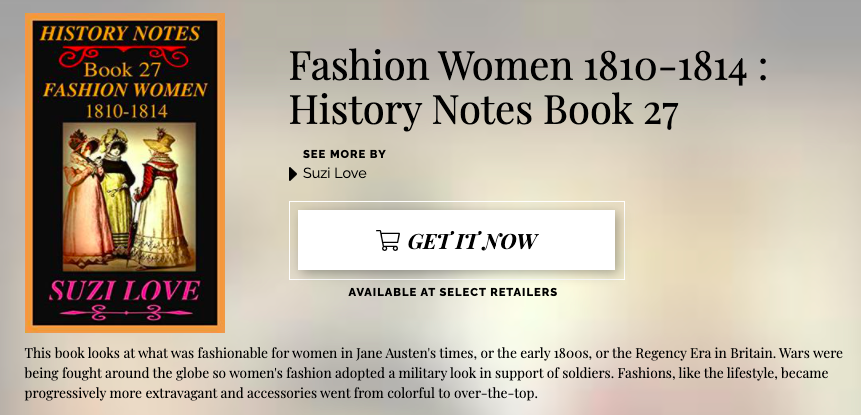
An overview of women’s fashions in the first twenty years of the 19th century. What was fashionable for women in Jane Austen’s times, or the early 1800s. Wars were being fought around the globe so women’s fashion adopted a military look in support of soldiers. In Britain, the Prince Regent ruled instead of his father, King George III, so fashions, like the lifestyle, became more extravagant and accessories went from pretty to opulent.
Reader Or Writer of Regency Era? Love Jane Austen and Bridgerton fashions? What was fashionable for women in Jane Austen’s times, or 1800s, or Regency Era. High-waisted dresses were extravagantly accessorized and hats, shoes, parasols and bags were added. Set includes History Notes Books 12, 25, 26, 27 and 28. https://books2read.com/SuziLoveFashionWomenBoxSet
Ladies clothing in the early 1800’s featured a high waist line called an Empire Line, or Empire style dress, with a waist line just under the natural bust line and much higher than the natural waist. The high-waisted, or short-bodied, Regency styles shifted focus away from the natural waist and so left the natural waist unconstricted, in direct contrast to previous and future styles. Britain took these simple European styles and progressively made them more elaborate by adding more and more complicated embroidery onto white fabrics to create the white on white look popular for many years.
The empire look of fine muslin dresses left women more exposed than in the Georgian Era when fabrics had been thicker and styles bulkier. Women, especially in England, preserved their modesty by adding lace, frills, flounces, ruches, and fabric plaits to dresses to adequately cover any parts that might inadvertently be exposed. Outer layers, such as Spencers, Redingotes or Pelisses or coats, and shawls, were also added for warmth and to brighten outfits. This Empire fashion was totally dependent on a supply of fine, translucent cotton muslin ā at first imported from India, then later, less exclusive imitations often woven and printed or embroidered in Britain. Fabrics were soft and lightweight and muslins and other cotton fabrics from India and other Asian countries were in high demand.
1810ā1850 ca. Corset, American or European. Front lacing, extra wide straps for under a square neckline dress. via Metropolitan Museum, N.Y.C., U.S.A. metmuseum.org
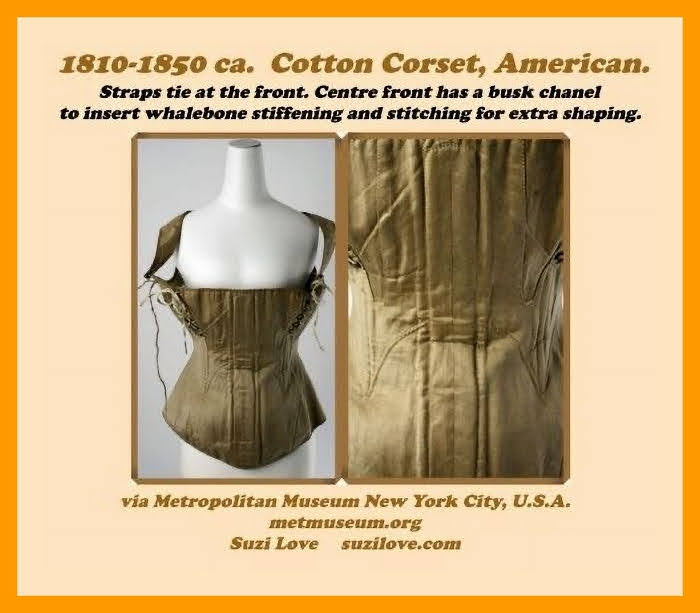
Surviving stays, or corsets as they became to be called in the nineteenth century, show that both longline and shorter corsets were worn and that they were made of cotton, silk and sateen. A lot of these corsets were front fastening, plus many were laced at both the front and the back so our aristocratic fictional heroines could indeed dress and undress themselves without the assistance of a maid.
Corsets 1810-1830 History Notes Book 17 This book shows howĀ corsets changed to fit well under clothing,Ā give maximum support and comfort. Corsets pushed up breasts and showed off the bust line beneath a square-cut and low-cut neckline as in the early 1800s, or Regency years. Jane Austen and her female and friends wore these corsets. https://books2read.com/SuziLoveCorsetBook17
Corsets originated in the beginning of the 16th century, when aristocratic Spanish women first adopted “whalebone bodies.” Stays (later known as corsets) rapidly became fashionable throughout Europe. In 1588, the French essayist Michel de Montaigne wrote, “To get a slim body, Spanish style, what torture do women not endure, so tightly tied and bound . . . ” Although doctors and moralists remonstrated, women continued to wear some form of corset until the middle of the 20th century, because corsetry was associated with feminine beauty, aristocratic display, and self-discipline.
1750-1770 ca. Back Lacing Linen Corset, European. Made of linen, lining of natural linen, chamois leather to strengthen, straps of linen, stiffening of whalebone. Corset: deep point, hip flaps, lacing at the back, Netherlands.
Description: Quilted linen corset with vertical tunnels and with ribs. Whalebone stiffening, point on front, hip flaps, front shoulder straps of fabric plus long narrow linen strips to tie. Lined and has chamois leather at armpits, front point and waist. Linen corset with a deep thickened point at the front, hip flaps, and lacing at the back. Fully quilted with vertical tunnels, with ribs. Thickened tip at the front is slightly triangular. Above for round shape due to wide horizontal rib. Flares from the waist into hip phlangers, or fingers. Lacing eyelets and criss-crossed lacing at the back. Front shoulder straps are of the fabric with very long linen straps with narrower linen strap, total 110 cm, and two horizontal linen loops on top of the backs. There is a narrow linen strip on all seams and along all edges. Armpits and the front point are reinforced with chamois leather and chamois leather is at the waist with straps attached. Via Mode Museum Province of Antwerp
Corsets 1700-1790 History Notes Book 15 This book shows how body wraps, stomachers and stays were worn during the 1700s. They created a variety of fashionable silhouettes to suit the elaborate fashions worn for court and daily life during the 18th Century. Wearing the correct underclothing was essential for keeping garments in place and giving the best fashion display.
1890 Cotton Twill Corset, England or Germany. Machine stitched with front hooks and back lacing and made in two parts. Brown corset with the bones covered with a darker cotton twill, black fabric covered busks and a trimming of black machine-made cotton lace. Lined with white cotton twill and the top and bottom are bound with reddish brown tape.
The front fastens with a busk and the backs are provided with metal eyelets for a lace. The corset is hip length, curving to a rounded point in the front and less deeply at the back. The bones are close-set and splayed out at the bust and hips, and at the tops are trimmed with fancy stitching in cream. There is a band of dark brown cording at the top, covering the breasts. At the waist there is a V-shaped band in darker brown stitching. With metal fastenings. via http://collections.vam.ac.uk/item/O351699/corset-unknown/
Corsets 1880-1900 History Notes Book 20 This book shows how a fashionable silhouette became of paramount importance and how a well-fitted corset became a fashion essential. As well as a decorative fashion item, tight lacing gave a narrow waist and the desired feminine form under clothing. https://books2read.com/SuziLoveCorsetBook20
1820-1840 ca. Hand-Embroidered Wedding Corset, Connecticut, USA. Ivory cotton covered with hand embroidery, including love birds on hearts, front pocket for busk, eyelets for back lacing. Trapunto (to embroider) cording decorates and shapes corset. The back closure has ivory eyelets for the lacing. The center-front has a pocket panel for inserting a busk. Trapunto (to embroider) shapes the corset by outlining the design with two or more rows of running stitches and then padding from the underside which gives a raised effect.The technique was always considered very elegant. Trapunto first appeared in 14th century Sicily and was widely adopted for clothing in Tudor England, and then brought to America by the new settlers. In addition to the cording, the corset is totally covered with hand-embroidered flowers and there are two embroidered love birds on hearts at the center-front. Above the birds is a section of trapunto work. via Vintage Textiles
18th Century Wool, Leather And Linen Front Lacing Stays. via digitalmuseum.norway
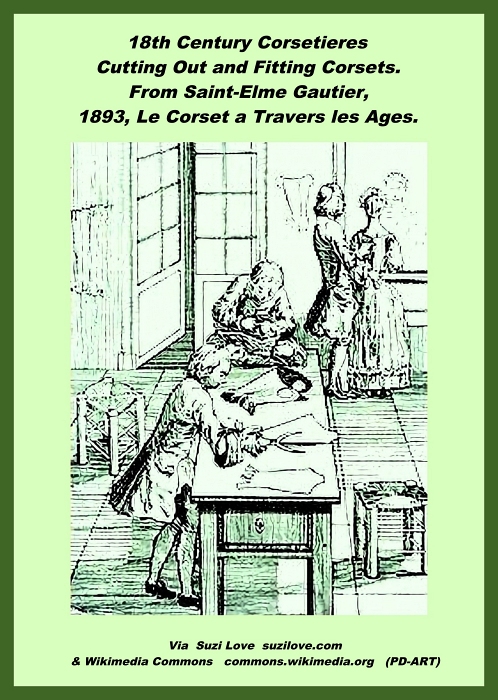
In the early 18th century, stays were basically quilted waistcoats, laced in the front and un-boned and to be worn on informal occasions. Mid century, the role of stays changed. They were then supposed to create a V shaped form and support a woman’s back, so baleen from whales was inserted into the garments and backs became longer.
Eyelet holes were stitched and staggered in spacing, so stays could be spiral laced. Stays were strapless or had straps attached in the back and tied at the front sides. Eyelet holes were stitched and staggered in spacing, so stays could be spiral laced. Later, they began to support the bust, give a fashionable conical shape, and draw shoulders back.
It was around the 1790s that the term corset started to be used as a refined name for stays. The Times of 24 June 1795 stated that: ‘corsettes about six inches long…are now the only defensive paraphernalia of our fashionable belle’.
corset_18th Century Wool, Leather And Linen Front Lacing Stays. via digitalmuseum.norwaycorset_18th Century Wool, Leather And Linen Front Lacing Stays. via digitalmuseum.norwaycorset_18th Century Wool, Leather And Linen Front Lacing Stays. via digitalmuseum.norwaycorset_18th Century Wool, Leather And Linen Front Lacing Stays. via digitalmuseum.norwaycorset_18th Century Wool, Leather And Linen Front Lacing Stays. via digitalmuseum.norwaycorset_18th Century Wool, Leather And Linen Front Lacing Stays. via digitalmuseum.norway18th Century Wool, Leather And Linen Front Lacing Stays. via digitalmuseum.norway #Corset #Europe #Historicalfashion https://books2read.com/SuziLoveCorsetBook15 Share on X
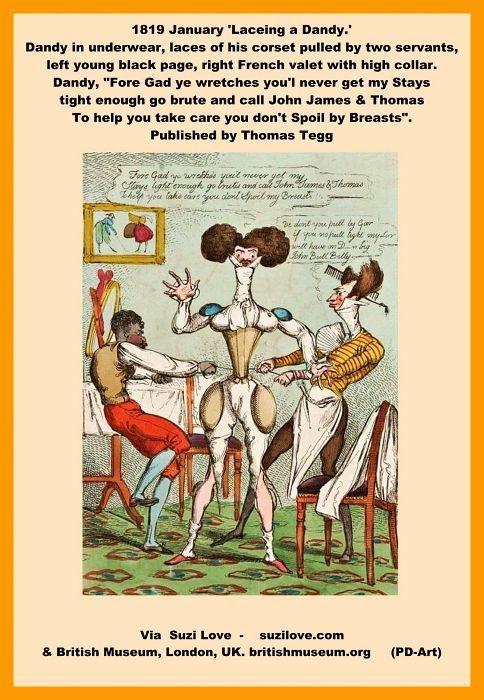
1818 September 18th Le Palais Royal de Paris, Or ‘A Peep at the French Monstrosities’. By George Cruikshank. Two English tourists, both dressed as dandies, walk arm-in-arm under the arcade of the Palais Royal, interested in the promenading courtesans. Two Frenchmen make more direct overtures to two women. Their dress is rather similar to that of the Englishmen, but the latter wear bell-shaped top-hats, while the Frenchmen have flower-pot shaped hats. An officer wearing a large cocked hat addresses a girl, and a man, said by Reid to be Irish, jovially accosts another. Some of the women are in evening-dress, others in street costume. Behind are iron railings between the supports of the roof; on one of these is the inscription ‘Caveau des Sauvages’. Published by: George Humphrey. via British Museum.