1806 Two Ladies In Empire style White Dresses, French. Costumes Anglais et Française, or English and French Costumes. Both with brown gloves and straw hats, one with blue shawl and other with blue Spencer and interesting blue trim. Fashion Plate via Journal des Dames et des Modes, or Costume Parisien.
Definition Empire Style Dress: Named after the First Empire in France. Empire dresses had a low neckline and skirts started directly under the bust and flowed into the classical relaxed wide styles of Greece and Rome. This style of dress is associated with Jane Austen and her contemporaries as a high-waisted dress was worn most days. Cotton, silk or taffeta were the popular fabrics.
Definition Spencer: Short jacket, cropped at the waist, worn over a dress, or gown. These close-fitting, tight sleeved, waist length jackets were modeled on a gentleman’s riding coat, but without tails. Delicate and regency dresses provided so little protection from the cold, so over garments were essential for warmth, modesty and good health.
18th Century Late Women’s Fashions. A conical body shape was still fashionable while the shape of the skirts changed. The wide panniers which held the skirts out at the sides mostly disappeared by 1780 for all but the most formal court functions and false rumps, or bum-pads or hip-pads were worn for a time. A low-necked gown, usually called in French a robe, was worn over a petticoat and most gowns had skirts that opened in front to show the petticoat worn beneath. As part of the general simplification of dress, the open bodice with a separate stomacher was replaced by a bodice with edges that met center front. Strapless stays which still were cut high at the armpit, to encourage a woman to stand with her shoulders slightly back, a fashionable posture. The fashionable shape was a rather conical torso, with large hips. The waist was not particularly small. Stays were usually laced snugly, but comfortably. Shoes had high, curved heels (the origin of modern “louis heels”) and were made of fabric or leather. Shoe buckles remained fashionable until they were abandoned along with high-heeled footwear and other aristocratic fashions in the years after the French Revolution,
18th Century Late Men’s Fashions. A man’s outfit consisted of a knee-length coat, knee breeches, a vest or long waistcoat, a linen shirt with frills and linen under drawers. Lower legs showed and were an important part of life. Men wore stockings and leather shoes with stacked heels of low or medium height. The whole ensemble would have been topped by a shoulder-length wig and a tricorne, or three-cornered, hat an upturned brim. By end of the 18th century, wigs were out of fashion except for the most formal occasions. Undergarments and knee breeches did not change very much. Coats gradually became less full and die front was cut in a curve towards the back. Waistcoats became shorter. The upper leg began to show more and more and by the end of the century breeches fitted better because they were often made of knitted silk. Shoes became low-heeled with pointed toes and were fastened with a detachable strap or ribbon on the front.
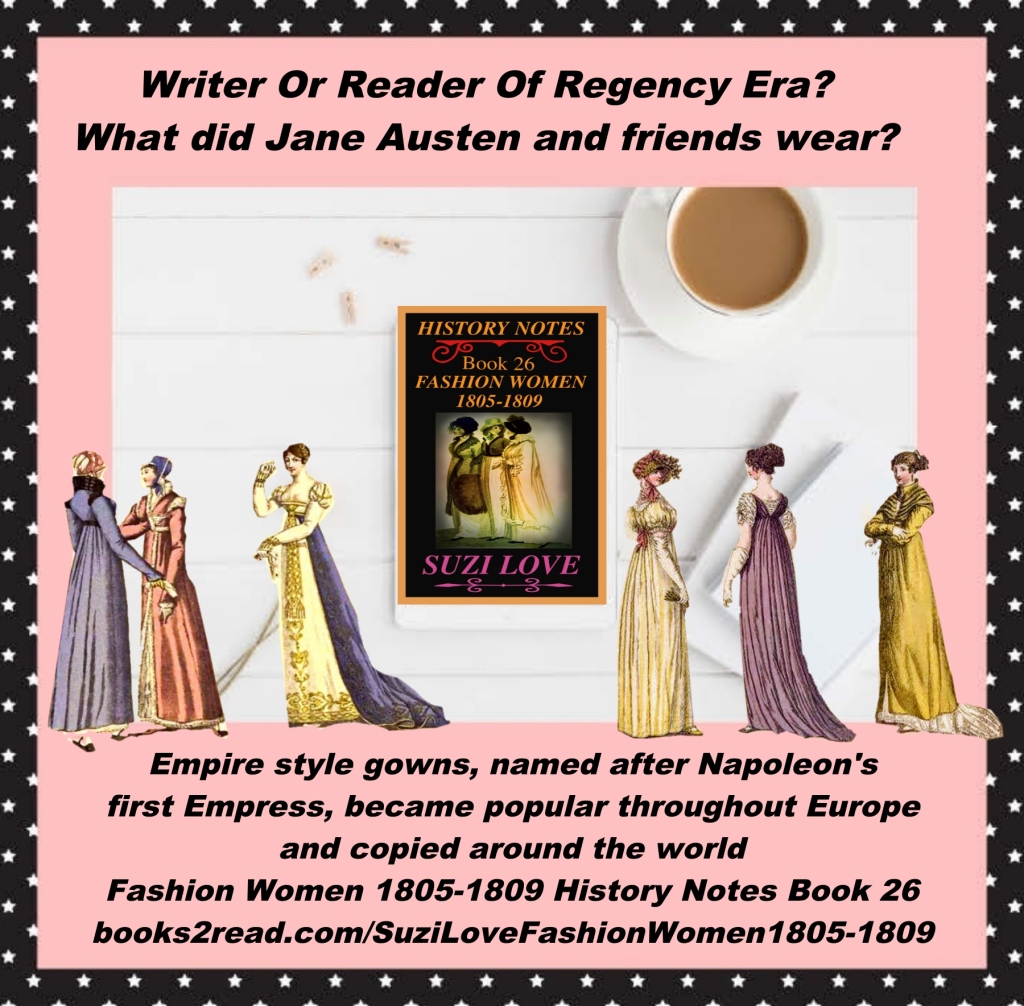
What did Jane Austen and friends wear? Early 1800s fashions were elegant and pretty with high waists and fabrics that were almost transparent. These Empire style gowns, named after Napoleon’s first Empress, became popular throughout Europe, and were then copied around the world. Colorful outwear was added to make an ensemble more attractive and warmer. History Notes Book 26 Fashion Women 1805-1809. https://books2read.com/SuziLoveFashionWomen1805-1809
What was fashionable outdoor wear for the Bridgerton ladis, Jane Austen, and their contemporaries? Reticules, Spencers, and Pelisses, or Walking Dresses, Or Redingotes. History Notes Books 3, 4, and 5 By Suzi Love.
What was fashionable for purses in past centuries? Call them what you like: purses, bags, handbags, reticules, ridicules, clutches, or pocket replacements. They all did the same job and they changed greatly with the prevailing fashions of time. books2read.com/suziloveReticules
What was fashionable in women’s jackets in the Regency Era? Call them what you like: Spencers, short jackets, or Regency jackets. They provided modesty and warmth and they changed greatly with the prevailing fashions of the time. Take a look at the jackets being worn by women in the early 1800s. books2read.com/suziloveSpencers
What sort of coats did women wear during the Regency years? them what you like: Coat, Pelisse, Redingote, Walking Dress, Promenade Dress. Take a look at what was being worn by women, men, and children. books2read.com/suzilovePelisse
What did Jane Austen and friends wear? Early 1800s fashions were elegant and pretty with high waists and fabrics that were almost transparent. These Empire style gowns, named after Napoleon’s first Empress, became popular throughout Europe, and were then copied around the world. Colorful outwear was added to make an ensemble more attractive and warmer. History Notes Book 26 Fashion Women 1805-1809. https://books2read.com/SuziLoveFashionWomen1805-1809
The Empire waist gown defined women’s fashion during the Regency Era. ‘Empire’ is the name given in France to the period when Napoleon built his French Empire. High-waisted, loose gowns were adopted by the aristocracy as a symbol of turning away from the fussy, elaborate and expensive clothing worn in the 1700s. Jean-Jaques Rousseau advocated copying peasants and returning to a simpler life and more natural fashions. Unrestricting clothing was part of the new Democracy in France and these simpler and flowing fashions were adopted all over Europe, including Britain and despite the continual wars being fought against France during the early 1800s. Not even war stopped fashions from being copied everywhere.
1818 January Fancy Mourning Dishabille. A lady reading a pink book while wearing Dishabille, or morning dress, though as this labeled ‘Fancy’, it was most likely more formal than any normal At-Home morning dress. Dress of crepe with a lavishly decorated hem, worn over a white cambric Spencer, ornamented with fine muslin, embroidered at the edge with black, finished at neck with a triple ruff of muslin, tied in front with black love. Black sarsnet French apron, edged round with a newly invented trimming of black love. Cornette, or hat, of fine muslin, crowned with a garland of black flowers. Black chamois slippers. Fashion Plate via John Belle’s La Belle Assemblée or, Bell’s Court and Fashionable Magazine, London. The magazine’s General Observations on Fashion and Dress tries to explain why the outfit is labeled ‘Fancy’, ‘However little versatility can possibly be attached to the sable garment of sorrow, yet the Print we have presented to our readers representing the home costume of a lady of high fashion, will prove to them how busy Fancy is in her endeavors to throw a changeful hue over the tinct of solid black.’
I can picture Jane Austen and her female friends and family wearing this sort of dress if they were in half-mourning yet wanted to look fashionable. .
1817 December Lady Reading A Pink Book. Blue dress with a lavishly decorated hem, worn under a black tunic, white sleeves and a high lace morning cap. Fashion Plate via John Belle’s La Belle Assemblée or, Bell’s Court and Fashionable Magazine, London.
1814 April Morning Dress and Lace Cap. ‘”A petticoat and bodice of fine jaconet muslin, finished round the bottom in vandykes and small buttons. The Rochelle spencer composed of the same material, appliqued with footing lace down the sleeve, and trimmed at each edge with a narrow but full border of muslin. Double fan frill of muslin round the neck, very full, continuing round the bottom of the waist, where it is gathered on a beading of needle-work. Bourdeaux mob cap, composed of lace, with treble full borders, narrowed under the chin. A small flower placed backward, on the left side. Hair much divided in front, and in full waved curls on each side. Necklace of twisted gold and pearl, with pendant cross in the center. Spring Green kid slippers and gloves of the same.”
“This dress is from Mrs. Gill, of Cork-street, to whose taste and invention this work as well as the world of fashion, are under continued obligations.” Fashion Plate via Rudolph Ackermann’s ‘The Repository of Arts’.
Definition Van Dyke Points: V-shaped lace and trims named after a 17th Century Flemish painter, Sir Anthony Van Dyck, known for painting V-shaped lace collars and scalloped edges on sitters.
Definition Jaconet: Cotton fabric of medium thickness made in England, lighter than shirting and heavier than mull.
Definition Muslin: Thin fabric said to take its name from Mosul or Moosul, a large town in Turkish Asia where it was first made.
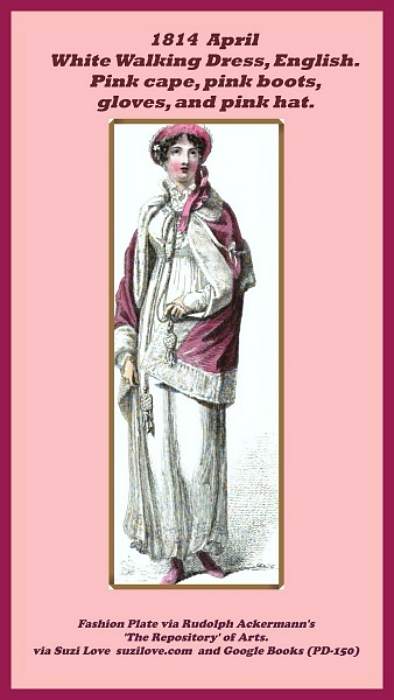
1814 April Promenade or walking dress of fine cambric with a high bodice and long sleeves, embroidered stomacher front and high collar, trimmed with muslin or lace, Tuscan border of needle-work the feet. A Cossack mantle of pink velvet lined with white sarsnet and trimmed with light sable, ermine, seal, or American squirrel. Short tippet of the same, mantle tied at throat with a silk cord and tassels. Pink velvet hat finished with narrow vandyke trimming and a small flower in the hair on the left side. Pink half boots and gloves of primrose kid or pale tan. Fashion Plate via Rudolph Ackermann’s ‘The Repository of Arts’.1814 April White Spencer Over Morning Dress Of Jaconet Muslin Finished With Vandykes. #RegencyEra #JaneAusten #FashionPlate https://books2read.com/SuziLoveFashion1810-1814 Share on XHN_27_D2D_fashwomen1810-1814
Fashion Must Haves In Jane Austen’s Times: Reticules, Spencers, Redingotes. History Notes Series Books 3, 4, and 5.
Reticule Or Bag: Purse, often with a drawstring to pull closed and usually made of cloth or covered cardboard and often decorated with beading or embroidery. Carried by a woman during the Regency period to carry all their daily necessities. in the place of pockets.
Spencer: Short jacket, cropped at the waist, worn over a dress, or gown. Delicate and regency dresses provided so little protection from the cold, so over garments were essential for warmth, modesty and good health.
Pelisse Or redingote Or Walking Dress: Coat worn over clothing of both sexes for warmth and protection from the elements.
What did Jane Austen and friends wear? Early 1800s fashions were elegant and pretty with high waists and fabrics that were almost transparent. These Empire style gowns, named after Napoleon’s first Empress, became popular throughout Europe, and were then copied around the world. Colorful outwear was added to make an ensemble more attractive and warmer. History Notes Book 26 Fashion Women 1805-1809. https://books2read.com/SuziLoveFashionWomen1805-1809
The Empire waist gown defined women’s fashion during the Regency Era. ‘Empire’ is the name given in France to the period when Napoleon built his French Empire.
High-waisted, loose gowns were adopted by the aristocracy as a symbol of turning away from the fussy, elaborate and expensive clothing worn in the 1700s. Jean-Jaques Rousseau advocated copying peasants and returning to a simpler life and more natural fashions. Unrestricting clothing was part of the new Democracy in France and these simpler and flowing fashions were adopted all over Europe, including Britain and despite the continual wars being fought against France during the early 1800s. Not even war stopped fashions from being copied everywhere.
1840-1880 ca. Burgundy and White Silk Jacket, Russian. #Romantic #Fashion #Russia via suzilove.com and Metropolitan Museum New York City, U.S.A. metmuseum.org
1840-1880 ca. Burgundy and White Jacket, Russian. Silk, metal, and cotton. Brooklyn Museum Costume via suzilove.com and Metropolitan Museum New York City, U.S.A. metmuseum.org