1815 May. Walking Dress, or Pelisse, or Redingote, English. Purple walking dress with wide collar, high white lace neck frill, and white trim down the vertical opening, white reticule, and a high white plumed hat. Fashion Plate via Rudolph Ackermann’s ‘The Repository of Arts’. Google Books (PD-180) suzilove.com Fashion Plate via Rudolph Ackermann’s ‘The Repository of Arts’.
Definition: Walking Dress Or Pelisse Or Redingote Woman’s long, fitted coat often worn open in front to show off the dress underneath. Walking Dress Or Pelisse are the terms used in English fashion plates, while Redingote is seen in European fashion plates, especially the French one, Journal des Dames et des Modes, or Costume Parisien.
1815 July Seaside Walking Dress. A high dress, of short walking length, made of French cambric or jaconot muslin, trimmed at the feet with treble flounces of French work, gathered into a rich bead heading, and laid upon the dress, at a suitable distance, one above the other, the body made with open fronts, worn with a full ruff of the French work, corresponding to the trimming at the feet; a long sleeve, drawn alternately across the arm, terminates with a broad wristband, worn plain over the hand. French bonnet of white satin, edged and tied under the chin with satin ribbon of celestial blue; ornamented with a rich plume of white feathers, edged to correspond. French mantle of the twilled silk en suite, richly embroidered at the ends in shaded silks, composing roses or lilies of the valley. Patent silk stockings. Slippers, or half-boots, or blue kid, or primrose colour. Gloves to correspond.
The bodies of the morning and promenade costume continue to be worn with cross or handkerchief fronts, and are generally trimmed, agreeably to the texture of the dress, with quilled tull or ribbon. The quilled ribbon is also predominant in single rows at the feet of all dresses composed of silk, bombazeen, or fancy prints. The prevailing colours are primrose, celestial blue, and evening primrose; the waist short, and the fullness of the petticoat carried to the back. Ruffs of French work are universally worn, except in full dress. The length of the petticoat continues not to exceed meeting the top of the boot and the color of the latter corresponds with the glove, mantle, and trimming of the bonnet.
1817 September Glengary Riding Habit, English, as would have been worn during Bridgerton and Jane Austen’s times. Pale blue cloth, richly ornamented with frogs and braiding, front braided on each side and fastens under the body of the habit, which slopes down on each side to define the figure. Epaulettes and jacket are braided to correspond with the front as is the bottom of the sleeve which is braided nearly half-way up the arm. Habit shirt is of cambric with a high standing collar and trimmed with lace. Cravat of soft muslin is richly worked at ends, tied in a bow, narrow lace ruffles at the wrists. Headdress is a Glengary cap of blue satin, trimmed with plaited ribbon of various shades of blue and a plume of feathers. Blue kid gloves are worn and half-boots. Fashion Plate via Rudolph Ackermann’s ‘The Repository of Arts’.
Male tailors made most women’s riding habits during the Regency years and they were constructed similarly to men’s riding outfits. Generally in two pieces, a jacket and a skirt, and with a shirt with a frilled collar or front opening underneath. The trains of a habit could be caught up for walking, usually with a button and loop, and unhooked and let down so that the skirt flowed over the woman’s legs when she rode side saddle. Due to the numerous wars during the early 1800s, it was seen as patriotic for women to add military style touches to outfits in support of military men. The shoulder and cuff trims resemble the epaulettes and coat trims of a military uniform.
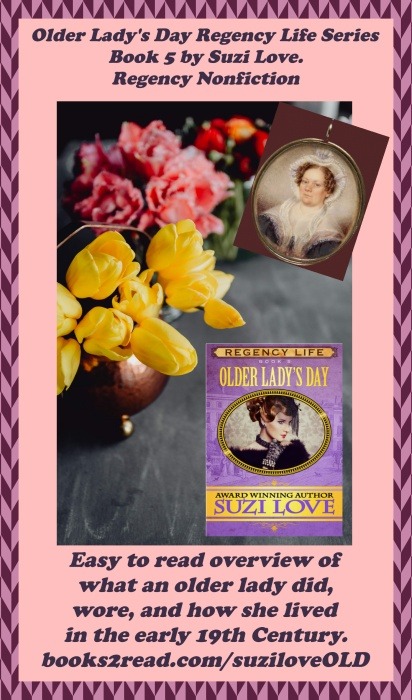
Easy to read overview of what an older lady did, wore, and how she lived in Jane Austen and Bridgerton’s time. Information for history buffs and pictures for readers and writers of historical fiction. Older Lady’s Day Regency Life Series Book 5 by Suzi Love books2read.com/suziloveOLD
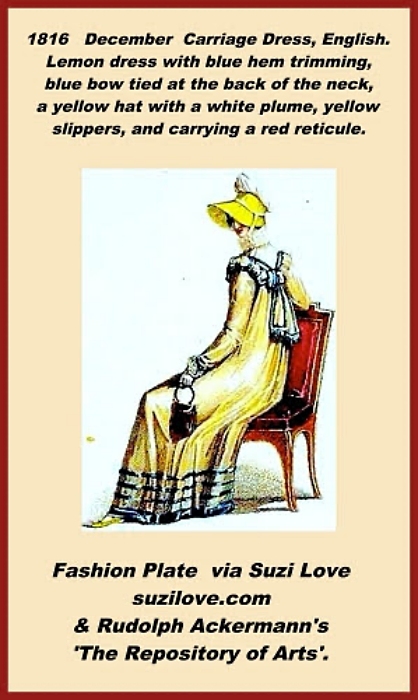
1816 December Carriage Dress, English. Fawn or lemon dress with blue silk hem trimming, blue bow tied at the back with long hanging ends, a half sleeve over a plain long sleeve, tight at the wrist and bound with blue trimming and finished with a narrow ruffle of three falls of tulle. A fichu of tulle with matching ruff. When worn as a carriage dress, the head-dress is a bonnet, the crown composed of white satin at the top and the middle and front of Leghorn. Lined with white satin and ornamented with a white satin band and strings. An indispensable India shawl, yellow slippers and carrying a black ridicule, or bag, and later called a reticule. Fashion Plate via Rudolph Ackermann’s ‘The Repository of Arts’.
Definition Fichu: Piece of lace, muslin, or other cloth worn about the neck and cleavage to preserve a lady’s modesty. From French word meaning neckerchief.
Definition Ridicule, Reticule, Indispensable, or Handbag: From the late 1700s, pockets could no longer be sewn into gowns nor could separate pockets be tied around their waists and accessed by slits in the gown and petticoats, as skirts fell from just under the bust and were full and flowing. In Jane Austen’s times, women carried small bags, known at first as ridicules and later as reticules, to keep necessary items on their person e.g. handkerchiefs, coins, vinaigrettes, calling cards, glasses etc.. For more on reticules, try my History Notes book 3 http://books2read.com/suziloveReticules
1816 June Bridal Dress, English A frock of striped French gauze over a white satin slip: the bottom of the frock is superbly trimmed with a deep flounce of Brussels lace, which is surmounted by a single tuck of byas white satin and a wreath of roses; above the wreath are two tucks of byas white satin. We refer our readers to our print for the form of the body and sleeve: it is singularly novel and tasteful, but we are forbidden either to describe it, or to mention the materials of which it is composed. The hair is dressed low at the side, and parted so as to entirely display the forehead: it is ornamented with an elegant aigrette of pearls in front, and a spring of French roses placed nearly at the back of the head. Necklace, ear-rings, and bracelets of pearl. White kid gloves, and white satin slippers. Fashion Plate via Rudolph Ackermann’s ‘The Repository of Arts’.
1809 May Walking Dress, English. Dress of white Scotia washing silk. Bishop’s mantle of sage or olive green striped and plain silks, made entirely without seams, border of the same color. Spanish hat to match the mantle turned up in front and decorated with artificial flowers. Shoes of sage or olive green match. Design by Mrs. James, New Bridge Street, Blackfriars. Fashion Plate via Rudolph Ackermann’s ‘The Repository’ of Arts.
General Observations for 1809 fashions from The Repository Of Arts: Spanish hats with feathers were worn all winter but are now worn as walking hats and the feathers have been replaced with flowers. Light silk mantles of all colors are being much worn. Scotia silk is now in great request for dresses and colors vary according to individual taste but silver-grey is the most elegant and fashionable. The attempt to introduce long waists failed. Full dress is the present standard.
1817 October. White Promenade Dress, English. High dress of jaconet muslin richly embroidered around the hem, body composed entirely of work, Long sleeve, finished down the arm in front by bouillons of lace. Charlotte Spencer of blue satin, tight fitting and short waist, wide sleeve ornamented at wrist and shoulder, elegant trimming and disposed in so tasteful manner to give the appearance of perfect novelty. Bonnet, a la Ninon, of the same material, cut in small squares, edged with white satin, turned over at the ends, very large front displays the front hair which is braided across the forehead, edged with puffed gauze, disposed in points, and confined by a narrow fold of white satin, sprig of acacia on left side and finished by white satin strings. French ruff and ruffles of rich lace. Blue or white kid shoes and gloves.
We have again to acknowledge our obligations to Miss M’Donald of 29, Great Russel Street, Bedford Square, for our dresses this month. Fashion Plate via Rudolph Ackermann’s ‘The Repository of Arts’.
1816 July Opera Dress, English. Dress of white lace worn over a rich soft white satin slip. Skirt trimmed in a style of peculiar elegance, with lace festooned at regular distances, festoons edged by plain band of byas satin and finished by pearl ornaments of a very novel and pretty shape. Lace body is cut byas and richly ornamented round the bosom with pointed lace. Plain long sleeve, very full, except towards the wrist, which is nearly tight to the arm, and elegantly finished with lace. Hair ornamented with a wreath of French roses, parted in front, and simply dressed in loose curls, which fall very low on each side. Hind hair forms a tuft at the back of the head. Necklace, ear-rings, and bracelets of pearl. White satin slippers, and white kid gloves and a blush colored French silk scarf. Fashion Plate via Rudolph Ackermann’s ‘The Repository of Arts’.
Gorgeous Regency Era clothing came in a wide range of styles to suit every season and occasion. Ladies in the Bridgerton series and in Jane Austen’s times wore Empire style dresses which were usually made of light fabric and floaty in style. By the later 1810s, stripes were very popular and lace and frills were added to make the dress more individual.
I love Pinterest for keeping thousands of historical images in some sort of order.And I love using Pinterest Boards as inspiration for my romance books.What about you? Do you use Pinterest for planning something, or just for fun?Need more hints for what to do with your boards and pins? Take a look at these fascinating articles on Pinterest. if you want even more Pinterest information and tips for becoming a power user, check out my Suzi Love Pinterest Boards